
India Semiconductor Mission 2.0 | 10 Feb 2026
Why in News?
The Union Budget 2026–27 marked a decisive step in India’s technology strategy with the announcement of India Semiconductor Mission (ISM) 2.0. Building on the ecosystem created under ISM 1.0, the new phase reflects a transition from policy formulation and capacity creation to consolidation, technological depth, and global integration.
What is India Semiconductor Mission 2.0?
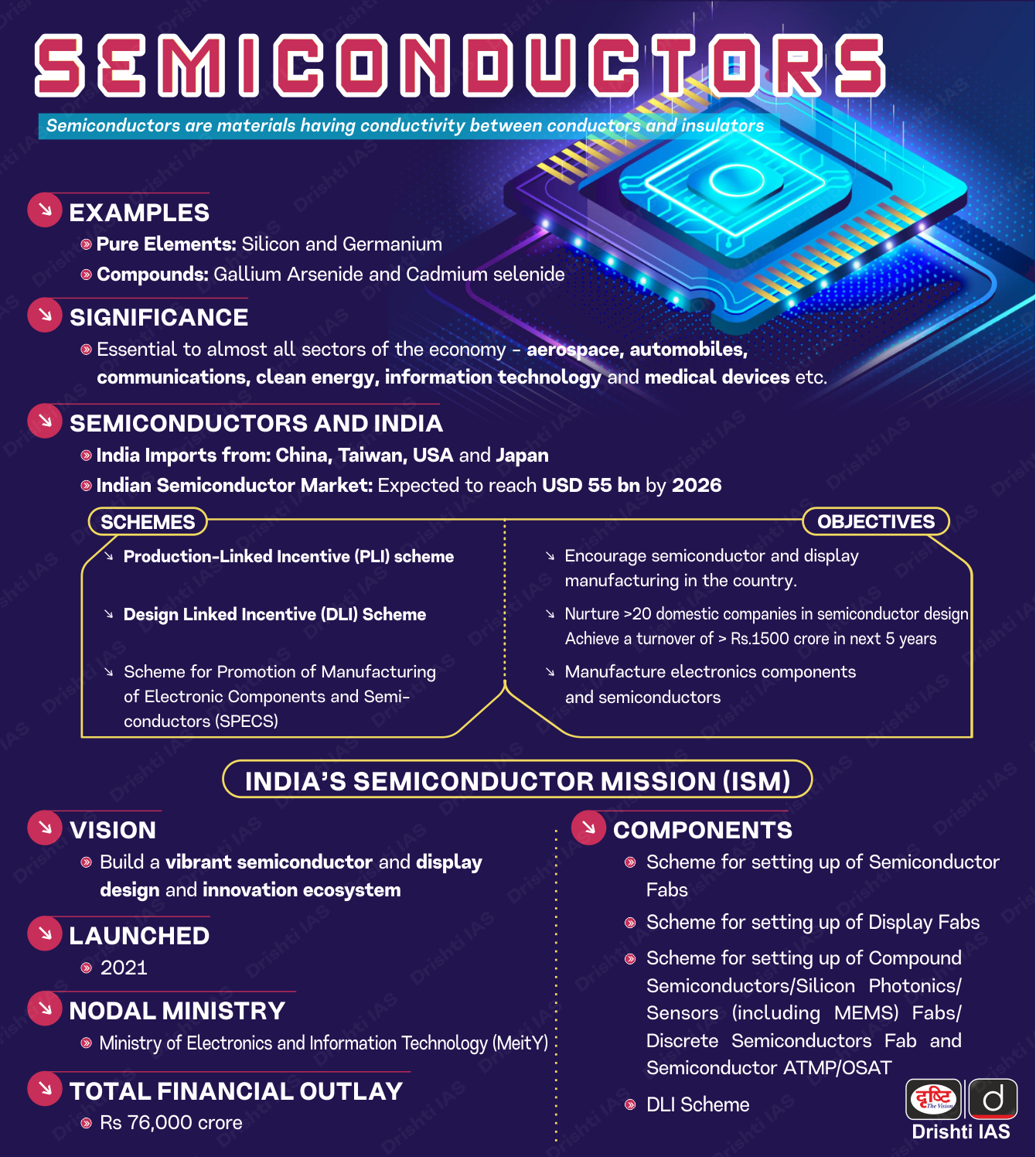
- About: ISM 2.0 aims to position India as a reliable and competitive player in the global semiconductor value chain while advancing the goals of Aatmanirbhar Bharat and Make in India–Make for the World. A budgetary provision of ₹1,000 crore has been made for FY 2026–27 to support this objective.
- Key Focus Areas:
- Indigenous Manufacturing: Production of semiconductor equipment, chemicals, gases, and materials within India to reduce import dependence and supply disruptions.
- Full-Stack IP Development: Promotion of end-to-end Indian semiconductor intellectual property for secure and globally competitive chip solutions.
- Research & Skills: Establishment of industry-led research and training centres to support applied R&D and advanced manufacturing skills.
- Supply Chain Resilience: Strengthening domestic and global semiconductor supply chains amid geopolitical uncertainties.
- Manufacturing: India has already laid a strong foundation under ISM 1.0, approved in December 2021 with an incentive outlay of ₹76,000 crore offering up to 50% fiscal support.
- As of December 2025, ten projects with investments of ₹1.60 lakh crore have been approved across six states, covering silicon fabs, compound semiconductors, advanced packaging, and testing facilities.
- Market Size: India’s semiconductor market has grown from $38 billion in 2023 to $45–50 billion in 2024–25 and is projected to reach $100–110 billion by 2030.
- India is emerging as a global semiconductor hub, targeting 70–75% self-sufficiency in domestic chip demand by 2029 and aiming to become a leading semiconductor nation with 3 nm and 2 nm manufacturing capabilities by 2035.
- Ecosystem: The Mission is complemented by the Modified Programme for Development of Semiconductor and Display Manufacturing Ecosystem, with a financial outlay of ₹8,000 crore for 2026–27.
- This programme aims to accelerate investments, expand fabrication and packaging capacity, and generate high-quality employment.
Key Initiatives For Semiconductors
- Design Linked Incentive Scheme: Supports fabless companies, semiconductor IP development, and expansion of design manpower.
- Digital India RISC-V Programme: Promotes open-source processor development without licence costs.
- Chips to Startup Programme: Enables access to advanced design tools and fabrication for universities and startups.
- Indigenous Microprocessor Development: Development of processors such as DHRUV64 to reduce dependence on imported chips.
Frequently Asked Questions (FAQs)
1. What is the budgetary allocation for ISM 2.0 in 2026–27?
₹1,000 crore has been allocated for India Semiconductor Mission 2.0 for FY 2026–27.
2. What is the primary shift from ISM 1.0 to ISM 2.0?
ISM 2.0 shifts focus from initial ecosystem setup to consolidation, advanced manufacturing, indigenous IP, and global integration.
3. Why is semiconductor self-reliance critical for India?
It ensures supply-chain security, economic stability, technological sovereignty, and resilience against global disruptions.
UPSC Civil Services Examination, Previous Year Question (PYQ)
Prelims:
Q. With reference to solar power production in India, consider the following statements:(2018)
- India is the third largest in the world in the manufacture of silicon wafers used in photovoltaic units.
- The solar power tariffs are determined by the Solar Energy Corporation of India.
Which of the statements given above is/are correct?
(a) 1 only
(b) 2 only
(c) Both 1 and 2
(d) Neither 1 nor 2
Ans: (d)