
IMD Summer Forecast 2026 | 01 Apr 2026
Why in News?
The India Meteorological Department (IMD) released its summer forecast (April to June 2026). The forecast predicts an increase in the number of heatwave days across most parts of East, Central, Northwest India, and the Southeast Peninsula, alongside a nationwide rise in minimum (night time) temperatures.
What are the Key Highlights of IMD Summer Forecast 2026?
- Heatwave Trend: India is expected to witness above-normal heatwave days, particularly across east, central, northwest India and the southeast peninsula.
- Temperature Pattern: Above-normal temperatures are likely over east and northeast India, eastern parts of central India, and adjoining peninsular regions, while most other regions may experience normal to below-normal temperatures.
- North India Exception: Unlike other regions, North India is likely to see a cooler-than-normal summer, indicating regional variation in heat patterns.
- Heatwave-Prone Areas: Regions such as Odisha, West Bengal, Tamil Nadu, Puducherry, Andhra Pradesh, and parts of Gujarat, Maharashtra, and Karnataka are likely to experience heatwaves, especially in April.
- Western Disturbances: India is expected to receive around 12% above-normal rainfall in April, supported by increased western disturbances.
- A higher frequency of western disturbances has contributed to increased rainfall and moderated temperatures.
- El Niño Concern: There is a likelihood of El Niño developing by July, which may negatively impact the monsoon.
- Cooler summer conditions may reduce land heating, potentially affecting monsoon onset and early progress.
What are Heat Waves?
- About: A heat wave is a period of unusually high temperatures compared to a region's normal climate.
- In India, these predominantly occur between March and June (peaking in May).
- Despite their severe health and environmental impacts, heat waves are not officially classified as natural disasters under the Disaster Management (DM) Act of 2005.
- The intensity and frequency of heat waves are heavily influenced by a combination of geographical and climatic factors.
- IMD Criteria for Declaring Heat Wave:
|
Region/Condition |
Heat Wave |
|
Plains |
Max temperature ≥ 40°C |
|
Hilly Regions |
Max temperature ≥ 30°C |
|
Coastal Stations |
When the maximum temperature departure is 4.5°C or more from normal, and provided the actual maximum temperature is 37°C or above. |
|
Based on Departure from Normal |
Heat Wave: Departure from normal is 4.5°C to 6.4°C Severe Heat Wave: Departure from normal is > 6.4°C |
|
Based on Actual Maximum Temperature |
Heat Wave: When actual maximum temperature ≥ 45°C Severe Heat Wave: When actual maximum temperature ≥ 47°C |
|
Spatial & Temporal Condition |
To declare as a heatwave the criteria must be met at minimum 2 stations in a Meteorological subdivision for at least 2 consecutive days. |
- Geographical Factors:
- Latitude and Solar Incidence: Regions near the Tropic of Cancer (like Telangana and Andhra Pradesh) face intense, nearly vertical solar radiation during summer, leading to rapid ground heating.
- Terrain and Soil Type: Rocky landscapes (like the Deccan plateau) and black soils absorb and retain heat much longer than other surfaces. In contrast, areas with dense vegetation or irrigation stay cooler due to evapotranspiration.
- Proximity to Water: Landlocked regions face higher heatwave risks because they lack the moderating, evaporative cooling effects provided by large water bodies (which protect coastal areas).
- Urban Heat Islands: Cities trap heat due to dense populations, concrete/asphalt surfaces, and a lack of greenery, creating localized pockets of extreme temperatures.
- Climatic Factors:
- Moisture and Cloud Cover: A lack of pre-monsoon rain leaves soils dry, drastically reducing evaporative cooling.
- Minimal cloud cover allows unchecked solar radiation to hit the surface. Furthermore, high humidity makes it harder for human sweat to evaporate, dangerously raising the "heat index."
- Wind and Pressure: Weak winds and stable atmospheric conditions (like temperature inversions) trap heat close to the ground.
- High-pressure systems (anti-cyclonic flows) cause sinking, dry air and clear skies, which enhance surface heating.
- Global and Regional Phenomena: El Niño weakens monsoon winds, reducing cloud cover and rainfall, which dries out the soil and primes the environment for heat waves.
- Regionally, the "Loo"—a fierce, hot, and dusty summer wind—directly drives up temperatures.
- Moisture and Cloud Cover: A lack of pre-monsoon rain leaves soils dry, drastically reducing evaporative cooling.
Impacts of Heatwaves and Rising Minimum Temperatures:
- Public Health Crisis: Warmer nights and prolonged daytime heat increase the risk of heat exhaustion, heatstroke, and cardiovascular stress, particularly among vulnerable populations (the elderly, children, and outdoor gig workers).
- According to the "Heat Watch 2024" report, 733 heatstroke deaths were reported across 17 Indian states between March and June.
- Agricultural Stress: Excessive heat can accelerate crop maturity, reducing the yield of Rabi crops like wheat, especially in Punjab and Haryana.
- Water Scarcity: Accelerated evaporation rates and heightened water consumption can severely deplete reservoirs and groundwater levels.
- Economic Toll: Extreme heat impacts labor productivity, particularly in the construction and agricultural sectors. Increased power demand for cooling also strains the energy grid.
- Environmental Impact: According to the Forest Survey of India, more than 36% of the country's forest cover has been estimated to be prone to frequent forest fires. Rising heat increases fire incidents, damaging ecosystems and nearby settlements.
India’s Initiatives to Tackle Heat Waves
- Heat Action Plans (HAPs): State-level plans using data, vulnerability mapping, and coordinated response strategies.
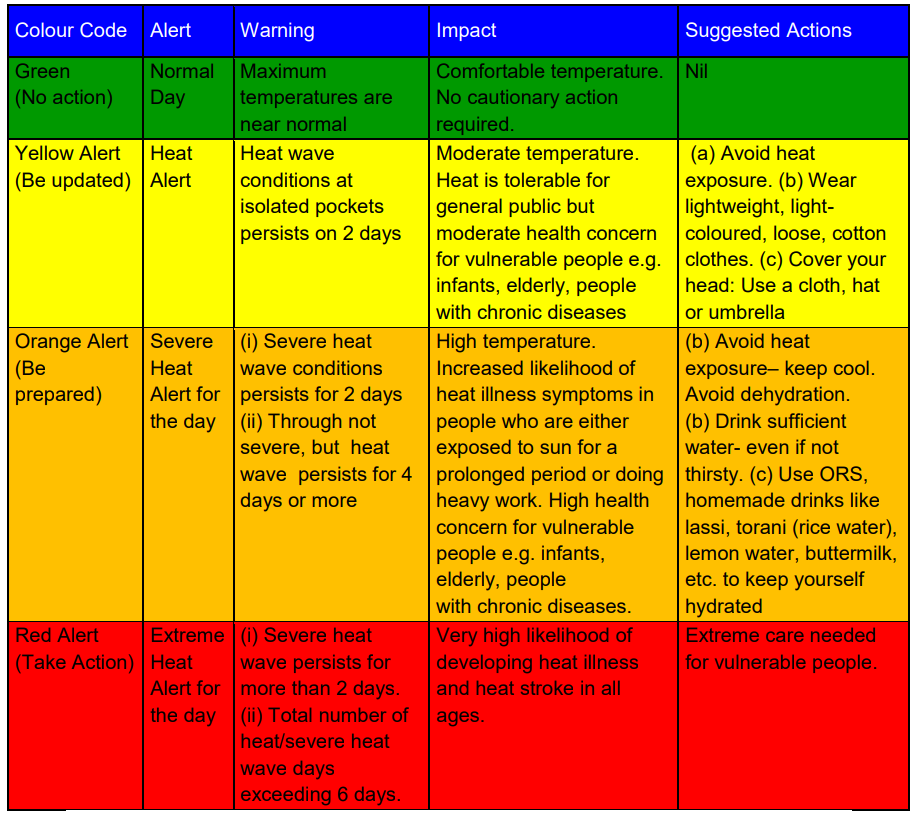
- IMD Warning System: IMD and the National Disaster Management Authority issue colour-coded heat alerts for early action.
- Jal Shakti Abhiyan: Focus on water conservation and restoration to tackle heat stress.
- Smart Cities Mission: Promotes green cover, climate-resilient planning, and urban cooling spaces.
- Cool Roof Initiatives: Use of reflective materials to reduce indoor heat; adopted in multiple states.
|
Drishti Mains Question: Heatwaves are not classified as disasters under the Disaster Management Act, 2005. Critically analyse the implications. |
Frequently Asked Questions (FAQs)
1. What is a heatwave as per IMD?
A heatwave is a period of abnormally high temperatures, declared based on thresholds (≥40°C plains) or deviation from normal (+4.5°C or more).
2. Are heatwaves classified as disasters in India?
No, heatwaves are not officially notified disasters under the Disaster Management Act, 2005.
3. What is the role of El Niño in the Indian climate?
El Niño weakens monsoon winds, often leading to reduced rainfall and increased heatwave conditions.
4. What are Heat Action Plans (HAPs)?
HAPs are state-level strategies involving early warnings, preparedness, and inter-departmental coordination to reduce heatwave impacts.
5. Why are rising night temperatures a concern?
Warmer nights reduce recovery from heat stress, increasing health risks, mortality, and energy demand.
UPSC Civil Services Examination, Previous Year Question (PYQ)
Q. What are the possible limitations of India in mitigating global warming at present and in the immediate future? (2010)
- Appropriate alternate technologies are not sufficiently available.
- India cannot invest huge funds in research and development.
- Many developed countries have already set up their polluting industries in India.
Which of the statements given above is/are correct?
(a) 1 and 2 only
(b) 2 only
(c) 1 and 3 only
(d) 1, 2 and 3
Ans: (a)
Mains
Q: Bring out the causes for the formation of heat islands in the urban habitat of the world (2013).