
Guidelines for Virtual Digital Assets | 17 Jan 2026
Why in News?
The Financial Intelligence Unit–India (FIU-IND) has introduced stringent new Anti-Money Laundering (AML) and Know Your Customer (KYC) guidelines for Virtual Digital Assets (VDAs) service providers to curb financial crimes in India’s cryptocurrency ecosystem.
What are the New FIU-IND Guidelines for Virtual Digital Assets?
- Enhanced Verification: Mandatory live selfie with liveliness detection (eye-blink/head movement) and geographic tracking (latitude, longitude, timestamp, IP) during user onboarding to prevent static/deepfake fraud.
- Multi-Layer KYC: Requires PAN + secondary ID (Aadhaar/Passport/Voter ID), OTP verification for email/mobile, and “penny-drop” bank account confirmation via a Rs 1 transaction.
- Risk-Based Monitoring: KYC updates every 6 months for high-risk clients and annually for others; enhanced due diligence for entities linked to tax havens, FATF grey/black lists, politically exposed persons (PEPs) or non-profit organisations (NPOs).
- Crackdown on Opaque Instruments: Strongly discourages Initial Coin Offerings (ICOs) and Initial Token Offerings (ITOs) and prohibits facilitation of anonymity-enhancing crypto tumblers and mixers.
- Crypto tumblers and mixers are services that enhance transaction privacy by pooling and scrambling funds from multiple users, then redistributing them to break the traceable link on the public blockchain ledger.
- Regulatory Compliance: Crypto exchanges must register as PMLA reporting entities, maintain 5-year client/transaction records, and report suspicious transactions to the FIU.
- A cryptocurrency exchange is a digital platform that allows users to buy, sell, and trade cryptocurrencies for other digital assets or traditional fiat money. E.g., Coinbase.
What are Virtual Digital Assets (VDAs)?
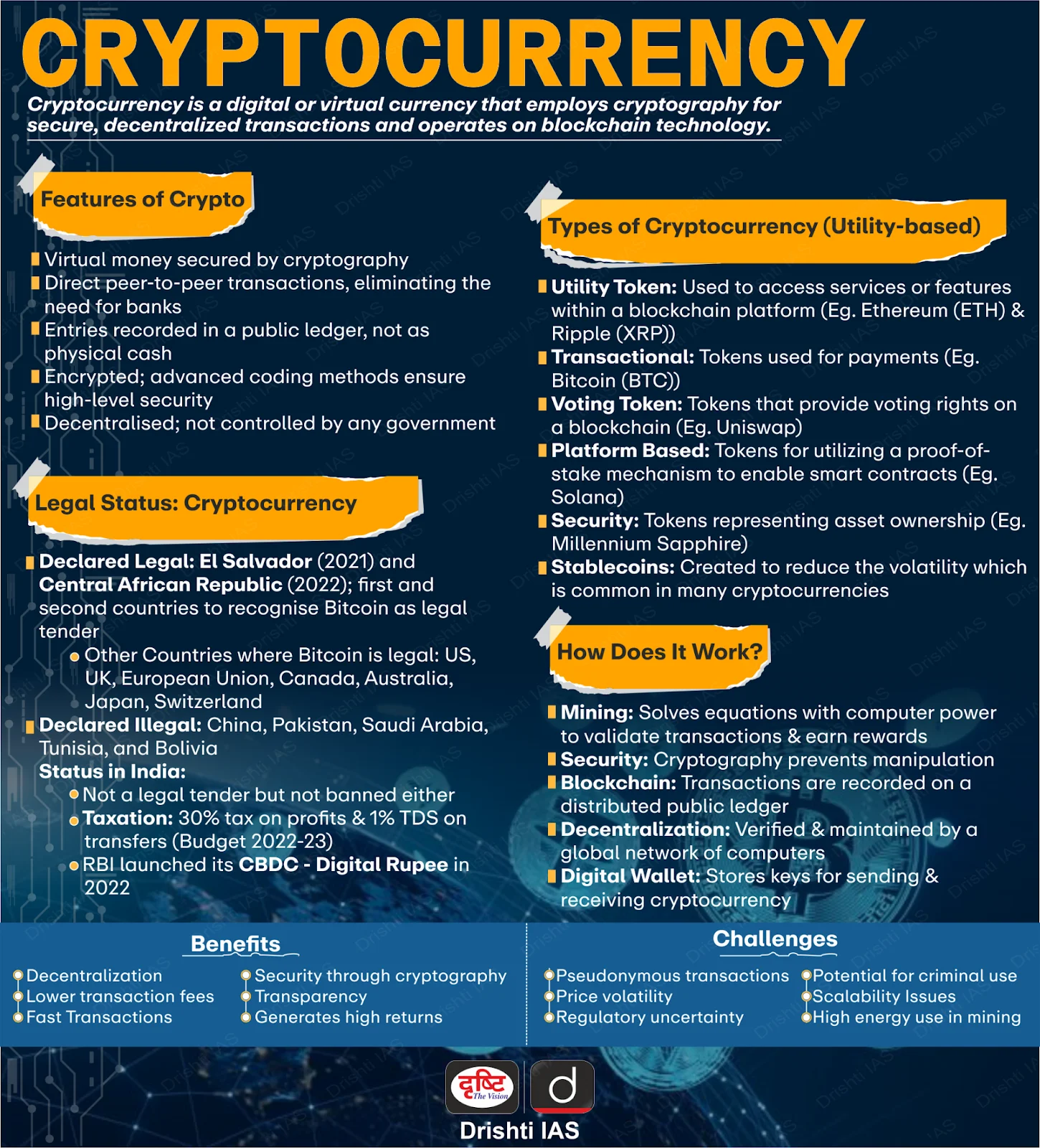
- About: VDAs are digitally represented values using cryptographic technology that have been formally defined and regulated in India to address taxation, financial integrity, and money-laundering risks amid their rapid growth.
- Key Types of VDAs:
- Cryptocurrencies: Digital currencies used as a medium of exchange.
- Non-Fungible Tokens (NFTs): Unique digital assets representing ownership of art, collectibles, or virtual goods.
- Utility Tokens: Provide access to specific services or platforms within a blockchain ecosystem.
- Asset/Security Tokens: Represent ownership or stake in real-world assets.
- Legal Definition in India: Statutorily defined under Section 2(47A) of the Income Tax Act, 1961, inserted by the Finance Act, 2022.
- Includes any information, code, number, or token (excluding Indian and foreign currency) generated through cryptographic means, representing digital value.
- Explicitly covers Non-Fungible Tokens (NFTs) and any other digital asset notified by the Central Government. Primarily encompasses cryptocurrencies (Bitcoin, Ethereum), NFTs, and similar tokens.
- Regulatory and Taxation Framework in India:
- Taxation: 30% flat tax on income from transfer of VDAs (effective from 1st April 2022). No deductions allowed except cost of acquisition; losses cannot be set off or carried forward.
- 1% TDS applicable on specified transactions under Section 194S of the Income Tax Act, 1961.
- Anti-Money Laundering Oversight: Since March 2023, VDA activities are covered under the Prevention of Money Laundering Act, 2002 (PMLA). Crypto exchanges and wallet providers are treated as reporting entities and must register with FIU-IND.
- Taxation: 30% flat tax on income from transfer of VDAs (effective from 1st April 2022). No deductions allowed except cost of acquisition; losses cannot be set off or carried forward.
Financial Intelligence Unit – India (FIU-IND)
- About: FIU-IND is India’s central agency responsible for receiving, analysing, and disseminating financial intelligence to combat money laundering and terrorist financing in India.
- Institutional Status: Functions under the Department of Revenue, Ministry of Finance, and derives its powers from the Prevention of Money Laundering Act, 2002 (PMLA). Reports directly to the Economic Intelligence Council (EIC), chaired by the Finance Minister.
- Regulatory Role in Crypto Sector: The FIU-IND is the single-point regulator for cryptocurrency exchanges under the PMLA, requiring mandatory registration, KYC compliance, and reporting of suspicious transactions.
- Crypto is not legal tender in India but is taxable under the Income-Tax law.
UPSC Civil Services Examination, Previous Year Question (PYQ)
Q. With reference to “Blockchain Technology”, consider the following statements: (2020)
- It is a public ledger that everyone can inspect, but which no single user controls.
- The structure and design of blockchain is such that all the data in it are about cryptocurrency only.
- Applications that depend on basic features of blockchain can be developed without anybody’s permission.
Which of the statements given above is/are correct?
(a) 1 only
(b) 1 and 2 only
(c) 2 only
(d) 1 and 3 only
Ans: (d)
Q. Consider the following pairs: (2018)
Terms sometimes seen in news Context/Topic
- Belle II experiment — Artificial Intelligence
- Blockchain technology —Digital/ Cryptocurrency
- CRISPR – Cas9 —Particle Physics
Which of the pairs given above is/are correctly matched?
(a) 1 and 3 only
(b) 2 only
(c) 2 and 3 only
(d) 1, 2 and 3
Ans: (b)