
Governor’s Address to State Legislature | 29 Jan 2026
For Prelims: Governor, Article 176, Constituent Assembly, Chancellor of Universities,
For Mains: Constitutional position and powers of the Governor, Aid and advice doctrine under Article 163, Governor–State Government relations and federalism
Why in News?
Recently, the Tamil Nadu Governor walked out of the State Assembly during his customary address. Simultaneously, the Kerala Governor omitted specific paragraphs. These incidents have reignited the debate on the discretionary powers of the Governor and the sanctity of Article 176.
Summary
- Recent walkouts and omissions by Governors during Assembly addresses in Tamil Nadu and Kerala have revived the constitutional debate on the limits of gubernatorial discretion under Article 176 and the primacy of elected governments.
- Constitutional provisions, conventions, and Supreme Court judgments consistently affirm that the Governor’s address is a ceremonial executive function to be delivered strictly on the aid and advice of the Council of Ministers, with minimal scope for personal discretion.
How does the Constitution Envisage the Role of the Governor?
Constitutional Provisions
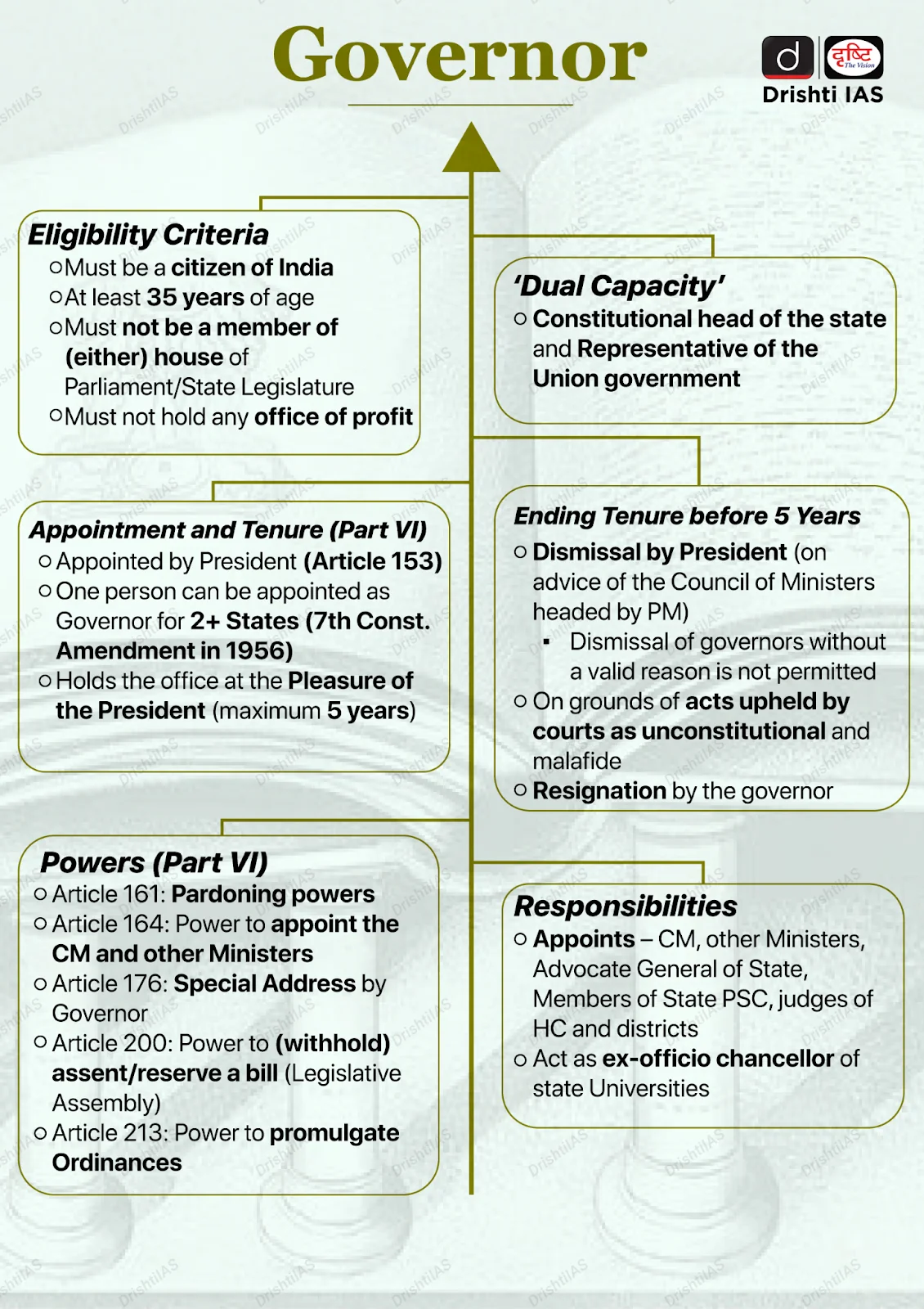
- Article 176: Mandates that the Governor shall address the Legislative Assembly, or both Houses in bicameral States, at the commencement of the first session each year to inform the Legislature of the causes of its summons.
- This address is a constitutional duty and functions as a policy statement of the elected State government, not as a personal expression of the Governor.
- Article 175: Empowers the Governor to address either House or both Houses of the State Legislature and to send messages, particularly in relation to Bills.
- However, this power is exercised as part of executive functioning and does not confer independent discretion, remaining subject to the aid and advice of the Council of Ministers.
- Article 163: Establishes that the Governor shall act on the aid and advice of the Council of Ministers except in matters where the Constitution explicitly provides discretion.
Constituent Assembly About the Governor’s Role
- The Constituent Assembly envisaged the Governor as a constitutional head rather than an autocratic authority, entrusted with duties but no independent powers.
- The governor is expected to act as a neutral representative of the people of the State as a whole, not as a political actor.
Supreme Court Judgments on Governor’s Role:
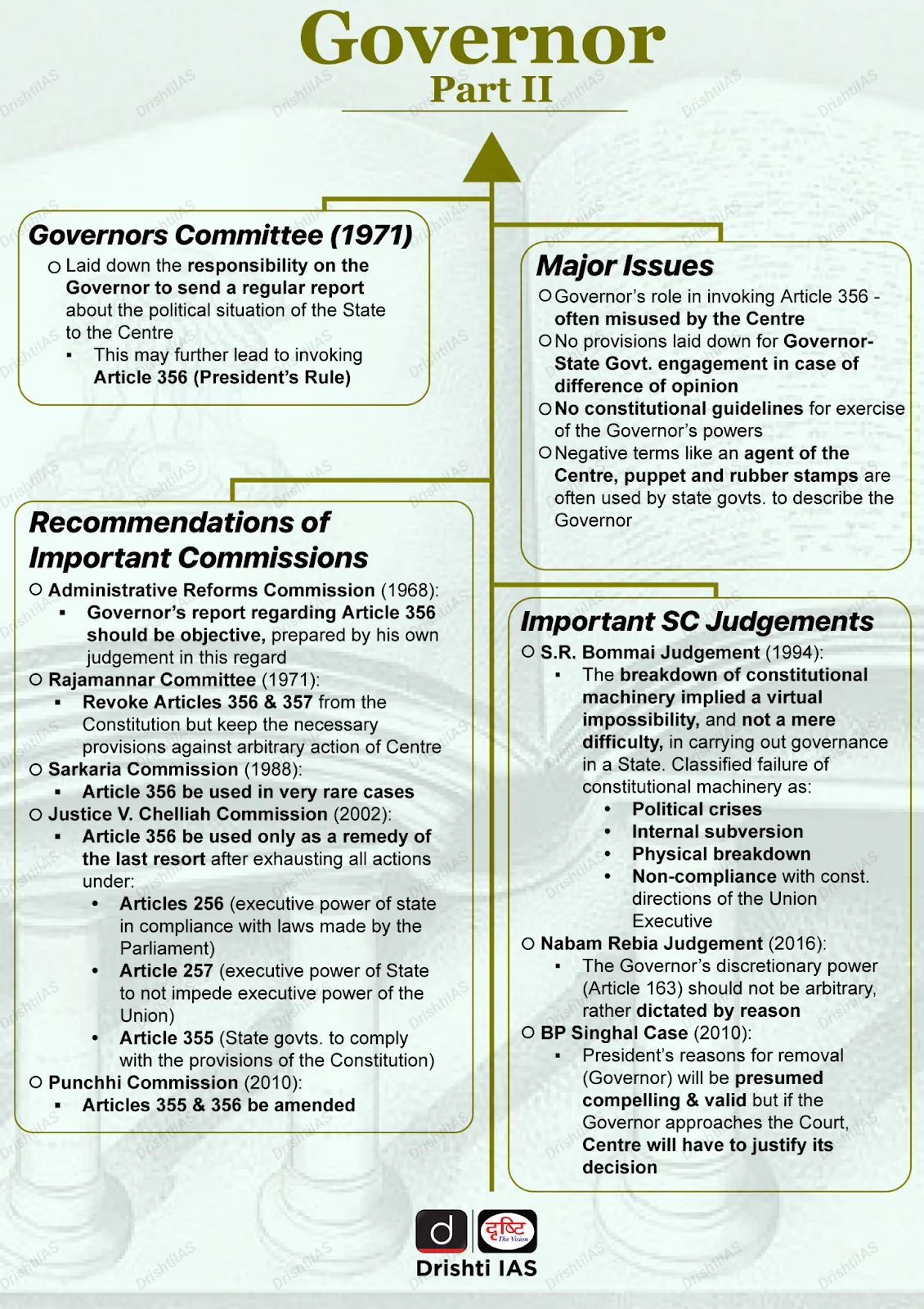
- State of Tamil Nadu v. Governor of Tamil Nadu (2024): The Supreme Court held that the Governor’s discretionary powers cannot be exercised to stall, obstruct, or negate the functioning of an elected government.
- Nabam Rebia v. Deputy Speaker (2016): A five-judge Constitution Bench ruled that the Governor’s discretionary powers are strictly limited and explicitly defined in the Constitution.
- Shamsher Singh v. State of Punjab (1974): A seven-judge Constitution Bench held that the Governor is a constitutional head and must act on the aid and advice of the Council of Ministers in all matters except those where the Constitution expressly grants discretion.
- It held that the Governor cannot exercise personal discretion in executive matters.
Committee Recommendations
- Sarkaria Commission (1988) Recommendations: It emphasized that the Governor must not be an agent of the Centre and should act as a "lynchpin" of federalism, avoiding active politics.
- Punchhi Commission (2007): Recommended that the Governor should not be burdened with positions (like Chancellor of Universities) that open them to political controversies, focusing strictly on constitutional duties.
What are the Arguments Regarding the Governor’s Discretion in Assembly Addresses?
Arguments for Governor’s Discretion
- Constitutional Oath (Article 159): The Governor takes an oath to preserve, protect, and defend the Constitution and cannot be compelled to read material perceived as unconstitutional, factually incorrect, seditious, or undermining constitutional values.
- Right to Dissent and Free Speech: As a high constitutional authority, the Governor is not a mechanical functionary and may refuse to endorse content that directly attacks the office of the Governor.
- Articles 175 and 176 mandate the Governor’s address but do not explicitly prescribe that the Governor must read it verbatim, leaving some interpretive space.
- This constitutional silence is cited to argue that discretion is not entirely excluded.
- Articles 175 and 176 mandate the Governor’s address but do not explicitly prescribe that the Governor must read it verbatim, leaving some interpretive space.
- Representative of the Union: Being the constitutional link between the Union and the State, the Governor is argued to have a responsibility to prevent speeches that may threaten national unity or federal integrity.
- Preventing Institutional Self-Contradiction: If the address contains content directly contradicting constitutional positions earlier taken by the Governor (e.g., assent, reservation of Bills, reports to the President), reading it may amount to institutional inconsistency.
Arguments Against Governor’s Discretion
- Aid and Advice Principle (Article 163): Under the Westminster model adopted by India, the Governor is a ceremonial head. The real power lies with the elected Council of Ministers, thus, the Governor must act on their "aid and advice".
- Nature of the Governor’s Address: The address is a statement of the State Government’s policy, not the Governor’s personal opinion. Altering or refusing it blurs accountability and confuses legislative responsibility.
- Erosion of Federalism: Unilateral edits or walkouts by a centrally appointed Governor are seen as encroachments on State autonomy and disrupt the federal balance.
- Allowing discretion in addresses opens the door to selective obstruction, especially in opposition-ruled States. This undermines the Governor’s expected neutrality and erodes public trust in constitutional offices.
- Threat to Parliamentary Democracy: Allowing discretion in routine executive functions risks creating a parallel authority, weakening the core principle of responsible government.
- Legislative Privilege and Autonomy: The Governor’s address is part of legislative proceedings.
- Interference may infringe upon the legislature’s privilege to debate and reject government policy on the floor, rather than through pre-emptive executive.
- Judicially Preferred Remedy Exists: If content is unconstitutional, the appropriate remedy lies in judicial review, not unilateral refusal by the Governor.
- Constitutional adjudication is the domain of courts, not individual constitutional authorities.
Way Forward
- Codification of Conventions: The "conventions" of the British parliamentary system (where the Monarch never deviates from the speech) should be codified or strictly adhered to.
- The Supreme Court can issue declaratory constitutional guidelines clarifying that the Governor’s address is a mandatory constitutional function without discretionary scope. This would reduce recurring litigation and prevent inconsistent practices across States.
- Orientation and Capacity-Building for Governors: Newly appointed Governors should undergo mandatory constitutional training on federalism, conventions, and judicial precedents. This would improve role clarity and reduce institutional friction.
- Constructive Dialogue: Chief Ministers and Governors must bridge the "trust deficit" through private consultation on the draft speech before the session, rather than public confrontation.
- Time-bound Constitutional Communication Mechanism: A formal, time-bound framework should require Governors to communicate any objections to the address in writing within a fixed deadline.
- If no response is given within this period, concurrence should be presumed. This would eliminate avoidable delays, discourage tactical silence, and ensure smooth constitutional processes.
Conclusion
The constitutional debate hinges on balancing the Governor’s oath-bound duty to the Constitution against the primacy of elected executive authority, with constitutional text, convention, and Supreme Court precedent strongly limiting gubernatorial discretion in Assembly addresses.
|
Drishti Mains Question: The Governor’s address under Article 176 is a constitutional duty, not a discretionary power.” Examine in the light of recent controversies and Supreme Court judgments. |
Frequently Asked Questions (FAQs)
1. What does Article 176 of the Constitution mandate?
It mandates that the Governor shall address the State Legislature at the commencement of the first session each year, conveying the elected government’s policy agenda.
2. Does the Governor have discretion over the content of the Assembly address?
No. Supreme Court jurisprudence holds that the address is an executive function performed strictly on the aid and advice of the Council of Ministers.
3. Which Supreme Court case limits the Governor’s discretionary powers?
Shamsher Singh v. State of Punjab (1974) established that the Governor is a constitutional head with no general discretionary power in executive matters.
4. Why are recent gubernatorial actions seen as constitutionally problematic?
Selective omission or refusal to deliver the address undermines Cabinet responsibility, federal balance, and parliamentary conventions.
5. What reforms are suggested to prevent such conflicts?
Codification of conventions, adherence to Sarkaria and Punchhi Commission recommendations, and greater consultative dialogue between Governors and Chief Ministers.
UPSC Civil Services Examination Previous Year Questions (PYQs)
Prelims
Q. Consider the following statements: (2018)
- No criminal proceedings shall be instituted against the Governor of a State in any court during his term of office.
- The emoluments and allowances of the Governor of a State shall not be diminished during his term of office.
Which of the statements given above is/are correct?
(a) 1 only
(b) 2 only
(c) Both 1 and 2
(d) Neither 1 nor 2
Ans: (c)
Q. Which of the following are the discretionary powers given to the Governor of a State? (2014)
- Sending a report to the President of India for imposing the President’s rule
- Appointing the Ministers
- Reserving certain bills passed by the State Legislature for consideration of the President of India
- Making the rules to conduct the business of the State Government
Select the correct answer using the code given below:
(a) 1 and 2 only
(b) 1 and 3 only
(c) 2, 3 and 4 only
(d) 1, 2, 3 and 4
Ans: (b)
Q. Which one of the following statements is correct? (2013)
(a) In India, the same person cannot be appointed as Governor for two or more States at the same time
(b) The Judges of the High Court of the States in India are appointed by the Governor of the State just as the Judges of the Supreme Court are appointed by the President
(c) No procedure has been laid down in the Constitution of India for the removal of a Governor from his/her post
(d) In the case of a Union Territory having a legislative setup, the Chief Minister is appointed by the Lt. Governor on the basis of majority support
Ans: (c)
Mains
Q. Discuss the essential conditions for exercise of the legislative powers by the Governor. Discuss the legality of re-promulgation of ordinances by the Governor without placing them before the Legislature.(2022)
Q. Though the federal principle is dominant in our constitution and that principle is one of its basic features, but it is equally true that federalism under the Indian Constitution leans in favour of a strong Center, a feature that militates against the concept of strong federalism. Discuss.(2014)