
Export Promotion Mission | 10 Dec 2025
For Prelims: Micro, Small and Medium Enterprises, Directorate General of Foreign Trade, Niryat Protsahan & Niryat Disha,
For Mains: Growth & Development, Transforming India’s Export Landscape, Districts as Export Hubs, Inclusive export growth.
Why in News?
The Government of India has approved the Export Promotion Mission (EPM), aiming to boost exports—especially from Micro, Small and Medium Enterprises (MSMEs) labour-intensive sectors and low-export-intensity regions.
What is the Export Promotion Mission (EPM)?
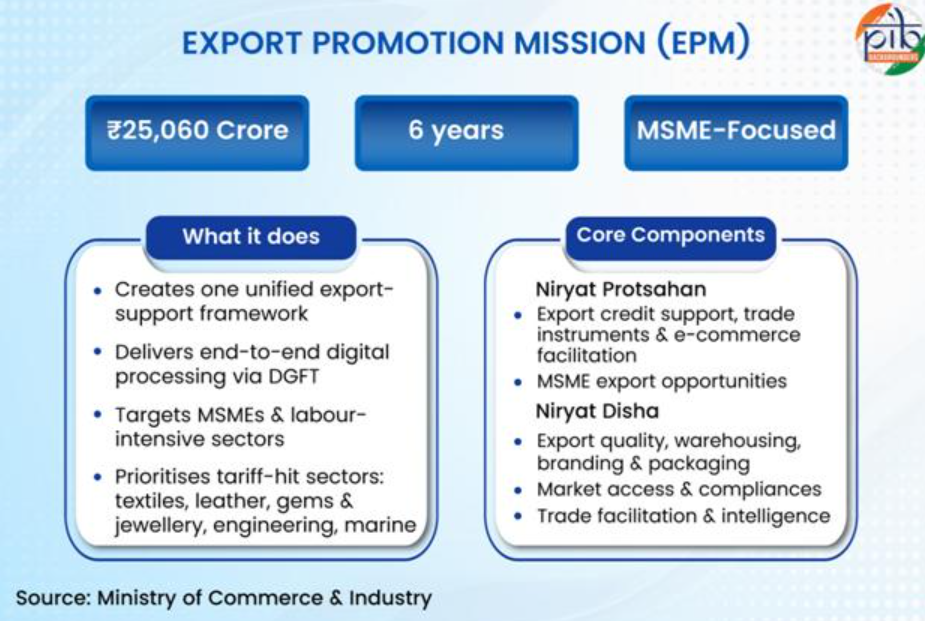
- About: The EPM, announced in Union Budget 2025–26, merges fragmented export-support schemes into a single, digitally enabled framework.
- With a Rs 25,060 crore outlay for FY 2025–26 to FY 2030–31, it aims to strengthen India’s export ecosystem and boost competitiveness for MSMEs and labour-intensive sectors.
- Structure and Governance: EPM is anchored in a coordinated institutional framework involving the Department of Commerce, MSME Ministry, Finance Ministry, Export Promotion Councils, Commodity Boards, financial institutions, industry bodies and state governments.
- The Directorate General of Foreign Trade (DGFT) serves as the implementing agency.
- Integrated Sub-Schemes: EPM operates through two integrated sub-schemes Niryat Protsahan & Niryat Disha, that together address finance and non-financial enablers.
- Niryat Protsahan: Provides financial support such as affordable trade finance, interest subvention, factoring, exporter credit cards, collateral aid and credit enhancement for MSMEs.
- Niryat Disha: Provides non-financial support such as quality and compliance help, branding, trade fairs, logistics and transport support, and district-level capacity-building.
- Digital Implementation and Monitoring: EPM uses a DGFT-run digital platform for paperless, integrated processing and faster, transparent delivery.
- Its outcome-based digital design ensures coordinated implementation and quick response to global trade changes.
- Sectoral and Regional Focus: EPM prioritises tariff-hit sectors such as textiles, leather, gems & jewellery, engineering goods and marine products, while supporting MSMEs, first-time exporters and labour-intensive value chains.
- Under Niryat Disha, targeted support to interior and low-export districts, to expand India’s export base and ensure more inclusive participation in global markets.
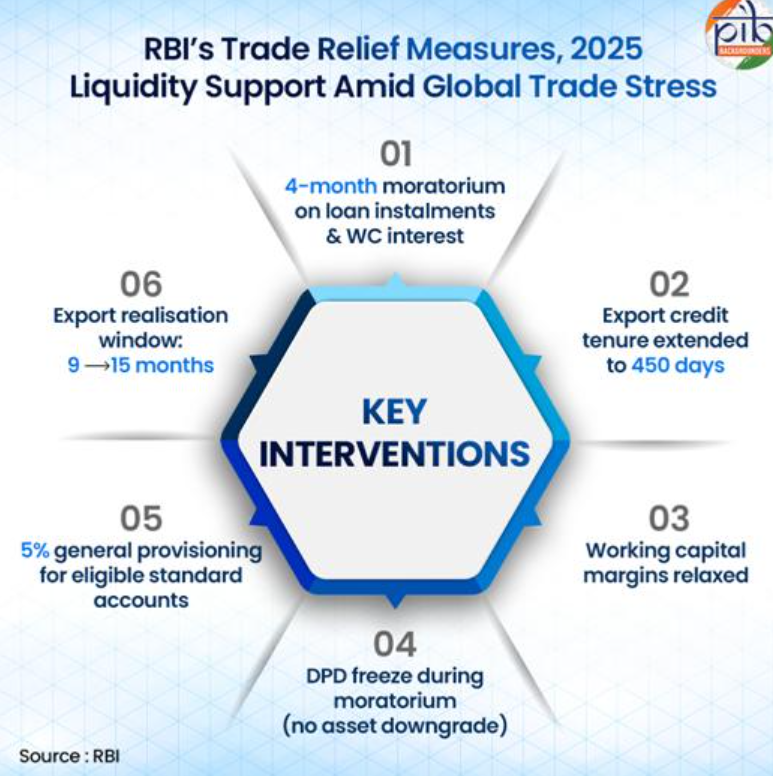
- Regulatory and Central Bank Support: Reserve Bank of India (RBI) Trade Relief Measures 2025 complement EPM by easing liquidity stress and supporting export-oriented businesses.
- Expected Outcomes: Include better trade finance for MSMEs, stronger certification and quality compliance, enhanced branding and global visibility, and increased exports from non-traditional districts.
- These outcomes support export-led growth, align with Atmanirbhar Bharat, and advance the vision of Viksit Bharat @ 2047 by making India a more competitive global trade partner.
What is the Status of India’s Export Industry?
- Export Growth: India’s exports reached a historic USD 778.21 billion in 2023–24, marking a sharp 67% rise from 2013–14.
- The rise in exports reflects expansion of manufacturing, digital capabilities, and greater market diversification, not short-term fluctuations.
- Major Export Markets: Top destinations (2023–24) include US, UAE, Netherlands, China, Singapore, UK, Saudi Arabia, Bangladesh, Germany, Italy.
- These 10 countries account for 51% of total merchandise exports.
- Export reach has expanded across North America, EU, ASEAN, West Asia, North-East Asia, showing diversified geographic spread.
- Evolution of India’s Export Composition: India’s export structure is undergoing a clear upgrade, shifting from low-value goods like textiles and basic agriculture to high-value manufacturing such as electronics and engineering goods.
- The services sector now contributes nearly 44% of total exports, reinforcing India’s global competitiveness.
- New sunrise sectors including medical devices, renewable-energy components, and advanced electronics are further strengthening India’s export diversification and value addition.
What are India’s Major Initiatives to Promote Exports?
|
Initiative |
Purpose / Key Features |
|
Integrates infrastructure planning; improves multimodal logistics and reduces transit time and cost. |
|
|
Aims to reduce logistics cost; promotes multimodal connectivity and digital logistics platforms. |
|
|
Provides 100% government guarantee to exporters, including MSMEs to boost liquidity and enhance India’s global competitiveness. |
|
|
Refunds embedded taxes/duties not covered under GST to improve export competitiveness. |
|
|
Rebates state and central taxes for textile and apparel exports. |
|
|
Boosts manufacturing scale and exports in sectors like electronics, pharma, textiles, drones etc. |
|
|
Funds export-related infrastructure—testing labs, ICDs, cold storage, border haats. |
|
|
Tariff reductions and market access through pacts with UAE, Australia, EFTA etc. |
|
|
Promotes district-specific products with branding, capacity-building, logistics support. |
|
|
Enhances quality, reduces waste, and aligns MSMEs with global production standards. |
Conclusion
The EPM creates a unified, technology-driven framework to strengthen India’s export ecosystem. Together with RBI measures and credit guarantees, it enhances India’s resilience and position in global trade.
|
Drishti Mains Question: Critically examine the design of the Export Promotion Mission (EPM) as a unified, digital framework for export facilitation. |
Frequently Asked Questions (FAQs)
Q. What is the Export Promotion Mission (EPM)?
EPM is a six-year, digitally enabled mission (outlay ₹25,060 crore for FY2025–26 to FY2030–31) that consolidates export support through Niryat Protsahan and Niryat Disha to boost MSME and labour-intensive exports.
Q. What are Niryat Protsahan and Niryat Disha?
Niryat Protsahan provides affordable trade finance (interest subvention, factoring, collateral support); Niryat Disha offers quality/compliance aid, branding, trade-fair support, warehousing and district-level logistics facilitation.
Q. How does the Credit Guarantee Scheme for Exporters (CGSE) support exporters?
CGSE expands export credit by up to Rs 20,000 crore with 100% government guarantee (via NCGTC), enabling collateral-free loans and additional working capital for eligible exporters, especially MSMEs.
Summary
- India launched the Export Promotion Mission (EPM) to unify export-support schemes and strengthen MSME and labour-intensive exports through digital, outcome-based delivery.
- EPM operates via Niryat Protsahan (financial support) and Niryat Disha (non-financial support), backed by DGFT’s digital platform and coordinated institutional governance.
- India’s exports reached USD 778.21 bn in 2023–24, driven by high-value manufacturing (electronics, engineering, pharma) and a strong services sector contributing ~44% of total exports.
- Complementary initiatives—CGSE, PM GatiShakti, National Logistics Policy, PLI schemes, FTAs and district-level export hubs—are enhancing logistics, credit access, compliance, and market diversification to sustain export-led growth toward Viksit Bharat @ 2047.
UPSC Civil Services Examination, Previous Year Questions (PYQs)
Q1. Increase in absolute and per capita real GNP do not connote a higher level of economic development, if (2018)
(a) Industrial output fails to keep pace with agricultural output.
(b) Agricultural output fails to keep pace with industrial output.
(c) Poverty and unemployment increase.
(d) Imports grow faster than exports.
Ans: (c)
Q2. The SEZ Act, 2005 which came into effect in February 2006 has certain objectives. In this context, consider the following: (2010)
- Development of infrastructure facilities.
- Promotion of investment from foreign sources.
- Promotion of exports of services only.
Which of the above are the objectives of this Act?
(a) 1 and 2 only
(b) 3 only
(c) 2 and 3 only
(d) 1, 2 and 3
Ans: (a)
Q3. A “closed economy” is an economy in which (2011)
(a) the money supply is fully controlled
(b) deficit financing takes place
(c) only exports take place
(d) neither exports or imports take place
Ans: (d)