
AI Impact Study on the Labour Market | 12 Mar 2026
For Prelims: Artificial Intelligence (AI), Large Language Models (LLMs), ChatGPT, Generative AI Chatbots, MSME, Intellectual Property, Social Security Code 2020.
For Mains: Key findings of the Anthropic labour market study on AI impact, Threats posed by AI to employment, Measures needed to make employment resilient against the growing impact of AI.
Why in News?
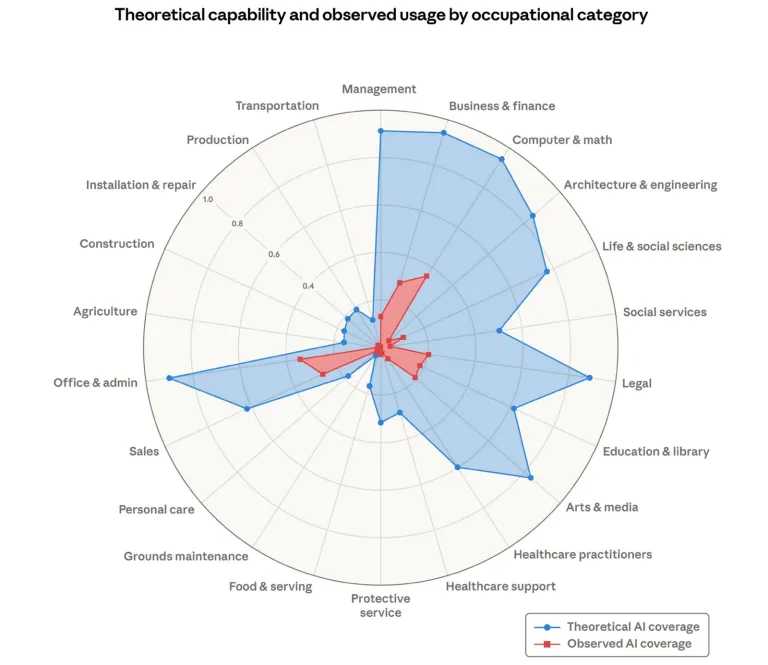
A recent labour market study by Anthropic highlights the growing influence of Artificial Intelligence (AI) on employment patterns, showing that while Large Language Models (LLMs) can theoretically perform many professional tasks, their current real-world use is still limited.
- The study pioneered a new measure called "observed exposure", which moves beyond theoretical AI capability to assess what AI is demonstrably already doing in professional settings.
Summary
- The Anthropic labour market study reveals that Artificial Intelligence is increasingly influencing employment, particularly in knowledge-intensive sectors.
- While AI’s theoretical capability is high, actual workplace usage remains limited but is growing rapidly.
- The findings highlight the need for reskilling, AI literacy, and policy measures to safeguard employment in the AI era.
What are the Key Findings of the Anthropic Labour Market Study on AI Impact?
- Gap Between Theoretical Capability and Actual Usage: Large Language Models like Claude could theoretically do 94% of the work for computer and math professionals. However, in practice, current versions of Claude are only used for about 33% of those tasks.
- Identification of High-Exposure and Insulated Sectors:
- Most Exposed Jobs: Computer programmers, customer service representatives, and financial analysts are considered "most exposed," with AI theoretically able to cover most tasks in fields like business, finance, computer science, engineering, law, and office administration.
- Insulated Sectors: Construction, agriculture, protective services, and personal care have limited theoretical AI use, making jobs in these areas more protected from immediate AI disruption.
- Sharp Decline in Entry-Level Hiring: Since the launch of ChatGPT in late 2022, entry into high-exposure occupations among workers aged 22 to 25 has fallen by 14%. Companies are reducing graduate programmes, entry-level analyst cohorts, and junior developer pipelines, effectively "closing the front door" for new hires even without widespread layoffs.
- Demographic Disparities in AI Exposure: Workers in the most AI-exposed professions exhibit distinct demographic characteristics:
- Gender: 54.4% of the most exposed group is female.
- Education: Workers with graduate degrees are nearly 4 times more likely to be in the most exposed quartile than the unexposed group.
- Race: White workers constitute 65.1% of the high-exposure group; Asian workers are nearly twice as likely to be in the most exposed group.
- Age: Average age of highly exposed workers is slightly higher (42.9 years) than those in unexposed roles.
- India-Specific Implications: The Indian IT services sector faces severe risks, with the Nifty IT index and stocks of majors like TCS, Wipro, and Infosys declining over 20% in the past year.
- Anthropic's workplace automation tools directly challenge the Indian IT business model by automating services like data processing, contract analysis, compliance monitoring, and customer support.
- India faces structural challenges, including a lack of mathematical and scientific skills and low R&D spending compared to the US and China.
How Artificial Intelligence Poses a Threat to Employment?
- Automation of Routine and Repetitive Tasks: AI-powered systems—including robots, optical character recognition, and process automation software—execute standardised operations with greater speed, accuracy, and consistency than humans. This eliminates workers in assembly lines, data entry, and basic processing roles where tasks lack complex judgement. E.g., Ola Electric laid off 1,000 employees after streamlining operations with AI tools.
- Substituting Humans in Customer Service: Generative AI chatbots and virtual agents handle high volumes of queries, complaints, and transactions autonomously, reducing or eliminating requirements for human call-centre staff. E.g., Startups like LimeChat enable clients to slash by 80% the number of workers needed to handle 10,000 monthly queries.
- Reduction in Demand for Entry-Level Technical Skills: AI coding assistants (like GitHub Copilot) and automated testing tools produce, debug, and maintain software code far more rapidly than junior developers, diminishing entry-level and mid-tier programming. This creates an "hourglass effect" in the job market, i.e., high demand for senior specialists but shrinking mid-level and entry-level positions. E.g., the IT sector experienced over 50,000 job cuts in 2024, predominantly affecting entry-level programmers.
- Devaluation of Creative Work: Creative freelancers (graphic designers, content writers) who earn by creating logos or blog posts now face clients using AI tools (DALL-E, Midjourney) to generate options at negligible cost. Human role reduces to editing AI output rather than creating original work.
Steps Taken by the Government to make India’s Labour Force AI Ready
What Measures are Needed to Make Employment Resilient against the Growing Impact of AI?
- Revolutionize Education: Embed AI Literacy at the foundational level in schools by introducing concepts of data, algorithms, and ethics, integrated with math and social studies.
- Create a National Re-skilling Pipeline: Fund a "Future Skills" Tax Credit providing businesses with tax benefits for up-skilling employees in AI-adjacent fields such as prompt engineering, data annotation, and robotics maintenance.
- Adopt "Cobotics" in the Workplace: Replace full automation with collaborative robotics where AI assists human workers—for instance, providing call centre agents with AI tools for emotional tone analysis and real-time solution suggestions.
- Protect the Apprenticeship Economy: Create sandbox environments in the IT sector where junior employees use AI to enhance productivity but are evaluated on innovation and value addition, countering the "deskilling threat."
- Ensure Cyber-Resilience for MSMEs: Provide subsidised "AI Firewall as a Service" to MSME clusters (e.g., pharma in Hyderabad, textiles in Surat) to prevent intellectual property theft that leads to job losses.
- Implement Portable Social Security: Effectively enforce the Social Security Code 2020 to ensure gig workers' contributions follow them across platforms, guaranteeing pension and health insurance even as AI devalues per-task wages.
Conclusion
The Anthropic labour market study highlights how Artificial Intelligence and Large Language Models (LLMs) are reshaping employment patterns, particularly affecting knowledge-based and entry-level roles. While AI adoption remains partial, its rapid expansion demands urgent investments in skills, education reform, and AI-human collaboration models to ensure employment resilience and inclusive economic growth.
|
Drishti Mins Question: Discuss the various mechanisms through which Artificial Intelligence poses a threat to employment. Illustrate your answer with relevant India-specific examples. |
Frequently Asked Questions (FAQs)
1. Which sectors are most exposed to AI disruption?
Computer programming, finance, business management, legal services, engineering, and office administration show the highest exposure due to their task-based and knowledge-intensive nature.
2. Why are entry-level jobs particularly vulnerable to AI?
AI coding tools, chatbots, and automation systems can perform routine technical tasks, reducing the need for junior developers, analysts, and graduate trainees.
3. Why are some sectors relatively insulated from AI disruption?
Jobs in construction, agriculture, protective services, and personal care involve physical work, situational judgement, and human interaction, limiting AI substitution.
4. How does AI create an "hourglass effect" in the job market?
AI creates an "hourglass effect" by generating high demand for senior specialists (top) while shrinking mid-level and entry-level positions (narrowing neck), threatening traditional career progression.
UPSC Civil Services Examination Previous Year Question (PYQ)
Prelims
Q. With the present state of development, Artificial Intelligence can effectively do which of the following? (2020)
- Bring down electricity consumption in industrial units
- Create meaningful short stories and songs
- Disease diagnosis
- Text-to-Speech Conversion
- Wireless transmission of electrical energy
Select the correct answer using the code given below:
(a) 1, 2, 3 and 5 only
(b) 1, 3 and 4 only
(c) 2, 4 and 5 only
(d) 1, 2, 3, 4 and 5
Ans: (b)
Mains
Q. Introduce the concept of Artificial Intelligence (AI). How does AI help clinical diagnosis? Do you perceive any threat to privacy of the individual in the use of AI in healthcare? (2023)
Q. How globalization has led to the reduction of employment in the formal sector of the Indian economy? Is increased informalization detrimental to the development of the country? (2016)