
Agricultural Safeguards in India–US Interim Trade Agreement | 10 Feb 2026
Why in News?
India and the US have issued a joint statement announcing a framework for an Interim Trade Agreement, following the US decision to cut reciprocal tariffs on Indian goods to 18%.
- It is seen as a precursor to a full Bilateral Trade Agreement, the framework gives India preferential access to the USD 30-trillion US market. It aims to expand bilateral trade while protecting Indian farmers and other sensitive sectors, even as it selectively opens India’s animal feed market to the US.
What are the Key Highlights of the India- US Trade Deal?
Click here to Read: India–US Trade Deal 2026
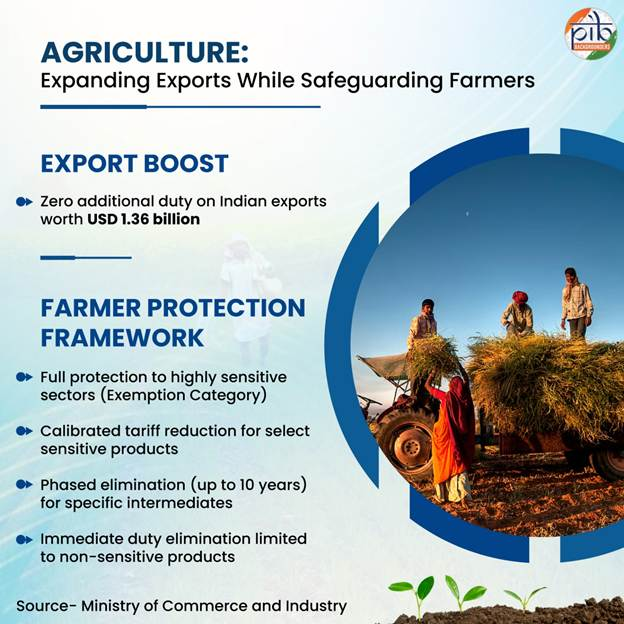
How are Indian Farmers Protected under the India - US Interim Trade Agreement?
- Excluded Items: India maintains a trade surplus of USD 1.3 billion in agricultural trade with the US, with exports of USD 3.4 billion and imports of USD 2.1 billion in 2024.
- The US will apply zero additional duty on Indian exports worth USD 1.36 billion.
- Additionally, a strict "negative list" has been maintained. No tariff relief has been granted to the US on sensitive agricultural products including:
- Meat, poultry, and dairy.
- Staple grains (wheat, rice, maize, millets).
- Fruits and vegetables (bananas, strawberries, cherries, citrus, green peas).
- Other commodities like soybean, sugar, oilseeds, ethanol, and tobacco.
- GM Ban Continues: India has firmly refused to open its doors to Genetically Modified (GM) items, specifically blocking American GM corn and soybean.
- Boost to Indian Farmers: India has secured duty-free entry into the US market for several sectors, with duties dropping from 50% to 0% in many cases.
- Agriculture Exports: Zero-duty access has been granted for Indian spices, tea, coffee, cashew nuts, Brazil nuts, and coconuts (including oil and copra).
- Fruits and Vegetables: Exports of mangoes, guavas, papayas, avocados, bananas, and mushrooms will benefit from tariff elimination.
- Processed Goods: Select processed foods and cereals like barley will also enter duty-free, encouraging value addition within India before export.
- Animal Feed Market: With India's domestic production of maize and soybean unable to keep pace with the rising demand from the poultry and livestock sectors, the deal opens specific windows for feed imports without compromising the ban on GM grains.
- The US can now export Sorghum (Red Sorghum) to India. It is seen as a vital non-GM alternative to corn for the Indian poultry industry.
- Distillers Dried Grains with Solubles (DDGS) is a by-product of ethanol production. Although it may be derived from GM corn, India is allowing it only as a processed feed input.
- It supports the protein requirements of livestock and poultry without opening the door to GM grains.
Calibrated Market Opening with Strong Safeguards
- For items that were opened, India used safeguards to prevent dumping:
- Tariff Rate Quotas (TRQs): Applied to items like apples and almonds, where only a specific quantity can be imported at lower rates.
- Phased Rollouts: Some tariffs will be reduced over a period (up to 10 years) to allow domestic industries to adjust.
- Minimum Import Price (MIP): Imposed on wines and spirits to ensure only high-value premium products enter, protecting the domestic mass-market industry.
India's Feed Market
- Current Output: According to the United States Department of Agriculture (USDA), India’s annual maize production is expected to be 43 million tonnes (mt) in 2025-26, with about 24 mt allocated specifically for feed use. Soybean output stands at approximately 12.5 mt.
- Compound Feed Industry: The total production of compound feed is pegged at 60 mt, comprising 40 mt for poultry, 18 mt for cattle, and 2 mt for aqua/shrimp feed.
- Domestic DDGS: Grain-based ethanol distilleries in India are currently supplying over 3 mt of DDGS to the feed industry, with a forecast of 4.2 mt in 2025-26.
- Yield Challenges: Domestic production struggles with low yields; maize yields average 3.75 tonnes/hectare (vs 11.25 in the U.S.), and soybean yields are below 1 tonne/hectare (vs 3.4 in the U.S.).
Demand Drivers
- Drivers: Rising incomes, urbanization, and a population expected to reach 1.5 billion by 2050 are driving a dietary shift toward protein (milk, eggs, meat), thereby increasing the demand for animal feed.
- Consumption Projections (USDA Report):
- Maize: From 34.7 mt (2022-23) to 93 mt (2050) under a moderate growth scenario, or up to 200.2 mt under a rapid growth scenario.
- Soybean Meal: From 6.2 mt (2022-23) to 28.3 mt (2050) under moderate growth, or up to 68.3 mt under rapid growth.
- Feed Composition: Maize is a critical component, making up 55-65% of broiler feed, 50-60% of egg-layer feed, and 15-20% of cattle feed.
US Role
- With India’s production unable to keep pace with demand, the U.S. is positioned to fill the deficit. The USDA projects India could need to import up to 46 mt of maize and 19 mt of soybean meal by 2040 under rapid growth scenarios.
|
Drishti Mains Question: How does the India–US Interim Trade Agreement balance export promotion with domestic farmer protection? |
Frequently Asked Questions (FAQs)
1. Why is the India–US Interim Trade Agreement significant?
It lowers U.S. tariffs on Indian goods to 18%, gives India preferential access to the U.S. market, and sets the stage for a full Bilateral Trade Agreement.
2. How are Indian farmers protected under the agreement?
Sensitive products like cereals, dairy, meat, pulses, oilseeds, fruits, ethanol and tobacco are kept on a strict negative list with no tariff concessions.
3. What agricultural exports gain zero-duty access to the U.S.?
Products such as spices, tea, coffee, cashew nuts, coconuts, mangoes, guavas, papayas, mushrooms and barley receive zero-duty access.
4. Does the deal allow imports of GM crops into India?
No, the ban on GM maize and GM soyabean remains intact; only non-GM sorghum and processed feed inputs like DDGS are permitted.
5. Why is the animal feed market important in this deal?
Rising demand for poultry and livestock feed, driven by income growth and dietary shifts, has outpaced domestic production, necessitating controlled imports.
UPSC Civil Services Examination, Previous Year Questions (PYQs)
Mains
Q. ‘What introduces friction into the ties between India and the United States is that Washington is still unable to find for India a position in its global strategy, which would satisfy India’s National self-esteem and ambitions’. Explain with suitable examples. (2019)