
The Escalating Crisis in West Asia
This editorial is based on “Full-blown conflict in West Asia” which was published in The Financial Express on 04/03/2026. The article brings into focus the rapidly escalating conflict in West Asia following US-Israeli strikes on Iran and Tehran’s retaliatory attacks across the region, which have begun disrupting global energy markets.
For Prelims: West Asia, US-Israeli air strikes on Iran, Sykes-Picot Agreement, Balfour Declaration, Operation Epic Fury by the U.S. , Operation Lion’s Roar by Israel, India-Middle East-Europe Economic Corridor.
For Mains: Historical Background of the West Asian Crisis, Forces that are Driving the Current West Asian Crisis, Implications of West Asian Conflict on India.
West Asia is engulfed in a full-blown conflict as US-Israeli air strikes on Iran trigger retaliatory missile and drone attacks across the region. Iran is targeting US bases in Qatar, Bahrain, and Kuwait, while Israel simultaneously strikes Hezbollah in Lebanon. The fallout is already rattling global energy markets, Iranian drone strikes have disrupted Saudi and Qatari oil output, threatening supplies through the critical Strait of Hormuz. For India, a major oil importer with deep ties across the region, the stakes of this escalation could not be higher. Any prolonged conflict directly threatens India's energy security, remittance flows, and economic stability.
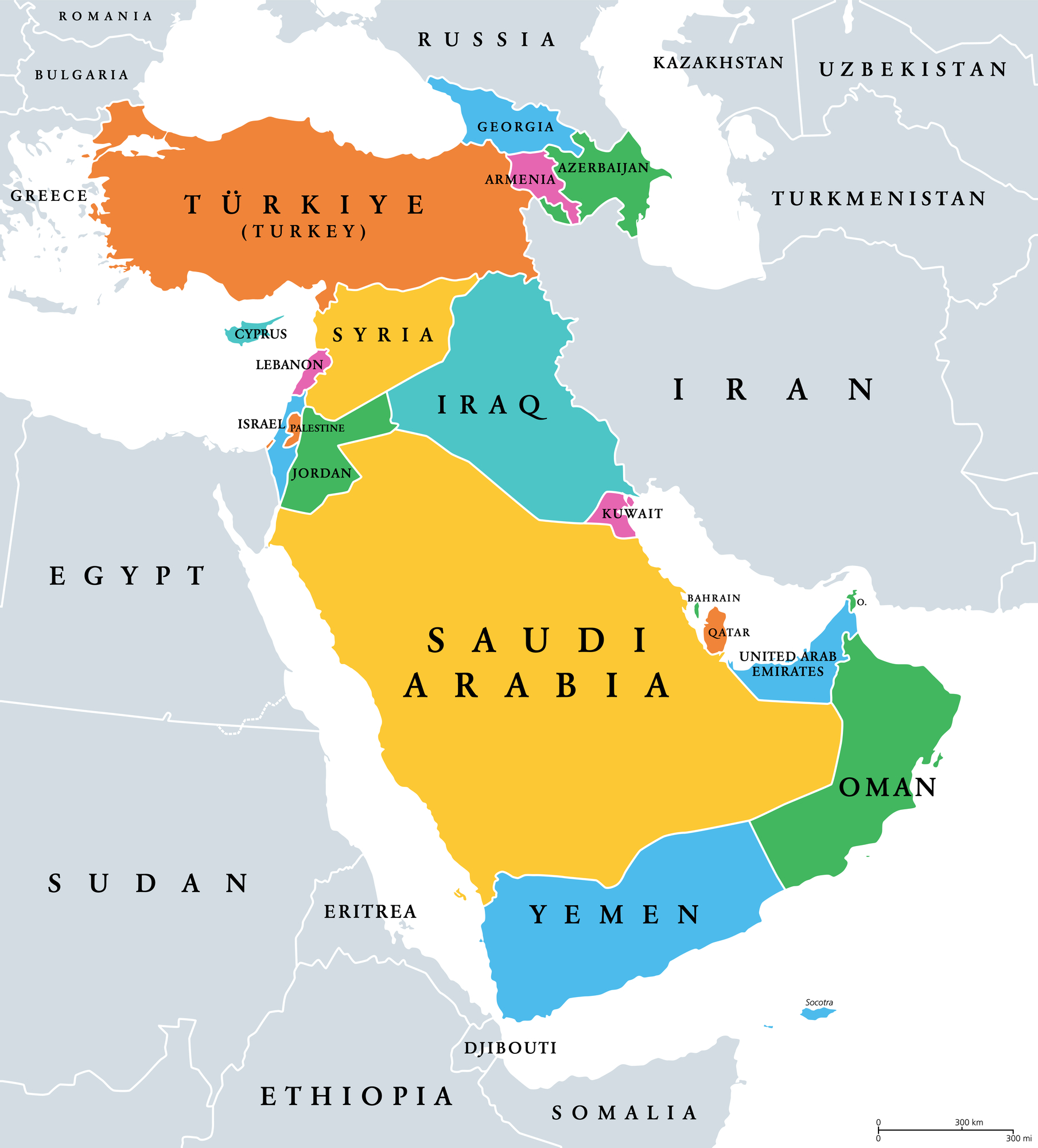
What is the Historical Background of the West Asian Crisis?
- The Colonial Legacy: Sykes-Picot and Balfour (1916–1917): The modern map of West Asia was largely drawn by European powers during World War I, following the decline of the Ottoman Empire.
- The secret Sykes-Picot Agreement (1916) between Britain and France created "artificial borders" that ignored ethnic and religious realities, while the Balfour Declaration (1917) expressed British support for a Jewish national home in Palestine.
- This "dual promise" to both Arabs and Jews laid the foundation for a century of territorial disputes, as the local Arab population felt betrayed by the division of their lands into British and French mandates.
- The Birth of Israel and the "Nakba" (1947–1948): Post-WWII, the UN Partition Plan (1947) proposed dividing the British Mandate of Palestine into separate Arab and Jewish states, a plan rejected by Arab leaders.
- The declaration of the State of Israel in 1948 triggered the first Arab-Israeli War, leading to Israel’s territorial expansion and the displacement of 700,000 Palestinians, an event known as the Nakba ("Catastrophe").
- By the end of 1949, Egypt and Jordan took control of the Gaza Strip and the West Bank, respectively.
- The 1979 Turning Point: The Islamic Revolution: Before 1979, Iran maintained relatively cordial ties with Israel however, the Islamic Revolution transformed Iran into a revisionist power and the ideological leader of the "Axis of Resistance."
- The new regime under Ayatollah Khomeini formally severed ties with Israel, labeling it the "Little Satan," and began supporting non-state actors like Hezbollah to counter Israeli and U.S. influence.
- This shift birthed the Iran-Israel Shadow War, characterized by cyber warfare, assassinations of nuclear scientists, and proxy conflicts in Lebanon and Syria that continue to dominate the current 2026 crisis.
- The Decades of War (1967–Present): The regional landscape was further reshaped by the Six-Day War (1967), where Israel occupied the Golan Heights, Sinai, Gaza, and the West Bank, cementing its military dominance.
- Subsequent conflicts, including the Yom Kippur War (1973) and the Lebanon Wars, transitioned the struggle from state-vs-state conventional warfare to asymmetric warfare involving groups like Hamas and the Houthis.
- As of March 2026, these historical grievances have reached a tipping point, with long-standing proxy tensions escalating into a direct and high-intensity conflict.
What Forces are Driving the Current West Asian Crisis?
- The Core Conflict: U.S.- Israel vs. Iran
- The current crisis was triggered by a series of coordinated, high-precision strikes launched by the United States and Israel against Iran, codenamed Operation Epic Fury by the U.S. and Operation Lion’s Roar by Israel.
- Operation True Promise IV is the official Iranian codename for its massive retaliatory military offensive against Israel and the United States.
- Leadership Decapitation: Reports indicate that the strikes targeted top-tier leadership in Tehran, including the death of Supreme Leader of Iran, Ayatollah Ali Khamenei.
- Strategic Targets: The military campaign has focused on three pillars:
- Nuclear Infrastructure: Facilities in Natanz, Fordow, and Isfahan.
- Retaliatory Capacity: Destruction of air defense systems and ballistic missile launch sites.
- Command and Control: Strikes on IRGC (Islamic Revolutionary Guard Corps) headquarters in Tehran.
- Iran’s Response: Tehran has retaliated with waves of ballistic missile and drone barrages targeting Israel and U.S. military bases in the region (e.g., Al-Udeid in Qatar).
- The current crisis was triggered by a series of coordinated, high-precision strikes launched by the United States and Israel against Iran, codenamed Operation Epic Fury by the U.S. and Operation Lion’s Roar by Israel.
- The Multi-Front Proxy War (Axis of Resistance)
- Iran’s regional allies have formally joined the fray, turning the conflict into a regional conflagration:
- Lebanon (Hezbollah): Following the strikes on Tehran, Hezbollah launched hundreds of rockets into northern Israel.
- Israel has responded with a "broad wave of strikes" in Beirut.
- Yemen (Houthis): The Iranian-backed Houthis in Yemen have decided to resume missile and drone attacks on shipping routes and on Israel in support of Iran. This poses a direct threat to the world's petroleum flow.
- Gaza (Hamas): While Hamas remains a factor, the focus has shifted toward regional escalation. Israel has indefinitely closed all Gaza border crossings as a security precaution.
- Interests of Key Players
|
Feature |
Israel/USA |
Iran/Axis of Resistance |
|
Primary Goal |
Regime change and nuclear degradation. |
Regime survival and regional attrition. |
|
Tactical Shift |
Debut of "Scorpion Strike" (autonomous drone swarms). |
Reliance on deep-hardened sites and asymmetric proxy strikes. |
What are the Implications of West Asian Conflict on India?
- Energy Security and "War Premium": India’s heavy reliance on the Persian Gulf for hydrocarbon imports makes it acutely vulnerable to the current naval blockade of the Strait of Hormuz.
- The conflict threatens to choke the transit of nearly 40–50% of India’s crude oil, leading to a massive spike in "war premiums" for insurance and freight.
- Brent crude oil prices have surged past $80 per barrel due to escalating tensions, while Liquefied natural prices on the Asia spot market surged to the highest in three years after QatarEnergy suspended production following Iranian strikes on its LNG facilities.
- A sustained spike in oil prices could widen India’s current account deficit (CAD) and place pressure on the rupee, complicating inflation management and fiscal stability.
- It may also derail India’s calibrated transition towards cleaner energy by forcing a temporary return to costlier fossil fuel imports.
- Diaspora Safety and Remittance Flows: The safety of over 9 million Indian expatriates in the Gulf remains the government’s primary humanitarian and economic concern as hostilities spread to civilian airspaces.
- Any large-scale displacement would not only necessitate a massive evacuation (on the scale of Operation Rahat) but also jeopardize 38% to India's total remittance inflow.
- A prolonged conflict could lead to job losses in construction, services, and energy sectors where Indians are heavily employed.
- This would reduce remittance flows that support millions of households in states such as Kerala, Uttar Pradesh, and Bihar.
- Strategic Connectivity (IMEC vs. Chabahar): India’s long-term "Look West" connectivity projects, aimed at bypassing traditional routes, have faced a total operational and existential paralysis.
- The India-Middle East-Europe Economic Corridor (IMEC) is currently non-viable, while the Chabahar Port faces secondary sanctions and military risks.
- India’s EAM noted at the Munich Security Conference (February 2026) that while interest remains, the "big conflict" has stalled IMEC progress as regional attention shifts to survival.
- These disruptions weaken India’s ambition to emerge as a connectivity hub linking Asia, Europe, and Africa.
- They also delay diversification of trade routes that are crucial for reducing dependence on congested maritime chokepoints.
- Agricultural and Industrial Input Shocks: The conflict has hit India’s "food and materials" security by disrupting the import of critical fertilizers and the export of high-value agricultural staples.
- Disruptions in the supply of Urea and NPK fertilizers (40% of which come from West Asia) threaten to inflate the government’s subsidy burden and cause domestic food inflation.
- At the same time, India’s export-oriented agricultural sectors are facing major logistical bottlenecks.
- India, the largest global exporter of premium aromatic basmati, depends heavily on West Asian markets, with buyers in Saudi Arabia, Iran and the United Arab Emirates accounting for more than half of total shipments.
- However due to conflict in the region, over 400,000 tonnes of Basmati rice are currently stuck at ports.
- Strategic Autonomy Issues: India faces a severe "diplomatic tightrope" as it balances its Special Strategic Partnership with Israel against its historical and energy-linked ties with Iran.
- The reported sinking of the Iranian warship IRIS Dena in the Indian Ocean by a U.S. submarine has brought the conflict into India's "backyard," testing its neutral stance.
- The February, 2026, India-Israel Joint Statement elevated ties to a "Special Strategic Partnership," yet India remains the only major power maintaining open lines with Tehran.
- This escalation tests India’s ability to maintain neutrality while safeguarding its economic and security interests.
- It also underscores the importance of India’s multi-alignment strategy in navigating an increasingly polarized geopolitical landscape.
How can India Secure its Strategic Interests in the Midst of the West Asian Conflict?
- Decentralized Strategic Petroleum Reserves: India should move beyond centralized underground caverns toward a decentralized, distributed storage network that integrates private sector inventory with national emergency stocks.
- By incentivizing oil marketing companies to maintain "floating buffers" and high-capacity coastal tanks, India can mitigate the immediate shock of a Strait of Hormuz closure.
- This "Buffer-as-a-Service" model would utilize smart-grid logistics to redirect fuel to critical industrial hubs, ensuring that a physical maritime blockade does not translate into a domestic kinetic standstill for the transport and power sectors.
- Institutionalizing a "Blue-Water Transit Corridor": The Indian Navy must transition from periodic "Operation Sankalp" patrols to a permanent, institutionalized Maritime Security Escort Architecture (MSEA) for Indian-flagged vessels.
- This involves deploying integrated carrier battle groups to establish "Sovereign Transit Bubbles" along high-risk littoral zones in the Arabian Sea and the Gulf of Aden.
- By utilizing advanced surveillance and sea-based drone swarms, India can provide real-time kinetic protection for its merchant fleet, asserting its role as a "Net Security Provider" while maintaining tactical distance from the U.S.-led offensive coalitions.
- Digital Financial Sanitization and "Rupee-Swap" Hubs: To bypass the weaponization of global financial messaging systems like SWIFT during high-intensity conflict, India should accelerate the creation of offshore Rupee-settlement hubs in neutral jurisdictions.
- Implementing a dedicated Central Bank Digital Currency (CBDC) bridge with Gulf partners would allow for "Direct-to-Sovereign" payments for energy imports, bypassing escalatory secondary sanctions.
- This "Financial Autonomy Circuit" would ensure that trade in essential commodities, like Urea and Basmati, continues uninterrupted, insulating the Indian macro-economy from the volatility of the petrodollar and Western banking freezes.
- Operationalizing the "Hormuz-Bypass" Logistics: India must urgently operationalize a contingency logistics framework that prioritizes the International North-South Transport Corridor (INSTC) as a viable alternative to the choked Persian Gulf.
- By securing "sovereign access" agreements with Central Asian states for land-based transit, India can create a permanent bypass for high-value cargo and pharmaceutical exports.
- This "Trans-Continental Pivot" would reduce the strategic "chokepoint-risk" of the Middle East, transforming India's trade route from a purely maritime dependency to a resilient, multimodal Eurasian gateway.
- Strategic Human Capital Repatriation and "Skill-Mapping: Instead of viewing the diaspora crisis as purely a humanitarian burden, India should implement a National Expatriate Integration and Skill-Mapping (NEIS) framework to harness returning talent.
- By creating a digital repository of the professional expertise of "conflict-returnees" from the Gulf, the government can facilitate their rapid absorption into domestic high-growth sectors like semiconductors and renewable energy.
- This "Reverse-Brain-Gain" strategy would convert a short-term repatriation crisis into a long-term developmental asset, ensuring the domestic economy remains resilient even if remittance inflows experience a temporary structural contraction.
- Kinetic Cyber-Shield for Undersea Assets: India must deploy a dedicated Sub-Surface Critical Infrastructure Protection (S-CIP) unit within the Defence Cyber Agency to safeguard undersea fiber-optic cables from asymmetric sabotage.
- This involves using Autonomous Underwater Vehicles (AUVs) for continuous "cable-health" monitoring and establishing "redundant data-bridges" via satellite-based internet constellations to prevent total digital decoupling.
- By treating undersea cables as "Sovereign Digital Territory," India can deter regional actors from using "grey-zone" maritime tactics to paralyze the nation’s IT services export engine during the 2026 crisis.
Conclusion:
The escalating West Asian conflict highlights the deep interlinkages between regional geopolitics and India’s economic and strategic security. For New Delhi, safeguarding energy supplies, protecting its diaspora, and maintaining strategic autonomy will be critical in navigating this volatile landscape. The crisis also underscores the urgency of diversifying energy sources, strengthening connectivity alternatives, and enhancing maritime and financial resilience. Ultimately, India’s ability to balance diplomacy with strategic preparedness will determine how effectively it protects its long-term national interests.
|
Drishti Mains Question: “Conflicts in West Asia have far-reaching implications beyond the region.” Examine the impact of the ongoing West Asian crisis on India’s strategic and economic interests |
FAQs:
1. Why is the current West Asian conflict significant for India?
The conflict threatens India’s energy security, trade routes, and the safety of over 9 million Indian expatriates in the region. It also risks disrupting remittance inflows and raising global oil prices, impacting India’s economic stability.
2. Why is the Strait of Hormuz critical for India?
Nearly 40–50% of India’s crude oil imports pass through the Strait of Hormuz, making it a vital energy chokepoint. Any disruption due to conflict can significantly impact India’s oil supply and fuel prices.
3. How does the conflict affect India’s diaspora and remittances?
The Gulf region hosts more than 9 million Indians who contribute a major share of India’s remittance inflows. Escalation of conflict could threaten their safety and disrupt remittances that support millions of Indian households.
4. What strategic projects of India are affected by the crisis?
Regional instability threatens major connectivity initiatives such as the India-Middle East-Europe Economic Corridor and India’s investment in Chabahar Port, which are central to India’s trade and connectivity strategy.
5. What steps can India take to safeguard its interests during the crisis?
India can diversify energy sources, strengthen strategic petroleum reserves, enhance maritime security for trade routes, and maintain diplomatic engagement with all regional actors to protect its strategic autonomy.
UPSC Civil Services Examination, Previous Year Question (PYQ)
Prelims
Q. Which one of the following countries of South-West Asia does not open out to the Mediterranean Sea? (2015)
(a) Syria
(b) Jordan
(c) Lebanon
(d) Israel
Ans: B
Q. The term “two-state solution” is sometimes mentioned in the news in the context of the affairs of (2018)
(a) China
(b) Israel
(c) Iraq
(d) Yemen
Ans: B
Mains
Q. “India’s relations with Israel have, of late, acquired a depth and diversity, which cannot be rolled back.” Discuss. (2018)