
Year End Review-2025: Ministry of Panchayati Raj
For Prelims: SVAMITVA Scheme, World Bank Land Conference, Gram Manchitra, SabhaSaar, BHASHINI, eGramSwaraj, Sashakt Panchayat Netri Abhiyan, Eklavya Model Residential Schools (EMRS), Panchayats Extension to Scheduled Areas Act (PESA), 1996, Digital India, 73rd Amendment Act, 1973, Gram Sabha, Rashtriya Gram Swaraj Abhiyan (RGSA), Eleventh Schedule, State Election Commissions (SECs).
For Mains: Key achievements of the Ministry of Panchayati Raj in 2025, Challenges associated with Panchayati Raj Institutions and way forward.
Why in News?
In 2025, the Ministry of Panchayati Raj (MoPR) significantly strengthened grassroots governance by leveraging digital tools, capacity building, women and tribal empowerment, and institutional reforms.
Summary
- SVAMITVA and digital governance tools improved land management, transparency, and financial oversight.
- Women, youth, and tribal empowerment enhanced inclusive participatory governance.
- Challenges persist in functional devolution, fiscal autonomy, Gram Sabha participation, and administrative capacity, requiring structural reforms
What are the Key Achievements of the Ministry of Panchayati Raj in 2025?
- Progress in Land Governance: Under the SVAMITVA Scheme, 2.75+ crore property cards were generated. Drone surveys completed in 3.28 lakh villages; full saturation achieved in multiple States/UTs.
- Earned international recognition at the World Bank Land Conference 2025.
- Digital & Geospatial Governance Innovations: Implementation of Enhanced Gram Panchayat Spatial Development Plans (GPSDP) in 36 Gram Panchayats (GPs) across 14 States.
- Promotion of One Nation One Map and digital planning tools like Gram Manchitra and SVAMITVA GIS platforms.
- AI and e-Governance for Transparency: Launch of SabhaSaar (AI-powered Gram Sabha meeting summarizer) supporting 13 regional languages via BHASHINI.
- eGramSwaraj platform strengthened financial governance with Rs 34,573 crore online payments.
- Institutional Strengthening: Construction sanctioned for 1,638 Gram Panchayat Bhawans, ensuring offices for all GPs with population above 3,000.
- Leadership and Management Development Programs conducted at IIMs, IITs, and IRMA, strengthening administrative capacity.
- Women-Led Development: Launch of Sashakt Panchayat Netri Abhiyan (44,421 Women Elected Representatives trained) and Model Women-Friendly Gram Panchayat initiative.
- Financial Self-Reliance of Panchayats: Promotion of the Saksham Panchayat initiative for Own Source Revenue (OSR) generation. Over 1.10 lakh elected representatives and officials trained using an IIM Ahmedabad-designed OSR module, advancing financial Atmanirbharta.
- Youth Engagement: Launch of Model Youth Gram Sabha (MYGS) involving Jawahar Navodaya Vidyalayas (JNVs) and Eklavya Model Residential Schools (EMRS) students, nurturing future democratic leadership.
- Empowerment of Tribal Communities: 16,000+ dedicated staff deployed for Panchayats Extension to Scheduled Areas Act (PESA), 1996 implementation across 10 PESA States.
- Launch of cultural campaigns like Hamari Parampara, Hamari Virasat and organization of PESA Mahotsav 2025.
- International Recognition: Meri Panchayat m-Governance platform won the WSIS Champion Award 2025, reinforcing India’s leadership in Digital India and good governance.
| Click Here to Read: What is a Panchayati Raj Institution? |
What are the Primary Challenges Confronting Panchayati Raj Institutions (PRIs) in India?
- Devolution Deficit: Despite the 73rd Amendment Act, 1973, mandating devolution of 29 subjects, functional devolution has declined from 35.34% to 29.18%. Critical functions like rural electrification and vocational training remain under state control, curtailing PRIs' authority and local accountability.
- Fiscal Dependence and Resource Starvation: PRIs exhibit extreme fiscal dependence, generating only about 1% of revenue from local taxes. In FY 2022–23, own tax revenue was a mere Rs 737 crore of a Rs 35,354 crore total revenue. Average own-tax per panchayat is just Rs 21,000, compared to ~Rs 20 lakh in combined grants.
- Patriarchal Norms and Apathetic Participation: The Sarpanch Pati phenomenon subverts women's leadership, particularly in states like Uttar Pradesh and Bihar. Gram Sabha efficacy is crippled by low turnout (average 13%) and a stark gender gap (men 21% vs. women 7%).
- Administrative Encroachment: Bureaucratic overreach through Panchayat secretaries and parallel bodies like District Rural Development Agencies (DRDAs) undermines elected representatives' decision-making.
- Infrastructure Deficits: Many PRIs face poor infrastructure (limited offices and internet) and a shortage of trained staff, creating bottlenecks in budgeting, planning, and implementation. Although Rashtriya Gram Swaraj Abhiyan (RGSA) addresses capacity building, its coverage remains uneven.
What Measures are Needed to Strengthen Panchayati Raj Institutions (PRIs) in India?
- Implement Constitutional Mandate on Devolution: States must fully devolve Functions, Finances, and Functionaries (3Fs) for all 29 Eleventh Schedule subjects, as mandated by the 73rd Amendment Act, 1973 and reinforced by the 2nd Administrative Reforms Commission (ARC’s) call for clear activity mapping to prevent overlap.
- Catalyze Fiscal Empowerment: PRIs must significantly boost their Own Source Revenues (OSR) through enhanced local taxation and fees, while adopting technology like the Samarth Panchayat portal for efficient revenue management.
- Innovative financing mechanisms, such as the Social Stock Exchange, are essential to reduce bureaucratic dependency.
- Build Institutional Capacity and Accountability Mechanisms: To bridge administrative gaps, training under the Rashtriya Gram Swaraj Abhiyan (RGSA) must be scaled up and full-time, trained Panchayat secretaries appointed.
- Accountability should be institutionalized through mandatory social audits (like Meghalaya's 2017 Act), performance-based incentives, independent State Election Commissions (SECs), and robust grievance systems.
- Harness Technology and Ensure Social Inclusion: Digital governance must be integrated through platforms like eGramSwaraj, SVAMITVA, and Gram Manchitra for transparent planning and property mapping.
- To ensure genuine women's leadership, legal sanctions and sensitization are needed to combat the Sarpanch Pati phenomenon, while actively integrating Women's Self-Help Groups (SHGs) into Panchayat processes.
- Citizen-Centric Governance: Gram Sabhas must be revitalized through mandatory regular meetings and digital tools like SabhaSaar, while expanding model initiatives like Youth Gram Sabhas to enhance engagement.
Conclusion
In 2025, the Ministry of Panchayati Raj significantly strengthened grassroots governance through digital tools, capacity building, and institutional reforms. Key achievements include SVAMITVA property mapping, AI-powered SabhaSaar, women and youth empowerment, and tribal development via PESA, while challenges persist in devolution, fiscal autonomy, and administrative capacity, requiring systemic reforms.
|
Drishti Mains Question: Q. Examine the challenges faced by Panchayati Raj Institutions in India despite constitutional provisions for devolution |
Frequently Asked Questions (FAQs)
1. What is the SVAMITVA Scheme?
SVAMITVA provides property cards to rural households, enabling legal ownership, land governance, and planning, with 2.75+ crore cards distributed in 2025.
2. How does SabhaSaar enhance Panchayat transparency?
SabhaSaar is an AI-powered tool that digitally records Gram Sabha proceedings in 13 languages, improving documentation, accountability, and citizen participation.
3. Why is fiscal autonomy a critical issue for PRIs?
PRIs generate only about 1% of their revenue from local taxes, creating extreme dependence on central and state grants, which weakens their autonomy and planning capacity.
UPSC Civil Services Examination, Previous Year Questions (PYQs)
Prelims
Q1. Local self-government can be best explained as an exercise in (2017)
(a) Federalism
(b) Democratic decentralisation
(c) Administrative delegation
(d) Direct democracy
Ans: (b)
Q. The fundamental object of Panchayati Raj system is to ensure which among the following? (2015)
- People’s participation in development
- Political accountability
- Democratic decentralisation
- Financial mobilisation
Select the correct answer using the code given below
(a) 1, 2 and 3 only
(b) 2 and 4 only
(c) 1 and 3 only
(d) 1, 2, 3 and 4
Ans: (c)
Mains
Q. In absence of a well-educated and organised local level government system,`Panchayats’ and ‘Samitis’ have remained mainly political institutions and not effective instruments of governance. Critically discuss. (2015)
Q. Assess the importance of the Panchayat system in India as a part of local government. Apart from government grants, what sources can the Panchayats look out for financing developmental projects? (2018)
Q. To what extent, in your opinion, has the decentralisation of power in India changed the governance landscape at the grassroots? (2022)
Viksit Bharat Shiksha Adhishthan Bill 2025
For Prelims: Lok Sabha, National Education Policy (NEP) 2020, Council of Architecture (CoA), University Grants Commission (UGC, 1956), Gross Enrolment Ratio (GER), G20, World Economic Forum, Global Gender Gap Index, Global Innovation Index, India Skills Report, National Research Foundation (NRF), GIFT City, Atal Innovation Mission, Startup India.
For Mains: Key provisions of the Viksit Bharat Shiksha Adhishthan Bill, 2025 and its significance, Challenges facing India's higher education system and remedial measures needed.
Why in News?
The Viksit Bharat Shiksha Adhishthan (VBSA) Bill, 2025 was introduced in the Lok Sabha in the Winter Session of Parliament and referred to a joint parliamentary committee.
- The Bill aims to revamp India's higher education regulation to implement the National Education Policy (NEP) 2020.
Summary
- The Bill unifies fragmented regulatory bodies into a single, technology-driven framework with three independent councils for standards, regulation, and accreditation to implement NEP 2020 reforms.
- It aims to enhance GER, research, employability, and global competitiveness while promoting interdisciplinary, flexible, and student-centric higher education.
What is the Viksit Bharat Shiksha Adhishthan Bill, 2025?
- About: It is a proposed new law to create a unified regulatory architecture for higher education in India, framed under Entry 66 (determination of standards for higher education) of the Union List of the Constitution.
- Its core purpose is to empower Higher Educational Institutions (HEIs) to achieve excellence through effective coordination and the determination of standards.
- Need of the Bill: To overhaul the higher education regulatory framework in line with NEP 2020 by eliminating overlapping authorities, simplifying regulation, and reducing compliance burdens so institutions can focus on academic excellence.
- Proposed Major Changes:
- Establishes a New Apex Body: The Viksit Bharat Shiksha Adhishthan will be set up as the overarching authority. The Council of Architecture (CoA) will function as a Professional Standard Setting Body (PSSB), as envisaged in NEP 2020.
- Creates Three Specialized Councils:
- Viksit Bharat Shiksha Viniyaman Parishad: The Regulatory Council for coordination and maintenance of standards.
- Viksit Bharat Shiksha Gunvatta Parishad: The independent Accreditation Council.
- Viksit Bharat Shiksha Manak Parishad: The Standards Council for specifying minimum academic standards.
- Replaces Existing Bodies: The Bill provides for repealing the acts governing the University Grants Commission (UGC, 1956), the All India Council for Technical Education (AICTE, 1987), and the National Council for Teacher Education (NCTE, 1993).
- All HEIs currently under these bodies will come under the Viksit Bharat Shiksha Adhishthan for standard-setting.
What is the Significance of the Viksit Bharat Shiksha Adhishthan Bill, 2025?
- Regulatory Consolidation and Simplification: By repealing the UGC (1956), AICTE (1987), and NCTE (1993) Acts, the Bill ends fragmented, contradictory regulation, replacing it with a single, unified regulatory architecture. This will drastically reduce compliance complexity, shifting the focus to academic excellence and implementing Single Window Interactive Systems for ease of operation.
- Operational Clarity: The Bill separates standard-setting, regulation, and accreditation into three independent councils under one apex body. This structural division enhances objectivity, reduces conflicts of interest, and improves the credibility and effectiveness of quality governance.
- Transparency and Trust-Based Governance: A public digital disclosure portal forms the cornerstone of the new framework, enabling stakeholders to make informed decisions based on accessible data. This move toward public self-disclosure strengthens accountability and promotes peer competition on quality metrics, creating strong incentives for continuous improvement.
- Alignment with NEP 2020 & Viksit Bharat: The Bill is the primary legislative vehicle to implement the NEP 2020 higher education vision by embodying its principles of autonomy, multidisciplinarity, and Indian knowledge systems. It contributes to the Viksit Bharat 2047 vision by aiming to create a high-quality knowledge economy through boosting research, innovation, and the Gross Enrolment Ratio (GER).
- Enhancing Global Competitiveness: The Bill mandates adapting global best practices to create globally benchmarked institutions and a credible accreditation system, aiming to elevate India’s global education standing. It seeks to reverse brain drain by offering world-class domestic opportunities and attracting international talent, thereby boosting India’s soft power.
What are the Primary Challenges Facing India's Higher Education System?
- Low Gross Enrolment Ratio (GER): India has the world’s 3rd-largest higher education system, yet its GER of approximately 28% is the lowest among G20 nations. Furthermore, it ranks 129th out of 146 countries for tertiary education enrollment in the World Economic Forum’s Global Gender Gap Index 2024.
- Faculty Shortage and Vacancy Crisis: Even prestigious institutions face major faculty shortages, with IITs having 40% and IIMs 31% vacancies. Furthermore, only 36.7% of Indian HEIs offer postgraduate programs and a mere 3.6% run PhD programs, severely limiting the pipeline of qualified teachers.
- While IIT Delhi and IIT Bombay secured places within the top 150, no Indian university featured in the top 100 of the QS Rankings 2024.
- Inadequate R&D Investment: India’s research spending is approximately 0.7% of GDP, trailing nations like China (2.4%) and the US (3.5%). It also lags in research quality, as measured by H-index scores (for productivity and impact) and citation counts, and ranks 38th in the Global Innovation Index 2025.
- Poor Graduate Employability and Industry Disconnect: India’s overall employability was 50.8% in 2023, while the India Skills Report 2024 shows a 60–73% demand-supply gap for key roles like ML engineer, data scientist, DevOps engineer, and data architect. In the Global Employability University Ranking and Survey 2025, only 10 Indian institutions rank among the top 250 universities globally for graduate employability.
- Outdated and Inflexible Curriculum: India’s higher education curriculum is outdated, rigid, and disconnected from 21st-century interdisciplinary skills. Most universities lack syllabi for fields like AI and data science, and less than 5% of students are exposed to vocational education—a stark contrast to the NEP 2020’s 50% target by 2025.
How can India’s Higher Education System be Revitalized?
- Enhancing Access and GER: India should scale the Multiple Entry and Exit (MEME) framework, now in 153 universities for entry and 74 for exit, to enhance student flexibility and reduce dropout rates. It must also implement the Academic Bank of Credits and UGC’s Biannual Admissions to boost academic mobility.
- Faculty Development and Research Ecosystem: To address faculty shortages and boost quality, India should launch a National Mission for Faculty Development, aligned with global benchmarks like the Academic Performance Indicator (API).
- Simultaneously, it must increase R&D investment from ~0.7% to at least 2% of GDP, with strategic focus on National Research Foundation (NRF)-led projects in areas such as AI, clean energy, and biotechnology.
- Equity, Access, and Inclusion: Equity should be advanced through digital access and literacy, supported by the NEP 2020’s Gender Inclusion Fund, Special Education Zones, and a strengthened National Scholarship Portal for SC, ST, OBC, and SEDG (Socio-Economically Disadvantaged Group) students.
- Internationalization and Global Competitiveness: Facilitate entry of World-Class Foreign Universities under the GIFT City model and through MOUs under NEP 2020. Promote joint degrees, faculty exchanges, and cross-border research initiatives via programs like SPARC (Scheme for Promotion of Academic and Research Collaboration).
- Skill Integration and Employability: To enhance employability, curricula must be aligned with Industry 4.0 skills, while innovation clusters and start-up cells are established in every university, linked to the Atal Innovation Mission and Startup India. Furthermore, a National Graduate Tracking System should be created to monitor employment outcomes and inform timely curriculum updates.
Conclusion
The Viksit Bharat Shiksha Adhishthan Bill, 2025, is a transformative step to replace fragmented regulation with a unified, transparent system. It aims to actualize NEP 2020’s vision, boost research and employability, and enhance global competitiveness, thereby revitalizing India’s higher education to meet 21st-century demands.
|
Drishti Mains Question: Q. Critically analyse the structural and systemic challenges confronting Indian higher education and propose holistic strategies for its revitalisation |
Frequently Asked Questions (FAQs)
1. What is the purpose of the Viksit Bharat Shiksha Adhishthan Bill, 2025?
To unify higher education regulation, empower HEIs, and implement NEP 2020 reforms for quality, autonomy, and global competitiveness.
2. Which existing regulatory bodies will the Bharat Shiksha Adhishthan Bill, 2025 replace?
It repealed UGC (1956), AICTE (1987), and NCTE (1993), consolidating their functions under the Viksit Bharat Shiksha Adhishthan.
3. What are the three proposed councils under the Viksit Bharat Shiksha Adhishthan Bill, 2025?
Viniyaman Parishad (Regulation), Gunvatta Parishad (Accreditation), and Manak Parishad (Standards).
UPSC Civil Services Examination, Previous Year Question (PYQ)
Prelims
Q. Which of the following provisions of the Constitution does India have a bearing on Education? (2012)
- Directive Principles of State Policy
- Rural and Urban Local Bodies
- Fifth Schedule
- Sixth Schedule
- Seventh Schedule
Select the correct answer using the codes given below:
(a) 1 and 2 only
(b) 3, 4 and 5 only
(c) 1, 2 and 5 only
(d) 1, 2, 3, 4 and 5
Ans- (d)
Mains
Q1. How have digital initiatives in India contributed to the functioning of the education system in the country? Elaborate on your answer. (2020)
Q2. Discuss the main objectives of Population Education and point out the measures to achieve them in India in detail. (2021)
Srimanta Sankardeva
Why in News?
The Union Home Minister inaugurated the redeveloped Batadrava Than, the birthplace of Vaishnavite saint Srimanta Sankardeva, in Assam's Nagaon district.

Who was Srimanta Sankardeva?
- About: He was a 15th–16th century Bhakti saint who holds a high position in Assam's history, society, culture, and religious beliefs. His diverse contributions led to a new phase of Assamese literature and culture, making him an important figure in the Indian Bhakti movement.
- Early Life and Background: Born in October 1449 to a family of Siromani Bhuyans (landed gentry), he undertook a transformative pilgrimage across North India in 1481 and composed his first Borgeet (devotional songs) at Badarikashrama (Badrinath).
- He faced opposition from kings and orthodox sections, shifted locations frequently, and passed away in 1568.
- Philosophical & Religious Contributions: Founder and propagator of the Neo-Vaishnava Bhakti movement in 15th-century Assam.
- He established eka-sarana-nama-dharma (also called Mahapurushiya dharma), whose cardinal principle was the worship of the single deity Vishnu (as Krishna), with its essence being the act of seeking refuge (sarana) in one God.
- Emphasized only two of the nine forms of Bhakti i.e., Sravana (hearing God's name) and Kirtana (chanting God's name).
- Preached universal brotherhood and sought to unite Assam's heterogeneous society (multiple tribes, languages, communities) under the Neo-Vaishnava fold.
- Institutional Contributions: He established Namghars (community prayer halls) and Satras (Vaishnava monasteries) which became centers for congregational worship, social equality, moral discipline, and the arts.
- Namghars, in particular, allowed the participation of all castes and communities, promoting social inclusivity.
- Literary Contributions: He translated eight of the twelve books of the Bhagavata Purana into Brajavali (common linguistic style in Assam) to make sacred Vaishnava texts accessible, with the Adi Dasama, covering Krishna's childhood, being the most popular.
- Major works include:
|
Work |
Description |
|
Kirtana-ghosha |
Considered his greatest achievement. A compendium of devotional songs for congregational prayer; one of the four sacred texts revered in Assam and sung daily in Namghars. |
|
Gunamala |
Condensed the essence of the Bhagavata Purana into six kirtans, composed in a single night. |
|
Nimi Nava Siddhi Samvada |
Doctrinal treatise. |
|
Bhakti Pradipa |
Denounces worship of deities other than Krishna. |
|
Bhatimas |
A poetic form he innovated for praising a guru or God. |
|
HariScandra-upakhyana, Rukmini Harana Kavya |
Early works |
- Contributions to Art & Culture:
- Ankiya Naats: One-act plays (devoid of any divisions) blending religious philosophy, indigenous entertainment, and classical Sanskrit drama techniques. Composed in Brajavali.
- Bhaona: The traditional theatrical performance of Ankiya Naats, staged in Namghars.
- Sattriya Dance: A classical dance form with prescribed rules of rhythm, presentation, and singing, performed as part of Bhaona.
- Borgeets: Devotional songs based on ragas and talas, accompanied by musical instruments. He composed an estimated 240 Borgeets, forming a living legacy.
- Legacy: The institutions (Satras, Namghars) and cultural forms (Sattriya, Bhaona, Borgeets, Kirtana-ghosha) he established remain vital, living elements of Assamese identity, promoting literature, music, theatre, dance, and crafts to this day.
|
Aspect |
Shaivism |
Vaishnavism |
Neo-Vaishnavism (Ekasarana Dharma) |
|
Primary Deity |
Shiva (as supreme Brahman, destroyer and transformer) |
Vishnu (or avatars like Krishna/Rama, as preserver) |
Krishna (sole refuge, identified with Narayana) |
|
Geographical Prevalence |
Predominant in South India, Kashmir, Nepal, and parts of North India |
Widespread across India, especially North and East |
Primarily in Assam and parts of Northeast India |
|
Key Practices |
Yoga, meditation, asceticism, tantra; lingam worship |
Bhakti devotion, temple worship, avatars’ narratives |
Congregational naam-kirtan (singing/chanting), sravan (listening); no idol worship |
|
Philosophical Emphasis |
Often non-dualistic (Advaita) or tantric; focus on jnana (knowledge) and self-realization |
Qualified non-dualism or dualism; strong emphasis on bhakti and prapatti (surrender) |
Exclusive shelter in one God (ekasarana); devotion in dasya bhava (servitude); egalitarian |
|
Associated Figures / Texts |
Adi Shankara, various Agama texts |
Ramanuja, Chaitanya, Madhva; Puranas like Bhagavata |
Srimanta Sankardeva, Madhavdeva; texts like Kirtan Ghosa |
|
Cultural Contributions |
Temple architecture, Shaiva Siddhanta philosophy |
Bhakti poetry, festivals like Janmashtami |
Sattras (monasteries), Namghars, Borgeet songs, Ankia Naat plays, Sattriya dance |
Frequently Asked Questions (FAQs)
1. Who was Srimanta Sankardeva?
A 15th–16th century Assamese Bhakti saint, social reformer, and cultural polymath, founder of Neo-Vaishnavism.
2. What are Namghars and Satras?
Community prayer halls (Namghars) and Vaishnava monasteries (Satras) established by Sankardeva to promote worship, social equality, and arts.
3. What are Sankardeva’s major literary contributions?
Works include Kirtana-ghosha, Gunamala, Bhatimas, HariScandra-upakhyana, and Rukmini Harana Kavya, mainly in Brajavali, promoting devotional literature
UPSC Civil Services Examination, Previous Year Questions (PYQs)
Q. With reference to the famous Sattriya dance, consider the following statements: (2014)
- Sattriya is a combination of music, dance and drama.
- It is a centuries-old living tradition of Vaishnavites of Assam.
- It is based on classical Ragas and Talas of devotional songs composed by Tulsidas, Kabir and Mirabai.
Which of the statements given above is/are correct?
(a) 1 only
(b) 1 and 2 only
(c) 2 and 3 only
(d) 1, 2 and 3
Ans: (b)
Q. With reference to the religious history of medieval India, the Sufi mystics were known to pursue which of the following practices? (2012)
- Meditation and control of breath.
- Severe ascetic exercises in a lonely place.
- Recitation of holy songs to arouse a state of ecstasy in their audience
Select the correct answer using the codes given below:
(a) 1 and 2 only
(b) 2 and 3 only
(c) 3 only
(d) 1, 2 and 3
Ans: (d)
Pinaka Long Range Guided Rocket
India successfully conducted the maiden flight test of the indigenously Pinaka Long Range Guided Rocket (LRGR 120), with a strike range of approximately 120 kilometers, enhancing the precision-strike capability of the Indian Army’s artillery.
- Its key features include being a guided rocket with inertial navigation, mid-course updates, and terminal guidance for high accuracy, while its launch from the existing Pinaka launcher ensures a cost-effective upgrade path.
Guided Pinaka Missile System
- About: The Pinaka Missile System, named after the bow of Lord Shiva, is a high-precision, multi-barrel rocket launcher developed indigenously by the Defence Research and Development Organisation’s (DRDO) Armament Research and Development Establishment (ARDE).
- Key Features: Known for high mobility and quick deployment capabilities. Capable of delivering intense and concentrated fire on enemy targets with high accuracy.
- Variants:
- Pinaka Mark I: Initial version with a range of 40 km.
- Pinaka Mark II: Upgraded version with extended range of 70–80 km, expandable up to 120 km and eventually 300 km.
- Launch Capability: Successfully tested from upgraded launchers, able to fire 12 rockets in a single salvo.

| Read More: Guided Pinaka Weapon System |
UN Office for the Coordination of Humanitarian Affairs
The United States announced a $2 billion pledge for UN humanitarian aid, even as the US administration cuts overall foreign assistance and pressures UN agencies to reform.
- The pledge is significantly lower than past US contributions (which reached up to $17 billion annually), but is described by the administration as sufficient to maintain the US position as the largest humanitarian donor.
- It will flow through an umbrella fund managed by the UN Office for the Coordination of Humanitarian Affairs (OCHA).
- The new funding model aims to share the humanitarian burden with other developed countries and enforce stronger accountability and oversight.
- The new funding approach will initially target 17 crisis-hit countries, including Bangladesh, Haiti, Syria, Ukraine, and the Democratic Republic of the Congo, while excluding Afghanistan and Yemen due to concerns over aid diversion.
United Nations Office for the Coordination of Humanitarian Affairs
- Establishment: The UN Office for the Coordination of Humanitarian Affairs (OCHA) was established in 1991 by the United Nations General Assembly.
- Mandate: OCHA brings together humanitarian actors to ensure a coherent and coordinated response to emergencies, providing a common framework for collective action.
- Transition: OCHA replaced the Office of the United Nations Disaster Relief Coordinator (UNDRO) to strengthen global humanitarian coordination.
- Coordination: Through the On-Site Operations Coordination Centres (OSOCC), OCHA facilitates immediate coordination of international response during sudden-onset or rapidly evolving emergencies.
- Funding: OCHA manages two pooled funding mechanisms: the Central Emergency Response Fund (CERF) for emergencies worldwide, and Country-Based Pooled Funds (CBPFs) tailored to specific countries.
| Read More: United Nations |
Australia to Eliminate Tariffs on 100% of Indian Exports
Under the India-Australia Economic Cooperation and Trade Agreement (Ind-Aus ECTA) Australia will provide duty-free access to 100% of Indian exports from 1 January 2026, marking a major milestone in bilateral trade relations.
- The ECTA, operational since December 2022, was an early-harvest deal, while negotiations for a broader India-Australia Comprehensive Economic Cooperation Agreement (CECA) are currently underway.
- Impact: Over three years, ECTA has delivered sustained export growth, wider market access, and stronger supply-chain resilience, benefiting exporters, MSMEs, farmers, and workers.
- Growth: India’s exports to Australia rose by 8% in 2024–25, improving the trade balance, with strong gains across manufacturing, chemicals, textiles, plastics, pharmaceuticals, petroleum products, and gems & jewellery.
- Boost to Agriculture: Agri-exports witnessed broad-based expansion with sharp rise in fruits & vegetables, marine products, spices, and exceptional growth in coffee exports.
- Support to Labour-Intensive Sectors: Full tariff removal is expected to unlock opportunities for MSMEs, farmers, and labour-intensive industries, enhancing employment and income generation.
- Significance: ECTA has strengthened supply-chain resilience, market diversification, and India’s Indo-Pacific economic integration.
| Read more: Ind-Aus Economic Cooperation and Trade Agreement |
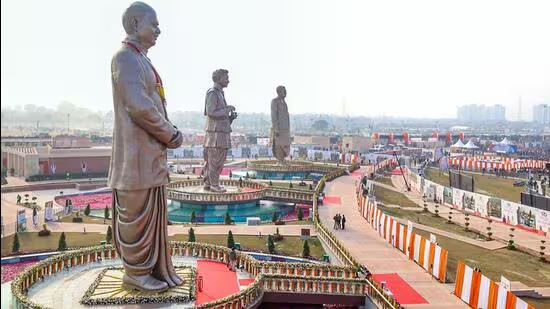
Rashtra Prerna Sthal
The Prime Minister (PM) inaugurated the Rashtra Prerna Sthal in Lucknow on the 101st birth anniversary of former PM Atal Bihari Vajpayee, dedicating it to the ideals of unity, self-respect, and service.
- Multi-Leader Tribute: The site honors Atal Bihari Vajpayee, Pandit Deendayal Upadhyay, and Dr. Syama Prasad Mookerjee with 65-feet bronze statues and a lotus-shaped museum.
- Atal Bihari Vajpayee: He served as India’s PM 3 times—in 1996, 1998–1999, and 1999–2004—and was awarded the Padma Vibhushan (1994) and the Bharat Ratna (2015). His birth anniversary (25th December) is observed as Good Governance Day.
- Pandit Deendayal Upadhyay: He was an Indian politician and ideologue of RSS and Bharatiya Jana Sangh, focused on Antyodaya—uplifting the most disadvantaged. His philosophy of Integral Humanism emphasized social justice and self-reliance, and his birth anniversary (25th September) is observed as Antyodaya Diwas.
- Dr Syama Prasad Mookerjee: He was an Indian politician, the youngest Vice-Chancellor of Calcutta University (1934), and founder of the Bharatiya Jan Sangh (1951), which later evolved into the Bharatiya Janata Party. He famously opposed Article 370, arguing one nation cannot have two constitutions, two heads, or two flags, and was known for his sharp parliamentary debates, earning the title The Lion of Parliament.
| Read More: Good Governance Day |