
Deepening India-Brazil Cooperation
For Prelims: BRICS, G20, Global Biofuel Alliance (GBA), International Solar Alliance (ISA), Digital Public Infrastructures (DPIs), Anti-dumping/Countervailing Duty, Rare Earth Elements, Critical Minerals, Tropical Forests Forever Facility (TFFF), National Biofuel Policy, Nuclear Suppliers Group (NSG), Amazon, Coalition for Disaster Resilience Infrastructure.
For Mains: Key outcomes of the President of Brazil visit to India, Key highlights of India-Brazil relations, obstacles in India-Brazil relations and way forward.
Why in News?
The President of Brazil paid a State Visit to India resulting in significant agreements across digital partnership, defense, energy transition, and global governance reform.
- The Indian Prime Minister invited the Brazilian President to the 18th BRICS Summit to be held in India in 2026, guided by the theme "Building for Resilience, Innovation, Cooperation and Sustainability".
Summary
- India-Brazil Strategic Partnership (2006) strengthened during Brazilian President February 2026 visit, with agreements on Digital Partnership, critical minerals, and defence cooperation.
- Bilateral trade reached USD 15.21 billion (2025) with a USD 30 billion target by 2030.
- Both nations cooperate in BRICS, G20, Global Biofuel Alliance (GBA), and International Solar Alliance (ISA) while navigating challenges like NSG divergence and geographical distance.
What are the Key Outcomes of the Brazilian President’s State Visit to India?
- Reaffirmation of the India–Brazil Strategic Partnership: Both countries reaffirmed the Brazil-India Strategic Partnership (2006) and reiterated commitment to the five priority pillars from the Brasilia Joint Statement 2025:
- Defense and security,
- Food and nutritional security,
- Energy transition and climate change,
- Digital transformation and emerging technologies and
- Industrial partnerships in strategic areas.
- Digital & AI Partnership:
- Digital Partnership for the Future: In the context of the India-Brazil Digital Partnership for the Future, both leaders welcomed the launch of the Open Planetary Intelligence Network (OPIN).
- They agreed to leverage Digital Public Infrastructures (DPIs) to boost sustainable development and climate action in developing nations.
- AI Cooperation: Both underlined the importance of multilateral AI initiatives including UNGA Resolutions, Digital Global Compact, UNESCO Recommendation on AI Ethics, and BRICS Leaders' Declaration on Global Governance of Artificial Intelligence.
- Digital Partnership for the Future: In the context of the India-Brazil Digital Partnership for the Future, both leaders welcomed the launch of the Open Planetary Intelligence Network (OPIN).
- Trade, Investment & Economic Cooperation: Bilateral trade surged by 25.5% in 2025, with a new target set at USD 30 billion by 2030, alongside a commitment to address non-tariff barriers and resolve anti-dumping concerns.
- To strengthen the India–MERCOSUR Preferential Trade Agreement (PTA), both sides agreed to expand its scope and signed an MoU on the Mutual Recognition of Electronic Certificates of Origin.
- Critical Minerals Cooperation: Leaders welcomed the signing of the MoU on cooperation in rare earth elements and critical minerals and the MoU in the Field of Mining for the Steel Supply Chain.
- Cyber Cooperation: They welcomed the first India-Brazil Cyber Dialogue in Brasilia (November 2025) to discuss cyber governance, data protection, and fight against cybercrime.
- Climate Change and Energy Transition: India’s PM commended Brazil for hosting COP30 in Belem (November 2025) and for launching the Tropical Forests Forever Facility (TFFF).
- Leaders reiterated commitment to the "Belém 4x Pledge on Sustainable Fuels" to expand sustainable fuels use fourfold by 2035.
- Science, Technology & Intellectual Property: Both agreed to hold the 3rd Joint Commission on Scientific & Technological Cooperation in India (August 2026) and enhanced Intellectual Property (IP) cooperation through Brazil's access to India's Traditional Knowledge Digital Library and closer ties between DPIIT and Brazil's Ministry of Development.
What are the Key Pillars of India-Brazil Cooperation?
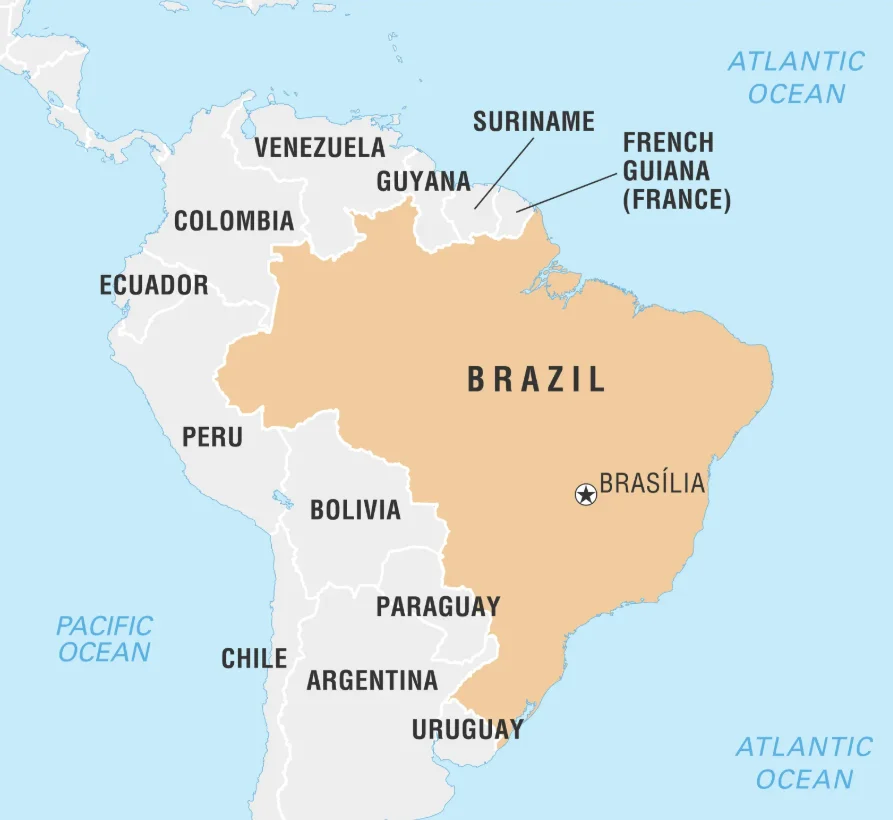
Diplomatic relations between India and Brazil were established in 1948. India opened the Embassy in Rio de Janeiro, the erstwhile capital, later moving to Brasilia in 1971. India has a Consulate General in São Paulo while Brazil has one in Mumbai.
- Trade and Investment: Brazil is India's largest trading partner in the Latin America and Caribbean region.
- Bilateral trade in 2025 grew by over 25% reaching USD 15.21 billion (Indian exports - USD 8.35 billion, imports from Brazil - USD 6.85 billion).
- Major Indian exports include processed petroleum products, agro-chemicals, pharmaceuticals, engineering products. Brazilian exports include crude oil, soybean oil, gold, raw sugar, cotton, iron ore.
- Total Indian investment in Brazil is estimated at more than USD 15 billion.
- Defence Cooperation: A defence cooperation agreement (2003) was ratified in 2006, creating the Joint Defence Committee (JDC).
- The 2+2 Political-Military dialogue was inaugurated in New Delhi (March 2024).
- A trilateral MoU was recently signed involving Mazagon Dock Ltd and the navies of India and Brazil for the maintenance of Scorpene-class submarines and other military vessels.
- Energy Transition and Biofuels: As "renewable energy super-powers," both nations are leading the global decarbonization agenda by harmonizing biofuel standards and creating a Sustainable Aviation Fuel (SAF) corridor.
- This cooperation is no longer just bilateral but global, utilizing the Global Biofuel Alliance (GBA) to set international sustainability benchmarks.
- The National Biofuel Policy (India) and Renova Bio Program (Brazil) share common objectives of enhancing biofuel blending.
- Multilateral Governance & G4 Reform: India and Brazil are increasingly acting as a unified "diplomatic bloc" to demand the democratization of global institutions like the UN Security Council and the WTO. Their cooperation is rooted in the belief that the current global architecture does not reflect the realities of the 21st century.
- Through the G4 group, both nations are coordinating a "text-based negotiation" strategy to secure permanent seats on an expanded UN Security Council.
What Obstacles Limit Effective India–Brazil Cooperation?
- Geographic and Logistical Distance: The vast 14,000+ km distance and lack of direct connectivity result in high transportation costs and long lead times, making trade less competitive compared to trade with neighbours or regions like Africa and Southeast Asia.
- Trade Composition and Asymmetry: Bilateral trade is characterized by a primary commodity composition, with India exporting pharmaceuticals and petroleum products while importing sugar, soybean oil, and gold from Brazil, making the relationship susceptible to global price fluctuations and lacking intra-industry depth.
- The "China Factor": Brazil’s deep economic cooperation with China creates a strategic imbalance for India.
- China is Brazil’s largest trading partner. This dominance makes it harder for Indian companies to compete in the Brazilian market.
- While India has been cautious about Chinese influence in the Global South, Brazil has at times been more receptive to Chinese-led initiatives, leading to occasional differences in the "rhythm" of cooperation within the BRICS framework.
- Nascent Defence Cooperation: Defence cooperation remains nascent, with limited joint exercises, defence technology transfers, or major procurement deals compared to India's relationships with traditional partners like Russia, France, or even the US.
What Measures are Needed to Further Strengthen India-Brazil Relations?
- Diversify and Deepen the Trade Basket: Efforts should focus on facilitating market access for high-value manufactured goods, IT services, and engineering products.
- Encouraging joint ventures in sectors like biofuels, pharmaceuticals, and aerospace (e.g., Embraer) can create intra-industry trade that is more resilient to price shocks.
- Establish Direct Maritime and Air Connectivity: India and Brazil should establish a maritime corridor to reduce shipping costs and launch direct flights between Delhi/Mumbai and Sao Paulo, enhancing trade, tourism, and business connectivity.
- Cooperation in Emerging Technologies: Joint initiatives in artificial intelligence, semiconductors, digital public infrastructure, and critical minerals can foster innovation and supply chain resilience.
- Institutionalize Defence Industrial Cooperation: India and Brazil should move beyond symbolic exercises by signing a Defence Technology Cooperation Agreement for co-developing MALE drones, jointly producing aircraft parts, and expanding joint military exercises, building on recent progress like the Scorpene submarine maintenance MoU.
- Boost Cultural and Academic Exchanges: To build societal resilience in the relationship, expand scholarship programs and promote Portuguese (Brazil) and Hindi language training will create a generation of experts who understand the other's market and culture.
- Coordinate Efforts in Multilateral Forums: Coordinated efforts in multilateral forums like BRICS, G20, G-4, International Solar Alliance, Global Biofuel Alliance, Coalition for Disaster Resilience Infrastructure, and the United Nations for global governance reforms would amplify their influence as Global South leaders.
Conclusion
The India-Brazil Strategic Partnership, bolstered by the President of Brazil 2026 State Visit, demonstrates growing convergence across digital transformation, energy transition, and defence cooperation. Overcoming challenges like geographical distance, trade asymmetry, and NSG divergence through enhanced connectivity, diversified trade, and coordinated multilateral action will be crucial for both nations to emerge as true Global South leaders.
|
Drishti Mains Question: Q. "The India-Brazil Strategic Partnership holds the key to amplifying the voice of the Global South." Critically examine the opportunities and challenges in this relationship |
Frequently Asked Questions (FAQs)
1. When was the India-Brazil Strategic Partnership established, and what are its five priority pillars?
Established in 2006, the five priority pillars are: (1) defense and security; (2) food and nutritional security; (3) energy transition and climate change; (4) digital transformation and emerging technologies; and (5) industrial partnerships in strategic areas.
2. What is the current status and target of India-Brazil bilateral trade?
Bilateral trade in 2025 registered 25.5% growth, reaching USD 15.21 billion, with a target of USD 30 billion by 2030.
3. How do India and Brazil cooperate in biofuels?
Brazil co-founded the Global Biofuel Alliance (2023), and both align India’s National Biofuel Policy with Brazil’s RenovaBio Program to enhance blending targets.
UPSC Civil Services Examination Previous Year’s Questions (PYQs)
Prelims
Q. In which one of the following groups are all the four countries members of G20? (2020)
(a) Argentina, Mexico, South Africa and Turkey
(b) Australia, Canada, Malaysia and New Zealand
(c) Brazil, Iran, Saudi Arabia and Vietnam
(d) Indonesia, Japan, Singapore and South Korea
Ans: (a)
Hoysala Temples
Why in News?
Several lesser-known 11th–13th century Hoysala-era temples across Karnataka are drawing fresh attention for their intricate soapstone carvings and distinctive star-shaped architecture.
What are Key Features of Hoysala Temples?
- About: The Hoysala temples were developed in the period from 1050-1300 A.D., with prominent seats at Belur, Halebid and Sringeri, though the dynasty's architectural influence spread across present-day Karnataka, including the regions near Mysore.
- Core Architectural Features
- Material: Hoysala architects favoured chloritic schist (soapstone), soft when quarried but hardening over time. Its pliability allowed microscopic detailing- jewellery, fingernails, hair curls, rendered in stone.
- Ground Plan Innovations:
- Ekakuta – Single sanctum
- Dvikuta – Two shrines
- Trikuta – Three shrines
- Chatushkuta/Panchakuta – Four or five shrines
These were often arranged on star-shaped platforms (jagati), creating rhythmic projections and recesses..
- Sculptural Narrative: Outer walls function like sculptural manuscripts:
- Friezes of elephants, horses, foliage, epics
- Celestial dancers (madanikas)
- Dynamic mythological battles
- Distinctive Stellate Plan: A defining feature is the stellate (star-shaped) plan of the sanctum and platform, creating multiple projecting angles that maximize surface area for ornamentation, differing from the crucified ground plan of the Panchayatan style.
- Ornamental Emphasis: Massive emphasis was laid on decoration through sculptures, with both interior and exterior walls, and even the jewellery worn by deities, being intricately carved.
- Exteriors feature horizontal friezes depicting elephants, mythical beasts, and narrative scenes.
- Shikhara Design: All chambers had Shikharas which were interconnected by an arrangement of horizontal lines and mouldings, resolving the tower into an orderly succession of tiers.
- Prominent Examples:
- Hoysaleswara Temple: The grand Hoysaleswara Temple at Halebidu stands as one of the most elaborate Shiva temples of the Hoysala age.
- Its walls unfold like sculpted epics, depicting mythological battles, celestial figures, and layered friezes of astonishing intricacy.
- Hoysaleswara Temple: The grand Hoysaleswara Temple at Halebidu stands as one of the most elaborate Shiva temples of the Hoysala age.
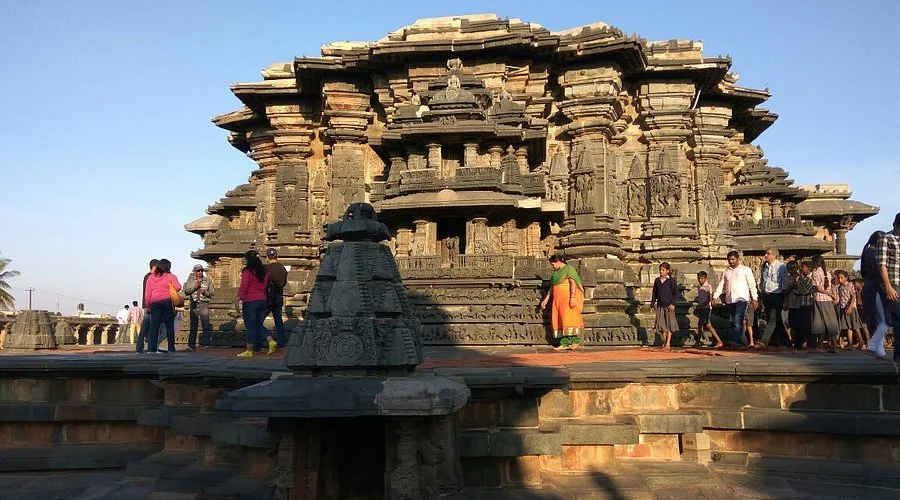
- Keshava Temple: It is a 13th-century Trikuta (three-shrined) Vaishnava temple in Somanathapura, known for its intricate Hoysala architecture and carvings.
- It was built by Somanatha Dandanayaka, a commander in the army of Hoysala King Narasimha III.
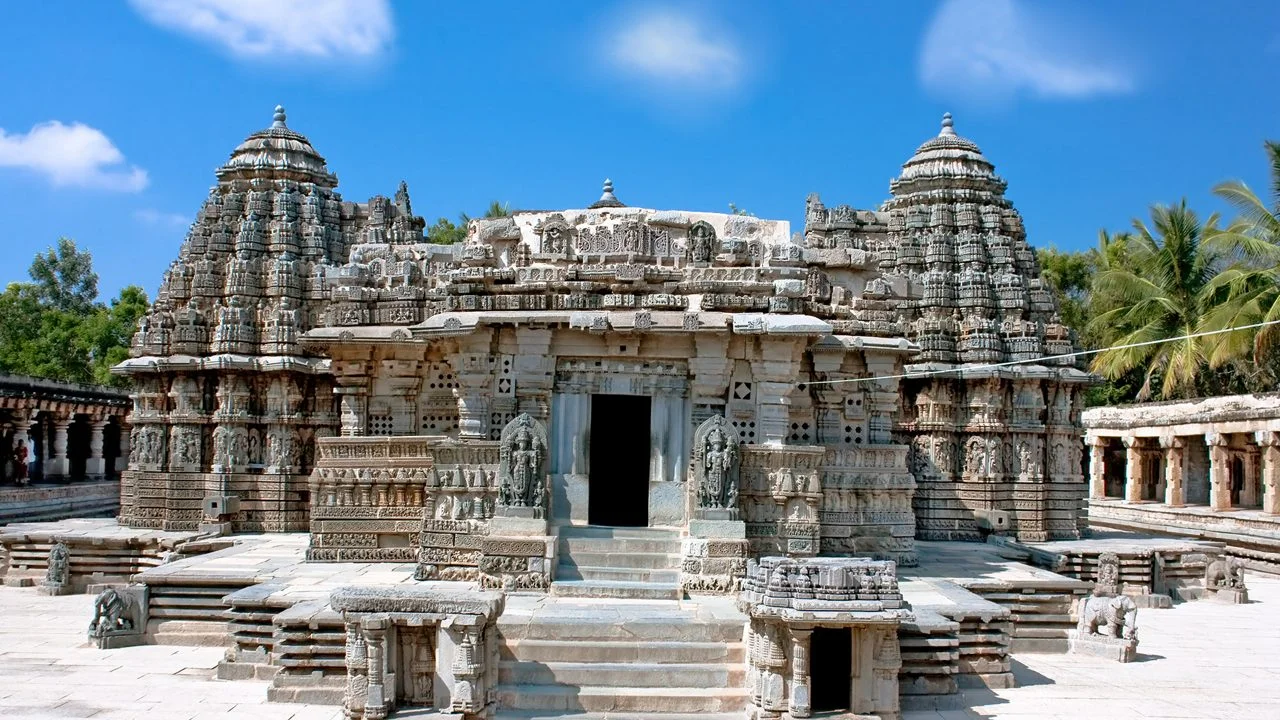
- Chennakeshava Temple: Located in Belur, it is renowned for its intricate Hoysala architecture. Commissioned by King Vishnuvardhana to celebrate his victory over the Cholas, this "living" temple is dedicated to Lord Vishnu.
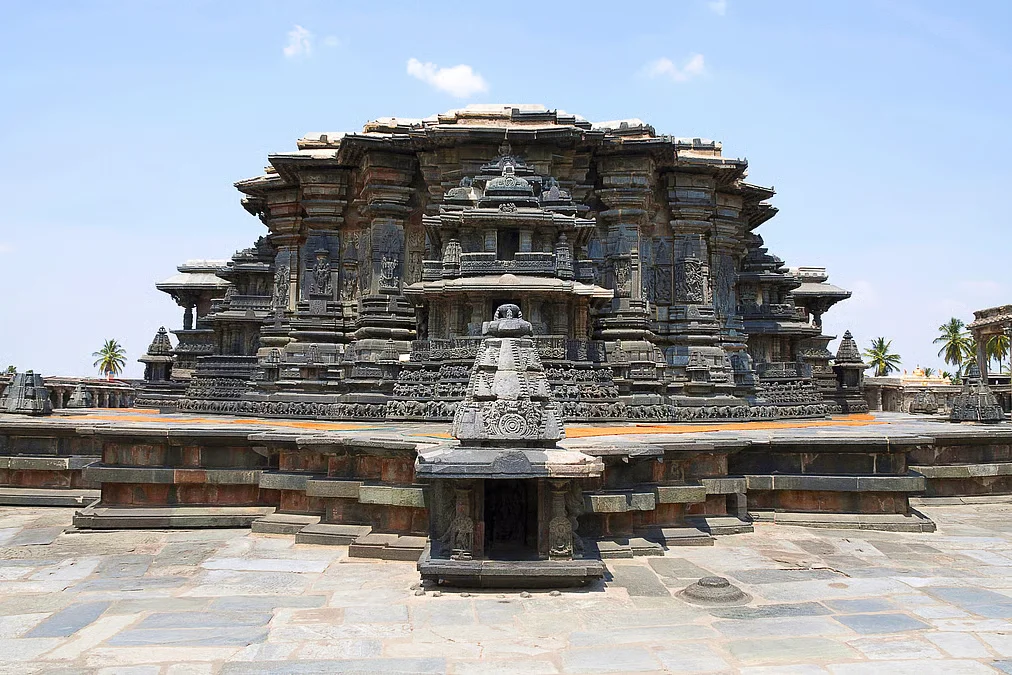
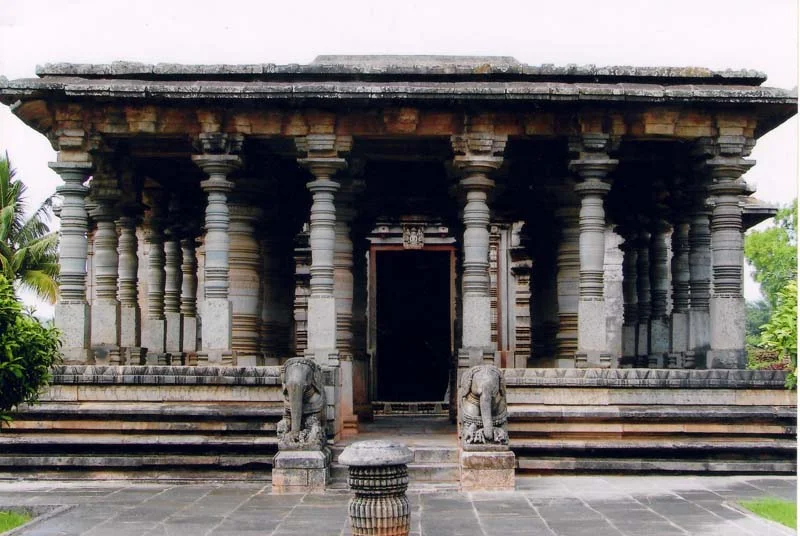
- Veera Narayana Temple: The Veera Narayana Temple, built around 1200 CE by Veera Ballala II, is renowned for its expansive ranga-mandapa and rows of uniquely carved elephants.
- Unlike heavily ornamented exteriors elsewhere, this temple emphasizes interior spatial grandeur and sculptural harmony.
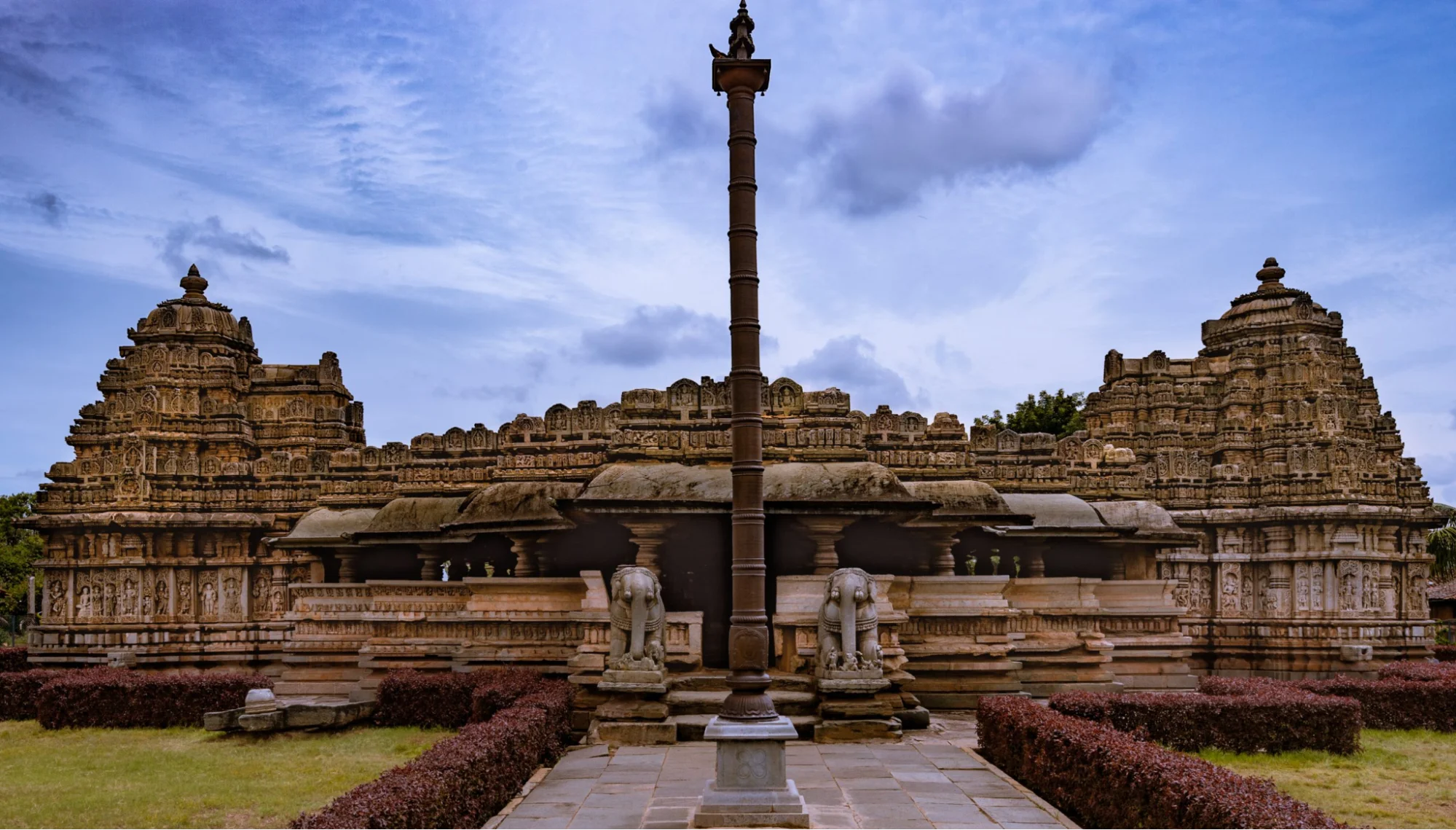
- Nageshwara Temple: The Nageshwara Temple at Koravangala reflects an early phase of Hoysala experimentation. Its relatively restrained ornamentation and compact plan reveal a transition from Chalukyan influences toward the fully evolved Hoysala style.
- Standing beside it, the Govindeshwara Temple shares the same date but exhibits greater refinement in sculptural articulation.
- Dedicated to Vishnu, it demonstrates the growing confidence of Hoysala craftsmen in carving rhythmic wall projections and intricate friezes.
- Standing beside it, the Govindeshwara Temple shares the same date but exhibits greater refinement in sculptural articulation.
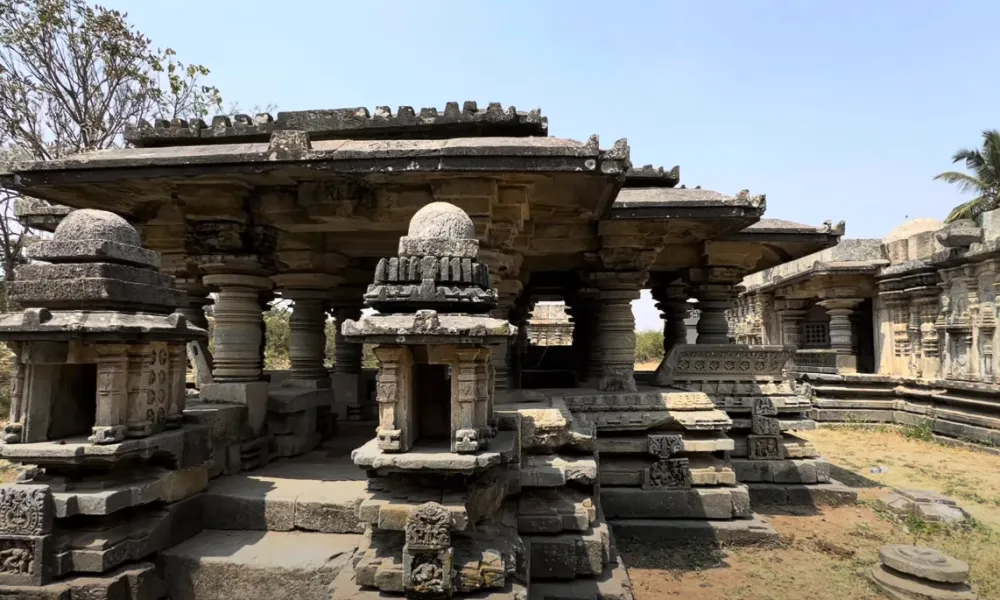
- Bucheshwara Temple: The Bucheshwara Temple, completed in 1173 CE in honour of King Veera Ballala II, marks the architectural high point of Koravangala. Its sculptural density, elegant star-shaped platform, and mature detailing signal the full flowering of Hoysala artistry.
- Lakshminarasimha Temple: The Lakshminarasimha Temple (1250 CE) at Javagal is a striking trikuta shrine known for its graceful elephant friezes and polished pillars. Built during the reign of Vira Someshwara, it reflects the prosperity of Javagal as a thriving medieval trade centre.
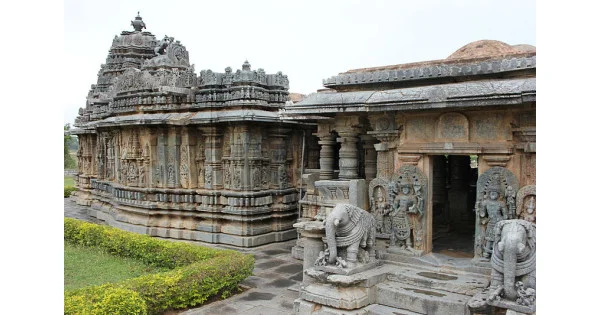
- Lakshmidevi Temple: The Lakshmidevi Temple (1114 CE) is among the earliest surviving Hoysala monuments and was commissioned by the merchant woman Sahaja Devi.
- Its four-shrine layout and rare Mahakali sanctum guarded by skeletal betalas hint at tantric influences and an experimental architectural phase.
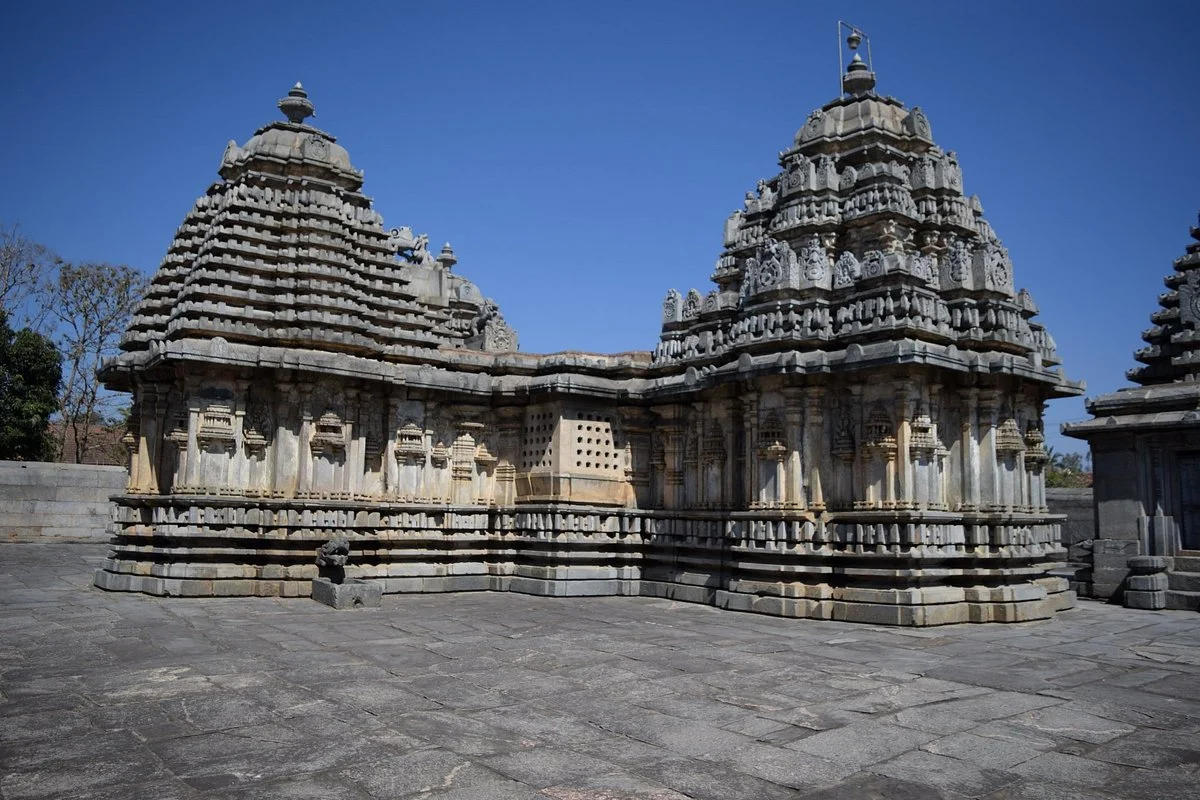
- Panchalingeshwara Temple: Located in Mandya, it features a rare Panchakuta design – five east-facing Shiva shrines aligned in a row and connected by a pillared hall.
- Jain Complex of Halebidu: It comprising the Parshvanatha Basadi, Shantinatha Basadi, and Adinatha Basadi, reflects a contrasting aesthetic of restraint and meditative stillness. Their clean lines and uncluttered interiors embody Jain ideals of clarity and spiritual contemplation.
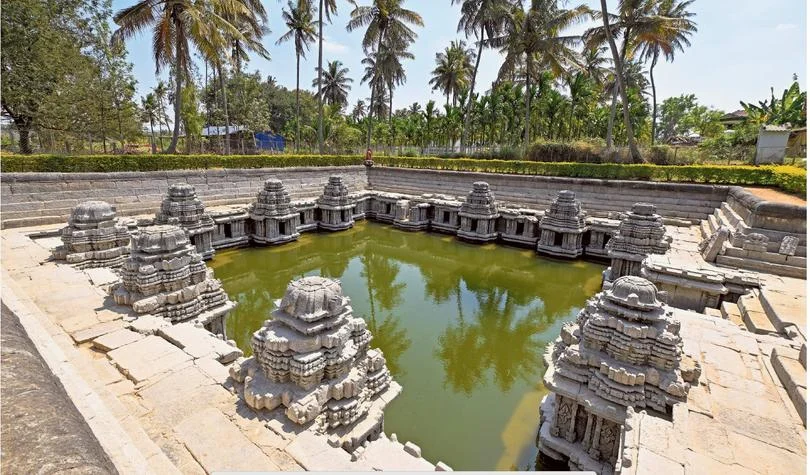
- Hulikere Kalyani: The 12th-century Hulikere Kalyani is a masterpiece of sacred water architecture built below ground level with symmetrical descending steps. With its constellation of miniature shrines symbolically linked to zodiac signs and nakshatras, it merges cosmology with hydraulic design.
- UNESCO Recognition: The Chennakeshava Temple, the Hoysaleswara Temple, and the Keshava Temple were collectively inscribed as a UNESCO World Heritage Site in 2023 under the title “Sacred Ensembles of the Hoysalas” during the 45th World Heritage Committee session.
Hoysala Dynasty
- About: Initially, the Hoysalas were feudatories of the Chalukyas of Kalyana, also known as the Western Chalukya Empire, before rising to independent power.
- The dynasty was founded by Nripa Kama II, who initially served as a vassal to the Western Chalukyas.
- Capital and Territory: The Hoysala dynasty's primary capital was Dwarasamudra (modern-day Halebidu), which served as the centre of their empire in Karnataka. Initially, the capital was located at Belur in the 11th century before being shifted to Halebidu.
- The Hoysalas governed areas spanning Karnataka and Tamil Nadu for over three centuries.
- Notable Rulers: The most notable rulers of the Hoysala dynasty were Vishnuvardhana, Veera Ballala II, and Veera Ballala III.
- Vishnuvardhana (also known as Bittideva) was the greatest king of the Hoysala dynasty, under whose reign the kingdom expanded significantly and witnessed prolific temple construction.
- King Vishnuvardhana was initially a Jain but later converted to Vaishnavism under the influence of the renowned Sri Vaishnava saint Ramanuja.
Frequently Asked Questions (FAQs)
1. What is the distinctive architectural plan of Hoysala temples?
Hoysala temples feature a distinctive stellate or star-shaped plan of the sanctum and platform, creating multiple projecting angles for extensive ornamentation.
2. What building material is characteristic of Hoysala temples?
They were constructed primarily from soft soapstone (chloritic schist) , which enabled extraordinarily intricate and detailed carvings.
3. Name three prominent examples of Hoysala temples.
Prominent examples include the Hoyasaleswara temple at Halebid, the Chennakesava temple at Belur, and the Keshava temple at Somanathapura.
UPSC Civil Services Examination Previous Year Question (PYQ)
Q. Which of the following is/are famous for Sun temples? (2017)
- Arasavalli
- Amarakantak
- Omkareshwar
Select the correct answer using the code given below:
(a) 1 only
(b) 2 and 3 only
(c) 1 and 3 only
(d) 1, 2 and 3
Ans: (a)
Q. The Nagara, the Dravida and the Vesara are the (2012)
(a) three main racial groups of the Indian subcontinent
(b) three main linguistic divisions into which the languages of India can be classified
(c) three main styles of Indian temple architecture
(d) three main musical Gharanas prevalent in India
Ans: (c)
Tetanus and Adult Diphtheria (Td) Vaccine
Why in News?
The Ministry of Health and Family Welfare launched the indigenously manufactured Tetanus and Adult Diphtheria (Td) vaccine at the Central Research Institute (CRI), Kasauli.
- This step strengthens Atmanirbharta in vaccine production, reducing import dependence and enhancing national health security.
What are the Key Features Tetanus and Adult Diphtheria (Td) Vaccine?
- Dual Protection: Unlike the traditional Tetanus Toxoid (TT) vaccine, which only protects against Tetanus, the Td vaccine provides protection against both Tetanus (T) and Diphtheria (d).
- Reduced Antigen Content: The "d" in Td stands for a reduced dose of diphtheria toxoid, which is specifically formulated for adults and adolescents to minimize side effects while effectively boosting immunity.
- While childhood DPT (Diphtheria, Pertussis, Tetanus) vaccines provide early cover, diphtheria immunity often declines in adulthood. The Td booster ensures long-term protection.
- Replacement of TT: World Health Organization (WHO) recommended that countries replace the Tetanus Toxoid (TT) vaccine with the Td vaccine.
- In India, National Technical Advisory Group on Immunization (NTAGI) has recommended replacing the TT vaccine with the Td vaccine in India’s immunization programme for all age groups, including pregnant women, to enhance protection against diphtheria while sustaining tetanus elimination gains.
- Supporting this shift, CRI has completed development, secured regulatory approvals, and begun commercial manufacturing of the Td vaccine.
- The vaccine is now formally inducted into the Universal Immunization Programme (UIP), the world's largest immunization initiative. CRI Kasauli will supply 55 lakh doses by April 2026.
What are the Key Facts About Tetanus and Diphtheria?
- Tetanus
- Etiology and Transmission: Tetanus is caused by anaerobic spores of Clostridium tetani found in soil and animal feces.
- It is non-communicable (cannot spread person-to-person) and enters the body through contaminated wounds, cuts, or the umbilical stump.
- Maternal and Neonatal Tetanus (MNT): This remains a major cause of death in low-income settings.
- Neonatal tetanus typically occurs when non-sterile instruments are used to cut the umbilical cord.
- Symptomology: Known commonly as "lockjaw," its hallmark symptoms include jaw cramping, painful muscle spasms (often triggered by noise), trouble swallowing, and seizures.
- Prevention and Immunization Strategy: Tetanus is entirely preventable through Tetanus-Toxoid-Containing Vaccines (TTCV).
- However, recovery from the disease does not provide natural immunity, necessitating vaccination even for survivors.
- Global Progress: Neonatal tetanus deaths saw a 97% reduction between 1988 and 2018 due to aggressive global scaling of immunization programs.
- India’s Public Health Milestones: India in 2015, reduced the annual rate of neonatal tetanus to less than 1 case per 1,000 live births in every district.
- Digital Tracking: India utilizes the U-WIN platform to digitally track every vaccination event for nearly 5 crore annual beneficiaries, ensuring they receive all 27 mandated doses up to age 16.
- Etiology and Transmission: Tetanus is caused by anaerobic spores of Clostridium tetani found in soil and animal feces.
- Diphtheria
- Etiology: Caused by toxin-producing strains of the bacterium Corynebacterium diphtheriae.
- Transmission: Spreads through respiratory droplets (coughing/sneezing) or direct contact. Notably, asymptomatic carriers can still transmit the bacteria.
- The "Pseudomembrane": A hallmark symptom is the formation of a thick, grey coating of dead tissue in the nose and throat within 2–3 days of infection, which can lead to respiratory obstruction.
- Fatal Complications: The toxin can enter the bloodstream, causing myocarditis (heart muscle inflammation) and neuropathy (nerve damage). Without treatment, the fatality rate can reach 30%, particularly in children under 5.
- Risk Factors: Overcrowding in refugee camps, damaged health infrastructure due to conflict, and under-vaccination are primary drivers of recent resurgences.
- The pandemic caused significant setbacks in routine immunization and surveillance, leaving millions of children susceptible to outbreaks.
- Treatment : Treatment requires Diphtheria Antitoxin (DAT) to neutralize the toxin and antibiotics to kill the bacteria. However, increasing antimicrobial resistance (AMR) in diphtheria strains is a growing concern.
Frequently Asked Questions (FAQs)
- What is the Td vaccine and how is it different from the TT vaccine?
Td vaccine provides dual protection against tetanus and diphtheria, unlike TT which protects only against tetanus. - Why did India replace the TT vaccine with the Td vaccine?
Based on WHO and NTAGI recommendations, the shift enhances diphtheria protection while sustaining tetanus elimination gains. - What is the significance of indigenous Td vaccine production at CRI Kasauli?
It strengthens Atmanirbhar Bharat, reduces import dependence, and ensures reliable vaccine supply for UIP. - How does tetanus differ from diphtheria in transmission?
Tetanus is non-communicable and enters through wounds, while diphtheria spreads via respiratory droplets and carriers. - What role does the U-WIN platform play in immunization?
U-WIN digitally tracks vaccination for millions of beneficiaries, ensuring timely coverage and monitoring under UIP.
UPSC Civil Services Examination, Previous Year Question (PYQ)
Prelims
Q.With reference to recent developments regarding ‘Recombinant Vector Vaccines’, consider the following statements: (2021)
- Genetic engineering is applied in the development of these vaccines.
- Bacteria and viruses are used as vectors.
Which of the statements given above is/are correct?
(a) 1 only
(b) 2 only
(c) Both 1 and 2
(d) Neither 1 nor 2
Ans: (c)
Q.Consider the following diseases: (2014)
- Diphtheria
- Chickenpox
- Smallpox
Which of the above diseases has/have been eradicated in India?
(a) 1 and 2 only
(b) 3 only
(c) 1, 2 and 3
(d) None
Ans: (b)
SANKALP Scheme
Why in News?
The Public Accounts Committee (PAC) of Parliament has expressed concern over gaps in planning and the slow pace of implementation of the Skill Acquisition and Knowledge Awareness for Livelihood Promotion (SANKALP) scheme.
- The observations were based on a report by the Comptroller and Auditor General (CAG) of India, which found that the SANKALP scheme utilised only 44% of its allocated funds, with significant World Bank assistance remaining unspent, indicating weak financial planning and absorption capacity.
What is the SANKALP Scheme?
- About: Launched in January 2018 by the Ministry of Skill Development and Entrepreneurship (MSDE), the SANKALP scheme is a Centrally Sponsored Scheme aimed at operationalising the National Skill Development Mission (NSDM).
- It focuses on strengthening institutional mechanisms for short-term skill training and expanding access to quality training for marginalised communities.
- Funding: The scheme was approved with a total budget of Rs 4,455 crore. It is primarily supported by a World Bank loan of Rs 3,300 crore, supplemented by state leverage and industry contribution.
- Timeline: Originally slated for completion by March 2023, the deadline was extended to March 2024.
- Core Objectives:
- Institutional Strengthening: Building capacity at the National, State, and District levels.
- This includes supporting District Skill Committees (DSCs) and the Mahatma Gandhi National Fellowship (MGNF).
- Quality Assurance: Standardizing certification, universalizing the National Skills Qualification Framework (NSQF), and creating a pool of quality trainers.
- Inclusion: Focusing on increasing the participation of women, SC/STs, and Persons with Disabilities (PwD) in vocational training.
- Institutional Strengthening: Building capacity at the National, State, and District levels.
- Key Achievements & Outcomes: Strengthened District Skill Committees (DSCs) enabling demand-driven implementation of Pradhan Mantri Kaushal Vikas Yojana (PMKVY).
-
Promoted Recognition of Prior Learning (RPL) and certification at Gram Panchayat level.
-
Funded development of an IT system namely “Skill India Portal” to capture the data for skilling related activities across the country.
-
Frequently Asked Questions (FAQs)
1. What is the SANKALP scheme?
A Centrally Sponsored Scheme launched in 2018 by MSDE to operationalise the National Skill Development Mission through institutional strengthening, quality assurance, and inclusive skilling.
2. What were the key CAG findings on SANKALP?
Only 44% of funds were utilised, implementation was delayed due to weak planning, and lack of central monitoring reduced accountability and effectiveness.
3. How is SANKALP funded?
It has a ₹4,455 crore outlay, primarily financed by a ₹3,300 crore World Bank loan, along with state leverage and industry contributions.
4. What are the core objectives of the scheme?
Institutional strengthening, quality assurance via NSQF and certified trainers, and increased participation of women, SC/STs, and PwDs in skill training.
UPSC Civil Services Examination Previous Year Question (PYQ)
Prelims
Q. With reference to Pradhan Mantri Kaushal Vikas Yojana, consider the following statements: (2018)
- It is the flagship scheme of the Ministry of Labour and Employment.
- It, among other things, will also impart training in soft skills, entrepreneurship, and financial and digital literacy.
- It aims to align the competencies of the unregulated workforce of the country to the National Skill Qualification Framework.
Which of the statements given above is/are correct?
(a) 1 and 3 only
(b) 2 only
(c) 2 and 3 only
(d) 1, 2 and 3
Ans: (c)
Rajagopalachari Statue to Replace Lutyens at Rashtrapati Bhavan
The Prime Minister of India announced that the statue of British architect Edwin Lutyens at Rashtrapati Bhavan will be replaced by that of C. Rajagopalachari.
- While Edwin Lutyens designed the monumental Rashtrapati Bhavan, C. Rajagopalachari holds the distinction of being the first Indian occupant of the building as the Head of State.
C. Rajagopalachari
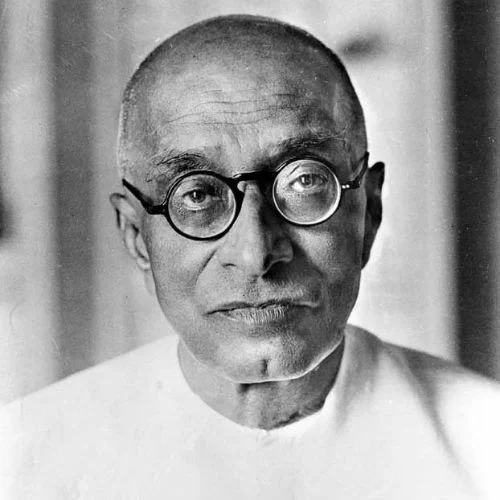
- About: Chakravarti Rajagopalachari, popularly known as Rajaji, was a towering Indian freedom fighter, politician, and the first and last Indian Governor-General of independent India.
- He was born on 10th December 1878 in Salem, Madras Province (now Tamil Nadu).
- Key Contributions:
- Role in the Indian National Movement: Inspired by Lokmanya Bal Gangadhar Tilak, he joined the Indian National Congress and took part in the freedom struggle and later hosted Mahatma Gandhi during the anti-Rowlatt agitation.
- Mirroring the Dandi March, he led the Vedaranyam Salt Satyagraha (1930) from Tiruchi to Vedaranyam.
- Rajaji served as the Prime Minister of Madras Province (1937), where he promoted Khadi, and advocated for the abolition of the Zamindari system.
- Role in the Indian National Movement: Inspired by Lokmanya Bal Gangadhar Tilak, he joined the Indian National Congress and took part in the freedom struggle and later hosted Mahatma Gandhi during the anti-Rowlatt agitation.
- The C.R. Formula (1944): Post-Quit India Movement, he authored the pamphlet "The Way Out," proposing a formula to solve the constitutional deadlock between the INC and the Muslim League regarding the demand for Pakistan.
- Post-Independence Political and Administrative Leadership: Served as the Governor of West Bengal, Union Home Minister (succeeding Sardar Patel), and played a role in drafting the First Five-Year Plan.
- He also piloted the Preventive Detention Act, 1950 in Parliament.
- Rajaji formed the Swatantra Party in 1959 which actively campaigned for a market economy. As the Chief Minister of Madras State, one of his first acts was to decontrol the distribution of foodgrains and their prices.
- Literary Contributions & Awards: He founded an ashram in Madras Province (1925) for social upliftment, and published Vimochanam (Tamil) and Prohibition (English).
- He won the 1958 Sahitya Akademi Award in Tamil literature for his retelling of the Ramayana, titled Chakravarthi Thirumagan.
- He was one of the first three recipients of India's highest civilian award, Bharat Ratna (1954) alongside Dr. S. Radhakrishnan and C.V. Raman.
Edwin Lutyens:
- A British architect and town planner who, in collaboration with Sir Herbert Baker, designed several monumental buildings in New Delhi, including Rashtrapati Bhavan, North Block, South Block, and India Gate.
- A part of New Delhi is known as Lutyens’ Delhi in recognition of his architectural contribution.
| Read more: C. Rajagopalachari |
North Eastern Science & Technology Cluster Project
The Ministry of Development of North Eastern Region (MDoNER), through the North Eastern Council (NEC), has sanctioned the North Eastern Science & Technology Cluster (NEST) project, aiming to create a self-sustaining ecosystem of research, entrepreneurship, and skill development.
- Nodal Agency & Duration: The implementation is spearheaded by the Indian Institute of Technology, Guwahati (IIT-G) for a duration of 5 years.
- Thematic Verticals: NEST operates through four specialized verticals namely:
- Innovation Hub on Grassroot Technologies
- Technology Hub for Semiconductor and AI
- Centre of Excellence for Innovation in Bamboo-Based Technology, Entrepreneurial Promotion & Skill Development
- Innovation Centre on Biodegradable and Ecofriendly Plastics
- Structural Design: NEST operates on a Hub and Spoke model with IIT Guwahati acting as the central 'Hub'.
- The 'Spokes' form a wide network of academic and research institutions across all northeastern states, facilitating last-mile outreach and resource sharing.
- Key Identified institutions include NITs (e.g., Agartala, Meghalaya etc), IIM Shillong, Tezpur University, etc.
- Key Project Components: The core activities include establishing Incubation and Tinkering Laboratories, conducting specialized training programs, facilitating technology transfer and product marketing, and developing the necessary infrastructure for research and skill development.
North Eastern Council (NEC)
- About: NEC is a statutory advisory body established under the North Eastern Council Act, 1971 (came into being in November, 1972), serving as the nodal agency for the economic and social development of India's 8 North Eastern Region (NER), with its headquarters in Shillong, Meghalaya.
- Member states include Arunachal Pradesh, Assam, Manipur, Meghalaya, Mizoram, Nagaland, Sikkim, and Tripura.
- It functions under the administrative control of the Ministry of Development of the North-Eastern Region (DoNER).
- Composition of the Council: The NEC comprises:
- The Union Home Minister serves as the ex-officio chairman.
- The Governors of the eight member states.
- The Chief Ministers of the eight member states.
- Three additional members nominated by the President of India.
| Read More: 72nd plenary of the North Eastern Council |
Namo Bharat Rapid Rail and Meerut Metro
The Indian Prime Minister inaugurated both the Namo Bharat Rapid Rail and the Meerut Metro from a single platform, marking the first time in India that a rapid rail and metro service were launched together on the same day.
- Meerut Metro, connecting Meerut South and Modipuram, is India’s fastest metro with speeds up to 120 km/h, operating on Namo Bharat infrastructure in a first-of-its-kind project.
Namo Bharat Rapid Rail
- About: It is India's inaugural Regional Rapid Transit System (RRTS), a dedicated semi-high-speed commuter rail network designed to revolutionize connectivity across the National Capital Region (NCR).
- It supports a maximum design speed of 180 km/h, with operational speeds reaching up to 160 km/h and average speeds around 100 km/h.
- Primary Objective: The system aims to alleviate congestion on conventional rail and road networks by providing a modern, high-frequency alternative for commuters traveling distances of 100-200 km.
- Distinction from Other Systems:
- Vs. Metro: Unlike metros for intra-city travel with frequent stops, RRTS focuses on regional connectivity with fewer halts and higher speeds.
- Vs. Vande Bharat: It differs from longer-distance inter-city trains like Vande Bharat Express by catering to shorter, regional inter-city routes with higher frequency.
- Flagship Corridor: The Delhi–Ghaziabad–Meerut RRTS spans approximately 82 km. Full operations along this route were inaugurated in February, 2026.
| Read More: Multimodal Transport Hub |