
IMD Summer Forecast 2026
Why in News?
The India Meteorological Department (IMD) released its summer forecast (April to June 2026). The forecast predicts an increase in the number of heatwave days across most parts of East, Central, Northwest India, and the Southeast Peninsula, alongside a nationwide rise in minimum (night time) temperatures.
What are the Key Highlights of IMD Summer Forecast 2026?
- Heatwave Trend: India is expected to witness above-normal heatwave days, particularly across east, central, northwest India and the southeast peninsula.
- Temperature Pattern: Above-normal temperatures are likely over east and northeast India, eastern parts of central India, and adjoining peninsular regions, while most other regions may experience normal to below-normal temperatures.
- North India Exception: Unlike other regions, North India is likely to see a cooler-than-normal summer, indicating regional variation in heat patterns.
- Heatwave-Prone Areas: Regions such as Odisha, West Bengal, Tamil Nadu, Puducherry, Andhra Pradesh, and parts of Gujarat, Maharashtra, and Karnataka are likely to experience heatwaves, especially in April.
- Western Disturbances: India is expected to receive around 12% above-normal rainfall in April, supported by increased western disturbances.
- A higher frequency of western disturbances has contributed to increased rainfall and moderated temperatures.
- El Niño Concern: There is a likelihood of El Niño developing by July, which may negatively impact the monsoon.
- Cooler summer conditions may reduce land heating, potentially affecting monsoon onset and early progress.
What are Heat Waves?
- About: A heat wave is a period of unusually high temperatures compared to a region's normal climate.
- In India, these predominantly occur between March and June (peaking in May).
- Despite their severe health and environmental impacts, heat waves are not officially classified as natural disasters under the Disaster Management (DM) Act of 2005.
- The intensity and frequency of heat waves are heavily influenced by a combination of geographical and climatic factors.
- IMD Criteria for Declaring Heat Wave:
|
Region/Condition |
Heat Wave |
|
Plains |
Max temperature ≥ 40°C |
|
Hilly Regions |
Max temperature ≥ 30°C |
|
Coastal Stations |
When the maximum temperature departure is 4.5°C or more from normal, and provided the actual maximum temperature is 37°C or above. |
|
Based on Departure from Normal |
Heat Wave: Departure from normal is 4.5°C to 6.4°C Severe Heat Wave: Departure from normal is > 6.4°C |
|
Based on Actual Maximum Temperature |
Heat Wave: When actual maximum temperature ≥ 45°C Severe Heat Wave: When actual maximum temperature ≥ 47°C |
|
Spatial & Temporal Condition |
To declare as a heatwave the criteria must be met at minimum 2 stations in a Meteorological subdivision for at least 2 consecutive days. |
- Geographical Factors:
- Latitude and Solar Incidence: Regions near the Tropic of Cancer (like Telangana and Andhra Pradesh) face intense, nearly vertical solar radiation during summer, leading to rapid ground heating.
- Terrain and Soil Type: Rocky landscapes (like the Deccan plateau) and black soils absorb and retain heat much longer than other surfaces. In contrast, areas with dense vegetation or irrigation stay cooler due to evapotranspiration.
- Proximity to Water: Landlocked regions face higher heatwave risks because they lack the moderating, evaporative cooling effects provided by large water bodies (which protect coastal areas).
- Urban Heat Islands: Cities trap heat due to dense populations, concrete/asphalt surfaces, and a lack of greenery, creating localized pockets of extreme temperatures.
- Climatic Factors:
- Moisture and Cloud Cover: A lack of pre-monsoon rain leaves soils dry, drastically reducing evaporative cooling.
- Minimal cloud cover allows unchecked solar radiation to hit the surface. Furthermore, high humidity makes it harder for human sweat to evaporate, dangerously raising the "heat index."
- Wind and Pressure: Weak winds and stable atmospheric conditions (like temperature inversions) trap heat close to the ground.
- High-pressure systems (anti-cyclonic flows) cause sinking, dry air and clear skies, which enhance surface heating.
- Global and Regional Phenomena: El Niño weakens monsoon winds, reducing cloud cover and rainfall, which dries out the soil and primes the environment for heat waves.
- Regionally, the "Loo"—a fierce, hot, and dusty summer wind—directly drives up temperatures.
- Moisture and Cloud Cover: A lack of pre-monsoon rain leaves soils dry, drastically reducing evaporative cooling.
Impacts of Heatwaves and Rising Minimum Temperatures:
- Public Health Crisis: Warmer nights and prolonged daytime heat increase the risk of heat exhaustion, heatstroke, and cardiovascular stress, particularly among vulnerable populations (the elderly, children, and outdoor gig workers).
- According to the "Heat Watch 2024" report, 733 heatstroke deaths were reported across 17 Indian states between March and June.
- Agricultural Stress: Excessive heat can accelerate crop maturity, reducing the yield of Rabi crops like wheat, especially in Punjab and Haryana.
- Water Scarcity: Accelerated evaporation rates and heightened water consumption can severely deplete reservoirs and groundwater levels.
- Economic Toll: Extreme heat impacts labor productivity, particularly in the construction and agricultural sectors. Increased power demand for cooling also strains the energy grid.
- Environmental Impact: According to the Forest Survey of India, more than 36% of the country's forest cover has been estimated to be prone to frequent forest fires. Rising heat increases fire incidents, damaging ecosystems and nearby settlements.
India’s Initiatives to Tackle Heat Waves
- Heat Action Plans (HAPs): State-level plans using data, vulnerability mapping, and coordinated response strategies.
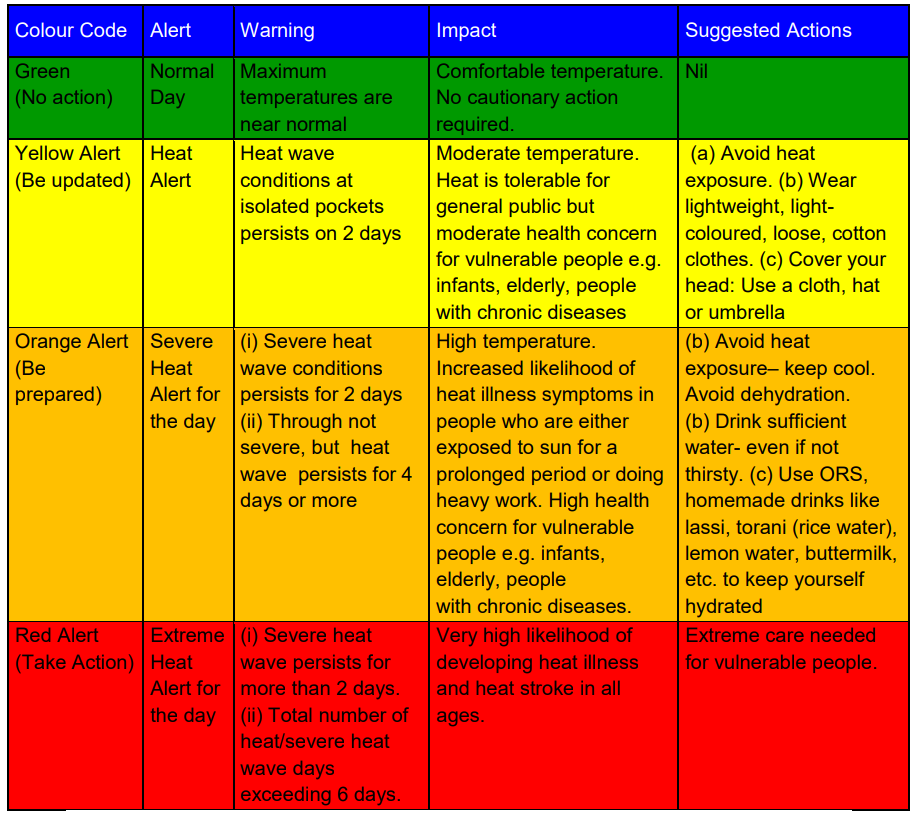
- IMD Warning System: IMD and the National Disaster Management Authority issue colour-coded heat alerts for early action.
- Jal Shakti Abhiyan: Focus on water conservation and restoration to tackle heat stress.
- Smart Cities Mission: Promotes green cover, climate-resilient planning, and urban cooling spaces.
- Cool Roof Initiatives: Use of reflective materials to reduce indoor heat; adopted in multiple states.
|
Drishti Mains Question: Heatwaves are not classified as disasters under the Disaster Management Act, 2005. Critically analyse the implications. |
Frequently Asked Questions (FAQs)
1. What is a heatwave as per IMD?
A heatwave is a period of abnormally high temperatures, declared based on thresholds (≥40°C plains) or deviation from normal (+4.5°C or more).
2. Are heatwaves classified as disasters in India?
No, heatwaves are not officially notified disasters under the Disaster Management Act, 2005.
3. What is the role of El Niño in the Indian climate?
El Niño weakens monsoon winds, often leading to reduced rainfall and increased heatwave conditions.
4. What are Heat Action Plans (HAPs)?
HAPs are state-level strategies involving early warnings, preparedness, and inter-departmental coordination to reduce heatwave impacts.
5. Why are rising night temperatures a concern?
Warmer nights reduce recovery from heat stress, increasing health risks, mortality, and energy demand.
UPSC Civil Services Examination, Previous Year Question (PYQ)
Q. What are the possible limitations of India in mitigating global warming at present and in the immediate future? (2010)
- Appropriate alternate technologies are not sufficiently available.
- India cannot invest huge funds in research and development.
- Many developed countries have already set up their polluting industries in India.
Which of the statements given above is/are correct?
(a) 1 and 2 only
(b) 2 only
(c) 1 and 3 only
(d) 1, 2 and 3
Ans: (a)
Mains
Q: Bring out the causes for the formation of heat islands in the urban habitat of the world (2013).
AI-Driven Tax Governance in India
Why in News?
India is increasingly using Artificial Intelligence (AI) in tax administration, especially through the Income Tax Department’s Project Insight (PI).
- While AI has improved tax compliance and revenue mobilisation, concerns around privacy, bias, and accountability are emerging.
What is Project Insight (PI)?
- About: Project Insight (PI) is an initiative of the Income Tax Department (ITD) launched in 2017 (operational from 2019) to use Artificial Intelligence (AI) and data analytics for strengthening tax administration.
- It creates a 360-degree financial profile of taxpayers by analysing data from sources like banking, GST, property, and high-value transactions.
- It aims to detect tax evasion, improve voluntary compliance, and ensure fair and efficient tax enforcement, with three interlocking components.
- INTRAC: The Income Tax Transaction Analysis Centre (INTRAC) is the core analytical engine.
- It pulls financial data from banks, property transactions, credit card records, GST payments, and cryptocurrency holdings to build a comprehensive financial picture of each taxpayer.
- CMCPC: The Compliance Management Centralized Processing Centre (CMCPC) uses INTRAC's outputs to identify discrepancies and flag likely cases of under-reporting.
- NUDGE strategy: Non-intrusive Usage of Data to Guide and Enable (NUDGE) sends SMS and email reminders to taxpayers whose declared income doesn't match their detected financial activity, prompting them to voluntarily revise their returns or explain their filings.
- Impact:
- Since 2020–21, AI nudges led to over 1 crore revised returns, generating Rs 11,000 crore additional tax.
- In the foreign assets campaign (2023–25), 62% of 19,501 taxpayers corrected disclosures, while a NUDGE drive covering 6.25 lakh taxpayers uncovered Rs 963 crore false claims and recovered Rs 410 crore taxes.
- Operational efficiency improved (post-2019), with refund time reduced from 93 to 17 days, and AI detected Rs 70,000 crore tax evasion since 2019–20.
Significance of AI in Tax Administration
- Accurate Risk Profiling: It helps tax agencies accurately assess taxpayer risk profiles and swiftly identify potential evasion patterns.
- Prioritization of Resources: Tax administrators can prioritize cases based on the scale, size, and sophistication of the tax evasion.
- Automation of Routine Tasks: AI automates repetitive administrative duties, freeing up human tax officers to focus on complex cases requiring subjective human judgment.
- Enhanced Taxpayer Services: AI-driven tools assist taxpayers in filing correct returns, deploy smart chatbots to answer queries, and help prevent tax-related scams.
- Countries like Australia, Italy, the United Kingdom, and the United States have deployed similar AI-enabled platforms and seen significant revenue gains.
What are the Risks Associated With AI Use in Tax Governance?
- Data Quality and False Positives: AI systems are only as reliable as the data they ingest.
- Variable-income earners (freelancers using prior savings, individuals in joint family structures, or those who made honest clerical mistakes) may be incorrectly flagged as evaders.
- Without accessible human review, these taxpayers bear the burden of proving their innocence.
- Algorithmic Bias: If an AI model is trained on historical enforcement records that reflect past socio-economic or geographic biases, it may repeat and amplify those biases.
- The Dutch childcare benefits scandal is a cautionary case study where flawed governance and algorithmic bias exposed thousands of families to wrongful accusations of fraud, causing severe financial hardship and social distress.
- Lack of Explainability and Due Process: Taxpayers currently lack visibility into why they were flagged or how the AI reached its conclusion.
- A fair system requires a transparent mechanism to challenge algorithmic decisions and mandates a "human-in-the-loop" for evaluations carrying serious consequences.
- Data Privacy Vulnerabilities: Aggregating highly sensitive personal and financial data into a single system creates a massive attack surface for cyber fraud, data breaches, and digital financial crimes. Indians lost at least USD 22,495 crore to such activities in 2025.
- Institutional Voids: India currently lacks an independent AI ombudsperson to review contested decisions.
- There is also no framework for algorithmic impact assessments, external audits of risk-scoring models, or public reporting on the rates of false positives and successful appeals.
How Can India Ensure Ethical AI Tax Governance?
- Human-in-the-Loop Approach: Ensure mandatory human review before punitive action and train officials to critically assess AI outputs, preventing blind reliance on algorithms.
- AI Ombudsperson: Establish an independent grievance redressal body for taxpayers to challenge AI-based decisions and address systemic errors like false positives.
- Algorithmic Transparency & Audits: Mandate independent audits and public reporting of AI systems to check bias, accuracy, and fairness in tax enforcement.
- Explainability & Due Process: Guarantee taxpayers the right to know why they are flagged and provide clear, accessible mechanisms to respond or correct errors.
- Data Privacy & Security: Implement strict access controls, data minimization, and strong cybersecurity frameworks to protect sensitive financial information.
- Better Data Contextualization: Train AI systems to account for India-specific financial realities (like Hindu Undivided Family (HUFs), informal economy, variable income) to reduce false positives.
Conclusion
India’s shift towards AI-driven tax administration marks a significant step in improving tax compliance and revenue mobilisation. However, this transformation must be balanced with strong ethical safeguards, including transparency, independent oversight, grievance redressal, and data privacy protections. With these measures in place, India can build a fair, efficient, and trustworthy tax system that upholds citizens’ rights.
|
Drishti Mains Question: “AI-driven governance improves efficiency but raises serious ethical concerns.” Discuss in the context of India’s tax administration. |
Frequently Asked Questions (FAQs)
1. What is Project Insight (PI)?
It is an AI-based initiative of the Income Tax Department (2017) to improve tax compliance using data analytics and 360-degree taxpayer profiling
2. What is the NUDGE strategy in tax administration?
It is a non-intrusive approach that sends SMS/email alerts to taxpayers to correct discrepancies and voluntarily comply
3. What are the key outcomes of AI use in tax governance?
Over 1 crore revised returns, ₹11,000 crore additional revenue, faster refunds, and detection of large-scale evasion.
4. What are the major risks of AI in tax governance?
Algorithmic bias, false positives, lack of transparency, and data privacy concerns
5. What reforms are needed for ethical AI governance?
Human oversight, AI ombudsman, transparency, audits, and strong data protection frameworks are essential.
UPSC Civil Services Examination Previous Year Question (PYQ)
Prelims
Q. With the present state of development, Artificial Intelligence can effectively do which of the following?(2020)
- Bring down electricity consumption in industrial units
- Create meaningful short stories and songs
- Disease diagnosis
- Text-to-Speech Conversion
- Wireless transmission of electrical energy
Select the correct answer using the code given below:
(a) 1, 2, 3 and 5 only
(b) 1, 3 and 4 only
(c) 2, 4 and 5 only
(d) 1, 2, 3, 4 and 5
Ans: (b)
Mains:
Q. Introduce the concept of Artificial Intelligence (AI). How does AI help clinical diagnosis? Do you perceive any threat to privacy of the individual in the use of AI in healthcare? (2023)
Appointment of Chairperson of NCBC
Why in News?
Niranjan Jyoti has assumed charge as Chairperson, and Kiran Umesh Mahalle has assumed charge as Member of the National Commission for Backward Classes (NCBC).
What is the National Commission for Backward Classes?
- About: NCBC is a constitutional body dedicated to the welfare and protection of Socially and Educationally Backward Classes (SEBCs).
- Initially established as a statutory body in 1993, it underwent a significant transformation through the 102nd Constitution Amendment Act, 2018, which granted it constitutional status.
- Significance of the 102nd Amendment: Before 2018, the NCBC was limited to recommending the inclusion or exclusion of castes in the Central List of Other Backwards Classes (OBCs). Under the new constitutional framework:
- The government is required to consult the NCBC on all major policy matters affecting socially and educationally backward classes.
- It provides a more robust grievance redressal mechanism similar to those available to SCs and STs.
- Constitutional Basis: The commission's authority is derived from Article 338B of the Indian Constitution. It operates alongside the National Commission for Scheduled Castes (Article 338) and the National Commission for Scheduled Tribes (Article 338A).
- Composition: NCBC consists of 5 members—a Chairperson, Vice-Chairperson, and three others—all appointed by the President of India by warrant under his hand and seal.
- Additionally, the President holds the constitutional authority to determine the members' specific tenure and conditions of service.
- Qualification of Members:
- Chairperson: Must be appointed from among eminent socio-political workers belonging to the SEBCs. They must be individuals who inspire confidence in the backward classes through their personality and record of service.
- Vice-Chairperson & Members: Out of the Vice-Chairperson and the three other members, at least two must belong to the socially and educationally backward classes.
- Women Representation: At least one member of the Commission must be a woman.
- Tenure and Conditions of Service: The tenure of office and the conditions of service (salary, allowances, etc.) are determined by the President.
- The Chairperson and members serve a term of 3 years from the date they assume office. Members are generally not eligible for appointment for more than 2 terms.
- Key Functions:
- Investigation: Monitoring and investigating all matters relating to the safeguards provided for the backward classes under the Constitution or any other law.
- Inquiry: Investigating specific complaints regarding the deprivation of rights and safeguards of the backward classes.
- Advisory: Participating in and advising on the socio-economic development of these classes and evaluating their progress.
- Reporting: Presenting annual reports to the President regarding the working of those safeguards.
- Powers of a Civil Court: While investigating matters or inquiring into complaints, the NCBC has the powers of a civil court, meaning it can:
- Summon and enforce the attendance of any person.
- Require the discovery and production of any document.
- Receive evidence on affidavits.
- Issue commissions for the examination of witnesses and documents.
- Related Constitutional Amendments: Article 342A was inserted alongside the NCBC’s constitutional status (102nd Constitution Amendment Act, 2018) that empowers the President to specify the socially and educationally backward classes in various States and Union Territories.
- Following the 105th Amendment Act, 2021, the power of State Governments to identify and maintain their own state lists of OBCs was explicitly restored.
Frequently Asked Questions (FAQs)
1. Which constitutional amendment granted constitutional status to the NCBC?
The 102nd Constitution Amendment Act, 2018 inserted Article 338B, transforming the NCBC from a statutory body into a full constitutional entity.
2. How is the composition and tenure of the NCBC determined?
It consists of five members (Chairperson, Vice-Chairperson, and three others) appointed by the President, who also determines their tenure and service conditions.
3. What was the impact of the 105th Constitutional Amendment Act, 2021?
It explicitly restored the power of State Governments to identify and maintain their own state-specific lists of Other Backward Classes (OBCs).
4. What quasi-judicial powers does the NCBC hold?
While investigating complaints, the NCBC has the powers of a civil court, including summoning witnesses, requiring document production, and receiving evidence on affidavits.
UPSC Civil Services Examination, Previous Year Question:
Q. Consider the following organizations/bodies in India: (2023)
- The National Commission for Backward Classes
- The National Human Rights Commission
- The National Law Commission
- The National Consumer Disputes Redressal Commission
How many of the above constitutional bodies?
(a) Only one
(b) Only two
(c) Only three
(d) All four
Ans: (a)
Fiscal Deficit
India’s fiscal deficit reached Rs 12.52 trillion by the end of February 2026, accounting for 80.4% of the annual budgetary target. It is notably lower than the 85.8% recorded during the same period in 2024-25.
- For the full 2025-26 fiscal year, the Centre has set a fiscal deficit target of 4.4% of the GDP, amounting to an absolute value of Rs 15.58 trillion.
- These monthly accounts were compiled and released by the Controller General of Accounts (CGA), which functions under the Department of Expenditure, Ministry of Finance.
Fiscal Deficit
- About: Fiscal Deficit is the difference between a government's total expenditure and its total revenue (excluding borrowings). It represents the total borrowing requirement of the government.
- Equation: It is calculated as the Total Expenditure minus (Revenue Receipts + Non-debt Capital Receipts), effectively showing the gap the government must fill through borrowing.
- Expenditure accounts for both Revenue Expenditure (recurring costs like salaries and interest) and Capital Expenditure (productive investments in infrastructure like roads and bridges).
- Revenue includes Tax and Non-tax revenue (dividends/fees) and Non-debt Capital Receipts (disinvestment proceeds and loan recoveries).
- Economic Implications: High deficits can lead to "Crowding Out" (reducing capital available for private investment), inflationary pressure, or a "Debt Trap" where a majority of revenue is consumed by interest payments.
- FRMB Act, 2003 Target: The FRBM Act’s 2003 original 3% fiscal deficit target for March 2021 was relaxed due to the pandemic, leading to a post-2021 consolidation glide path. This commitment to bring the deficit below 4.5% of GDP by 2025-26 has now been achieved.
- Fiscal Deficit vs. Revenue Deficit: While Fiscal Deficit indicates total borrowing, Revenue Deficit specifically measures the shortfall in the government's daily operational expenses compared to its current income.
| Read More: Fiscal Deficit and its Management |
Japan Establishes Specialized Centre for Indian Investments
Japan is launching a specialized centre to streamline operations and provide critical support for Japanese firms expanding into the Indian market.
- Institutional Support: The new centre will act as a facilitator to help companies navigate India’s complex tax system, state-level regulations, and perceived lack of transparency in legal applications.
- This move supports the 10 trillion yen (USD 62.6 billion) private-sector investment target set by New Delhi and Tokyo in August 2025 for the coming decade.
- Targeted Sectors: Beyond traditional manufacturing, the focus will extend to high-tech and strategic areas including Artificial Intelligence (AI), startups, and critical minerals.
- Comparative Presence: Despite strong political ties, only 1,434 Japanese companies operated in India in 2024, significantly lower than the ~6,000 in Thailand and ~4,500 in Singapore.
- FDI Standing: Japan currently ranks as the 5th-largest source of FDI for India, with cumulative investments reaching USD 43.2 billion (2000–December 2024), primarily in automobiles and telecommunications.
- Strategic Alignment: The partnership is reinforced by shared democratic values and a mutual commitment to the Quad (Quadrilateral Security Dialogue), positioning India as a vital strategic partner in the Indo-Pacific.
| Read More: India-Japan CEPA Meeting |
Dunagiri 5th Ship of Project 17A
The Indian Navy has received 'Dunagiri (Yard 3023)' marking a significant leap forward in India's pursuit of Aatmanirbharta (self-reliance) in advanced warship design and maritime security.
- Historical Legacy: The ship is a reincarnation of the original INS Dunagiri (a Leander-class frigate), which served the Indian Navy for 33 years from 1977 to 2010.
- Indigenous Design & Push: Designed entirely by the Warship Design Bureau (WDB), the project boasts an indigenous content of 75%.
- This has significantly boosted the domestic defense ecosystem by involving over 200 MSMEs and generating massive direct and indirect employment.
- Advanced Propulsion Strategy: The frigate operates on a Combined Diesel or Gas (CODOG) propulsion plant, driving a Controllable Pitch Propeller (CPP) on each shaft, managed by a state-of-the-art Integrated Platform Management System (IPMS).
- Strategic Combat Capabilities: It is equipped with a highly potent weapon and sensor suite, including BrahMos Surface-to-Surface Missiles (SSM), MFSTAR radar, the MRSAM complex, and specialised rockets and torpedoes for Anti-Submarine Warfare (ASW).
- Project 17A (Nilgiri Class): 'Dunagiri' is the 5th ship of the Project 17A frigates and the second to be constructed by Garden Reach Shipbuilders and Engineers Ltd (GRSE), Kolkata.
- Project 17A is India’s programme to build seven Nilgiri-class stealth frigates as an upgraded successor to the Shivalik class.
- Of the seven frigates, four (Nilgiri, Udaygiri, Taragiri, Mahendragiri) are being built by Mazagon Dock Shipbuilders Ltd (MDL), and three (Himgiri, Dunagiri, Vindhyagiri) by GRSE.
| Read more: Project 17A: INS Himgiri & INS Udaygiri |
India's Net International Liability Comes Down
India's net financial obligations to the rest of the world saw a notable decline of USD 10.9 billion during the third quarter of the 2025-26 fiscal year.
- Net Claims Reduction: The net claims of non-residents on India decreased to USD 260.5 billion, primarily because the growth in Indian residents' overseas financial assets (USD 12.8 billion) significantly outpaced the rise in foreign-owned assets in India (USD 1.9 billion).
- Net claim is the difference between total foreign-owned assets in India and Indian-owned assets abroad.
- Asset-to-Liability Ratio: The ratio of India’s international assets to liabilities improved to 82.1%, up from 74.6% in 2024-25, indicating a strengthening external balance sheet.
- The Asset-to-Liability Ratio is a financial metric used to assess the solvency and financial health of an entity (a company, a country, or even an individual). It measures the relationship between what is owned (assets) and what is owed (liabilities).
- Outward Investment Drivers: The surge in overseas assets was fueled by a USD 7.6 billion rise in outward direct investments and a USD 9.4 billion increase in currency and deposits.
- Reserve Assets Trends: While Reserve assets (making up 57.4% of total overseas assets) dipped by USD 12.4 billion during the quarter to reach USD 687.7 billion, they maintained an annual growth of 8.2%.
- Liability Shifts: Inward direct and portfolio investments declined, but were offset by a USD 11.4 billion rise in trade credit; consequently, the share of debt liabilities in total external liabilities rose to 55.3%.
| Read More: Rise in Net Financial Assets |
Khelo India Tribal Games (KITG) 2026
India is hosting its first national multi-sport event for tribal athletes, Khelo India Tribal Games (25th March – 3rd April 2026) in Chhattisgarh (Raipur, Jagdalpur and Surguja), bringing tribal athletes from across the country onto a national platform.
- About: The Games are jointly organised by the Ministry of Youth Affairs & Sports, SAI, IOA, National Sports Federations and the Chhattisgarh government, with international-level technical standards.
- Objective: It aims to integrate tribal talent into mainstream sports by providing exposure, structured competition and pathways for future development.
- The Games are part of the Khelo India programme, which promotes grassroots participation, talent identification and inclusive expansion of India’s sporting ecosystem.
- Mascot: “Morveer” symbolises tribal pride, identity and bravery.
- Sports Included: The Games feature seven medal sports—athletics, football, hockey, weightlifting, archery, swimming and wrestling—along with indigenous sports like kabaddi and mallakhamb, with over 60,000 athletes competing for 338 medals.
- Selection Process: Athlete selection follows a two-stage process: state/UT trials followed by national-level trials by sports federations, ensuring merit-based participation.
- A dedicated Talent Identification and Development Committee (TIDC) scouts promising athletes for further training under the Khelo India framework.
 2026.png)
| Read more:Tribal Development Approaches |