60 Steps To Prelims (2020): Day 14 (Date : 17-03-2020)
Question 1:
With reference to the Mauryan Empire, consider the following statements:
- Along with the huge army, it also maintained navy.
- Rajukas were appointed for the propagation of dhamma.
- The state enjoyed a monopoly in the sale of liquor.
Which of the statements given above is/are correct?
1 and 2 only
1 and 3 only
2 and 3 only
1, 2 and 3 only
Correct Answer : B
Explanation
- The most striking feature of the Mauryan Empire was the maintenance of a huge army. According to the account of a Roman writer, Pliny, Chandragupta maintained 600,000-foot soldiers, 30,000 cavalry and 9000 elephants. In addition to this, they also maintained a navy.
- Records show that in the period after his conquest, Chandragupta Maurya established an Admiralty Division under a Superintendent of Ships as part of his war office, with a charter including responsibility for navigation on the seas, oceans, lakes and rivers. Hence, statement 1 is correct.
- Rajukas were appointed for the administration of justice in the empire. They were vested with the authority of not only rewarding people but also punishing them wherever necessary.
- Dhamma mahamatras (mahamattas) were appointed for the propagation of dhamma. Hence, statement 2 is not correct.
- According to the Arthashastra, the state-controlled almost all the economic activities in its realm. Taxes collected from peasants varied from one-sixth to one-fourth.
- Tolls were levied on commodities brought to town for sale, and they were collected at the gate.
- The state enjoyed a monopoly in mining, sale of liquor, manufacture of arms etc. Hence, statement 3 is correct.
Question 2:
Which one of the following best describes the ‘bherighosha’?
Policy of cultural conquest
Policy of religious toleration
Taxation Policy
Policy of physical occupation
Correct Answer : D
Explanation
Bherighosha: It refers to the policy of physical occupation. After the Kalinga war, Ashoka was shattered by the large scale killing and bloodshed.
- The war caused great suffering to the brahmana, priests and Buddhist monks, and this, in turn, brought upon Ashoka much grief and remorse.
- Therefore, he abandoned the policy of physical occupation in favour of one of cultural conquest. In other words, bherighosha was replaced with dhammaghosha.
- Dhamma policy of Ashoka was aimed at eliminating social tension and sectarian conflicts, and to promote a harmonious relationship between the diverse elements of the vast empire.
- Ashoka’s dhamma was neither a new religion nor a new political philosophy. Rather, it was a way of life, a code of conduct and a set of principles to be adopted and practised by the people at large. Hence, option D is correct.
Question 3:
Consider the following pairs:
Which of the pairs given above is/are not correctly matched?
1 only
3 and 4 only
2 and 4 only
1, 2 and 3
Correct Answer : B
Explanation
- Varahamihira’s main work is the book Pancha Siddhantika (Treatise on the five Astronomical Canons). It is a treatise on mathematical astronomy. Hence, pair 1 is correctly matched.
- Milindapanho is an important Pali work, which explains the Buddhist doctrines in the form of a dialogue between Milinda (who is generally identified with the Indo-Greek king Menander) and his teacher, the great Buddhist philosopher, Nagasena. Hence, pair 2 is correctly matched.
- Ayurveda has its origin in Atharvaveda. The medicine became a regular subject of study at centres of learning like Taxila and Varanasi. The school at Varanasi specialised in surgery and Sushruta Samhita is an encyclopaedia of surgery, compiled by the great surgeon Sushruta. Hence, pair 3 is not correctly matched.
- At Taxila, the teachings of Atreya were collected by his pupils and compiled by Charaka in his Charaka Samhita. Charaka and Sushruta were contemporaries of Kushana king Kanishka.
- The most outstanding work in the field of grammar, Mahabhasya was written by Patanjali in the second century B.C., is a commentary on Panini's Ashtadhyayi. Hence, pair 4 is not correctly matched.
- After Patanjali, the centre of Sanskrit grammar learning shifted to the Deccan where the Katantra school flourished in the first century A.D.
- Sarvavarman, a scholar of great repute in the court of the Satavahana King Hala, composed the grammar of Katantra. This work was short and handy which helped the learning of Sanskrit in about six months.
- Hala wrote a great poetical work Gathasaptasati in Prakrit.
Question 4:
Which of the following literatures is/are written by Kalidas?
- Raghuvamsa
- Mrichchhakatika
- Meghaduta
- Kadambari
Select the correct answer using the code given below:
1 and 4 only
1 and 3 only
4 only
1, 2 and 3
Correct Answer : B
Explanation
- Kalidas stands foremost in the history of Indian literature. He is credited with having written the best works in poetry, drama as well as in prose. His kavya’s such as Meghaduta, Raghuvamsa and Kumarasambhava, and dramas such as Abhijnashakuntalam are considered to be among the best literary works in the world and have been translated into many languages.
- Kalidas graced the court of Vikramaditya, the king of Ujjayini, who has been identified with Chandragupta II.
- A few inscriptions of the period also possess, to some degree, most of the characteristics features of Sanskrit kavya. The Allahabad pillar inscription by Harisena, Mandsor inscription composed by Vatsabhatti, Junagarh rock inscription, Mehrauli Pillar inscription, Aihole inscription by Ravikriti etc. are some examples of literary expression.
- Mrichchhakatika is a ten-act Sanskrit drama attributed to Sudraka, an ancient playwright whose is possibly from the 5th century AD, and who is identified by the prologue as a Kshatriya king as well as a devotee of Siva who lived for 100 years.
- Kadambari is a romantic novel in Sanskrit. It was substantially composed by Banabhatta in the first half of the 7th century CE, who did not survive to see it through completion. The novel was completed by Banabhatta's son Bhushanabhatta, according to the plan laid out by his late father. Hence, option B is correct.
Question 5:
Which of the following factors contributed to the decline of the Mauryan Empire?
- Financial Crisis
- Oppressive Rule
- Neglect of North-West Frontier
- Brahmanical Reaction
Select the correct answer using the code given below:
1 and 3 only
1, 2 and 3 only
1, 3 and 4 only
1, 2, 3 and 4
Correct Answer : D
Explanation
- The enormous expenditure on the army and payment to bureaucracy created a financial crisis for the Mauryan empire.
- Despite all kinds of taxes imposed on the people, it was difficult to maintain the huge superstructure.
- Ashoka made large grants to the Buddhist monks which left the royal treasury empty. In order to meet expenses in the last stage, they had to melt the images made of gold. Hence, statement 1 is correct.
- The oppressive rule in the provinces was an important cause of the break-up of the empire. In the reign of Bindusara, the citizens of Taxila bitterly complained against the misrule of wicked bureaucrats.
- The Kalinga edicts shows that Ashoka felt very much concerned about oppression in the provinces and therefore asked the mahamatras or mahamattas not to torture townsmen without due cause.
- For this purpose, he introduced rotation of officers in provinces. He himself spent 256 nights on a pilgrimage tour which may have helped administrative supervision. Hence, statement 2 is correct.
- Ashoka was mostly preoccupied with missionary activities at home and abroad, he could not pay attention to the safeguarding of the passage on the north-western frontier.
- Security of borders had become a necessity in view of the movement of tribes in Central Asia in the third century B.C. The Scythians were in a state of constant flux, they pose serious dangers to the settled empires in China and India.
- The Chinese ruler Shih Huang Ti (247-210 B.C) constructed the Great Wall of China in about 220 B C. to shield his empire against the attacks of the Scythians.
- No similar measures were taken by Ashoka. The Mauryan empire was formally destroyed by Pushyamitra Sunga in 185 B.C. Hence, statement 3 is correct.
- The brahmanical reaction began as a result of the policy of Ashoka. Ashoka adopted a tolerant policy and asked the people to respect even the brahmanas. But he prohibited the killing of animals and birds, and ended superfluous rituals performed by women. Thus naturally affected the income of the brahmanas.
- The anti-sacrifice attitude of Buddhism and of Ashoka naturally brought much loss to the Brahmanas, who lived on the gifts made to them through various kind of sacrifices.
- Hence, in spite of the tolerant policy of the Ashoka, the brahmanas developed some kind of antipathy to him.
- Some of the new kingdoms, which arose on the ruins of the Mauryan empire, were ruled by the Brahmanas. For example: the Sungas and the Kanvas. Hence, statement 4 is correct.
Question 6:
Consider the following pairs:
Which of the pairs given above is/are correctly matched?
1 only
1 and 2 only
2 and 4 only
2, 3 and 4 only
Correct Answer : D
Explanation
- White Island is New Zealand’s most active cone volcanoes which has been built up by continuous volcanic activity over the past 1,50,000 years.
- About 70% of the volcano lies under the sea and the island forms the tip of the volcano. Hence, pair 1 is not correctly matched.
- A volcano called Taal on the island of Luzon, 50 km from Manila, Philippines erupted on 12th January, 2020.
- Taal is classified as a "complex" volcano by the Philippine Institute of Volcanology and Seismology (PHIVOLCS).
- A complex volcano, also called a compound volcano, is defined as one that doesn't have just one main vent or cone but several eruption points.
- Taal has erupted more than 30 times in the last few centuries, the most recent was in 1977.
- Philippines is situated at the boundaries of two tectonic plates — the Philippines Sea Plate and the Eurasian plate — thus susceptible to earthquakes and volcanism. Hence, pair 2 is correctly matched.
- Taal is classified as a "complex" volcano by the Philippine Institute of Volcanology and Seismology (PHIVOLCS).
- Mount Sinabung, which is 2,460 m high, is among Indonesia's most active volcanoes, but had been inactive for four centuries before its 2010 eruption.
- Indonesia has nearly 130 active volcanoes, more than any other country. It is particularly prone to seismic activity due to its location on the "Ring of Fire", an arc of volcanoes and fault lines encircling the Pacific Basin. Hence, pair 3 is correctly matched.
- Mount Etna is the highest Mediterranean island mountain and the most active stratovolcano in the world. It is about 3,326 metres high and is the highest peak in Italy.
- Eruptions of Etna follow a variety of patterns. Most occur at the summit, where there are currently (as of 2019) five distinct craters.
- The eruptive history of the volcano can be traced back 500,000 years and at least 2,700 years of this activity has been documented. Hence, pair 4 is correctly matched.
Question 7:
The Chinese traveller Yuan Chwang (Hiuen Tsang) who visited India recorded the general conditions and culture of India at that time. In this context, which of the following statements is/are correct?
- The roads and river-routes were completely immuned from robbery.
- As regards punishment for offences, ordeals by fire, water and poison were the instruments for determining the innocence or guilt of a person.
- The tradesmen had to pay duties at ferries and barrier stations.
Select the correct answer using the codes given below:
1 only
2 and 3 only
1 and 3 only
1, 2 and 3
Correct Answer : B
Explanation
- Yuan Chwang (Hiuen Tsang) was a Chinese Buddhist monk, scholar, traveller, and translator who visited India during the reign of Harsha.
- His objective was to secure authentic Buddhist scriptures and visit places of Buddhist interest. Hiuen Tsang visited Kashmir, Punjab, Kapilavastu, Bodh-Gaya, Sarnath, and Kusinagara. He studied at the University of Nalanda.
- Huein Tsang’s Observations
- Kingdoms were well-governed and free from revolts.
- Offenders were given physical punishments and were tortured. Traitors were given death sentences or turned out of the kingdom.
- Ordeals by which the innocence or guilt of an accused was determined included water, fire, and poison. Hence, statement 2 is correct.
- Prayag was an important city while the importance of Pataliputra was replaced by Kannauj.
- Nalanda and Valabhi were the centres of Buddhist learning.
- Main source of income of the State was land revenue, which formed 1/6th of the produce.
- Harsha divided income as one part of it was spent on administrative routine of the State; the second part of it was distributed among government employees; the third of it was given to scholars; and the fourth part of it was given in charity to the Brahamanas and the Buddhist monks.
- Army of Harsha consisted of 60,000 war-elephants, 50,000 strong cavalry chariots and a 1,00,000 strong infantry.
- The roads and river-routes were not completely immune from robbery. Hence, statement 1 is not correct.
- The caste-system was rigid. There was no Purdah-system and women were provided education. Practice of Sati prevailed. Education was religious and was provided orally. Texts were put in writing and their script was Sanskrit.
- Harsha was a devotee of Buddha. Hinduism was more widely popular in India at that time as compared to Buddhism.
- Harsha used to spend 3/4th of the state-income for religious purposes.
- Taxes were light during that time and tradesmen used to go to and fro bartering their produce and merchandise after paying light duties at ferries and barrier stations. Hence, statement 3 is correct.
Question 8:
With reference to the scientific progress of ancient India, which of the statements given below are correct?
- Different kinds of specialized surgical instruments were in common use by 1st century AD.
- Transplant of internal organs in the human body had begun by the beginning of 3rd century AD.
- The concept of sine of an angle was known in 5th century AD.
- The concept of cyclic quadrilaterals was known in 7th century AD.
Select the correct answer using the codes given below:
1 and 2 only
3 and 4 only
1, 3 and 4 only
1, 2, 3 and 4
Correct Answer : C
Explanation
- In the Sushruta Samhita, Sushruta describes the method of operating cataract, stone disease, and several other ailments. He mentions that as many as 121 implements were used for surgery. However, historians have not been able to assign a definite period to Sushruta, but definitely it was prior to 1st century AD. Hence, statement 1 is correct.
- There is no direct historical evidence or texts that point out that the transplant of internal organs in the human body occurred in the beginning of 3rd century AD. Hence, statement 2 is not correct.
- The concept of sine of an angle was known in the 5th century AD. Aryabhata had given the sine and versed sine tables. Hence, statement 3 is correct.
- The concept of cyclic quadrilaterals was known in 7th century AD. Brahmagupta (598 AD-668 AD) gave the formula for the area of the cyclic quadrilateral. Hence, statement 4 is correct.
Question 9:
Consider the following statements:
- Gold Coins were issued for the first time by Shungas.
- Sudarshan lake was built by Rudraraman I.
- Caps and helmets for warfare were introduced in India by the Central Asians.
Which of the statements given above is/are correct?
1 and 2 only
2 and 3 only
3 only
1 and 3 only
Correct Answer : C
Explanation
- The Indo-Greeks were the first to issue gold coins in India, which increased in number under the Kushans. However, the punched-marked coins were introduced during the Mahajanapada period. Hence, statement 1 is not correct.
- According to Junagarh inscription, Sudarshan lake was an artificial reservoir, built by the local governor of Mauryan Emperors for checking floods.
- Rudradaman I was Shaka ruler, who ruled from 130 to 150 AD. He ruled from Sindh to Narmada valley, which sometimes extends upto Konkan. He is famous in history for the repair of Sudarsana lake in the semi-and zone of Kathiawar. Hence, statement 2 is not correct.
- The Sakas and Kushans added new ingredients to Indian culture and enriched it immensely. They introduced better cavalry and the use of horse riding on a large scale. They made common use of reins and saddles.
- The Sakas and Kushans introduced turban, tunic, trousers, and heavy long coat.
- The Central Asians also brought in caps, helmets and boots which were used by warriors. Because of these advantages they have made a clean sweep of the opponents in Iran, Afghanistan and Indian sub-continent. Hence, statement 3 is correct.
Question 10:
The term 'Sandhivigrahika' used during the Gupta period refers to?
Chief of the guild of traders and bankers.
Council in the village consists of Headman of village and elders.
Minister of peace and war.
Chariot warriors and horsemen in the army.
Correct Answer : C
Explanation
- The Prayagraj Pillar Prasasti makes the mention of officials known as 'Mahadandnayaka' 'Kumaramaty' and 'Sandhivigrahika'. Two new classes of officers were introduced by the Guptas.
- Sandhivigrahika - the minister of peace and war i.e. modern foreign minister.
- Kumaramatyas - a body of top-ranking officials attached not only to the king but also to the crown-prince and sometimes placed as in charge of districts.
- Another class of important officials were Ayuktas, probably the same as Yuktas mentioned in the Ashokan inscriptions and in Kautilya's Arthasastra. Hence, option C is correct.
Question 11:
With reference to the system of administration in the Gupta period, arrange the following in descending order of their scale:
- Bhukti
- Vithis
- Adhisthana
- Vishaya
Select the correct answer using the code given below:
4-3-2-1
1-4-3-2
3-4-1-2
2-3-1-4
Correct Answer : B
Explanation
- During the Gupta to Harsha period, the kingdom (Rajya) was divided for administrative convenience into a number of provinces - Bhukti in the north and mandala or Mandalam in the south. The provinces, in turn, were sub-divided into divisions - Vishaya or Bhoga in the north and Kottams or Valanadu in the south. The other units of administration in the descending scale were the districts - Adhisthana or Pattana in north and Nadu in the south; groups of villages i.e. modern tehsil called Vithis in north and Pattala and Kurram in south Indian records. The villages formed the lowest administrative units. Hence, option B is correct.
Question 12:
Which one of the following foreign travellers elaborately discussed about diamonds and diamond mines of India?
Francois Bernier
Jean-Baptiste Tavernier
Jean de Thevenot
Abbe Barthelemy Carre
Correct Answer : B
Explanation
- Francois Bernier, a Frenchman, was a doctor, political philosopher and historian. Like many others, he came to the Mughal Empire in search of opportunities.
- He was in India for twelve years, from 1656 to 1668, and was closely associated with the Mughal court, as a physician to Prince Dara Shikoh, the eldest son of Emperor Shah Jahan, and later as an intellectual and scientist, with Danishmand Khan, an Armenian noble in the Mughal court.
- Jean-Baptiste Tavernier (1605-1689) was a French explorer and merchant. He was the first European to describe the diamond mines in India. In 1676, Tavernier published an account of his six journeys to India and Persia from 1631 to 1668 in Les Six Voyages de Jean-Baptiste Tavernier (translated into English in 1678 as The Six Voyages of John Baptista Tavernier).
- Jean de Thevenot (1633-1667) was a French traveller who came to India during Aurangzeb’s reign. He had set sail from Balsora in the ship ‘Hopewell’, on 6th November 1665 AD and reached Surat on 10th January 1666.
- He was an accomplished polyglot, skilled in Turkish, Arabic and Persian, and a diligent observer. Skilled in natural sciences, especially in botany, he collected vast corpus of samples from India.
- Abbe Barthelemy Carre (born around 1636) was a French traveller and an employee of French East India Company who was sent by French Finance Minister Jean-Baptiste Colbert to India for the cause of the expansion of the French empire in the East.
- His travelogue presents rich accounts of the Sultanates of Bijapur and Golconda, English and Dutch operations in sub-continent and their hostilities with French, especially the siege of St. Thome by the Golconda army.
- Hence, option (b) is correct.
Question 13:
With reference to ‘Nicotine’, consider the following statements:
- It is a plant alkaloid which is sedative in nature.
- It has a cancer-causing effect.
- Maharashtra has notified nicotine as class A poison.
Which of the statements given above is/are correct?
1 and 2 only
1 and 3 only
2 and 3 only
1, 2 and 3
Correct Answer : A
Explanation
- Nicotine is a plant alkaloid that contains nitrogen, which is found in several types of plants, including the tobacco plant and can also be produced synthetically.
- Nicotine is both a sedative and stimulant. Hence statement 1 is correct.
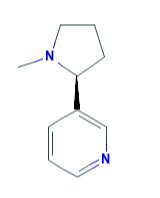
- Nicotine is both a sedative and stimulant. Hence statement 1 is correct.
- Recent studies suggest that nicotine has several cancer-causing effects:
- In small doses, nicotine speeds up cell growth and in larger doses, it is poisonous to cells.
- Nicotine kick-starts a process called epithelial-mesenchymal transition (EMT). EMT is one of the important steps in the path toward malignant cell growth.
- Nicotine decreases the tumor suppressor CHK2. This may allow nicotine to overcome one of the body’s natural defenses against cancer.
- Nicotine can abnormally speed up the growth of new cells. This has been shown in tumor cells in the breast, colon, and lung.
- Nicotine can lower the effectiveness of cancer treatment. Hence, statement 2 is correct.
- Karnataka has amended Poisons (Possessions and Sale) Rules 2015 by notifying nicotine as Class A poison.
- The move aims at strengthening the enforcement of the ban on production and sale of electronic cigarettes. Hence, statement 3 is not correct.
Question 14:
With reference to Amravati School of Art, consider the following statements:
- It has Greek and Roman influence.
- The sculptures mainly focus on narrative art.
- Use of white marble was a special feature of this school.
Which of the statements given above is/are correct?
1 and 2 only
2 only
2 and 3 only
1, 2 and 3
Correct Answer : C
Explanation
Amravati School of Art flourished in the Andhra region of southeastern India from about the 2nd century BC to the end of the 3rd century AD, during the rule of the S?tav?hana dynasty. It flourished in the Krishna River Valley.
- It was developed indigenously and not influenced by external cultures. Hence, statement 1 is not correct.
- The sculptures are generally part of narrative art, there is less emphasis on the individual features of Buddha. The sculptures generally depict life stories of Buddha and the Jataka tales.
- Amaravati sculptures have a sense of movement and energy with profound and quiet naturalism in human, animal and floral forms. Hence, statement 2 is correct.
- The major centres were Amravati and Nagarjunakonda.
- Amaravati School of Art predominantly made use of a distinctive white marble, which was not used in Mathura or Gandhara Style. Hence, statement 3 is correct.
Question 15:
Consider the following statement:
- The National Physical Laboratory (NPL) is India’s official reference keeper of units of measurements.
- The National Physical Laboratory is a body under the Ministry of Consumer Affairs.
- The definition of the kilogram is based on Planck constant.
Select the correct answer using the code given below:
1 and 3 only
2 only
2 and 3 only
1, 2 and 3
Correct Answer : A
Explanation
- The National Physical Laboratory (NPL), which is India’s official reference keeper of units of measurements, released a set of recommendations to update the definition of the kilogram. Hence, statement 1 is correct.
- The National Physical Laboratory, India was set up in 1900. It is one of the earliest national laboratories set up under the Council of Scientific & Industrial Research (CSIR). Hence, statement 2 is not correct.
- In 2018, at the General Conference on Weights and Measures (CGPM) in Versailles (France), delegates of the International Bureau of Weights and Measures (BIPM) had voted to redefine the kilogram in terms of Planck constant.
- Earlier, the kilogram derived its provenance from the weight of a block of a platinum-iridium alloy housed at the International Bureau of Weights and Measures in France. Hence, statement 3 is correct.
Question 16:
Consider the following pairs:
Which of the pairs given above is/are correctly matched?
1 and 2 only
2 and 3 only
1, 2 and 3
1, 2 and 4
Correct Answer : A
Explanation
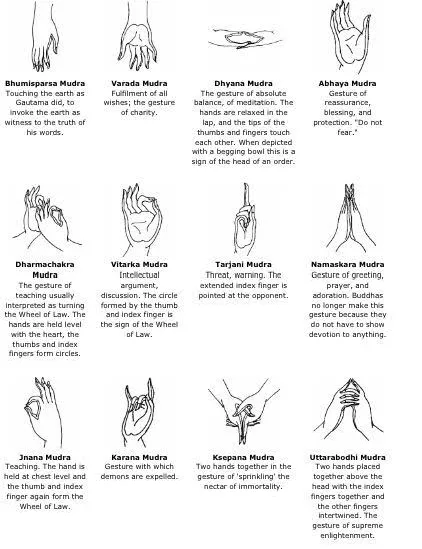
Various Mudras Related to Buddha
- Bhumisparsha Mudra: It depicts the Buddha sitting in meditation with his left hand, palm upright, in his lap, and his right hand touching the earth.
- It signifies ‘Calling the Earth to Witness the Truth’, and it represents the moment of Buddha’s attaining enlightenment. Hence, pair 1 is correctly matched.
- Dhyana Mudra: It indicates meditation and is also called ‘Samadhi’ or ‘Yoga’ Mudra.
- It signifies the attainment of spiritual perfection.
- Abhaya Mudra: It symbolizes strength and inner security. It is a gesture which instills a sense of fearlessness to others as well. Hence, pair 2 is correctly matched
- Dharmachakra Mudra: It means ‘Turning the Wheel of the Dharma or Law’, i.e., setting into motion the wheel of Dharma.
- It represents the first sermon in Sarnath after he attained enlightenment.
- Vajra Mudra: This mudra signifies the importance of knowledge or supreme wisdom. Knowledge is represented by the forefinger and the fist of the right hand protects it.
- This mudra is better known in Korea and Japan.
- In this mudra, the erect forefinger of the left hand is held in the fist of the right hand. It is seen in the mirror-inverted form also. Hence, pair 3 is not correctly matched.
- Vitarka Mudra: It indicates teaching and discussion or intellectual debate.
- Anjali Mudra: It signifies greetings, devotion, and adoration. It is a common gesture used in India to greet people (Namaste). It signifies adoration of the superior and considered a sign of regards with deep respect. Hence, pair 4 is not correctly matched.
- Uttarabodhi Mudra: It means supreme enlightenment. This mudra is known for charging one with energy. It symbolises perfection.
- Varada Mudra: It indicates charity, compassion or granting wishes.
- It signifies five perfections: generosity, morality, patience, effort and meditative concentration, through the five extended fingers.
- Karana Mudra: It indicates warding off evil. The energy created by this Mudra helps remove obstacles such as sickness or negative thoughts.
Question 17:
The temple is internally and externally carved from solid rock, with exquisite precision, to build a monolithic rock temple. It is one of the largest rock-cut temples in the world. The temple is dedicated to Lord Shiva and it was constructed by Rashturkuta kings.
Identify the temple discussed in the above paragraph?
Mahabalipuram Shore Temple
Pancha Rathas Temple
Kailasa Temple
Kandariya Mahadeva Temple
Correct Answer : C
Explanation
- The construction of the Kailasa temple began during the rule of the Rashtrakuta king, Dantidurga (735-757 AD). A group of skilled artisans cut and carved the vertical face of the basalt rock of a hill in Elapura, known today as Ellora, near Aurangabad.
- Unlike the Buddhists who made carvings inside the rock to construct cave temples, this group cut the rock internally and externally, with exquisite precision, to build a monolithic rock temple.
- Major work on the temple was done by King Dantidurga’s successor, Krishna I (757-773 AD), although work continued under many successive kings for more than a century. Hence, option C is correct.
- Pancha Rathas also referred to as Pandava Rathas are the most excellent architectural edifices of the nine monolithic temples of Mahabalipuram situated on the Coromandel Coast of the Bay of Bengal. These are five monolithic temple structures built by the Pallavas in the early 7th century AD.
- Shore Temple is one among a number of Hindu monuments at Mamallapuram (Mahabalipuram), on the Coromandel Coast of Tamil Nadu. It is considered the finest early example of medieval southern Indian temple architecture.
- It was built probably in the reign of Narasimhavarman II, also known as Rajasimha (Pallava ruler) who reigned from 700 to 728 CE.
- Unlike most of its neighbours at the site, it is built of cut stones rather than carved out of caves.
- Kandariya Mahadeva Temple occupies an area of about 6,500 square feet and rises 117 feet above ground level. The meaning "the Great God of the Cave", is the largest and most ornate Hindu temple in the medieval temple group found at Khajuraho in Madhya Pradesh. It is considered one of the best examples of temples preserved from the medieval period in India.
It is the largest of the western group of temples in the Khajuraho complex which was built by the Chandela rulers. Shiva is the chief deity in the temple deified in the sanctum sanctorum.
Question 18:
With reference to India’s culture and tradition, what is 'Kalaripayattu'?
It is an ancient Bhakti cult of Shaivism still prevalent in some parts of South India
It is an ancient style bronze and brass work still found in southern part of Coromandel area
It is an ancient form of dance-drama and a living tradition in the northern part of Malabar
It is an ancient martial art and a living tradition in some parts of South India
Correct Answer : D
Explanation
- Kalaripayattu means ‘practicing the arts of the battlefield’. Considered to be more than 2000 years old, it is practiced widely in Kerala and in the fringes of Karnataka and Tamil Nadu and also in Sri Lanka.
- It is probably the oldest form of martial arts in India and across the world and is believed to have been founded by Parasurama. It is said to be forerunner of Chinese martial art (Kung-fu) as the Buddhist monk Bodhidharma took this art from India to China.
- It finds reference in the Dhanurveda (an Upveda) also known as the Indian Science of Warfare. It is also referenced in the Sangam literature.
- The art reached its zenith during the hundred years of war between the Cholas, Pandyas and Cheras. During the 13th and 16th centuries, the art was incorporated into many religions as well.
- It primarily emphasises on footwork patterns and the ability to strike at vital points. It includes strikes, kicks and the use of weapons. It is a silent combat, where style matters the most and it is not accompanied by any music or drumming.
- The demonstration of Kalaripayattu includes physical exercise and mock duel (armed and unarmed). It is practiced by women also. Hence, option (d) is correct.
Question 19:
Which of the following statements is/are correct regarding measles?
- It is a contagious disease caused by bacteria.
- It can be prevented with the MMR vaccine.
- It is not covered under the Universal Immunization Programme (UIP).
Select the correct answer using the code given below:
1 and 2 only
2 only
2 and 3 only
1, 2 and 3
Correct Answer : B
Explanation
- Measles virus is an enveloped ribonucleic acid virus of the genus Morbillivirus. It is highly contagious, and an infected person will often transmit the virus to over 90% of unprotected close contacts. Hence, statement 1 is not correct.
- The virus infects the respiratory tract, then spreads throughout the body. Measles is a human disease and is not known to occur in animals.
- Measles can be entirely prevented through a two-dose vaccine and had been officially eliminated in many countries with advanced healthcare systems. It can be prevented with MMR vaccine. The vaccine protects against three diseases: measles, mumps, and rubella. Hence, statement 2 is correct.
- Government of India is providing vaccination free of cost against vaccine-preventable diseases include diphtheria, pertussis, tetanus, polio, measles, a severe form of childhood tuberculosis, hepatitis B, meningitis and pneumonia (Haemophilus influenzae type B infections), Japanese encephalitis (JE) in JE endemic districts. Hence, statement 3 is not correct.
Question 20:
Consider the following statements:
- The Ajanta caves were constructed only during the Mahayana phase of Buddhism.
- The themes of Ellora caves are based on Hinduism, Buddhism and Jainism traditions.
Which of the statements given above is/are correct?
1 only
2 only
Both 1 and 2
Neither 1 nor 2
Correct Answer : B
Explanation
- The Ajanta caves were inscribed by the Buddhist monks, under the patronage of the Vakataka kings – Harishena being a prominent one. The figures in these caves were done using fresco painting and demonstrate considerable naturalism.
- The paintings are generally themed around Buddhism – the life of Buddha and Jataka stories. Of the 29 caves, 5 were developed during the Hinayana phase while the remaining 24 were developed during the Mahayana phase of Buddhism. Hence, statement 1 is not correct.
- Ellora caves are located in the Sahyadri range of Maharashtra. It is a group of 34 caves – 17 Brahmanical, 12 Buddhist and 5 Jain. These set of caves were developed during the period between the 5th and 11th centuries A.D.
- Built by various guilds from Vidarbha, Karnataka and Tamil Nadu. Hence, the caves reflect a natural diversity in terms of theme and architectural styles.
- Caves 1-12: Buddhist Caves
- 13-29: Hindu Caves
- 30-34: Jain (Digambara sect)
- Hence, statement 2 is correct.
- Built by various guilds from Vidarbha, Karnataka and Tamil Nadu. Hence, the caves reflect a natural diversity in terms of theme and architectural styles.