
Unlocking India’s Bioeconomy Potential | 08 Dec 2025
This editorial is based on “India can build a $1.2-trillion bioeconomy by 2047” which was published in The Hindu on 08/12/2025. The article brings into picture the rapid rise of India’s bioeconomy and contrasts it with China’s successful biotech overhaul driven by capital access and strong regulation. It highlights that with similar reforms, India’s growing strengths in genomics and biomanufacturing can position it as a global biotech leader by 2047.
For Prelims: India's bioeconomy, BioE3 Policy, Net-Zero 2070, Genome India Project, GM mustard hybrid DMH‑11, Ethanol Blending, Biosimilars
For Mains: Major Advancements India has Made in its Bio-economy, Major Challenges Confronting India’s Bio-economy.
India's bioeconomy has surged from $10 billion to $165 billion over the past decade, yet reaching the $1.2 trillion target by 2047 requires transformative reforms beyond scientific capability. China's decade-long transformation through dedicated biotech listing boards and a restructured, science-led regulatory authority demonstrates the blueprint, attracting $45 billion in venture capital and spawning over 200 globally competitive biotech firms. India’s biotech sector stands on the brink of a breakthrough, with strengths in genomics, biopharma, and bio-manufacturing positioning it to lead the next wave of global innovation. With regulatory modernisation and deeper capital access, India can evolve into a world-scale biotech powerhouse by 2047.
What are the Major Advancements India has Made in its Bio-economy?
- Exponential Expansion of Bioeconomy: India has successfully transitioned from a nascent biotech player to a global powerhouse by decoupling growth from fossil dependency and integrating circular bio-resources into the core GDP, growing at a pace that significantly outstrips global averages.
- India's bioeconomy has grown from $10 billion in 2014 to $165.7 billion in 2024, with a target of $300 billion by 2030.
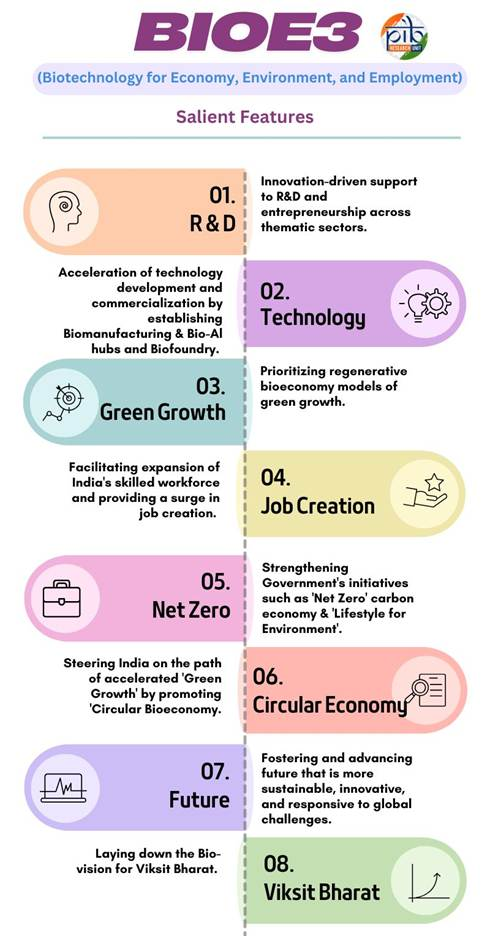
- Strategic Policy Shift- BioE3 Framework: The Cabinet-approved BioE3 Policy marks a structural shift towards "High-Performance Biomanufacturing," aiming to industrialize biology by replacing chemical-based processes with Bio-Foundries and Bio-AI Hubs to create a self-reliant bio-manufacturing ecosystem.
- Targets 6 thematic sectors (e.g., smart proteins, precision biotherapeutics) and establishes a network of Bio-Enabler Hubs to support India’s Net-Zero 2070 climate goals.
- Genomic Sovereignty & Precision Medicine: India has secured "Genomic Sovereignty" by completing the Genome India Project, creating a distinct indigenous reference genome that corrects the Euro-centric bias in global medical databases and enables precision medicine tailored to India's unique ethnic diversity.
- For instance, Indian scientists complete whole genome sequencing of 10,000 individuals, revealing population specific variations and variants related to diseases.
- Global Biopharma & Vaccine Leadership: Moving beyond volume dominance as the "Pharmacy of the World," India is climbing the value chain into novel biologics and biosimilars, strengthening R&D capabilities to reduce import reliance for critical immunotherapies and high-value drugs.
- India broke into the Top 10 of Cytiva’s Global Biopharma Index 2025. Serum Institute of India is now the world's largest vaccine manufacturer by number of doses produced and sold globally (more than 1.5 billion doses).
- Energy Security via Bio-Fuel Integration: The country has aggressively operationalized bio-energy to create a robust agrarian-energy nexus, effectively utilizing agricultural waste (parali) to lower crude oil imports and carbon emissions while boosting farmer incomes.
- India achieved 20% Ethanol Blending (E20) in 2025, 5 years ahead of the original 2030 target, saving approx. ₹1.44 lakh crore in forex and substituting 244 Lakh Metric Tonnes of crude oil.
- Deep-Science Startup Ecosystem: The innovation landscape has matured from academic research to commercial viability, driven by BIRAC’s "lab-to-market" funding, creating a deep-science pipeline that attracts private equity and solves grassroots challenges in health and agriculture.
- The number of biotech startups has skyrocketed from just 50 in 2014 to nearly 9,000 as of February 2025, making India a global hub for biotech innovation.
- Also, India has 12 DBT-supported biotechnology parks and 95 BIRAC-supported bio-incubators (75 Bio-NEST and 20 E-Yuva centres), as of August 2025.
- Resilience in Agricultural Biotechnology: Despite regulatory caution, the Bio-Agri sector is advancing towards technology-driven food security through the development of climate-resilient GM crops and bio-stimulants, balancing productivity needs with environmental sustainability.
- For instance, the GM mustard hybrid DMH‑11, developed in India, is projected by experts to raise mustard yields by about 25–30% compared with existing varieties.
What are the Major Challenges Confronting India’s Bio-economy?
- Stagnant R&D Investment: India's bio-innovation ecosystem is stifled by chronic underinvestment, creating a "resource trap" where researchers lack funds for high-risk moonshots.
- The private sector's reluctance to share the R&D burden forces heavy reliance on government grants, limiting the scale of breakthrough discoveries compared to global peers.
- India's Gross Expenditure on R&D (GERD) stagnates at 0.64-0.7% of GDP compared to the global average of 1.8%.
- Regulatory Gridlock in Agri-Biotech: The agricultural biotechnology sector is paralyzed by policy unpredictability and judicial deadlock, specifically regarding the commercialization of Genetically Modified (GM) crops.
- This "regulatory freeze" deters foreign investment and denies farmers access to climate-resilient seeds, keeping India dependent on edible oil imports despite having indigenous solutions.
- Despite GEAC approval, GM Mustard (DMH-11) remains stalled by Supreme Court split verdict, leaving Bt Cotton (2002) as India’s only commercialized GM crop for over two decades.
- Critical "Import Addiction" in Supply Chains: The bio-pharma and medtech sectors face a massive vulnerability due to reliance on external supply chains for upstream raw materials and high-end equipment.
- This dependence on imported Key Starting Materials (KSMs) and advanced diagnostics compromises national health security and erodes profit margins for domestic manufacturers.
- India imports 70-80% of its medical devices and relies on China for over 70% of critical APIs, despite recent PLI schemes attempting to bridge this gap.
- The "Valley of Death" in Funding: Deep-science startups face a lethal funding gap between proof-of-concept and commercialization, where risk capital evaporates.
- While early-stage grants (BIRAC) are plentiful, the lack of patient late-stage venture capital forces promising biotech firms to either shut down or sell their IP abroad before reaching industrial scale.
- This pattern is described as resulting in Indian biotech companies contributing talent and intellectual property to foreign economies instead of scaling domestically, reinforcing the “forced to sell IP or move out before industrial scale” narrative.
- Bio-Manufacturing Infrastructure Void: The ambition of the BioE3 policy clashes with the reality of fragmented and insufficient bio-manufacturing infrastructure. The acute lack of industrial-scale fermentation tanks ("Bio-Foundries") and pilot plants creates a bottleneck where lab-proven technologies cannot be mass-produced domestically, forcing outsourcing to contract manufacturers.
- India holds just 1.5% of the global MedTech market due to infra gaps, and high-end bio-manufacturing remains limited to a few clusters like Genome Valley, delaying the $300 Bn bioeconomy target.
- The Innovation-Commercialization Paradox: There is a glaring disconnect between "Academic Output" and "Commercial Impact," where India produces high volumes of research papers but low numbers of globally granted patents.
- This means Indian taxpayer-funded research often fails to translate into marketable products, leading to a "Brain-to-Paper" cycle rather than a "Lab-to-Market" pipeline.
- Despite ranking 39th in the Global Innovation Index 2024, India lags significantly in "knowledge impact" and IP creation.
- Talent Mismatch in High-End Bio-Sciences: The sector battles a "Quality-Quantity Mismatch" in human capital, producing thousands of graduates who lack practical skills in emerging fields like synthetic biology or AI-driven drug discovery.
- This talent gap necessitates expensive retraining or improved academia-industry linkages to make the workforce "industry-ready" for the BioE3 era.
- Industry reports highlight a critical shortage of specialized talent in bioinformatics and biologics, with the BioE3 policy (2024) specifically citing this skill gap as a major hurdle for establishing Bio-AI Hubs.
What Steps can India take to Strengthen and Accelerate the Growth of its Bio-economy Sector?
- Operationalize "Plug-and-Play" Bio-Foundries: To bridge the critical gap between lab-scale innovation and industrial production, India must aggressively establish a network of shared Bio-Foundries and Pilot-Scale Facilities accessible to startups on a pay-per-use basis.
- This infrastructure-as-a-service model will lower the capital expenditure barrier for deep-tech firms, allowing them to validate technologies at a pre-commercial stage without incurring the massive cost of building private fermentation or downstream processing plants, thus directly solving the "scale-up bottleneck."
- Institutionalize a "Science-First" Regulatory Sandbox: The regulatory framework needs a paradigm shift from a "policing" model to a "facilitating" model by creating Regulatory Sandboxes specifically for synthetic biology and gene editing.
- By allowing parallel processing of clinical trial phases and separating scientific assessment from administrative licensing, the government can drastically reduce the "time-to-market" for novel biologics.
- This creates a predictable policy environment that encourages risk-taking and attracts foreign direct investment into cutting-edge research.
- Create a Dedicated "Biotech Innovation Board" for Capital: To solve the "Valley of Death" funding crisis, financial regulators should introduce a specialized Biotech Innovation Listing Board on stock exchanges, similar to global models that allow pre-revenue R&D companies to list based on intellectual property value rather than profit history.
- This would unlock domestic "Patient Capital" from retail and institutional investors who understand the long gestation periods of deep science, reducing the sector's over-reliance on government grants and fickle foreign venture capital.
- Mandate "Bio-AI" Integration in Workforce Skilling: The current skills gap requires an immediate overhaul of the academic curriculum to integrate Artificial Intelligence and Data Science directly into biotechnology programs.
- By fostering a hybrid workforce proficient in "Computational Biology" and "In-silico Drug Discovery," India can create a talent pool capable of leveraging big data to accelerate research.
- This moves the workforce beyond traditional bench-work, preparing them for the high-value, tech-driven demands of the BioE3 era.
- Incentivize Domestic Production of Key Starting Materials (KSMs): To insulate the bio-economy from geopolitical shocks and supply chain disruptions, the government must extend Production Linked Incentive (PLI) schemes specifically to the upstream manufacturing of biological raw materials and bioreactor components.
- Reducing import dependence for these critical inputs will not only secure national health security but also improve the profit margins of Indian biopharma exporters, making them globally competitive against dominant market players.
- Establish "Technology Transfer Offices" (TTOs) in Academia: There is an urgent need to professionalize the commercialization interface between research institutes and industry by mandating dedicated Technology Transfer Offices in all major universities.
- These units should be staffed with industry veterans rather than academics, focused solely on patent valuation, IP licensing, and spinning off academic research into viable startups.
- This measure effectively converts India's high volume of research publications into tangible economic assets and marketable products.
- Leverage "Genomic Data Sovereignty" for Precision Care: India should monetize its vast genetic diversity by treating the Indian Biological Data Centre (IBDC) as a strategic asset for global pharmaceutical partnerships.
- By creating a secure, privacy-compliant framework for accessing this genomic data, India can attract global R&D centers to develop "Precision Medicine" tailored to non-European populations.
- This positions India not just as a manufacturing hub, but as an indispensable partner in the global discovery value chain for next-generation therapeutics.
Conclusion:
India’s bio-economy stands at a decisive inflection point-armed with strong scientific capabilities, a booming startup ecosystem, and ambitious policy frameworks like BioE3. Yet unlocking its full potential demands bold regulatory reform, deeper capital access, and world-class bio-manufacturing infrastructure. With strategic investments in talent, technology, and genomic sovereignty, India can shift from being a biotech participant to a global innovation leader. If these transformative steps are sustained, India is well-positioned to emerge as a $1.2 trillion bio-economy powerhouse by 2047.
|
Drishti Mains Question: Highlight the recent achievements of India’s bioeconomy. What structural challenges persist in the sector, and what policy interventions are required to ensure sustainable and inclusive bioeconomic growth? |
FAQs
Q. What is driving the rapid growth of India’s bioeconomy?
India’s bioeconomy is expanding due to advancements in genomics, biomanufacturing, vaccines, biofuels, and a strong startup ecosystem supported by initiatives like BIRAC and the BioE3 Policy.
Q. Why is the BioE3 Policy considered a game changer?
The BioE3 Policy shifts India toward high-performance biomanufacturing by establishing Bio-Foundries, Bio-AI hubs, and Bio-Enabler networks, helping industrialize biology and reduce dependence on chemical-based processes.
Q. What is the biggest challenge facing India’s biotech startups?
The largest barrier is the “Valley of Death” funding gap—startups struggle to access late-stage capital required to scale innovations from lab-level to commercial production.
Q. Why is regulatory reform crucial for India’s bioeconomy?
Outdated and fragmented regulations slow down approvals for genetically edited crops, novel biologics, and deep-science innovations. A science-led, predictable regulatory system is essential to attract investment and speed up commercialization.
Q. How can India become a global biotech leader by 2047?
India must invest in biofoundries, strengthen domestic supply chains, expand precision-medicine capabilities, boost R&D spending, and create a dedicated biotech capital market similar to global innovation boards.
UPSC Civil Services Examination, Previous Year Question (PYQ)
Prelims
Q. Other than resistance to pests, what are the prospects for which genetically engineered plants have been created? (2012)
- To enable them to withstand drought
- To increase the nutritive value of the produce
- To enable them to grow and do photosynthesis in spaceships and space stations
- To increase their shelf life
Select the correct answer using the codes given below:
(a) 1 and 2 only
(b) 3 and 4 only
(c) 1, 2 and 4 only
(d) 1, 2, 3 and 4
Ans: (c)