
Reimagining Corporate Social Responsibility in India | 24 Dec 2025
This editorial is based on “Step up: On corporate environmental responsibility” which was published in The Hindu on 23/12/2025. The article highlights how corporate-led growth has intensified environmental stress, making stronger corporate environmental responsibility essential for sustainable development.
For Prelims: CSR,SDG,companies Act 2013,Injeti Srinivas Committee on CSR,Art 51(g)
For Mains:CSR success and limitations, measure to unlock the potential of csr
In the face of accelerating environmental degradation and climate risk, simply ticking CSR checkboxes is no longer enough; corporate India must embed genuine environmental stewardship into its core responsibilities. While CSR spending in India has expanded steadily and compliance levels remain high, environmental initiatives continue to be largely project-based and peripheral to core business decisions. Weak enforcement, greenwashing, and limited outcome measurement dilute the developmental impact of CSR-led environmental action. Yet, with stronger regulation, constitutional anchoring of environmental duties, and outcome-oriented CSR reforms, corporate India can emerge as a key partner in sustainable development.
What is Corporate Social Responsibility?
- About: Corporate Social Responsibility (CSR) is a business model where companies integrate social and environmental concerns into their operations.
- While globally it is often voluntary, India became the first country in the world to make CSR a legal mandate through the Companies Act, 2013.
- Statutory Framework in India: The CSR mandate is governed by Section 135 of the Companies Act, 2013, and the Companies (CSR Policy) Rules, 2014.
- Eligibility Criteria: A company must comply with CSR provisions if it meets any one of the following thresholds during the immediately preceding financial year:
- Net Worth: ₹500 Crore or more.
- Turnover: ₹1,000 Crore or more.
- Net Profit: ₹5 Crore or more.
- The "2% Mandate" (Spending Requirement): Eligible companies are legally required to spend at least 2% of their average net profits made during the three immediately preceding financial years on CSR activities.
- Eligibility Criteria: A company must comply with CSR provisions if it meets any one of the following thresholds during the immediately preceding financial year:
- Permitted Activities (Schedule VII): Companies cannot spend CSR funds on just anything. The activity must fall under Schedule VII of the Act, which includes:
- Eradication of hunger, poverty and malnutrition; healthcare, sanitation and safe drinking water
- Promotion of education, vocational skills and livelihood enhancement.
- Gender equality, women empowerment and support for senior citizens and vulnerable groups
- Environmental sustainability, ecological balance and conservation of natural resources
- Protection and promotion of national heritage, art, culture and traditional crafts
- Welfare of armed forces, CAPF and paramilitary veterans and their dependents
- Promotion of rural, national, Paralympic and Olympic sports
- Contributions to Prime Minister’s relief and other government welfare funds
- Support to research, innovation, incubators and public-funded institutions aligned with SDGs
- Non-Compliance & Penalties: India shifted from a "Comply or Explain" model to a "Comply or Be Penalized" model in 2021.
- Unspent Funds: If the unspent amount relates to an Ongoing Project, it must be transferred to a special "Unspent CSR Account" within 30 days of the FY end and spent within 3 years.
- If not for an ongoing project, it must be transferred to a government-specified fund (Schedule VII) within 6 months.
- Penalties:
- Company: Twice the unspent amount or ₹1 Crore (whichever is less).
- Defaulting Officers: 1/10th of the unspent amount or ₹2 Lakh (whichever is less).
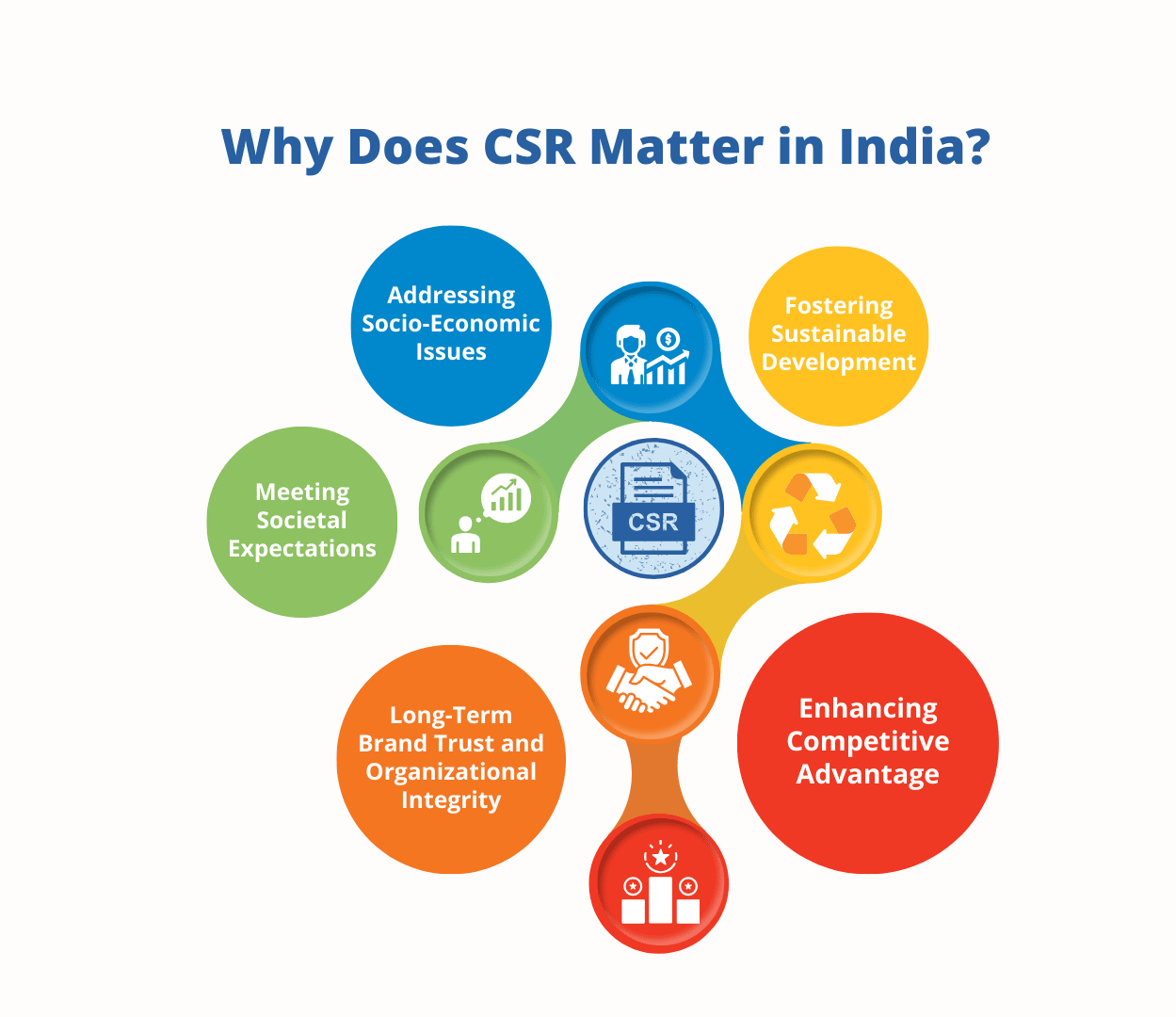
How does Corporate Social Responsibility Drive India’s Socio-Economic Development?
- Bridging Development Gaps: CSR supplements government efforts in health, education, skill development, and rural infrastructure, helping address unmet social needs and promote inclusive growth.
- For example, Indian corporates spent a record ₹34,909 crore on Corporate Social Responsibility (CSR) initiatives in FY 2023-24, a 13% rise from the previous year, according to Fulcrum's latest Bharat CSR Performance Report.
- Companies like Tata Group and Infosys have supported large-scale school infrastructure, digital classrooms, and primary healthcare projects, directly improving access in aspirational and rural districts
- Ensuring Sustainable Development: By encouraging environmentally responsible practices, CSR balances economic growth with ecological protection and long-term resource sustainability.
- Infosys has committed to net zero emissions by 2040, aligning with the national goals.
- ITC’s watershed development projects have helped create water-positive outcomes in drought-prone regions, aligning business growth with ecological balance
- Stakeholder-Centric Governance: CSR reflects a shift from shareholder-only focus to stakeholder responsibility, ensuring businesses remain accountable to employees, communities, and society at large.
- Firms increasingly engage local communities in project design, seen in Mahindra & Mahindra’s skill development programmes, which align training with local employment needs
- Supporting Long-Term Business Stability: CSR reduces social, environmental, and regulatory risks, creating a stable operating environment and supporting long-term profitability.
- For instance,L&T’s construction skill councils reduced project delays by creating a trained local workforce.
- Ethical and Moral Responsibility: Since businesses benefit from public resources and social stability, CSR embodies the ethical obligation to give back to society.
- Also, Ethical conduct and social engagement under CSR improve corporate credibility, brand value, and public trust, strengthening the social licence to operate.
- For instance, approximately 49% of eligible listed companies exceeded their prescribed 2% CSR spending requirement, showing positive trends in CSR allocation.
- Philanthropy-led models like Azim Premji Foundation’s education work exemplify this moral dimension.
- Also, Ethical conduct and social engagement under CSR improve corporate credibility, brand value, and public trust, strengthening the social licence to operate.
- Aligning with National and Global Goals: CSR spending increasingly aligns with SDGs and national priorities such as Swachh Bharat, Skill India, and Jal Jeevan Mission.
- CSR is no longer just "philanthropy" but "National Development Capital." In FY 2023-24 alone, 97% of funds (approx. ₹33,840 crore) were spent directly on social projects rather than just being transferred to government funds.
- It indicates that companies are actively implementing programs that mirror the Jal Jeevan and Skill India missions on the ground.
- For instance, companies like HDFC Bank and Reliance have integrated water security into their "Rural Development" portfolios.
- CSR is no longer just "philanthropy" but "National Development Capital." In FY 2023-24 alone, 97% of funds (approx. ₹33,840 crore) were spent directly on social projects rather than just being transferred to government funds.
What are the Key Challenges Limiting the Developmental Impact of CSR in India?
- Uneven Regional Reach and Limited Depth of Social Impact: Despite large cumulative CSR spending, developmental benefits remain spatially and sectorally concentrated.
- Over 60% of CSR funds are absorbed by a handful of industrialised states, while many Aspirational Districts and tribal regions receive limited support.
- CSR projects often focus on visible infrastructure rather than long-term human development outcomes, leading to fragmented impact.
- For instance, education-related CSR spending is skewed towards urban digital classrooms, while rural learning outcomes remain weak.
- Peripheral Environmental Action: Environmental initiatives by many companies remain largely symbolic and detached from core business operations, dominated by short-term activities.
- For instance, Environmental sustainability initiatives account for less than 15% of total CSR expenditure, and many firms rely on standalone projects such as plantation drives rather than systemic emission reduction.
- While companies announce net-zero commitments, independent ESG reviews show limited coverage of supply-chain (Scope-3) emissions, diluting real sustainability gains.
- Episodic Spending and "Short-Termism": The pressure of the annual 2% mandate forces a cycle of "episodic spending" where companies fund quick, high-visibility projects to meet yearly deadlines rather than committing to decade-long transformations.
- They fail to invest in the "Soft Infrastructure"-long-term infrastructure development, water supply integration, and waste management systems.
- This undermines trust and creates a "grant-dependency" culture among NGOs who cannot plan for long-term staff or infrastructure.
- For instance, in FY 2024, nearly 65% of CSR-active organizations implemented fewer than 5 projects, often as one-time grants.
- Strategic Misalignment and Fragmented Efforts: CSR is frequently treated as a "compliance tax" managed by HR or legal teams rather than being integrated into the core business strategy or national developmental goals.
- This leads to fragmented, small-scale interventions that lack the "multiplier effect" required to solve complex issues like malnutrition or deep-tech skilling.
- For instance, approximately 40% of Indian businesses report difficulty aligning CSR with their overarching business goals, leading to "random acts of kindness."
- Compliance-Driven Philanthropy and Concentration of Control: While nearly 49% of eligible companies exceed the 2% CSR spending norm, effectiveness varies.
- A significant share of funds is channelled through company-controlled foundations, raising concerns about independence, innovation, and grassroots reach.
- Smaller NGOs and community organisations face barriers in accessing CSR funding, restricting diversity of interventions.
What Measures Are Needed to Unlock the Full Potential of Corporate Social Responsibility?
- Targeted and Equitable Allocation: To address regional imbalance, CSR allocation should be guided by district-level development indicators rather than corporate location preferences.
- A national CSR prioritisation framework, similar to the UK’s “place-based social investment” model, can channel funds to Aspirational Districts and tribal areas. India can mandate partial convergence of CSR with District Development Plans (DDPs) to ensure complementarity with public schemes rather than duplication.
- Embedding Sustainability into Core Business and Value Chains: Environmental CSR must move beyond peripheral projects to business-integrated sustainability, as seen in the EU’s ESG-linked corporate responsibility model. Indian firms should link CSR with supply-chain decarbonisation, circular economy practices, and water stewardship.
- For example, Unilever’s global sustainability plan integrates supplier emissions and community outcomes, delivering measurable climate and livelihood benefits.
- Institutionalising Community Participation and Co-Creation: CSR effectiveness can be enhanced by mandating local stakeholder consultations at the design stage, similar to Brazil’s participatory development model.
- Indian companies should partner with Panchayats, SHGs, and local NGOs for needs assessment and monitoring.
- Successful pilots like Tata Trusts’ community-led rural development programmes show that local ownership improves sustainability and outcomes.
- Shifting from Event-Based Philanthropy to Long-Term Institution Building: To strengthen trust, CSR should prioritise long-duration projects with exit and maintenance plans, following the Nordic model of social investment, where funding spans 5–10 years.
- Indian firms can adopt multi-year CSR commitments for health and education infrastructure, ensuring trained personnel and operational funding beyond asset creation.
- Outcome-Oriented Skilling Linked to Market Demand: To improve employment conversion, CSR skilling must be industry-linked and demand-driven, as practiced under Germany’s dual vocational training system.
- Indian companies should co-design curricula with industry associations, provide apprenticeships, and track post-training employment for at least 12 months. L&T’s integrated training-to-employment model offers a scalable domestic template.
- Injeti Srinivas Committee recommends promoting outcome-based CSR, and encouraging collaboration with credible implementing agencies instead of company-controlled foundations.
- Deepening SDG Alignment Through Measurable Indicators: CSR–SDG convergence must move from symbolic mapping to indicator-based reporting, following the UN SDG Compass framework.
- Companies should define outcome metrics (learning levels, income enhancement, health indicators) rather than output counts. Japan’s SDG-linked corporate reporting demonstrates how measurable alignment improves accountability and scaling.
- Expanding Impact Assessment and Data Transparency: Impact assessment should be gradually extended to medium-sized CSR projects, supported by standardised tools and digital dashboards.
- Countries like Canada and Australia use centralised social-impact registries to track outcomes across sectors.
- India can strengthen the MCA CSR Portal into a real-time outcome monitoring platform, improving learning and evidence-based redesign.
- Reframing CSR as a Constitutional and Environmental Duty: CSR must move beyond voluntary charity and be anchored in Article 51A(g), which mandates protection of the environment as a fundamental duty, as emphasised by the Supreme Court.
- This requires companies to internalise environmental responsibility as a core obligation, not discretionary spending.
Conclusion
Corporate Social Responsibility has emerged as a vital instrument for advancing inclusive and sustainable development, contributing directly to SDG-4 (Quality Education), SDG-3 (Good Health), SDG-8 (Decent Work), and SDG-13 (Climate Action). While India’s CSR framework has scaled up in spending and compliance, its future impact depends on shifting from compliance-driven philanthropy to outcome-oriented, community-led, and business-integrated social investment.
|
Drishti Mains Question Discuss the role of corporate accountability and environmental governance in achieving sustainable development in India. Illustrate your answer with suitable examples. |
FAQs
1.What is Corporate Social Responsibility (CSR) ?
It refers to the role of companies in reducing environmental harm and promoting sustainable practices as part of their CSR obligations.
2. Why does the editorial stress environmental focus within CSR?
Because rapid economic growth has intensified pollution and ecological stress, making environmental responsibility a critical CSR priority.
3. What limitations of current CSR practices are highlighted?
CSR often remains voluntary and project-based, with weak enforcement and instances of greenwashing.
4. How does weak regulation affect CSR outcomes?
Poor monitoring and accountability allow companies to treat environmental CSR as a compliance exercise rather than a core responsibility.
5. What is the way forward for CSR as suggested by the editorial?
Strengthening regulations, transparency, and integrating environmental safeguards into business decisions to make CSR more effective.
UPSC Civil Services Examination, Previous Year Question
Mains
Q. Corporate social responsibility makes companies more profitable and sustainable. Analyse. (2017)