
Reforming India’s Air-Quality Governance | 22 Dec 2025
This editorial is based on “India’s pollution crisis is also about inclusion” which was published in The Indian Express on 20/12/2025. The article brings into picture how Air pollution disproportionately hampers the poor and marginalized classes. Further it highlights how policies around pollution have transferred institutional responsibility to individual innovation.
For Prelims:Air Pollution,NCAP,GRAP,AQI,Industrial Emission,Vehicular emission,
For Mains: Air pollution causes, key issues in regulation,measures to improve air pollution.
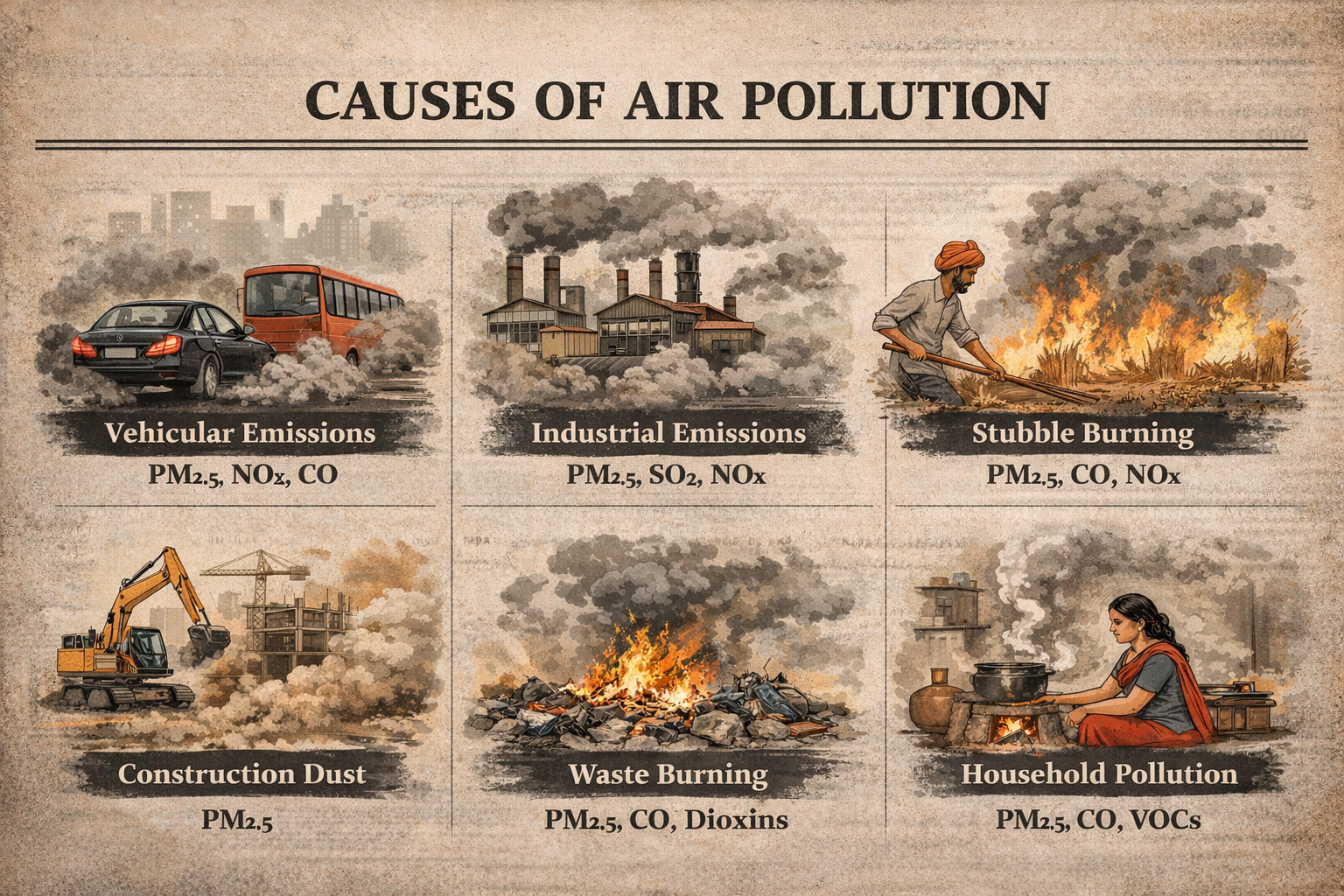
Air pollution continues to pose a serious public-health and governance challenge in India, with PM2.5 levels in many cities still 5–8 times above WHO limits, despite policy interventions. Recent winter episodes in the NCR triggered GRAP-IV measures as AQIcrossed 400, disrupting schools, transport and economic activity. While national data indicate a ~25% decline in particulate pollution since 2019 under the National Clean Air Program, episodic spikes from vehicles, construction dust and stubble burning persist. Encouragingly, tighter enforcement, real-time monitoring and regional coordination signal a gradual shift from crisis management to structural air-quality governance.
What Current Steps are Being Implemented in India to Manage and Control Air Pollution?
- National Clean Air Programme (NCAP): NCAP (launched 2019) was strengthened and has been revised toward an overall ~40% reduction in PM levels by 2026 for NCAP cities, backed by central funding to municipal/state agencies for specific interventions.
- Further 130+ cities given city-wise annual reduction targets (3–15% per year) and central grants to support actions.
- Independent tracking and government releases indicate ~25–27% reduction in particulate matter (PM) levels nationally in the 2019–2024 window, with NCAP cities showing similar improvement ranges.
- Graded Response Action Plan (GRAP): GRAP is a stage-wise emergency framework to control severe air pollution in the Delhi–NCR region. It mandates pre-defined measures linked to AQI levels, enabling timely, automatic restrictions on pollution sources such as construction, transport, and industry, under the supervision of the Commission for Air Quality Management (CAQM).
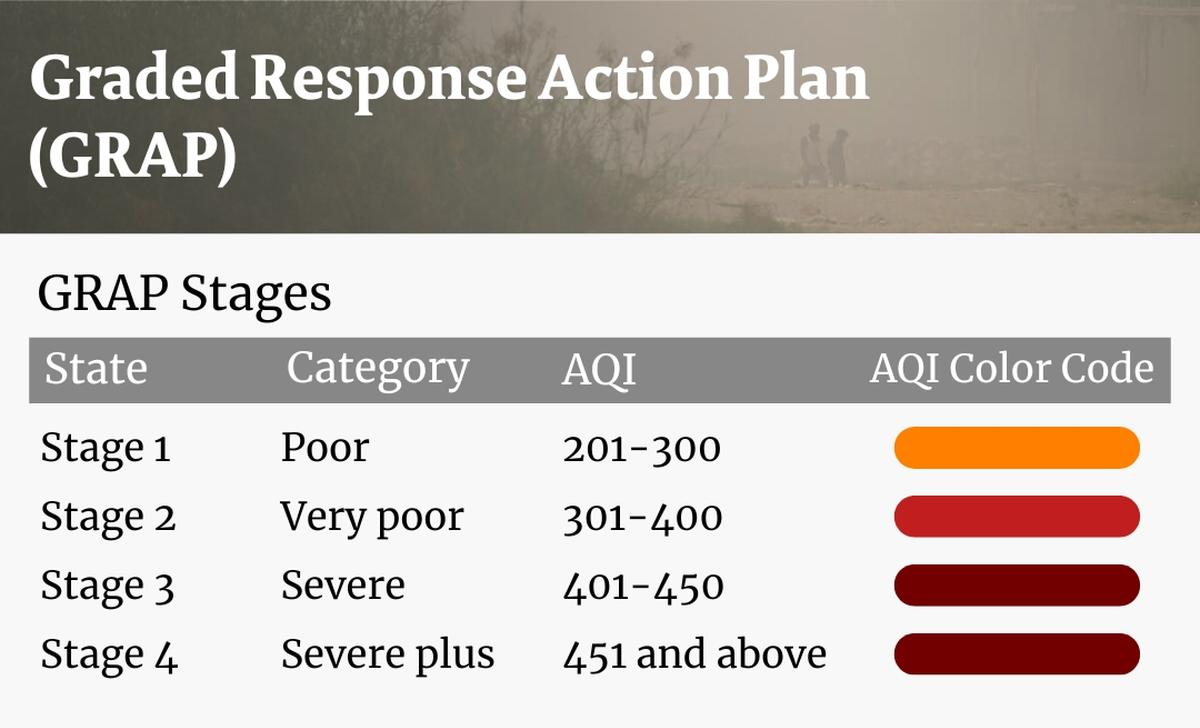
- Unlike earlier, GRAP now uses air-quality modelling and forecasts to automatically trigger actions in advance, instead of waiting for pollution to peak.
- This allows pre-emptive steps such as stopping construction work, implementing odd–even traffic rules, closing schools, and restricting diesel generators.
- For example, in December 2025, the Commission for Air Quality Management (CAQM) activated Stage IV measures when Delhi’s AQI crossed 430–440, even before it touched the extreme severe mark, to prevent further deterioration.
- Unlike earlier, GRAP now uses air-quality modelling and forecasts to automatically trigger actions in advance, instead of waiting for pollution to peak.
- Monitoring, Data & Forecasting: India has strengthened air-pollution control through expanded real-time monitoring and forecasting. The Central Pollution Control Board (CPCB) has widened the CAAQMS/NAQI network, providing live AQI data via national dashboards that help authorities trigger GRAP actions in time.
- Improved air-quality forecasting and modelling, developed through CPCB collaborations with the India Meteorological Department(IMD) and research institutions, enables early warnings and dynamic GRAP activation.
- In addition, low-cost sensors and citizen-led monitoring now complement official stations, improving local coverage and public awareness.
- Transport & Vehicular Emissions: Cities have tightened control over vehicular pollution through strict PUC enforcement and the “no-PUC, no-fuel” rule, especially in Delhi.
- Real-time checks led to a sharp rise in compliance; PUC issuance jumped by about 46% in just one day. In parallel, older vehicles are being phased out, with fuel denied to diesel vehicles older than 10 years and petrol vehicles older than 15 years (from July 2025), alongside tighter inspections to reduce on-road emissions.
- EV Push, Charging Infrastructure & Municipal Plans: Urban bodies are accelerating the shift to electric mobility by expanding charging infrastructure and reforming parking policies.
- For example, the Municipal Corporation of Delhi (MCD) plans to scale up EV charging stations from about 422 to nearly 994, aiming to cut congestion and idle emissions.
- This local push is supported by central and state incentives that subsidise EV adoption and the electrification of public transport, strengthening cleaner urban mobility.
- Industrial & Power Sector Controls:Industrial pollution control has been tightened through updated consent and emissions guidelines (2025), which introduce stricter timelines, clearer procedures, and closer monitoring by state-level committees to improve compliance.
- In the power sector, the Central Pollution Control Board (CPCB) and the Ministry of Environment, Forest and Climate Change (MoEFCC) are enforcing tougher emission norms for coal-based plants, including ESP upgrades and SOx/NOx controls. These measures, supported under the National Clean Air Programme (NCAP), aim to reduce industrial and power-sector emissions at the city level.
- For example, the Performance Achieve and Trade (PAT) scheme incentivises the industries to use energy efficient technologies.
- Agriculture / Crop-Residue (Stubble) Burning Solutions: To curb stubble burning, governments are scaling up in-situ residue management through subsidies for machines like happy seeders and straw mulchers, backed by financial incentives and procurement support under state action plans.
- Satellite-based monitoring enables quick detection of fire hotspots, allowing targeted enforcement, penalties, and timely incentives during peak burning months (Oct–Nov).
- As a result, the stubble burning in Punjab and Haryana has reduced by 50% this season as compared to 2024.
- These combined measures, used more actively in 2024–25 alongside GRAP warnings, aim to reduce open burning while offering farmers viable alternatives.
- Satellite-based monitoring enables quick detection of fire hotspots, allowing targeted enforcement, penalties, and timely incentives during peak burning months (Oct–Nov).
- Interventions to Curb Dust and Waste-Related Air Pollution: Urban local bodies are tightening dust-control measures through mechanized road sweepers, covered construction sites, wheel-wash facilities for trucks, and regular debris removal.
- For example, the Municipal Corporation of Delhi (MCD) has earmarked funds for sweepers and construction-dust control in its annual plans.
- 1,000 water sprinklers and 140 anti-smog guns are deployed across the city to combat dust pollution, particularly at the 13 identified air pollution hotspots.
- At the same time, cities are focusing on landfill management and preventing waste burning, including measures to stabilize and remediate major dumpsites like Okhla, Bhalswa, and Ghazipur, which are major contributors to winter smog.
- For example, the Municipal Corporation of Delhi (MCD) has earmarked funds for sweepers and construction-dust control in its annual plans.
- Public Health & Social Measures: Air-pollution response now places stronger emphasis on public health protection, especially for children, the elderly, and patients.
- Under GRAP, authorities issue health advisories, allow school closures or indoor activities, and alert hospitals during high-AQI episodes; some cities have also installed air purifiers in schools and hospitals, such as Delhi’s “Breathe Smart” classrooms initiative.
- At the same time, research on PM2.5 exposure and disease burden is increasingly used under the National Clean Air Programme (NCAP) to link cleaner air with long-term health benefits and guide policy decisions.
- Domestic Fuel & Household Emissions: India continues to reduce household pollution by promoting clean cooking fuels, with the Pradhan Mantri Ujjwala Yojana expanding LPG access and lowering reliance on biomass and coal, especially among vulnerable households.
- City action plans under NCAP also address domestic emission sources where they remain significant.
- In addition, targeted indoor air-quality measures, such as installing air purifiers in government-school classrooms during high-AQI periods, aim to protect children’s health during severe pollution episodes.
- Technology, Innovation & Private-Sector Engagement :India is leveraging air-quality technologies such as advanced forecasting, low-cost sensors, and satellite analytics, with strong support from private firms and NGOs.
- These platforms provide hyperlocal pollution maps, helping cities target interventions more precisely.
- For example, Project SAMEER (Science & Technology Alliance for Mitigation of Environmental Risks), leverages technologies such as Internet of Things (IoT)–based sensors to monitor and mitigate Delhi’s air pollution by bringing together academia (Indian Institute of Technology Delhi), industry, and government for real-time, data-driven solutions and public awareness initiatives
- Financing & Institutional Coordination: Air-pollution control is being strengthened through dedicated funding and better coordination.
- Cities receive targeted grants under the XV Finance Commission and the National Clean Air Programme (NCAP) for projects like monitoring, dust control, public transport, and green cover.
- At the institutional level, coordination among the Commission for Air Quality Management (CAQM), Central Pollution Control Board (CPCB), state pollution control boards, and municipal bodies has improved, with dynamic GRAP triggers and mandatory monthly reviews to ensure accountability and timely action.
What are the Key Issues Hindering the Effectiveness of Air Pollution Control Measures in India?
- Weak Urban Implementation Capacity: Despite clear targets under the National Clean Air Programme, several cities face shortages of trained staff, technical expertise, and project-management capacity.
- According to MoEFCC/NCAP review reports, many cities have been unable to fully utilise central funds on time, delaying measures such as mechanised road sweeping and pollution source apportionment studies.
- As a result, annual PM-reduction targets (3–15% per year) are often missed despite funding availability.
- According to MoEFCC/NCAP review reports, many cities have been unable to fully utilise central funds on time, delaying measures such as mechanised road sweeping and pollution source apportionment studies.
- Fragmented Governance and Poor Regional Coordination: Air pollution transcends administrative boundaries, but regulation remains fragmented across states and agencies.
- For instance, Delhi’s winter smog is significantly influenced by emissions from neighbouring states, yet enforcement responsibility is uneven.
- Even bodies like the Central Pollution Control Board primarily play a coordinating and advisory role, limiting their ability to ensure uniform compliance. This weak coordination reduces the effectiveness of region-wide responses such as GRAP.
- Seasonal and Episodic Pollution Peaks: India’s air pollution is highly seasonal. CPCB data show that PM2.5 levels in NCR nearly double during October–December, driven by temperature inversion, stubble burning, and increased emissions.
- For example, in November 2024–25, AQI crossed 400 (Severe) on multiple days despite year-round controls.
- Emergency actions like construction bans offer short-term relief but do not tackle structural sources behind these recurring spikes.
- Monitoring–Enforcement Mismatch: India has rapidly expanded real-time air-quality monitoring—over 900 continuous monitoring stations nationwide—but enforcement capacity has not grown proportionately.
- The “No PUC, No Fuel” drive in Delhi led to a ~46% spike in PUC demand in a single day, temporarily overwhelming systems and exposing enforcement bottlenecks.
- Data generation thus outpaces the ability of agencies to act consistently on violations.
- Economic and Livelihood Constraints: Pollution-control measures often impose immediate economic costs. Farmers face ₹2,000–3,000 per hectare costs for residue management without assured market linkages, leading to continued stubble burning despite subsidies.
- Similarly, restrictions on older vehicles disproportionately affect informal workers dependent on private transport.
- These livelihood pressures weaken compliance and create resistance to regulatory measures.
- Limited Behavioural Change and Public Compliance: Behavioural sources like private vehicle use, open waste burning, and firecrackers,remain significant contributors.
- CPCB assessments show that transport and dust together contribute over 40% of urban PM pollution in many cities.
- Awareness campaigns alone have not translated into sustained behavioural change, indicating the need for stronger incentives and nudges.
- The "Industrial Data Gap": While India has mandated Online Continuous Emission Monitoring Systems (OCEMS) for highly polluting industries, the system is plagued by data reliability issues.
- A recent assessment by the CEEW found that approximately 81% of monitored industrial stacks experienced more than 1,000 hours of missing data annually.
- Also, OCEMS data is often used only for "alerts." It is not yet widely accepted as primary legal evidence in courts to penalize industries, meaning State Pollution Control Boards (SPCBs) still rely on manual inspections, which are infrequent.
What Measures are Needed to Effectively Tackle the Issue of Air Pollution in India?
- Build City Implementation Capacity: Create dedicated Air Quality Cells (AQCs) in municipal corporations with full-time engineers, GIS/monitoring analysts and project managers; fund posted positions from NCAP/XVFC grants so cities aren’t hiring ad-hoc contract staff.
- Standardise project templates and procurement packs (for sweepers, sensors, CHC machines) so cities can deploy money fast without bespoke tender delays.
- Offer “capacity-building vouchers” (central funding for third-party project management/technical assistance) for small cities,short-term consultants to prepare DPRs, run procurement, and monitor outcomes.
- For instance, EU structural funds link grants to technical assistance for absorptive capacity.
- Strengthen Regional & Inter-State Coordination : Formalise interstate Pollution-Reduction Compacts with binding action schedules (emission inventories, mutually agreed milestones) for metro regions (e.g., NCR). Use a secretariat with legal mandate to track compliance and disburse conditional funds.
- CAQM’s region-level reviews show fewer fire counts when states coordinate; formal compacts would make this routine.
- Adopt a regional data-sharing platform + joint GRAP triggers so a hotspot in State A automatically triggers agreed actions in States B/C (construction halt, transport curbs).
- Global model: Europe’s Convention on Long-range Transboundary Air Pollution and the Gothenburg approach use joint modelling and common rules.
- Use conditional central funding: release parts of NCAP/XVFC grants only when joint targets (e.g., cross-border emission reduction milestones) are met — proven to improve cooperation where financial incentives exist.
- Prevent And Mitigate Seasonal/Episodic Spikes: Scale preventive measures ahead of known seasons (pre-winter readiness): pre-position road sweepers, extra public transport capacity, temporary odd-even or congestion pricing trigger thresholds, and free public-transport days when forecasts show rising AQI.
- Aggressively expand in-situ crop-residue solutions before harvest (custom hiring centres, subsidised happy-seeders, biomass aggregation) to cut stubble burning.
- Close the Monitoring & Enforcement Gap: Link real-time monitors, PUC databases, and industrial consents to automated notice-generation and fine collection systems so detected breaches trigger follow-up inspections within 24–72 hours.
- No-PUC, No-Fuel exposed backend overloads , a scalable IT architecture and distributed testing rather than central choke points avoids collapse.
- Scale mobile enforcement teams and rapid response units (truck-mounted samplers; mobile PUC vans) funded by NCAP for peak months so data leads to timely action.
- For Example, London’s mobile enforcement for idling/engine checks improved on-street compliance.
- Address Economic & Livelihood Trade-Offs : Support small bio-refineries, pellet plants and biogas units near farming clusters (capital grant + purchase guarantees) so residue becomes an input, not waste.
- Retirement buyouts/vouchers for old-vehicle owners, subsidised retrofit programs for last-mile delivery three-wheelers, and time-limited financial support to drivers transitioning to electric vehicles.
- For example, Stockholm congestion pricing used revenues to subsidise public transport and protect low-income commuters.
- Retirement buyouts/vouchers for old-vehicle owners, subsidised retrofit programs for last-mile delivery three-wheelers, and time-limited financial support to drivers transitioning to electric vehicles.
- Drive Sustained Public Behavioural Change: Apply fiscal nudges and disincentives: congestion/low-emission zones, parking reform, higher waste-burning fines, and subsidies for cleaner home heating and cookstoves.
- Mandatory ‘Clean-Air Days’ protocols, indoor air filters for vulnerable institutions, and incentivised tele-work during severe episodes.
- Engage schools, ASHA workers, and municipal bodies to conduct door-to-door and ward-level sensitisation. Integrate alerts with mobile apps and public display boards suggesting daily behaviour changes (e.g., avoid waste burning, use public transport on high-AQI days).
- Such targeted, evidence-based awareness drives create behavioural change rather than mere information dissemination.
Conclusion
India’s air pollution challenge is no longer one of policy absence but of execution, coordination, and social transition. Measurable declines in particulate pollution since 2019 show that regulatory and technological interventions can work when implemented effectively. However, lasting improvement demands stronger city capacities, regional cooperation, livelihood-sensitive transitions, and behavioural change alongside enforcement. Moving from episodic crisis management to preventive, region-wide governance is essential. With sustained political will and citizen participation, clean air can shift from an emergency aspiration to a durable public good.
|
Drishti Mains Question Air pollution in India has shifted from a seasonal environmental concern to a chronic public health crisis.Examine the major sources of air pollution in urban India and critically evaluate the effectiveness of current policy measures such as NCAP and GRAP in addressing them. |
FAQs
1.Why is air pollution a serious challenge in India?
Air pollution in India frequently exceeds safe limits, causing major health impacts such as respiratory and cardiovascular diseases, especially among children, the elderly, and the poor.
2.What is the National Clean Air Programme (NCAP)?
NCAP is India’s flagship policy launched in 2019 to reduce particulate pollution through city-specific targets, funding support, and improved monitoring.
3.What is GRAP and why is it important?
The Graded Response Action Plan is a stage-wise emergency framework for Delhi–NCR that triggers automatic restrictions based on AQI levels to prevent severe pollution episodes.
4.Why do pollution levels spike during winter despite policies?
Winter pollution spikes due to temperature inversion, stubble burning, vehicular emissions, and dust, which overwhelm routine control measures.
5. How does air pollution raise issues of social justice?
Air pollution disproportionately affects low-income and informal workers, while pollution-control measures often impose higher livelihood costs on vulnerable groups.
UPSC Civil Services Examination, Previous Year Question (PYQ)
Prelims
Q. Which of the following are the reasons/factors for exposure to benzene pollution? (2020)
- Automobile exhaust
- Tobacco smoke
- Wood burning
- Using varnished wooden furniture
- Using products made of polyurethane
Select the correct answer using the code given below:
(a) 1, 2 and 3 only
(b) 2 and 4 only
(c) 1, 3 and 4 only
(d) 1, 2, 3, 4 and 5
Ans: (a)
Q. In the context of solving pollution problems, what is/are the advantage/advantages of bioremediation techniques? (2017)
- It is a technique for cleaning up pollution by enhancing the same biodegradation process that occurs in nature.
- Any contaminant with heavy metals such as cadmium and lead can be readily and completely treated by bioremediation using microorganisms.
- Genetic engineering can be used to create microorganisms specifically designed for bioremediation.
Select the correct answer using the code given below:
(a) 1 only
(b) 2 and 3 only
(c) 1 and 3 only
(d) 1, 2 and 3
Ans: (c)
Mains
Q. Describe the key points of the revised Global Air Quality Guidelines (AQGs) recently released by the World Health Organisation (WHO). How are these different from its last update in 2005? What changes in India’s National Clean Air Programme are required to achieve revised standards? (2021).
Q. What are the key features of the National Clean Air Programme (NCAP) initiated by the government of India? (2020).