
Recalibrating India’s Neighbourhood Policy | 02 Apr 2026
This editorial is based on “India must reboot neighbourhood policy- trade is the key” which was published in The Indian Express on 02/04/2026. The article brings into focus India’s rare opportunity to strengthen neighbourhood ties through a trade-first approach. It underscores the need to move from paternalism to mutually beneficial regional economic integration.
For Prelims: Neighbourhood First Policy, Gujral Doctrine, UPI, Agartala–Akhaura Rail Link, Kaladan Multi-Modal Transit Transport Project (KMMTTP), Operation Sagar Bandhu, Operation Brahma.
For Mains: Key Strides that India has Undertaken under its Neighbourhood First Policy, Key Issues Hindering Effectiveness of India’s Neighbourhood First Policy
India stands at a rare inflection point in its Neighbourhood First Policy (NFP), with new governments in Bangladesh, Nepal, and Sri Lanka opening fresh doors for engagement. Yet the biggest opportunity and the most neglected lever remains trade. Trade, more than any other instrument, holds the key to translating diplomatic goodwill into lasting regional partnership. With the global trading order fragmenting and regional interdependence becoming more vital than ever, India must urgently replace paternalism with a trade-first neighbourhood strategy built on mutual benefit.
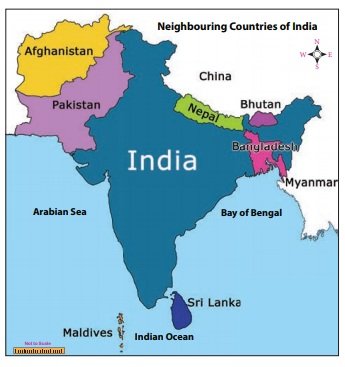
What is India's Neighbourhood First Policy?
- About: India’s Neighbourhood First Policy is a key pillar of its foreign policy that prioritizes building strong, cooperative, and mutually beneficial relations with its immediate neighbours in South Asia and the Indian Ocean region.
- Core Philosophy & Origins: The policy is built on the realization that India cannot achieve its global ambitions or domestic development goals without a peaceful and prosperous neighborhood.
- The policy gained significant momentum when all SAARC (South Asian Association for Regional Cooperation) leaders were invited to the Prime Minister's swearing-in ceremony in 2014.
- The Gujral Doctrine Connection: It draws inspiration from the Gujral Doctrine (1996), which advocates for "non-reciprocity" giving more to smaller neighbors (like Nepal, Bhutan, and Bangladesh) than India expects back in return, simply to build trust.
- Key Objectives:
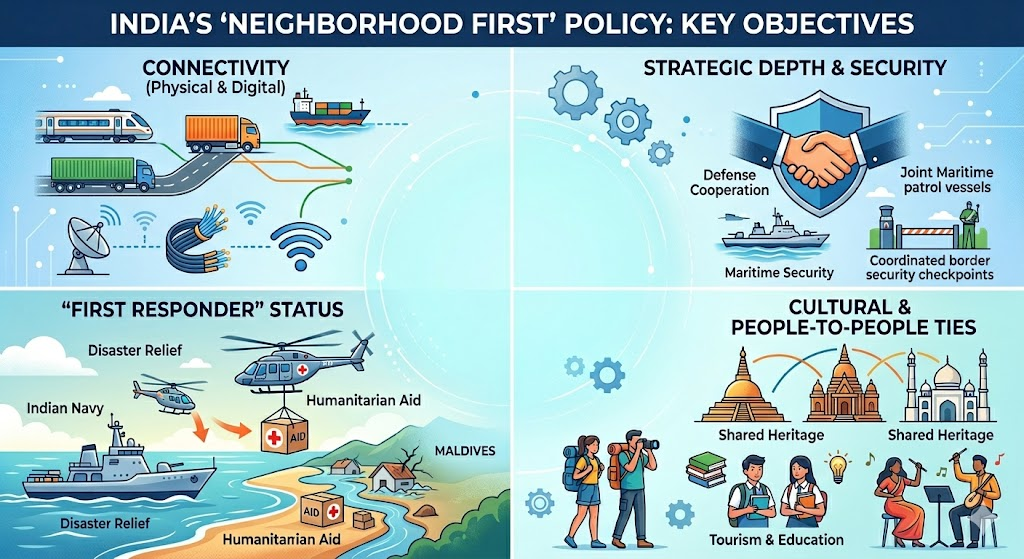
What Key Strides has India Undertaken under its Neighbourhood First Policy?
- Strategic Energy Integration: India is shifting from a power-surplus neighbor to the regional "Energy Grid Hub," transitioning bilateral energy ties into a multilateral sub-regional framework.
- This move leverages India’s geography to create a common South Asian power pool, making regional energy security dependent on Indian infrastructure.
- For instance, in 2025, India and Nepal signed two key agreements to develop high-capacity cross-border transmission lines (Inaruwa–New Purnea and Lamki/Dododhara–Bareilly).
- These projects, to be executed through joint ventures in both countries, aim to boost electricity trade, strengthen grid resilience, and enhance regional energy connectivity.
- Digital Public Infrastructure (DPI) Diplomacy: The internationalization of India's Stack, specifically UPI, is being used as a soft-power tool to simplify trade and bypass the "dollar-dependence" that often cripples smaller economies.
- By integrating real-time payment systems, India is weaving its neighbors into a seamless digital economic zone that fosters direct people-to-people and B2B commercial ties.
- For instance, in July 2025, India signed a definitive Network-to-Network Agreement with the Maldives Monetary Authority to launch UPI, following successful rollouts in Sri Lanka and Nepal.
- First Economic Responder: India is repositioning itself as the "Net Security Provider" and "First Economic Responder" to stabilize the Indian Ocean Region against debt-trap narratives.
- The focus has moved toward sustainable debt management and infrastructure grants rather than high-interest loans, ensuring long-term strategic loyalty through fiscal bailouts and essential supply guarantees.
- In 2023, India became the first country to hand-over its letter of support for financing and debt restructuring of Sri Lanka to the International Monetary Fund in a sign of its continued support for the island nation’s economic recovery.
- In 2022, India provided $4.5 billion in assistance to Colombo to tide over its dire economic situation.
- More recently, in July 2025 state visit to Maldives, India extended a ₹4,850 crore Line of Credit and reduced annual debt repayment obligations to stabilize the Maldivian economy.
- Multimodal Connectivity & "Act East" Synergy: The NFP is now inextricably linked with the Act East Policy, transforming the North-East into a gateway for regional transit rather than a landlocked frontier.
- By operationalizing coastal shipping and inland waterways with Bangladesh, India is reducing transit costs and time for its landlocked states while deepening the Bay of Bengal integration.
- The Agartala–Akhaura Rail Link and access to Chittagong and Mongla Ports exemplify how India’s Neighbourhood First Policy complements its Act East Policy.
- Also, despite regional security challenges, the Kaladan Multi-Modal Transit Transport Project (KMMTTP) remains a vital strategic project.
- Hydropower-Led Strategic Interdependence: India is deepening its neighbourhood engagement by leveraging cross-border hydropower as a tool for long-term economic and strategic integration.
- By co-developing and importing clean energy from Himalayan neighbours, India not only meets its energy needs but also anchors their economies to its grid, fostering irreversible interdependence.
- For instance, in February 2026, India and Bhutan reviewed the Punatsangchhu-II (1020 MW) project, emphasized early commissioning of Punatsangchhu-I (1200 MW), and initiated transmission planning up to 2040 to ensure grid stability.
- Institutionalized Humanitarian Assistance (HADR): India is transitioning from ad-hoc disaster relief to a structured "Regional First Responder" framework, utilizing its military logistics to anchor regional human security.
- This shift positions India as the indispensable security anchor of the Global South, capable of rapid-scale mobilization that builds deep strategic trust and counters the influence of non-regional powers.
- For instance, in 2025, India launched Operation Sagar Bandhu to assist Sri Lanka after Cyclone Ditwah.
- Additionally, under Operation Brahma, the Indian Army provided medical assistance to earthquake victims in Myanmar.
What are the Key Issues Hindering Effectiveness of India’s Neighbourhood First Policy?
- Systematic Neglect of Intra-Regional Trade: South Asia remains one of the world's least integrated regions because India and its neighbors have prioritized global markets and protectionist "Sensitive Lists" over creating a cohesive regional value chain.
- This lack of economic "stickiness" means that neighbors have no structural or fiscal deterrent to moving into the orbit of external powers like China, who offer immediate, albeit debt-heavy, commercial alternatives.
- For instance, Intra-regional trade in South Asia accounts for less than 5% of total trade, a stark contrast to 25% in ASEAN.
- While India’s total merchandise and services exports rose by USD 36 billion during April–January FY 2025–26, trade with neighbouring countries has largely remained stagnant.
- Border Disputes and Territorial Frictions: Unresolved border disputes remain the primary structural bottleneck to the NFP, as neighbors increasingly use "Cartographic Aggression" to assert sovereignty and domestic nationalist credentials.
- These territorial flashpoints, particularly in the Himalayas, force India into a resource-heavy "Defensive Crouch," where military posturing and border infrastructure development often take precedence over regional economic integration or soft-power initiatives.
- Frequent tensions along the LoC with Pakistan, LAC with China and its claims over Arunachal Pradesh (symbolic renaming of places) strain strategic stability.
- Similarly, Nepal continues its steadfast adherence to the revised political map, including the Kalapani–Lipulekh–Limpiyadhura triangle within its territory.
- Such disputes complicate diplomacy, and slow regional integration efforts.
- Assertive "Chequebook Diplomacy" by China: China’s Belt and Road Initiative (BRI) creates a "strategic encirclement" and “String of Pearls” by offering massive, high-interest infrastructure loans that smaller neighbors find difficult to refuse despite the risk of debt-traps.
- This economic leverage is increasingly converted into military access, challenging India’s traditional role as the primary security provider and forcing a costly "bidding war" for regional influence.
- For instance, China is expanding its influence in South Asia through BRI-led investments, strategic ports like Gwadar (Pakistan) and Hambantota (Sri Lanka), and deeper ties with Nepal and Bangladesh, reshaping the regional balance of power around India, though India’s counter-strategy of the “Diamond of Necklace” remains slow and lagging.
- Constant Political Volatility in Neighbourhood: The persistent political volatility in neighboring capitals remain the most significant structural risks to India’s long-term strategic investments.
- Internal power shifts often lead to "Zero-Sum" foreign policy pivots, where new regimes systematically dismantle or "review" India-backed projects to signal a break from their predecessors and appease populist nationalist sentiments.
- For instance, the “India Out” campaign in Maldives initially strained ties, though the country later recalibrated and moved closer to India.
- Similarly, recent political transitions in Nepal and Bangladesh highlight how domestic shifts can directly impact India’s regional engagements.
- The "Delivery Deficit" & Implementation Lags: India frequently faces criticism for the "Big Brother" syndrome, where it announces grand infrastructure projects but fails to complete them within the promised timelines compared to China’s rapid execution.
- These bureaucratic and red-tape delays create a "trust deficit," pushing neighbors to seek more efficient partners for their immediate developmental needs.
- For instance, the Kaladan Multi-Modal Transit Transport Project (KMMTTP), a strategic initiative designed to connect Kolkata with Mizoram via Sittwe port in Myanmar, has faced significant delays, with its completion date pushed to a revised 2027.
- Cross-Border Migration Challenges: India’s land borders remain flashpoints for ethnic tensions and illegal migration, which often spill over into bilateral diplomatic crises with countries like Bangladesh and Myanmar.
- Issues such as the National Register of Citizens (NRC) or the influx of refugees from conflict zones create "identity-based friction" that undermines economic cooperation.
- Since the Myanmar civil war, over 40,000 refugees have crossed into Mizoram, leading India to suspend the Free Movement Regime (FMR).
- This move, while necessary for security, led to a decrease in formal border trade.
- Security-Development Paradox in the IOR: The Indian Ocean Region (IOR) is seeing an unprecedented "militarization" where traditional non-traditional threats like piracy are being replaced by high-state naval competition and "dual-use" port facilities.
- India's challenge lies in balancing its "Net Security Provider" role without appearing hegemonistic or infringing upon the maritime sovereignty of smaller island nations like the Seychelles or Mauritius.
- On the other hand, in recent years, the Chinese tracking vessel Yuan Wang 5 has been frequently spotted in the Indian Ocean Region, raising security concerns for India, over potential surveillance.
- State-Sponsored Terrorism by Pakistan: Pakistan’s continued use of state-sponsored terrorism remains the most serious obstacle to India’s Neighbourhood First Policy.
- Cross-border terror networks targeting India undermine trust and make sustained diplomatic engagement untenable.
- For instance, the Pahalgam terror attack (2025) highlighted persistent security threats, prompting a calibrated Indian response through Operation Sindoor.
- Such incidents derail regional cooperation and force India to prioritise security over development partnerships.
- Until Pakistan dismantles its terror infrastructure, meaningful regional integration will remain severely constrained.
What Measures Can India Adopt to Further Strengthen its Neighbourhood First Policy?
- Transitioning to "Institutionalized Multilateralism" (BIMSTEC+): India must lead the structural transformation of BIMSTEC into a high-functioning alternative to SAARC by establishing a permanent Regional Security Council.
- By moving from bilateral "hub-and-spoke" diplomacy to a rules-based multilateral framework, India can dilute the "Big Brother" perception and provide neighbors with a collective platform for dispute resolution.
- This institutionalization fosters a sense of equal stakeholding, making regional integration resilient to individual regime changes or populist "India-Out" shifts.
- Establishing a "Regional Net-Security Architecture": India should formalize its role as the "Net Security Provider" by creating a shared maritime and cyber-security umbrella that integrates the coastal radars and digital defenses of its neighbors.
- Through joint patrolling, harmonized Standard Operating Procedures (SOPs) for HADR, and a Regional Cyber-Threat Intelligence Hub, India can offer a "security-as-a-service" model that counters external military encroachment.
- This "integrated defense ecosystem" creates a high-tech dependency that is far more durable than traditional diplomatic ties and directly secures India’s maritime "red lines."
- Operationalizing a "South Asian Energy & Digital Grid": The focus must shift toward creating "Irrevocable Interdependencies" through a unified cross-border electricity market and the regionalization of India's Digital Public Infrastructure (DPI).
- By integrating like minded countries into a common National Power Grid and scaling UPI-based cross-border payments, India can ensure that the economic stability of its neighbors is physically wired into India’s own growth.
- This "infrastructure-led diplomacy" makes the cost of pivoting away from India prohibitively expensive for any neighboring government, regardless of their political leanings.
- By integrating like minded countries into a common National Power Grid and scaling UPI-based cross-border payments, India can ensure that the economic stability of its neighbors is physically wired into India’s own growth.
- Evolution to "Frictionless Border Economic Zones" (IBEZ): India needs to transform its land borders from "security barriers" to "Economic Gateways" by upgrading Integrated Check Posts (ICPs) into comprehensive industrial hubs with dedicated Special Economic Zones (SEZs).
- Implementing a "Single-Window" digital customs clearance and allowing the co-location of industries across borders will create shared value chains in textiles, agro-processing, and pharmaceuticals.
- This measure converts the "periphery" into a "core" economic asset, incentivizing border populations and local governments to maintain peace and actively participate in formal trade.
- Harnessing "Soft Power 2.0" & Knowledge Diplomacy: India should move beyond traditional cultural exchange to "Knowledge-Based Integration" by establishing satellite campuses of IITs/IIMs and offering "Digital Residency" programs for regional entrepreneurs.
- By creating a South Asian Talent Pool through harmonized professional certifications and a "Neighbourhood First" scholarship fund, India can anchor the regional intelligentsia and future leaders to its own educational and economic ecosystem.
- This builds long-term "Cognitive Trust" and counters the information-warfare narratives by creating a professional class that views India as the primary engine of their personal and national prosperity.
- Space & Climate "Common-Pool" Management: As a regional space power, India must provide "Environmental Sovereignty" to its neighbors by sharing real-time satellite data for precision agriculture, groundwater management, and glacial lake outburst flood (GLOF) monitoring.
- Establishing a Regional Climate Adaptation Fund and a shared "Himalayan-Oceano Data Bank" will position India as a solution-provider for the existential threat of climate change.
- This "Green Diplomacy" addresses the most pressing non-traditional security threats of the 2030 horizon, aligning India’s high-tech capabilities with the survival instincts of its smaller neighbors.
- Formalizing "Blue Economy" Joint Ventures: India must move beyond maritime security to "Maritime Resource Co-management" by launching joint ventures in deep-sea mining, sustainable fisheries, and offshore wind energy in the Bay of Bengal and the Arabian Sea.
- By treating the Indian Ocean as a "Common Heritage," India can provide the technology and capital for its island neighbors to tap into their Exclusive Economic Zones (EEZs) without falling into debt-traps.
- This transforms the relationship from "Protector-Protected" to "Commercial Partners," creating a shared financial stake in maintaining a "Free and Open Indo-Pacific."
Conclusion:
The success of India’s Neighbourhood First Policy hinges on transitioning from a traditional security-provider role to an indispensable economic anchor through deep structural integration. By replacing historical paternalism with "irrevocable interdependencies" in energy, digital infrastructure, and trade, India can neutralize external competition and domestic political volatility in neighboring capitals. Achieving this requires a shift toward "Institutionalized Multilateralism," where shared prosperity and technological synergy transform South Asia from a fractured periphery into a cohesive, India-led global growth engine.
|
Drishti Mains Question: “India’s Neighbourhood First Policy has evolved from a goodwill-driven approach to one focused on strategic interdependence, yet it continues to face structural constraints.” Discuss the key achievements and challenges of the policy, and suggest measures to enhance its effectiveness. |
FAQs:
1. Why is trade considered the most critical lever in India’s Neighbourhood First Policy?
Trade creates structural interdependence, ensuring that regional ties are not merely political but economically irreversible. Unlike aid or diplomacy, it builds mutual stakes in stability, reduces external influence (especially China), and fosters long-term regional integration.
2. How is India transforming from a bilateral partner to a regional systems integrator?
India is moving towards creating regional grids and networks—energy (cross-border electricity trade), digital (UPI), and connectivity corridors. This shift from “project-based diplomacy” to “system-based integration” makes neighbouring economies increasingly dependent on Indian infrastructure.
3. What are the key structural constraints limiting the success of the Neighbourhood First Policy?
Major constraints include low intra-regional trade (<5%), persistent border disputes, China’s BRI-led influence, and political volatility in neighbouring countries. Additionally, India’s implementation delays (“delivery deficit”) weaken its credibility compared to faster actors like China.
4. How does China’s growing presence challenge India’s regional strategy?
China’s chequebook diplomacy through BRI projects and strategic ports (e.g., Gwadar, Hambantota) creates economic dependence and potential military leverage.
This leads to a strategic encirclement (“String of Pearls”), forcing India into a reactive and resource-intensive balancing role.
5. What strategic shift is required to make India’s neighbourhood policy more effective?
India must transition from a paternalistic, aid-driven model to a trade-first, interdependence-based framework. This includes building multilateral institutions (BIMSTEC+), integrated energy & digital grids, and border economic zones, ensuring durable and mutually beneficial regional partnerships.
UPSC Civil Services Examination, Previous Year Questions (PYQs)
Prelims:
Q. Elephant Pass, sometimes seen in the news, is mentioned in the context of the affairs of which one of the following? (2009)
(a) Bangladesh
(b) India
(c) Nepal
(d) Sri Lanka
Ans: (d)
Q. Consider the following statements: (2020)
- The value of Indo-Sri Lanka trade has consistently increased in the last decade.
- “Textile and textile articles” constitute an important item of trade between India and Bangladesh.
- In the last five years, Nepal has been the largest trading partner of India in South Asia.
Which of the statements given above is/are correct?
(a) 1 and 2 only
(b) 2 only
(c) 3 only
(d) 1, 2 and 3
Ans: (b)
Mains:
Q. “China is using its economic relations and positive trade surplus as tools to develop potential military power status in Asia”. In the light of this statement, discuss its impact on India as her neighbour. (2017)