
India’s Transition Towards Natural Farming | 22 Jan 2026
This editorial is based on “Designing the transition to natural farming” which was published in The Hindu business line on 20/01/2026. This editorial examines India’s transition towards natural farming as a response to rising input costs, soil degradation, and climate stress. It analyses policy initiatives, structural challenges, and reform pathways needed to make natural farming economically viable and scalable.
For Prelims: Natural Farming, Green Revolution,National Mission on Natural Farming, Krishi Vigyan Kendras,FPOs.
For Mains: Need for natural farming, measures taken , Key issues, and measures to smoothen the transition.
Amid rising input costs, climate volatility, and agrarian distress, a quiet shift is underway in India’s fields. From Andhra Pradesh to Uttar Pradesh, farmers experimenting with natural farming are challenging the chemical-intensive growth model that powered the Green Revolution. This transition reflects not nostalgia, but a pragmatic search for ecological resilience, soil sovereignty, and income stability. The debate is no longer whether agriculture must change, but how urgently and at what scale.
What is Natural Farming?
- About: Natural Farming (NF) is a chemical-free, low-intervention agricultural system that works with nature's processes, minimizing human labor by avoiding synthetic inputs, tillage, and weeding, and instead fostering biodiversity, soil health, and on-farm resource utilization (like cow dung/urine for bio-inputs) to create self-sustaining, ecological farm ecosystems
- NF recognises the interdependence of the natural ecosystem amongst soil, water, microbiome, plants, animals, climate and human requirements.
- Its most famous proponent, the Japanese farmer Masanobu Fukuoka (author of The One-Straw Revolution), established these four principles:
- No Tillage: The soil is not plowed or turned. This preserves soil structure and protects microorganisms.
- No Chemical Fertilizers: Nutrients are provided by nature (microbes, earthworms, and organic matter), not synthetic chemicals.
- No Weeding by Tillage/Herbicides: Weeds are controlled by natural suppression (mulching) rather than elimination, as they play a role in soil balance.
- No Chemical Pesticides: Pests are managed by ecological balance and natural predators, not poisons
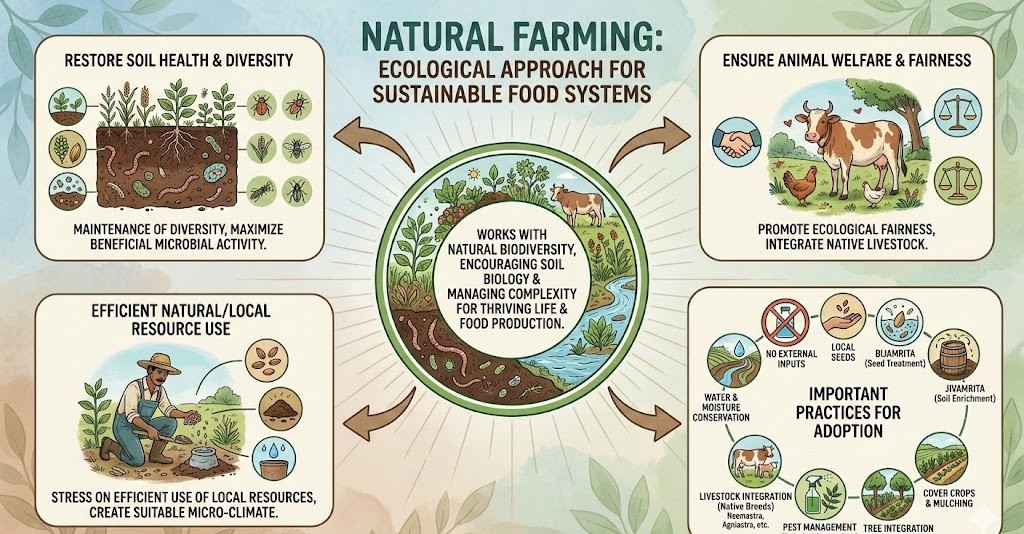
- Natural Farming in India- "Zero Budget Natural Farming" (ZBNF):In India, Natural Farming is popularly practiced as Zero Budget Natural Farming (ZBNF), promoted by Subhash Palekar. It is now often supported under government initiatives like the National Mission on Natural Farming (NMNF).
- The term "Zero Budget" implies that the cost of production is near zero because farmers do not need to buy expensive inputs like fertilizers or pesticides.
- Components of Natural Farming
- Seed Treatment (Beejamrut): Use of locally adapted indigenous seeds and on-farm seed treatment with natural formulations such as Beejamrut to enhance seed vigour and protect against soil-borne diseases.
- Soil Health Management (Ghan Jeevamrut): Application of farm-made inputs like Ghan Jeevamrut to improve microbial activity, nutrient availability, and long-term soil fertility.
- Round-the-Year Soil Cover ( Acchadana- Mulching): Maintaining continuous soil cover through live crops or crop residues to conserve moisture, regulate temperature, suppress weeds, and prevent erosion.
- Soil Microclimate Management (Waaphasa – Soil Aeration): Minimising soil disturbance to enhance natural porosity, ensuring optimal air–water balance for better root growth, moisture retention, and crop resilience.
- Plant Health Management: Use of bio-inputs and need-based natural formulations to strengthen plant immunity, reduce pest incidence, and lower dependence on external chemical inputs.
- Resource Efficiency and Income Enhancement: Holistic adoption of natural farming principles to reduce input costs, improve soil health, and enhance net farm income in a sustainable manner.
What Compels India to Shift Towards Natural Farming?
- Economic Sustainability and Farmer Income Security: Indian agriculture is trapped in a high-cost, low-return cycle driven by external inputs such as chemical fertilizers, pesticides, and proprietary seeds.
- For instance, on an average, to cultivate rice, farmers spent INR 5,961 per acre on chemical inputs while farmers who were practicing complete Zero Budget Natural Farming spent INR 846 per acre on natural inputs.
- Small and marginal farmers who form the majority (over 85% of the farmers in India ),are disproportionately affected by rising input prices and climate shocks. Natural farming lowers entry barriers by reducing dependence on market-purchased inputs and credit.
- Soil Health and Long-Term Productivity: An ICAR study, based on analysis of 2.54 lakh soil samples from 620 districts across 29 States, indicates that unscientific fertilizer use and climate change are eroding organic carbon levels in India’s arable soils.
- Natural farming restores soil biology through organic carbon enrichment and microbial activation, improving nutrient cycling and soil structure.
- Water Conservation and Climate Resilience: Conventional agriculture is highly water-intensive and vulnerable to erratic monsoons and rising temperatures.
- And, already around 600 million people in India experience high to extreme water stress.
- Natural farming practices such as mulching and improved soil aeration reduce evaporation losses and enhance moisture retention.
- This lowers irrigation demand while improving crop tolerance to droughts and heat stress.
- As climate risks intensify, such agro-ecological resilience becomes a necessity rather than a choice.
- Environmental Protection and Biodiversity Revival: Chemical runoff pollutes groundwater, degrades ecosystems, and disrupts beneficial insect populations.
- Natural farming minimises synthetic chemical use, allowing natural predators, pollinators, and soil fauna to recover.
- This restores ecological balance and reduces long-term pest pressures. Environmentally, the shift helps internalise ecological costs previously externalised by chemical agriculture.
- Human Health and Food Safety: Farmers are directly exposed to hazardous agrochemicals, while consumers face risks from pesticide residues in food and water.
- Natural farming reduces chemical exposure across the food chain, lowering occupational health risks and public health burdens.
- Cleaner food systems also align with rising consumer demand (particularly in the EU's market) for safe and nutritious produce.
- Institutional and Fiscal Rationality: India’s fertiliser and pesticide subsidies impose a heavy fiscal burden while encouraging inefficient input use (eg, Fertiliser subsidy is second highest after food ).
- Promoting natural farming can gradually rationalise subsidy expenditure by shifting support from chemicals to knowledge, training, and ecosystem services.
- This improves public spending efficiency without compromising food security. Over time, it aligns agricultural policy with ecological and fiscal sustainability.
- Alignment with Sustainable Development and Future Food Systems: India must balance food security with environmental limits in a climate-constrained future.
- Natural farming contributes to sustainable agriculture, climate action, and land restoration goals without requiring high capital intensity.
- It represents a transition towards regenerative food systems rather than extractive production models. Strategically, it is central to building a future-ready agricultural economy.
What Current Measures India has Undertaken to Promote Natural Farming ?
- Institutional Mission Mode: National Mission on Natural Farming (NMNF): This "Mission Mode" priority, effectively institutionalizing the shift from chemical-intensive to chemical-free agriculture by creating a dedicated management structure that standardizes protocols and ensures direct funding flow to districts.
- Approved in late 2024 with a ₹2,481 crore outlay, the mission targets 1 crore farmers across 7.5 lakh hectares, providing an incentive of ₹4,000 per acre/year to buffer transition costs.
- Fiscal Federalism & Subsidy Reform-PM-PRANAM Scheme: The scheme incentivises states to reduce chemical fertiliser use by allowing them to retain 50% of the resulting subsidy savings as central grants, with 70% earmarked for creating organic and bio-fertiliser infrastructure.
- By converting subsidy savings into a fiscal reward, it embeds ecological outcomes within a competitive federal framework, encouraging states to promote natural farming and balanced nutrient use..
- Supply Chain Infrastructure – Bio-Input Resource Centres (BRCs):To overcome labour and time constraints in preparing bio-inputs like Jeevamrit, the government is promoting BRCs as village-level micro-enterprises that supply standardized, ready-to-use natural inputs.
- This reduces farmer drudgery while creating entrepreneurship opportunities for SHGs and rural youth. The 2024–25 roadmap targets 10,000 BRCs to serve 15,000 clusters, ensuring reliable access to bio-inputs for over 1 crore farmers.
- Eco-Geographical Corridor- Arth Ganga: Under the Arth Ganga approach, a chemical-free natural farming corridor is being developed along the Ganges to curb agro-chemical runoff while linking river rejuvenation with sustainable agriculture.
- By promoting a “Ganga-branded” organic belt, it leverages cultural value to secure premium markets for farmers. The initiative prioritises natural farming within a 10-km belt along the river banks, integrating water conservation with livelihoods..
- Certification & Market Trust – Digital Portal & Branding:To address credibility and traceability gaps, the government has streamlined certification through the Jaivik Kheti portal, PGS, and PKVY , enabling smallholders to authenticate natural produce without costly third-party audits.
- This digital, cluster-based model aggregates farmers into a unified marketplace, helping them bypass intermediaries and access premium buyers. The portal hosts over 6 lakh farmers, while NMNF’s “Single National Brand” aims to standardize quality across 15,000 clusters.
- Educational Integration & Gender-Led Extension:ICAR has integrated natural farming into UG and PG curricula, shifting it from traditional practice to scientifically validated pedagogy through research and field trials at KVKs, thereby strengthening extension capacity.
- Complementing this, the Krishi Sakhi Convergence Program (KSCP) deploys trained women SHG members as para-extension workers, leveraging peer networks for behavioral change.
- Linked with the Lakhpati Didi initiative, over 70,000 Krishi Sakhis (as of August 2025) now ensure last-mile guidance, community ownership, and livelihood generation.
What are the Key Issues Associated with India’s Transition Towards Natural Farming?
- The "Yield Penalty" Transition Dip: The most immediate economic barrier is the sharp decline in crop yields during the initial years (although region specific) conversion period as the soil microbiome rebuilds itself without synthetic boosters.
- This "transition dip" creates a severe liquidity crunch for smallholders who operate on thin margins and cannot afford even a single season of reduced output, leading to high dropout rates before soil fertility stabilizes.
- Labour Intensity & Input Drudgery: Natural farming methods including the preparation of bio-inputs like jeevamrit and manual weed control are more labour-intensive than conventional input-based systems.
- Such practices often require greater reliance on manual labour, especially where mechanisation is limited, which can pose a challenge for farmers in regions experiencing labour shortages and rising wage rates.
- These act as a barrier to wider adoption, particularly where farm households depend on off-farm income or struggle with time constraints.
- The "Indigenous Cattle" Constraint: The core protocol of Natural Farming relies heavily on dung and urine from indigenous (Desi) cows, yet the mechanization of agriculture has drastically reduced the male cattle population, making access to fresh inputs a logistical nightmare for non-dairy farmers.
- For instance, the 20th Livestock Census shows a 6% decline in total indigenous cattle.
- This creates a dependency paradox where a "self-reliant" farming method forces landless or cattle-less farmers to buy bio-inputs, reintroducing a cost structure they tried to escape.
- Asymmetric Fiscal Incentives: There is a massive policy contradiction where the government promotes natural farming with modest funds while simultaneously underwriting chemical farming with enormous subsidies, effectively paying farmers to stay chemical-dependent.
- In 2024–25, the chemical fertilizer subsidy bill stands at a colossal ₹1.64 lakh crore, this heavily skewed financial ecosystem makes cheap urea excessively accessible, rendering natural farming economically unattractive despite its long-term ecological benefits.
- Certification & Traceability Deficit: The current market lacks a robust, scalable verification system for natural produce, forcing farmers to sell premium chemical-free crops at ordinary mandi prices because they cannot prove their "natural" status to distant urban consumers.
- The reliance on Participatory Guarantee Systems (PGS) is socially inclusive but commercially weak, as it lacks the brand trust of third-party certifications required by major retail chains and exporters.
- Scientific Validation Void: A persistent friction exists between traditional knowledge and formal agricultural science, as the lack of rigorous, long-term peer-reviewed studies across diverse agro-climatic zones creates skepticism among extension officials and scientists.
- Without a definitive "package of practices" (PoP) validated by universities for every crop-region combination, state agriculture departments remain hesitant to aggressively push natural farming as a mainline strategy.
- Market Absorption & Price Risk Uncertainty: Even when natural farming reduces input costs, farmers remain exposed to volatile output markets where prices are determined by conventional produce benchmarks.
- In the absence of assured procurement or differentiated pricing, productivity-neutral or slightly lower yields translate into income risk rather than ecological gain.
- This weak market signal discourages rational farmers from transitioning, as economic survival today outweighs uncertain environmental dividends tomorrow, especially in cereals and perishables where MSP or contract farming dominates price discovery.
- Food Insecurity and Nutritional Vulnerability: While Natural Farming promises long-term sustainability, cost reduction, and soil health restoration, its transition phase poses short-term risks that intersect critically with India’s existing food and nutrition challenges.
- According to the State of Food Security and Nutrition in the World 2025, about 12% of India’s population (around 172 million people) remain undernourished, and nearly 42.9% cannot afford a healthy diet due to rising food costs, reflecting deep structural challenges in food access, affordability, and quality.
- This persistent food insecurity increases vulnerability for smallholder farmers transitioning to natural farming, as even marginal yield dips or market uncertainties can exacerbate households’ ability to secure adequate nutrition and income.
What Measures are Needed to Smoothen India’s Transition Towards Natural Farming?
- Institutionalize "Transition Insurance" for Yield Gaps: To address the immediate productivity dip during the conversion phase, the state must design a "Yield Deficit Underwriting" mechanism that compensates farmers not just for crop failure, but for the specific volume difference between conventional and natural output during the first three years.
- This de-risking financial instrument should be pegged to regional baseline yields rather than market prices, ensuring that the farmer's income volatility is neutralized while the soil microbiome regenerates, effectively treating the transition period as a state-subsidized gestation phase for long-term ecological asset creation.
- Decentralize Bio-Input Supply Chains via "Micro-Enterprises": Instead of relying on farmer-level production alone, the ecosystem needs a network of professionalized "Bio-Input Resource Centers" (BRCs) operating as village-level micro-enterprises run by women collectives or rural youth.
- This professionalization ensures standardization of quality (controlling pH, bacterial count) for inputs like Jeevamrut and Beejamrut, removing the labor burden from individual farmers and creating a reliable, just-in-time supply chain that mimics the convenience of chemical fertilizer shops but with localized, circular economy principles.
- Create "Bio-Village Clusters" for Aggregated Market Leverage: To solve the fragmentation issue, the transition strategy should focus on notifying contiguous "Natural Farming Zones" or Bio-Villages rather than isolated individual adoption.
- This spatial clustering allows for the synchronization of planting schedules, prevention of chemical drift from neighboring farms, and the creation of economies of scale for bulk procurement and logistics, enabling FPOs to negotiate with large retail chains using the collective bargaining power of a verified, chemical-free regional brand identity.
- Digitize Trust with "Blockchain-Enabled Traceability": To bypass the expensive and slow third-party certification systems, the sector needs a "Participatory Guarantee System (PGS) 2.0" anchored on distributed ledger technology.
- By allowing consumers to scan a QR code and view the immutable history of farm inputs, verified peer-to-peer by local farmer groups, the system replaces institutional bureaucracy with "Digital Trust," significantly lowering compliance costs for smallholders while offering premium market assurance to urban consumers wary of "greenwashing."
- Mandate "Green Procurement" in Public Distribution Systems (PDS): The state can act as the "Market-Maker of First Resort" by mandating that a fixed percentage of produce for Mid-Day Meals and Anganwadis be sourced exclusively from local natural farming clusters.
- This creates a guaranteed, non-volatile demand sink that insulates farmers from open market fluctuations during their vulnerable transition years, while simultaneously improving nutritional security for public beneficiaries, effectively closing the loop between public health goals and agricultural sustainability.
- Re-engineer Extension Services into "Farmer-Scientist Loops": The current top-down technology transfer model must be replaced by "Co-Creation Labs" where agricultural universities validate traditional wisdom rather than just imposing lab techniques.
- By formally recognizing "Champion Farmers" as adjunct faculty and codifying their experiential knowledge into the official curriculum, the system can bridge the "Lab-to-Land" credibility gap, ensuring that scientific research is responsive to the hyper-local realities of agro-climatic zones and pest dynamics.
Conclusion:
Natural farming represents a strategic shift from input-intensive agriculture to a regenerative, climate-resilient, and fiscally rational food system. However, its success hinges on de-risking the transition phase, correcting asymmetric subsidy structures, and building credible markets and scientific validation. With mission-mode implementation, outcome-based incentives, and institutional trust mechanisms, natural farming can transform soil health into a productive economic asset. Done right, it aligns farmer income security, ecological sustainability, and long-term food sovereignty.
|
Drishti Mains Question “Natural farming is not an ideological alternative but an economic and ecological correction to India’s input-intensive agricultural model.” Examine the statement in light of recent policy initiatives and transition challenges. |
FAQs
1. What is the core objective of Natural Farming?
To reduce input costs while restoring soil ecology and farm sustainability.
2. Which flagship mission promotes Natural Farming in India?
National Mission on Natural Farming (NMNF).
3. What is the major short-term challenge in adopting Natural Farming?
Initial yield dip during the transition phase.
4. Why is Soil Organic Carbon important in Natural Farming?
It improves nutrient cycling, water retention, and climate resilience.
5. How does the government support market trust for natural produce?
Through Participatory Guarantee Systems (PGS) and the Jaivik Kheti portal.
UPSC Civil Services Examination, Previous Year Question (PYQ)
Prelims
Q. How is permaculture farming different from conventional chemical farming? (2021)
- Permaculture farming discourages monocultural practices but in conventional chemical farming, monoculture practices are predominant.
- Conventional chemical farming can cause an increase in soil salinity but the occurrence of such phenomenon is not observed in permaculture farming.
- Conventional chemical farming is easily possible in semi-arid regions but permaculture farming is not so easily possible in such regions.
- Practice of mulching is very important in permaculture farming but not necessarily so in conventional chemical farming.
Select the correct answer using the code given below.
(a) 1 and 3
(b) 1, 2 and 4
(c) 4 only
(d) 2 and 3
Ans: (b)
Q. Consider the following agricultural practices: (2012)
- Contour bunding
- Relay cropping
- Zero tillage
In the context of global climate change, which of the above helps in carbon sequestration/storage in the soil?
(a) 1 and 2 only
(b) 3 only
(c) 1, 2 and 3
(d) None of them
Ans: (b)