
Visakhapatnam Selected for High-Energy Proton Accelerator | 12 Mar 2026
Why in News?
Visakhapatnam has been selected to host a high-energy proton accelerator system to support India’s three-stage nuclear power programme and harness its thorium reserves through Accelerator-Driven Systems (ADS).
- The location was chosen due to its strong technological ecosystem and proximity to the sea, which ensures adequate cooling water for high-energy systems.
- The project is being developed by the Raja Ramanna Centre for Advanced Technology (RRCAT) in Indore, Madhya Pradesh.
What is the High-energy Proton Accelerator System?
- High-energy Proton Accelerator System: A high-energy proton accelerator uses electromagnetic fields to accelerate protons (from ionized hydrogen) to extremely high speeds, creating a powerful proton beam.
- The beam is directed at a heavy metal target such as lead or bismuth, triggering a spallation reaction.
- In this reaction, the collision breaks the heavy nucleus and releases a large number of neutrons.
- These neutrons trigger nuclear fission, enabling the system to generate energy.
- Accelerator-Driven System (ADS): In an ADS, neutrons produced from the spallation process are supplied to a specially designed sub-critical nuclear reactor core, which cannot sustain a chain reaction on its own.
- The reactor depends on an external neutron supply from the proton accelerator to maintain the fission process.
- This design provides high inherent safety because if the accelerator stops due to a power failure or malfunction, the neutron supply immediately ends, and the nuclear reaction automatically shuts down, preventing a reactor meltdown.
- Need of ADS for India:
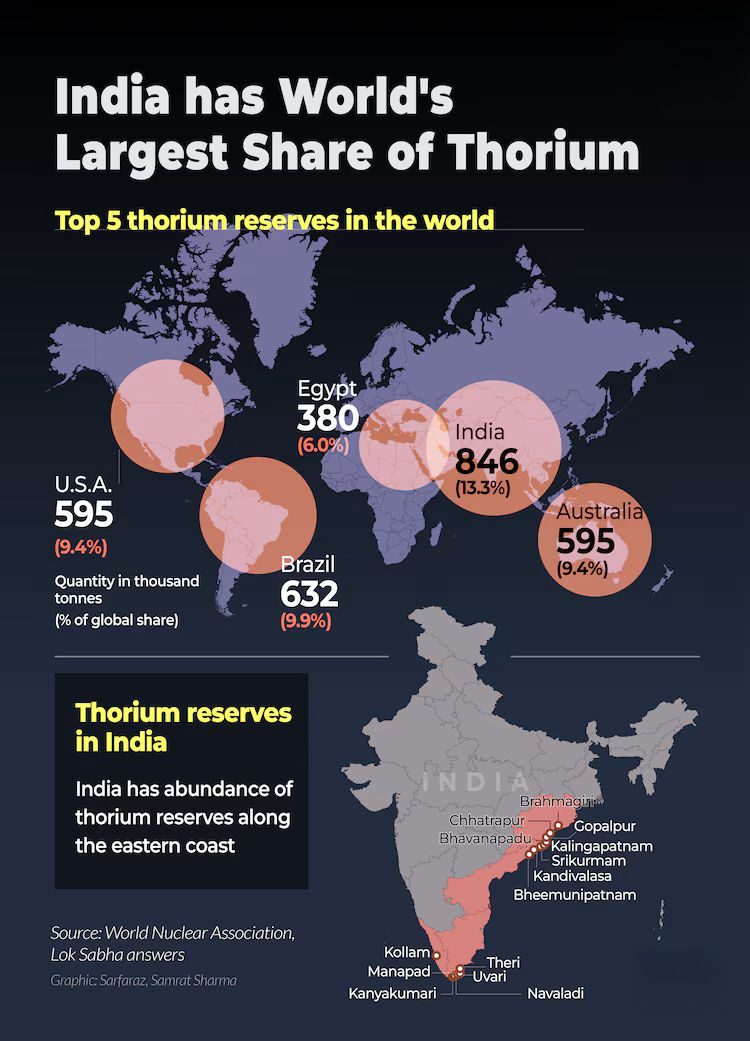
- Harnessing Thorium: India possesses about 25% of the world's Thorium reserves. However, naturally occurring Thorium (Th-232) is "fertile," not "fissile".
- This means it cannot split and sustain a nuclear chain reaction on its own. It must first capture a neutron to transmute into Uranium-233 (U-233), which is highly fissile.
- The abundant, high-energy neutrons provided by the ADS are used to bombard Thorium, converting it into Uranium-233, an excellent fissile fuel that can then generate vast amounts of electricity.
- Nuclear Waste Management (Transmutation): Traditional nuclear reactors produce highly radioactive, long-lived nuclear waste (like Minor Actinides) that remain toxic for thousands of years.
- The high-energy neutrons in an ADS can "burn" or transmute this toxic waste into shorter-lived or stable isotopes, drastically reducing the burden of nuclear waste disposal.
- Harnessing Thorium: India possesses about 25% of the world's Thorium reserves. However, naturally occurring Thorium (Th-232) is "fertile," not "fissile".
What is India's 3-Stage Nuclear Power Programme?
- Click here to Read: India's 3-Stage Nuclear Power Programme
Raja Ramanna Centre for Advanced Technology (RRCAT)
- RRCAT in Indore is a unit of the Department of Atomic Energy and is India’s premier institute for research and development in lasers, particle accelerators, and related technologies.
- Established in 1984, it developed India’s synchrotron radiation sources Indus-1 and Indus-2, which serve as national research facilities.
- RRCAT conducts advanced research in accelerators, laser systems, and synchrotron radiation technologies.
- RRCAT's research translates into societal benefits, such as using linear accelerators for electron-beam sterilization of medical devices exported globally.
- The AIC-RRCAT Pi-Hub (an incubation center) is currently driving indigenous tech development, collaborating with startups to create economical metal 3D printing for space and defense, fibre-based optical sensors, and cryogenic cooling systems for Magnetic resonance imaging (MRI) machines.
Frequently Asked Questions (FAQs)
1. What is a High-Energy Proton Accelerator?
Ahigh-energy proton accelerator uses electromagnetic fields to accelerate protons to extremely high speeds, producing a proton beam used to generate neutrons through spallation reactions.
2. What is an Accelerator-Driven System (ADS)?
AnADS is a nuclear reactor system that uses an external proton accelerator to supply neutrons to a sub-critical reactor core, improving reactor safety and efficiency.
3. Why is thorium important for India’s nuclear programme?
India holdsabout 25% of the world’s thorium reserves, which can be converted into Uranium-233, a fissile fuel for generating nuclear energy.
4. How does ADS improve nuclear safety?
Since thereactor is sub-critical, the fission reaction stops automatically if the accelerator shuts down, preventing a reactor meltdown.
5. What is the role of RRCAT in India’s nuclear research?
TheRaja Ramanna Centre for Advanced Technology develops particle accelerators, laser systems, and synchrotron radiation facilities like Indus-1 and Indus-2 for advanced scientific research.
UPSC Civil Services Examination, Previous Year Questions (PYQs)
Prelims
Q. With reference to India, consider the following statements:
- Monazite is a source of rare earths.
- Monazite contains thorium.
- Monazite occurs naturally in the entire Indian coastal sands in India.
- In India, Government bodies only can process or export monazite.”
Which of the statements given above are correct?
A. 1, 2 and 3 only
B. 1, 2 and 4 only
C. 3 and 4 only
D. 1, 2, 3 and 4
Ans: B
Q. In India, why are some nuclear reactors kept under “IAEA safeguards” while others are not? (2020)
(a) Some use uranium and others use thorium
(b) Some use imported uranium and others use domestic supplies
(c) Some are operated by foreign enterprises and others are operated by domestic enterprises
(d) Some are State-owned and others are privately owned
Ans: (b)