
Transgender Welfare in India | 10 Jan 2026
For Prelims: Transgender, NHRC, Unemployment, Census, National Portal for Transgender Persons, Parliament, Transgender Persons (Protection of Rights) Act, 2019, Fundamental Rights, Right to Privacy, National Council for Transgender Persons (NCTP), Election Commission, SMILE Scheme, Ayushman Bharat.
For Mains: Steps taken to ensure transgender welfare in India, Major challenges faced by the transgender community in India and further measures required for transgender empowerment in India.
Why in News?
Recent reports highlight that trans men and gender-diverse persons assigned female at birth (AFAB) continue to face systemic discrimination, medical ignorance, and structural barriers in accessing even basic healthcare.
- This has brought renewed attention to the gaps in affirmative, ethical, and evidence-based transgender welfare in India.
Summary
- Transgender persons in India face systemic discrimination in healthcare, education, and the economy despite landmark laws like the Transgender Persons (Protection of Rights) Act, 2019.
- Progressive judicial rulings and welfare schemes exist, but implementation gaps and societal stigma remain major hurdles.
- Empowerment requires convergent action in legal enforcement, affirmative socio-economic policies, and nationwide sensitization.
What are the Major Challenges Faced by the Transgender Community in India?
- Healthcare Access and Medical Discrimination: Nearly 27% report being refused medical care due to their gender identity. Even basic treatment is often gatekept by judgmental attitudes, misgendering, and disrespect.
- Healthcare lacks training on trans men, leading to misgendering, denial of care, and reliance on untrained gynecologists due to binary gender views and invisibility.
- Barriers force unsafe self-medication (risking stroke/kidney disease) amid no pan India protocols or affirming specialists.
- Social Stigma, and Mental Health Crisis: Discrimination against transgender persons starts within the family and extends to all public spheres, causing profound isolation. This pervasive societal stigma and abuse contributes to alarming suicide rates, with 31% dying by suicide and 50% attempting it before age 20.
- Economic Exclusion: Stark economic exclusion persists, with 92% affected (NHRC, 2018) and a 48% unemployment rate (ILO, 2022), forcing many into informal work.
- Additionally, access to finance and inheritance is denied, as banking access remains poor and laws like the Hindu Succession Act, 1956 exclude non-binary heirs.
- Barriers in Education: A stark literacy gap exists, with the community's literacy rate at 56.1% (2011 Census) compared to the national 74%, due to harassment, non-inclusive infrastructure, and high dropout rates.
- This is compounded by near non-existent representation in universities and teaching staff, and the absence of a nationwide gender-sensitive educational framework, which perpetuates stigma.
- Ineffective Legal Implementation: The National Portal for Transgender Persons has issued only 277 certificates of identity since its launch in November 2020, with a low 16% application processing rate despite nationwide functionality. Furthermore, supportive initiatives like the Garima Greh shelter homes remain hindered by inadequate funding, poor awareness, and limited coverage.
- Political Under-Representation: Political representation for transgender persons remains minimal across Parliament, State Assemblies, and local governance, crippling their advocacy for inclusive policy. While voter turnout for the third gender rose to 25% in the 2024 Lok Sabha polls, elder care systems continue to largely exclude gender-diverse individuals.
Transgender
- About: A transgender person is an individual whose gender identity (internal sense of self) does not align with the sex assigned at birth.
- This is an umbrella term that includes people with diverse socio-cultural identities such as Hijra, Kinnar, Aravani, and Jogta, as well as those who identify as trans men, trans women, genderqueer, or non-binary.
- Demographics & Population: According to Census 2011, India has a transgender population of approximately 4.88 lakh.
- The top three states with the largest enumerated transgender populations are Uttar Pradesh, Andhra Pradesh, and Maharashtra.
- Legal Recognition: The Transgender Persons (Protection of Rights) Act, 2019 provides the formal legal definition and framework for the recognition of transgender identity in India. The Act acknowledges the right to self-perceived gender identity.
- Place within the LGBTQIA+ Community: Transgender persons are a core part of the LGBTQIA+ community, represented by the "T" in the acronym.
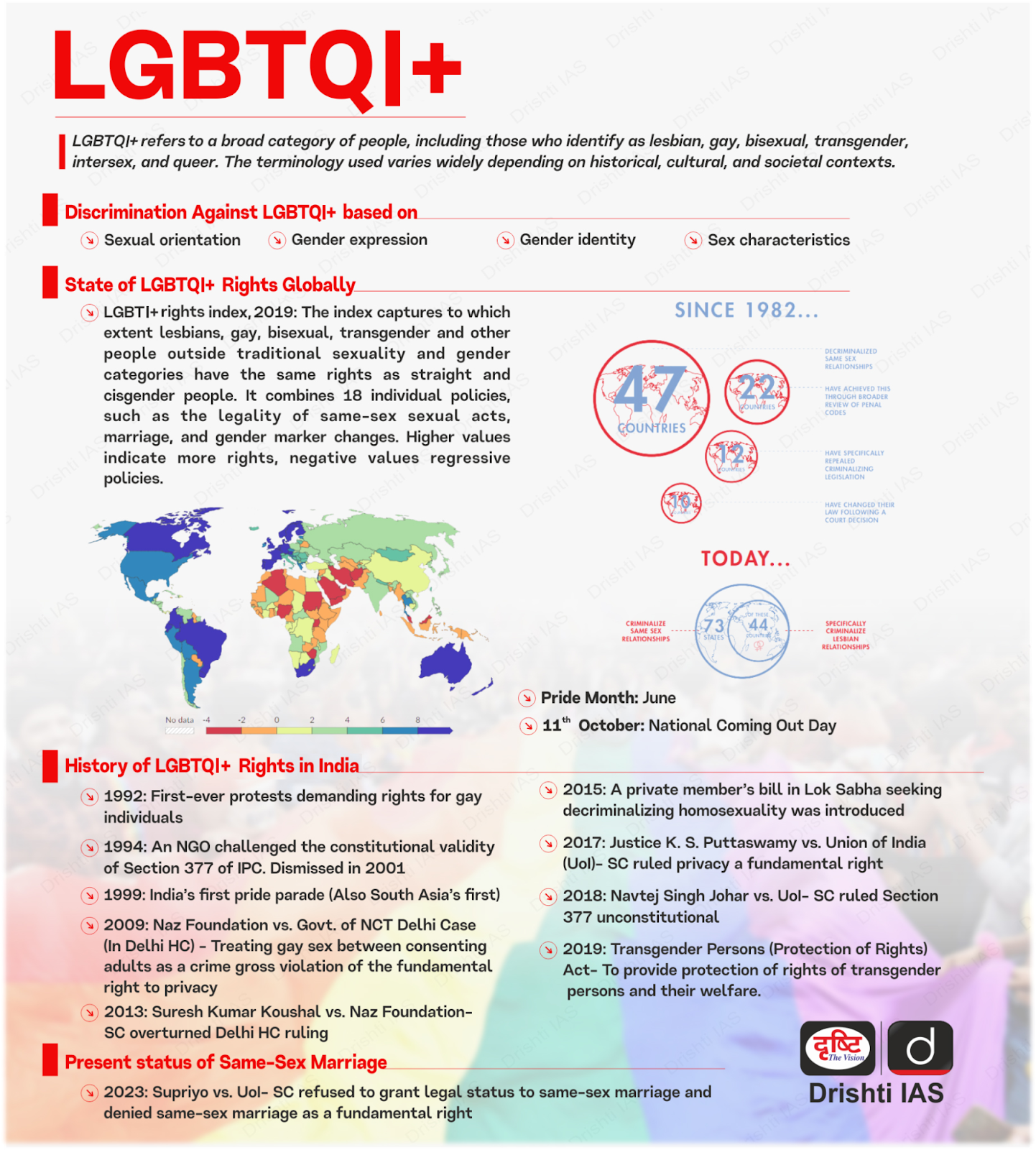
What Steps have been Taken to Ensure Transgender Welfare in India?
Judicial Interventions
- NALSA v. Union of India (2014): It legally recognized transgender persons as a third gender and affirmed their fundamental rights under Articles 14, 15, 16, 19, and 21.
- It upheld the right to self-identify one’s gender and classified transgender people as Socially and Educationally Backward Classes (SEBCs), making them eligible for reservations.
- The ruling also directed central and state governments to formulate welfare schemes and provide necessary public facilities for the community.
- Puttaswamy v. Union of India (2017): It declared the right to privacy a fundamental right, explicitly including the protection of sexual orientation and gender identity within the Constitution.
- Navtej Singh Johar v. Union of India (2018): It decriminalised consensual same-sex relations by striking down Section 377 of IPC (now BNS 2023), indirectly advancing the social acceptance and dignity of transgender and LGBTQ+ persons.
- Ms. X v. State of Karnataka (2024): The Karnataka High Court upheld the right of transgender persons to change one’s name and gender on birth certificates, reinforcing the implementation of the Transgender Persons Act, 2019 and its 2020 Rules.
Legislative Framework
- Transgender Persons (Protection of Rights) Act, 2019: It provides a legal framework prohibiting discrimination in education, employment, healthcare, housing, and public services.
- It allows for self-identification through a District Magistrate-issued Certificate of Identity without medical exams and mandates access to gender-affirming care, and HIV surveillance.
- The Act also establishes a statutory National Council for Transgender Persons (NCTP), constituted in 2020, for policy oversight and grievances.
- Transgender Persons (Protection of Rights) Rules, 2020: It lays down procedures for identity certification, provides for education, health, social security, housing, and welfare measures, and operationalises the Act's non-discrimination mandate.
Electoral Measures
- Election Commission Directive (2009): The Election Commission of India introduced an “Others” gender option in 2009 in voter registration forms, allowing transgender persons to identify without being forced into the male/female binary.
Welfare Schemes
- SMILE (Support for Marginalised Individuals for Livelihood and Enterprise) Scheme: Umbrella scheme for livelihood, education, health, and shelter support (under the sub-scheme Garima Greh).
- Ayushman Bharat TG Plus: Provides health insurance coverage of Rs 5 lakh per year per beneficiary for transgender persons.
- Transgender Pension Scheme: Allows transgender persons to be covered under the Indira Gandhi National Disability Pension Scheme.
- National Portal for Transgender Persons: Enables online applications for Transgender Identity Certificates and tracks their status.
Administrative Measures
- Recognition in Indian Prisons: The Ministry of Home Affairs issued guidelines in 2022 to ensure the privacy, safety, and dignity of transgender inmates in prisons across states.
State-Level Initiatives
- Kerala: Provides reservations for transgender students in universities and has established transgender-exclusive hostel facilities.
- Maharashtra: Has set up transgender welfare cells in colleges to address grievances and support students.
- Tamil Nadu: Pioneered free gender-affirming surgeries and established dedicated transgender health clinics.
What Further Measures are Required for Transgender Empowerment in India?
- Full Enforcement of Existing Laws: The 2019 Act requires full implementation through efficient grievance redressal cells, a centralized digital portal for certificates, and regular implementation audits.
- Essential steps include simplifying the self-identification process to end delays, mandatory gender-sensitivity training for key officials, and adopting robust state frameworks like Delhi Transgender Persons (Protection of Rights) Rules, 2025.
- Economic Inclusion & Livelihood Opportunities: Efforts must scale up successful state-level models, like Karnataka’s 1% job reservation and Tata Steel’s corporate diversity hiring, while expanding SMILE Scheme skilling and entrepreneurship programs.
- Accessible & Affirmative Healthcare: To ensure comprehensive care, gender-affirming treatments like surgery and hormones must be covered under insurance schemes such as Ayushman Bharat, following the model of states like Odisha and Karnataka.
- This requires establishing dedicated health centres, like AIIMS Delhi’s Centre of Excellence, and integrating specialized mental health services.
- Social Awareness & Cultural Change: Sustained public awareness campaigns like “I Am Also Human” and respectful media representation are essential to challenge stigma. This must be supported by amplifying cultural advocacy such as the Koovagam Festival (Tamil Nadu) and inclusive platforms like sports, exemplified by the Ya_All Sports Club's (Manipur) all-transgender football team.
Conclusion
Despite progressive laws and judicial mandates, transgender persons in India face systemic exclusion in healthcare, education, and the economy. True empowerment requires convergent action—rigorous legal implementation, affirmative socio-economic policies, and nationwide sensitization to translate constitutional promises into lived equality.
|
Drishti Mains Question: Despite progressive laws, transgender persons in India continue to face marginalisation. Analyse the reasons and suggest reforms. |
Frequently Asked Questions (FAQs)
1. Who is considered a transgender person under Indian law?
A transgender person is one whose gender identity differs from sex assigned at birth, as defined under the Transgender Persons (Protection of Rights) Act, 2019.
2. Which Supreme Court case recognised transgender persons as the third gender?
NALSA v. Union of India (2014) recognised transgender persons as the third gender and extended full constitutional rights.
3. Name two major welfare schemes for transgender persons in India.
The SMILE Scheme (including Garima Greh shelters) for livelihood and support, and Ayushman Bharat TG Plus, which provides health insurance coverage of ₹5 lakh per year per beneficiary.
UPSC Civil Services Examination, Previous Year Questions (PYQs)
Prelims
Q. In India, Legal Services Authorities provide free legal services to which of the following types of citizens? (2020)
- Person with an annual income of less than Rs. 1,00,000
- Transgender with an annual income of less than Rs. 2,00,000
- Member of Other Backward Classes (OBC) with an annual income of less than Rs. 3,00,000
- All Senior Citizens
Select the correct answer using the code given below:
(a) 1 and 2 only
(b) 3 and 4 only
(c) 2 and 3 only
(d) 1 and 4 only
Ans: (a)
Mains
Q. Women empowerment in India needs gender budgeting. What are the requirements and status of gender budgeting in the Indian context? (2016)