
The Repealing and Amending Act, 2025 | 02 Jan 2026
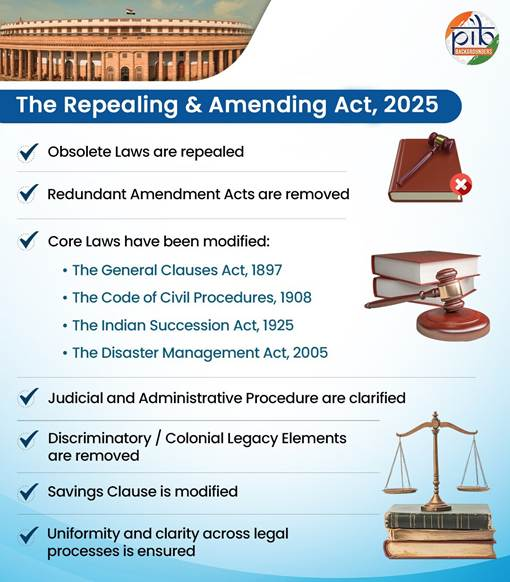
The Repealing and Amending Act, 2025 streamlines India’s legal framework by removing 71 obsolete laws ( from 1886–2023) and amending four key Acts. It acts as a legislative “housekeeping” measure to eliminate redundant laws, reduce legal clutter, and update statutory references. The Act also supports Ease of Governance and Ease of Doing Business.
- Repeal refers to the removal or abrogation of a law by a competent authority, while Amendment means modifying an existing law by adding, deleting, or substituting provisions.
- Repealing and Amending Act, 2025: The First Schedule of the Act lists Acts that are repealed as they are obsolete or have served their purpose, whereas the Second Schedule introduces targeted amendments to existing laws, updating language, fixing errors, and removing inconsistencies.
- Notably, since 2014, over 1,500 outdated Central laws have been repealed, making the statute book more concise and easier to navigate.
- Targeted Statutory Amendments:
- Code of Civil Procedure (CPC), 1908 & General Clauses Act, 1897: Outdated references to "registered post" have been replaced with “speed post with registration and proof of delivery” to align with modern postal services.
- Indian Succession Act, 1925: Section 213 has been removed to eliminate community-based disparities in probate requirements, ensuring fairness and uniformity in succession.
- Disaster Management Act, 2005: The word “prevention” has been substituted with “preparation”, a critical change that better reflects the operational mandate of the National Disaster Management Authority (NDMA).
- Savings Clause: The Act ensures that the repeal does not affect existing rights, liabilities, or ongoing legal proceedings established under the old laws.
|
Read more: |