
Substantive Motion in Lok Sabha | 16 Feb 2026
Why in News?
A Member of Parliament (MP) has invoked a Substantive Motion in the Lok Sabha against the Leader of the Opposition (LoP), seeking disqualification from Parliament and a lifetime ban from contesting elections over alleged conduct against national interest.
What are the Key Facts About Motion?
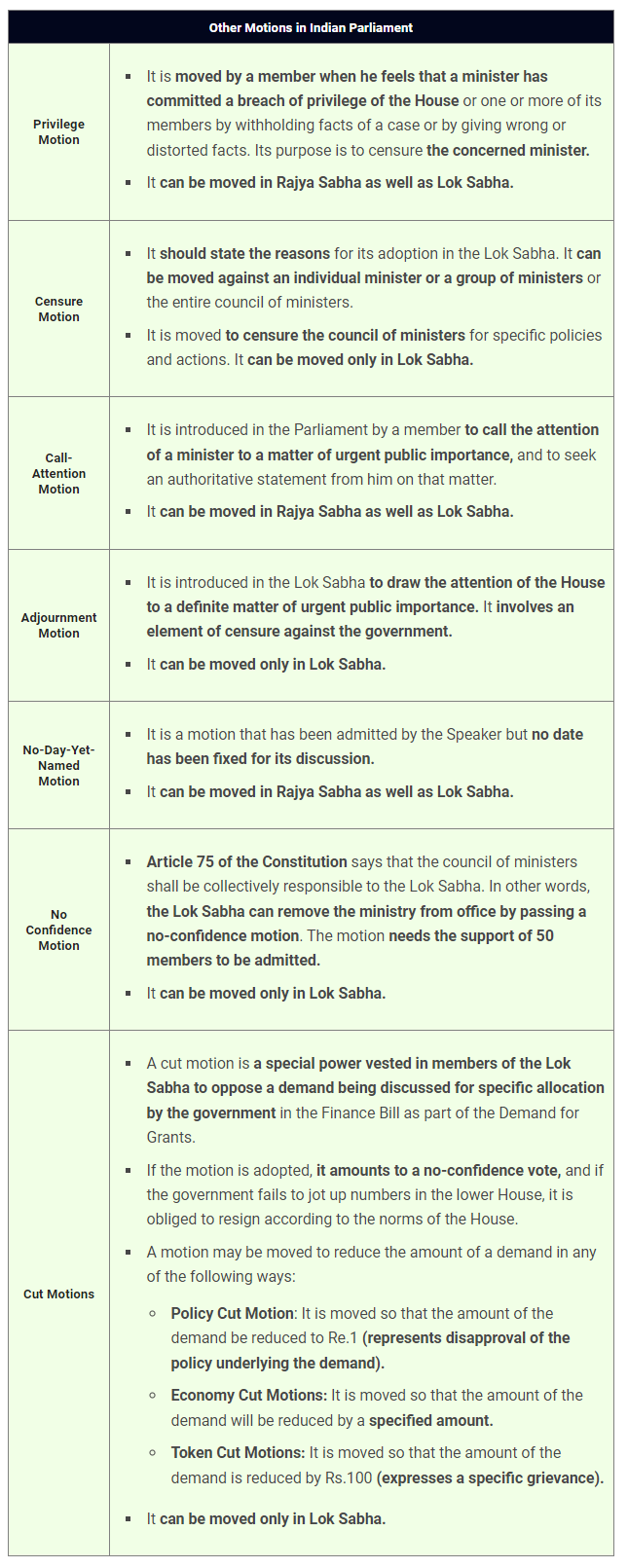
- About: In parliamentary proceedings, a 'motion' is a formal proposal made by a member to elicit a decision from the House.
- Every question decided by the House must be proposed as a motion, which is then resolved in either the affirmative or the negative.
- Motions are the fundamental basis for all discussions and decisions in Parliament.
- Admissibility of Motions: The Speaker decides the admissibility of a motion. Under Rule 186 of the Rules of Procedure and Conduct of Business in Lok Sabha, a motion must satisfy specific criteria to be admitted, including:
- It must raise one definite issue.
- It must not contain arguments, ironical expressions, or defamatory statements.
- It must be restricted to a matter of recent occurrence.
- It must not relate to a matter currently under adjudication by a court (Sub-judice).
- It must be primarily the concern of the Government of India.
- Types of Motions: Motions are classified into three primary categories based on their independence and purpose:
Substantive Motions
- About: A Substantive Motion is a self-contained proposal that stands on its own and is drafted to express a clear decision of the House without referring to any other motion.
- It is used for discussing the conduct of persons in high authority or for making major decisions.
- Example: All resolutions are substantive motions because they are complete in themselves and express the decision of the House.
- It is used for:
- Impeachment of the President.
- Removal of a Judge of the Supreme Court or High Court.
- Election of the Speaker or Deputy Speaker.
- Motion of Thanks on the President’s Address.
- Adjournment motion on a matter of public importance.
- Confidence or No-Confidence motion in the Council of Ministers.
- Resolution for removal of the Speaker or Deputy Speaker.
- Motion declaring a member’s seat vacant.
- Motions for discussion on matters of general public interest.
- It is used for:
Substitute Motions
- About: Substitute Motions are moved in substitution of an original motion (such as a motion to consider a policy or situation).
- While they can express an opinion, they depend on the original motion.
- Process: During a debate on a policy consideration, a member can move a substitute motion.
- At the end of the debate, only the substitute motion is put to the vote.
- Example: In 1991, during a discussion on the international situation, members moved substitute motions to express that the government's foreign policy was "unsatisfactory" due to specific failures (e.g., response to the Gulf War).
Subsidiary Motions
- About: It is a motion which depends upon or relates to another motion or follows upon some proceedings in the House.
- By itself it has no meaning and is not capable of stating the decision of the House without reference to the original motion or proceedings of the House.
- Types of Subsidiary Motions:
- Ancillary Motions: It is a motion recognised by the practice of the House as the regular method for conducting various kinds of legislative business.
- It facilitates the progress of proceedings, such as moving that a Bill be taken into consideration or that the Bill be passed.
- Superseding Motions: It is moved during debate to replace or delay the main question under consideration. These are often dilatory (intended to delay).
- Examples include recommitting a Bill to a Select or Joint Committee, recirculating it for public opinion, or adjourning its consideration to a later date.
- Amendments: It is a subsidiary motion that introduces a new stage of consideration before the final decision on the main question.
- It may seek to modify a Bill, resolution, motion, or even another amendment, either to make the proposal more acceptable or to present an alternative proposition to the House.
- Ancillary Motions: It is a motion recognised by the practice of the House as the regular method for conducting various kinds of legislative business.
Frequently Asked Questions (FAQs)
1. What is a motion in parliamentary procedure?
A motion is a formal proposal made by a member to obtain a decision of the House, forming the basis of all parliamentary discussions and resolutions.
2. What is Substantive Motion?
It is a self-contained proposal capable of expressing the decision of the House independently, used for major actions like confidence motions or removal resolutions.
3. Who decides the admissibility of motions in Lok Sabha?
TheSpeaker decides admissibility under Rule 186, ensuring motions meet procedural and constitutional criteria.
4. What is the difference between substitute and subsidiary motions?
Substitute motions replace the original motion, while subsidiary motions depend on another motion to modify, delay, or facilitate proceedings.
5. Why are motions important in a parliamentary democracy?
They enable debate, ensure accountability, and allow the House to formally express its will on public matters.
UPSC Civil Services Examination, Previous Year Questions (PYQs)
Prelims
Q. The Parliament of India exercises control over the functions of the Council of Ministers through (2017)
- Adjournment motion
- Question hour
- Supplementary questions
Select the correct answer using the code given below:
(a) 1 only
(b) 2 and 3 only
(c) 1 and 3 only
(d) 1, 2 and 3
Ans: (d)