
Strengthening Central Information Commission | 18 Dec 2025
For Prelims: President, Chief Information Commissioner, Central Information Commission (CIC), Right to Information Act, 2005, Quasi-judicial Body, Prime Minister, Office of Profit, Public Information Officers.
For Mains: Key facts regarding the Central Information Commission (CIC) and provisions of Right to Information Act, 2005. Concerns associated with CIC and steps needed to strengthen it.
Why in News?
The President appointed Raj Kumar Goyal as Chief Information Commissioner and 8 new Information Commissioners, thereby fully constituting the Central Information Commission (CIC) for the first time in 9 years.
Summary
- The CIC, constituted under the RTI Act, 2005, ensures citizen access to information, enhancing transparency and accountability across central government and public institutions.
- Strengthening the CIC requires timely appointments, digital case management, stricter enforcement powers, and proactive disclosure initiatives.
What is the Central Information Commission (CIC)?
- About: It is a statutory body constituted under provisions of the Right to Information Act, 2005 and functions as a quasi-judicial body to handle complaints and appeals regarding information access.
- Jurisdiction covers Central Government offices, financial institutions, public sector undertakings, and Union Territories (UTs).
- Composition: Comprises one Chief Information Commissioner and up to 10 Information Commissioners (ICs).
- Appointment: Appointed by the President of India on recommendation of a committee consisting of:
- Prime Minister (Chairperson)
- Leader of Opposition in Lok Sabha
- Union Cabinet Minister (currently Home Minister) nominated by the Prime Minister.
- Eligibility criteria: Must be persons of eminence in public life with wide knowledge and experience in law, science and technology, social service, management, journalism, mass media, administration, or governance.
- Disqualifications: Cannot be Member of Parliament or Member of the Legislature of any State or UT; cannot hold any office of profit, be connected with political parties, carry on business, or pursue any profession.
- Tenure and Service Conditions: The Chief ICs or ICs shall hold office for a term prescribed by Central Government or until age 65 years, whichever is earlier.
- Not eligible for reappointment after completing term.
- Removal: Removal by President under specific circumstances:
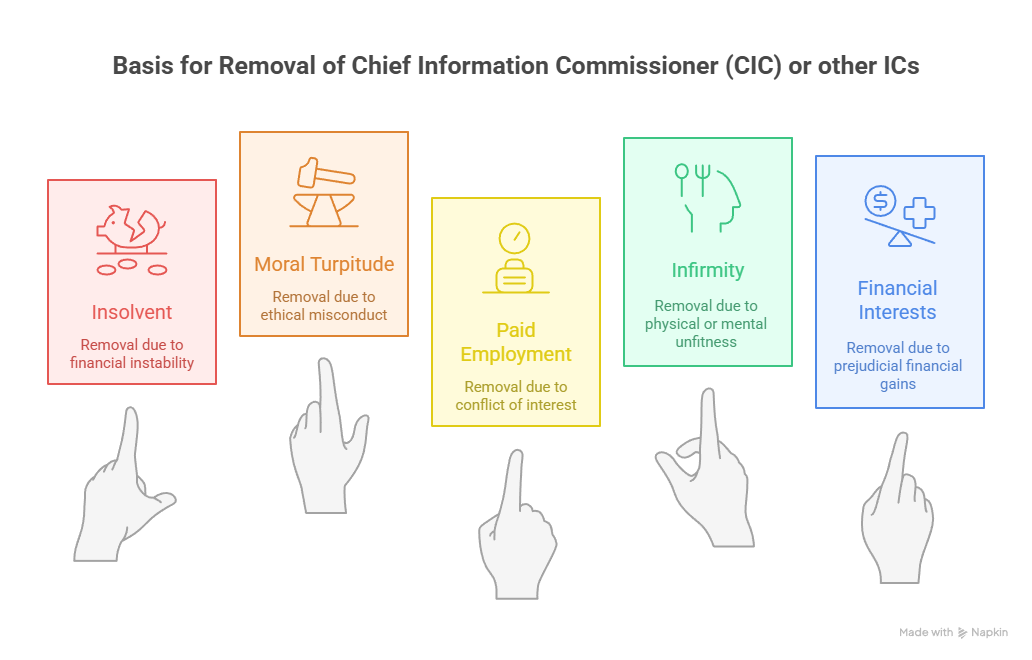
- Removal for misbehavior or incapacity requires Supreme Court (SC) inquiry and recommendation before the President can remove.
- Powers and Functions:
- Receives and inquires complaints from citizens regarding refusal of information requests, incomplete, misleading, or false information provided under the RTI Act, 2005.
- Quasi-judicial powers equivalent to civil court including summoning and enforcing attendance of persons.
- Unrestricted access to records: Can examine any record under public authority's control; no record may be withheld on any grounds during inquiry.
- Reporting obligation: Submits annual report to Central Government on RTI Act, 2005 implementation, which is placed before both Houses of Parliament.
Right to Information Act, 2005 (RTI Act, 2005)
- About: The RTI Act, 2005 was enacted to give citizens the right to access information from public authorities.
- It seeks to enhance transparency, accountability, and good governance in the operations of government bodies and public authorities.
- Key Provisions: The Act applies to all levels of government, including central, state, and local bodies.
- Section 8(2) allows for the disclosure of information when the public interest outweighs confidentiality of information.
- Section 22 ensures that the RTI Act, 2005 takes precedence over any inconsistencies with other laws.
- Right to Information (Amendment) Act, 2019: Under the RTI Act, 2005, the term of the Chief IC and ICs was fixed at 5 years or until the age of 65, whichever is earlier. After the 2019 Amendment, the term is decided by the Central Government.
- Originally, the CIC's salary and terms of service aligned with the Chief Election Commissioner (CEC), and the IC's with an Election Commissioner. After the amendment, salaries, allowances, and terms of service for both CICs and ICs are prescribed by the Central Government.
What Concerns are Associated with the Central Information Commission (CIC)?
- Poor Transparency in the Appointment: The selection process for ICs has faced criticism for insufficient disclosure of criteria and candidate details. In Anjali Bhardwaj v. Union of India (2019), the SC directed greater transparency in appointments to ensure public scrutiny.
- Perceived Compromise of Independence: The RTI (Amendment) Act, 2019 allows the Central Government to set tenure, salaries, and service conditions of commissioners, raising concerns about executive influence over the CIC’s quasi-judicial autonomy.
- Ineffective Enforcement: While the Chief Information Commissioner can order disclosure and impose penalties, its powers are not sufficiently coercive, with limited ability to enforce compliance, especially when public authorities ignore its directions. Reports show they were applied in only about 2.2% of disposed cases.
- Backlog and Delays: As of November 2024, due to vacancies and staff shortages, around 22,000 cases remain pending at the CIC, resulting in long waiting periods for appellants.
- Adjudication Issue: Decisions become overly procedural, with technical dismissals, repeated adjournments, and wide use of exemptions such as privacy or national security, which if not carefully balanced, can reduce information disclosure and weaken the CIC’s role in ensuring transparency.
What Steps are Needed to Strengthen the Central Information Commission (CIC)?
- Timely and Transparent Appointments: Establish a predictable, time-bound, and participatory process for appointing commissioners by following the SC guidelines in Anjali Bhardwaj v. Union of India Case, 2019, and ensure the timely filling of vacancies.
- Reduce Pendency: Increase the number of ICs in proportion to case volume and establish specialized sectoral benches (e.g., for defense and finance).
- Implement mandatory case disposal timelines and a comprehensive digital management system with video conferencing.
- Strengthen Enforcement and Compliance: Empower the CIC with contempt or direct enforcement powers to secure compliance from public authorities. Introduce a compliance tracking system, requiring department heads to report on directives, monitored by parliamentary committees.
- Proactive Disclosure: The CIC must actively enforce Section 4 of the RTI Act to enhance proactive disclosure and reduce appeals. Detailed CIC performance data—bench disposal, penalty trends, compliance rates, and reasoning patterns—must be made public, as an institution that enforces transparency must practice it to preserve its own credibility.
- Administrative Dependence: It performs quasi-judicial functions but remains administratively dependent on the executive for staffing, and infrastructure. Critics argue this duality subtly influences institutional behaviour even without direct interference.
Conclusion
The recent full constitution of the CIC is a positive step, but its effectiveness depends on addressing key issues: ensuring genuine autonomy from executive influence, enforcing penalties to deter non-compliance, and implementing systemic reforms to reduce the massive backlog of appeals that undermines the RTI Act’s objectives.
|
Drishti Mains Question: Q. How can the CIC's enforcement powers be strengthened to ensure effective implementation of its orders, addressing low penalties and poor compliance? |
Frequently Asked Questions (FAQs)
Q. What is the Central Information Commission (CIC)?
The CIC is a statutory quasi-judicial body under the RTI Act, 2005, handling complaints and appeals related to citizen access to information from public authorities.
Q. Who appoints the Chief Information Commissioner and Information Commissioners?
The President of India appoints them based on recommendations from a committee chaired by the Prime Minister, including the Leader of Opposition and a nominated Union Minister.
Q. What was the significance of the Supreme Court's ruling in the Anjali Bhardwaj v. Union of India case 2019?
The Supreme Court directed the government to ensure transparency and timeliness in appointing Information Commissioners, filling vacancies proactively to prevent the CIC from becoming dysfunctional.
UPSC Civil Services Examination, Previous Year Question (PYQ)
Mains
Q. The Right to Information Act is not all about citizens’ empowerment alone, it essentially redefines the concept of accountability.” Discuss. (2018)