
State of Finance for Nature 2026 | 28 Jan 2026
For Prelims: United Nations Environment Programme, Nature-based Solutions, National Mission on Sustainable Agriculture (NMSA), National Water Mission, National Afforestation Programme (NAP)
For Mains: Nature-based Solutions as a climate and biodiversity strategy, Financing gaps in global environmental governance, Role of subsidies in environmental degradation, India’s fiscal federalism and biodiversity conservation
Why in News?
The United Nations Environment Programme (UNEP) released its flagship report titled "State of Finance for Nature 2026," which highlights a stark imbalance in global financial flows, revealing that for every USD 1 invested in protecting nature, nearly USD 30 is spent on activities that destroy it.
Summary
- The State of Finance for Nature 2026 reveals a severe financing imbalance, with USD 30 spent on nature-destructive activities for every USD 1 invested in conservation, driven by environmentally harmful subsidies and private-sector dominance in nature-negative finance.
- For India, scaling Nature-based Solutions through reforms like the Nature Transition X-Curve, green taxonomy, subsidy rationalisation, and private-capital mobilisation is critical to protect biodiversity while sustaining long-term economic growth.
What are the Key Highlights of the State of Finance for Nature 2026?
- Nature-Negative Finance: Global financial flows to activities harming nature (e.g., fossil fuel extraction, unsustainable agriculture, deforestation) reached USD 7.3 trillion in 2023. This is approximately 7% of global GDP.
- The private sector accounts for USD 4.9 trillion of nature-negative flows, concentrated in sectors like energy, utilities, and basic materials.
- Governments provide about USD 2.4 trillion annually in Environmentally Harmful Subsidies (EHS), dominated by fossil fuel support, followed by unsustainable agriculture and water subsidies.
- These subsidies distort market prices, making environmental destruction cheaper than conservation.
- Nature-Positive Finance: Investments in Nature-based Solutions (NbS) stood at only USD 220 billion.
- This creates a massive disparity, with harmful investments outpacing protective spending by a 30:1 ratio, resulting in a stark and unsustainable imbalance.
- However, spending on biodiversity and landscape protection is rising, increasing by 11% between 2022 and 2023, while international public finance for nature-based solutions in 2023 was 22% higher than in 2022 and 55% above 2015 levels.
- The Finance Gap for NbS: The NbS finance is overwhelmingly driven by public funds (90% of total NbS finance comes from governments).
- Private investment in NbS is negligible, accounting for just 10% of the total.
- To meet the Rio Convention targets, NbS investment must increase 2.5 times to reach USD 571 billion annually by 2030.
- The Rio Conventions from the 1992 Earth Summit target climate stability, biodiversity conservation, and land restoration.
- The UN Framework Convention on Climate Change (UNFCCC) aims to limit warming to below 2°C, preferably 1.5°C.
- The Convention on Biological Diversity (CBD) seeks to conserve 30% of land, waters, and seas and restore 30% of degraded ecosystems by 2030.
- The UN Convention to Combat Desertification (UNCCD) targets restoring 1.5 billion hectares of degraded land by 2030.
What are Nature-based Solutions (NbS)?
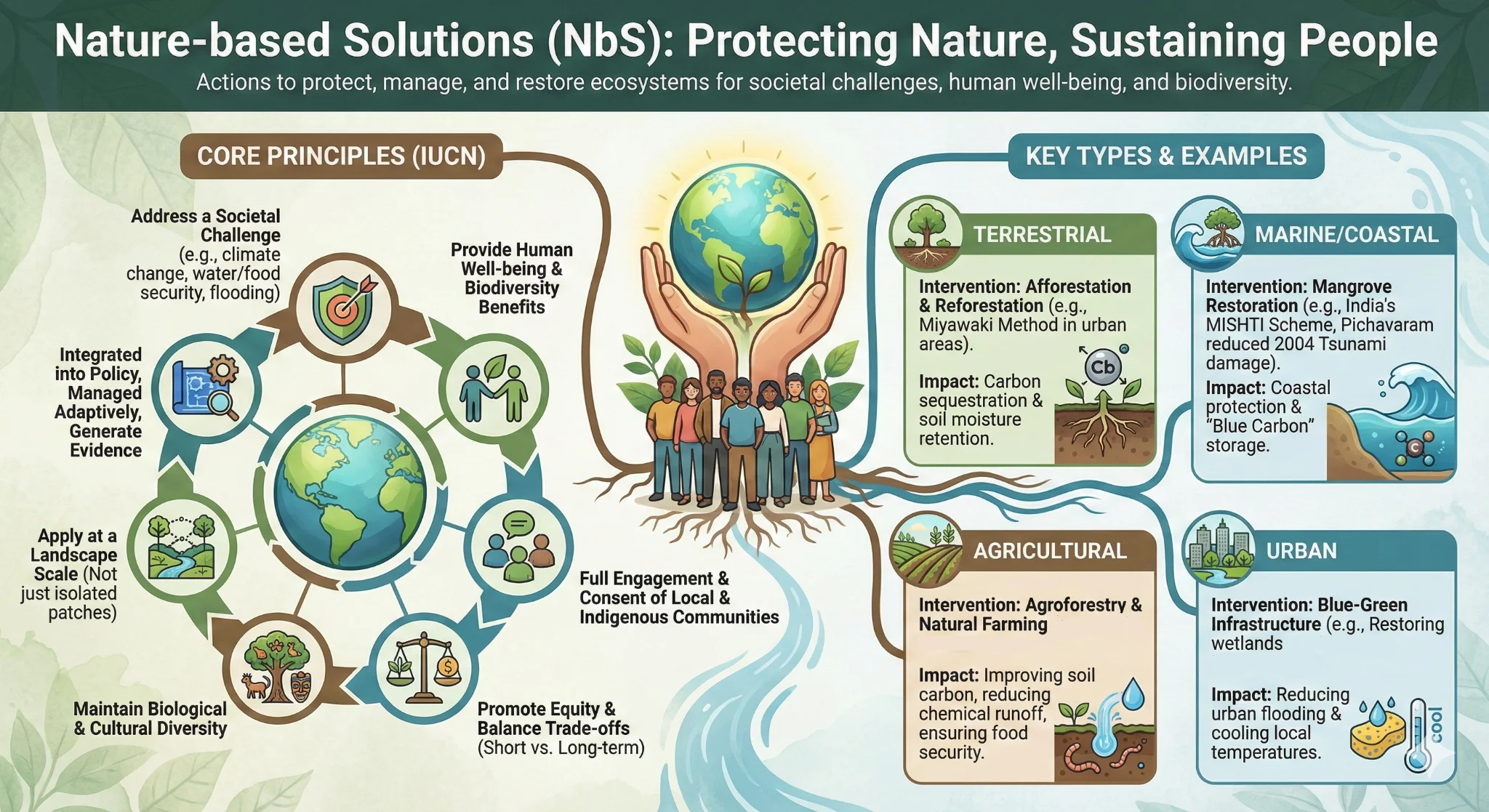
- Definition: NbS refers to actions to protect, sustainably manage, and restore natural or modified ecosystems that address societal challenges (like climate change, food security, and disaster risk) effectively and adaptively, simultaneously providing human well-being and biodiversity benefits.
- Examples:
- Mangrove Restoration: Protects coastlines from storms (Disaster Management) + Sequesters Carbon (Climate Change).
- Agroforestry: Increases crop yield (Food Security) + Maintains Soil Health (Biodiversity).
- Green Urban Spaces: Reduces heat island effect (Urban Planning).
What are the Challenges in Scaling NbS Finance?
- High Due Diligence Costs: The lack of standardized data and the unique biological complexity of each site require bespoke, expensive assessments. This raises the transaction cost significantly compared to standardized grey infrastructure projects, deterring mainstream capital.
- NbS is a nascent asset class with limited historical performance data. Without a proven track record of risk-adjusted returns, credit rating agencies cannot accurately price the risk, forcing investors to demand higher premiums.
- Liquidity Constraints: Investments in nature are inherently illiquid and long-term (10–20 years). There is no active secondary market where investors can easily exit or trade their stakes, creating a "lock-in" risk that repels private equity seeking shorter horizons (3–5 years).
- Currency & Sovereign Risk: The majority of high-impact NbS potential lies in the Global South (tropical belts), while the capital sits in the Global North.
- This exposes investors to significant foreign exchange volatility and sovereign risk, often requiring expensive hedging instruments that erode returns.
- Lack of Data: Unlike carbon, "nature" is hard to measure. Investors lack standardized metrics to assess the return on investment (ROI) for biodiversity projects.
What are the Implications of Low NbS Finance for India?
- Subsidy Paradox: India faces a critical fiscal-ecological contradiction where "nature-negative" subsidies (for chemical fertilizers, free electricity for pumping groundwater) vastly outstrip "nature-positive" allocations (e.g., budget for MoEFCC or organic farming), effectively paying to degrade the very soil and aquifers the economy depends on.
- Public Finance Over-reliance: Unlike the Global North, where private capital is entering conservation, India's NbS are almost entirely state-funded through schemes like Compensatory Afforestation Fund Management and Planning Authority (CAMPA).
- This places an unsustainable burden on the exchequer while the private sector's contribution (CSR/Impact Investing) remains negligible.
- GDP Exposure Risk: With over 50% of India's workforce engaged in agriculture and allied sectors, the economy has an exceptionally high "nature-dependency ratio."
- The collapse of ecosystem services (pollination, water tables) could trigger systemic financial instability faster in India than in industrialized nations.
- Green Taxonomy Void: India is still in the process of developing a formalised "Green Taxonomy" (a classification system defining what counts as 'green').
- This regulatory gap allows financial institutions to lend to projects that claim to be sustainable but are actually "nature-negative" (Greenwashing), hindering the flow of genuine global capital into Indian NbS projects.
- Fiscal Federalism Paradox: While India’s international commitments (Paris Agreement, Kunming-Montreal Framework) are made by the Center, the actual implementation of NbS (land, water,) is primarily a State Subject.
- This creates a misalignment where the Center pushes for conservation, but revenue-starved States prioritize extractive industries (mining, real estate) for immediate funds.
India’s Initiatives for Promoting NbS
- National Mission for a Green India (GIM),
- National Mission on Sustainable Agriculture (NMSA),
- National Water Mission.
- National Afforestation Programme (NAP),
- Atal Mission for Rejuvenation and Urban Transformation (AMRUT) 2.0, Mangrove Initiative for Shoreline Habitats and Tangible Incomes (MISHTI).
- Mission Amrit Sarovar.
What Measures can Effectively Increase Nature-based Solutions (NbS)?
- Nature Transition X-Curve: UNEP proposes a Nature Transition X-Curve, a dual strategy of rapidly phasing out nature-negative flows such as harmful subsidies while scaling nature-positive markets, by redirecting capital from destructive activities to regenerative ones to decouple growth from environmental degradation
- Pricing Externalities: Implement mechanisms to internalize environmental costs, such as Carbon Taxes or "Nature-Liability" levies, making destruction expensive and conservation profitable.
- Mandatory Disclosures: Governments should make nature-related financial disclosures mandatory (aligned with TNFD - Taskforce on Nature-related Financial Disclosures).
- Companies must report their "nature dependency" and "nature impact" to shareholders.
- Innovative Instruments: Scale up financial products like "Green Bonds", "Sustainability-Linked Loans", and "Biodiversity Credits" to attract mainstream investors.
- Public institutions (like the World Bank or National Development Banks) should provide "First-Loss Guarantees" or concessional capital to de-risk private investments in NbS projects.
- Standardized Metrics: Move beyond focusing only on CO2 and adopt standardized metrics for biodiversity (e.g., Mean Species Abundance) to prevent greenwashing.
- Integrated Policy: Ministries of Finance, Agriculture, and Energy must align their policies with the Kunming-Montreal Global Biodiversity Framework (GBF) targets, ensuring that one ministry is not funding what another is trying to save.
Conclusion
The State of Finance for Nature 2026 warns that current economic systems are funding environmental destruction. For India, implementing the Nature Transition X-Curve through is essential to shift from a nature-subsidising economy to a nature-positive growth model, safeguarding biodiversity and the USD 5-trillion economic goal.
|
Drishti Mains Question: Examine the significance of Nature-based Solutions in addressing climate change and biodiversity loss in developing countries. |
Frequently Asked Questions (FAQs)
1. What does the State of Finance for Nature 2026 report reveal?
It shows that global finance overwhelmingly supports nature-destructive activities, with a 30:1 imbalance between harmful and protective investments.
2. What are Nature-based Solutions (NbS)?
NbS are actions that protect, restore, or manage ecosystems to address societal challenges while delivering biodiversity and human well-being benefits.
3. Why is private investment in NbS limited?
High due diligence costs, lack of standard metrics, long gestation periods, and absence of secondary markets deter private capital.
4. Why is low NbS finance risky for India?
India’s economy is highly dependent on natural systems; ecosystem collapse could threaten agriculture, livelihoods, and macroeconomic stability.
UPSC Civil Services Examination Previous Year Question (PYQ)
Prelims
1. With reference to the role of UN-Habitat in the United Nations programme working towards a better urban future, which of the statements is/are correct? (2017)
- UN-Habitat has been mandated by the United Nations General Assembly to promote socially and environmentally sustainable towns and cities to provide adequate shelter for all.
- Its partners are either governments or local urban authorities only.
- UN-Habitat contributes to the overall objective of the United Nations system to reduce poverty and to promote access to safe drinking water and basic sanitation.
Select the correct answer using the code given below:
(a) 1, 2 and 3
(b) 1 and 3 only
(c) 2 and 3 only
(d) 1 only
Ans: (b)
Mains
Q. The frequency of urban floods due to high intensity rainfall is increasing over the years. Discussing the reasons for urban floods, highlight the mechanisms for preparedness to reduce the risk during such events.(2016)
Q. Do government schemes for up-lifting vulnerable and backward communities by protecting required social resources for them, lead to their exclusion in establishing businesses in urban economies? (2014)