
Sarvam AI and the Sovereign AI in India | 11 Feb 2026
For Prelims: Artificial Intelligence, Sarvam AI, Sovereign AI, India AI Mission, Large Language Model
For Mains: Sovereign AI and Strategic Autonomy, IndiaAI Mission and Indigenous LLM Development, AI Governance
Why in News?
In a major boost to India’s Artificial Intelligence (AI) ambitions, Bengaluru-based startup Sarvam AI’s latest models Sarvam Vision and Bulbul V3 have reportedly outperformed Google Gemini and OpenAI’s ChatGPT on India-specific AI benchmarks, marking a significant step toward building sovereign AI ecosystems tailored to Indian needs.
Summary
- Sarvam AI’s Sarvam Vision and Bulbul V3 have outperformed global models on India-specific benchmarks, advancing India’s push for Sovereign AI under the IndiaAI Mission.
- Building a strong sovereign AI ecosystem requires focus on data sovereignty, semiconductor capability, multilingual inclusion, frugal innovation, and AI governance reforms to achieve true technological Atmanirbharta.
What is the Sarvam Vision and Bulbul V3?
- Sarvam Vision: It is a 3 billion-parameter vision-language model capable of a range of visual understanding tasks, including image captioning, scene text recognition, chart interpretation, and complex table parsing.
- It focuses on digitizing physical Indian records—including manuscripts, financial tables, and historical texts.
- Key Features:
- While traditional Optical Character Recognition (OCR) only extracts text, Sarvam Vision performs "Knowledge Extraction."
- It understands the structure of a document, interpreting complex tables, charts, and reading orders (e.g., distinguishing between a caption and a headline).
- It is trained on datasets covering all 22 official Indian languages, making it capable of handling documents with mixed scripts (e.g., a government form in Hindi and English).
- Performance: Under olmOCR-Bench, which evaluates how accurately AI converts PDFs and complex document images into structured text, Sarvam Vision scored 84.3%, outperforming Google Gemini 3 Pro and DeepSeek OCR v2.
- On OmniDocBench v1.5, which tests document parsing across diverse real-world formats, it achieved 93.28% accuracy, demonstrating strong capability in handling complex layouts.
- Bulbul V3: It is Sarvam’s upgraded text-to-speech (TTS) AI model designed to generate natural, region-sensitive speech across India’s diverse linguistic landscape.
- It supports over 35 professional-quality voices across 11 Indian languages, with plans to expand to all 22 Scheduled Languages.
- Bulbul V3 captures prosody (pauses, tone, and emphasis )for natural speech and is optimized for Indian accents and linguistic nuances.
- It handles code-switching, regional variations, abbreviations, and emotional tone, making it well-suited for India’s multilingual environment.
- It is part of India’s broader push for sovereign AI models under the Rs 10,300-crore India AI Mission.
Note: The Government of India has selected Bengaluru-based startup Sarvam to develop the country’s first indigenous Large Language Model (LLM) under the IndiaAI Mission.
- Sarvam is building three variants: Sarvam-Large (advanced reasoning), Sarvam-Small (real-time applications), and Sarvam-Edge (on-device use) to develop a 70-billion-parameter AI model, aimed at population-scale deployment in Indian languages.
- Sarvam has launched a suite of AI tools tailored for multilingual and enterprise use.
- Sarvam Samvaad: Conversational AI agents that integrate with enterprise tools to generate insights and take actions using proprietary data.
- Sarvam Audio: An audio extension of the 3B language model, supporting English and 22 Indian languages.
- Sarvam Dub: An AI dubbing model with zero-shot voice cloning and cross-lingual speech capability for multilingual content creation.
What is Sovereign AI?
- About: Sovereign AI refers to a nation’s capability to develop, deploy, and govern AI technologies using its own infrastructure, data, workforce, and regulatory frameworks, rather than relying heavily on foreign technology giants.
- Core Philosophy: It is based on the premise of "Strategic Autonomy," ensuring that a country’s critical digital infrastructure is not held hostage to the geopolitical interests or corporate policies of other nations.
- Significance for India:
- Data Security: By building models indigenously, sensitive Indian data (like Aadhaar details or financial records) does not need to cross borders to servers in the US or China.
- Cultural Context: Global models often suffer from "Western Hallucinations" (giving answers relevant to US culture). Models like Sarvam Vision are grounded in the Indian context, reducing cultural bias.
- Frugal Innovation: Sarvam Vision achieves high performance with just 3 billion parameters, whereas models like Gemini use trillions.
- This makes the technology cheaper and energy-efficient to run, crucial for a developing economy.
- Digital Inclusion: Tools like Bulbul V3 can bridge the digital divide by allowing illiterate populations to interact with the internet through voice in their native dialect.
What are the Challenges in Scaling Up the Sovereign AI Ecosystem in India?
- Linguistic Exclusion: The internet is dominated by English/Latin scripts. The lack of high-quality, tokenized datasets for India’s 22 scheduled languages and thousands of dialects leads to "Token Inequality," where AI models perform poorly on vernacular tasks.
- Bias Reinforcement: Indigenous models trained on uncurated societal data may inadvertently amplify caste, gender, or religious biases, leading to algorithmic discrimination in welfare delivery.
- Riskless Capitalism: Indian Venture Capital (VC) often prioritize safe, low-risk bets in "consumer tech" (quick commerce, fintech) over R&D-heavy "deep tech."
- Sovereign AI requires "Patient Capital" with long gestation periods, which is currently scarce.
- Data Quality & Accessibility: Although India generates vast data, much of it is unstructured or siloed in government files. Creating high-quality, machine-readable datasets remains a hurdle.
- The "Moat" Sustainability Challenge: If global tech giants (Google, Meta) decide to fine-tune their massive foundational models specifically on high-quality Indic datasets, the performance gap could close rapidly, eroding Sarvam's "moat."
What Measures are Needed to Strengthen India’s Sovereign AI Ecosystem?
- Link AI with Semiconductor Mission: India must not just build AI models (software) but also secure the underlying hardware. The India Semiconductor Mission (ISM) should prioritize the fabrication of AI-specific chips (ASICs/TPUs) domestically.
- Design-Led Manufacturing: Incentivize the design of indigenous AI accelerators (like the 'Shakti' and 'Vega' microprocessor series by IIT Madras) to reduce reliance on NVIDIA/Intel, creating a fully "Atmanirbhar" compute stack.
- Focus on "Frugal AI": Instead of blindly copying massive western models, India should focus on Small Language Models (SLMs) that are highly efficient, require less energy, and can run on consumer devices (Edge AI).
- GPAI Leadership: Leverage India’s position as the Lead Chair of the Global Partnership on Artificial Intelligence (GPAI) to champion a "Global South" AI framework—one that prioritizes developmental goals (poverty, disease) over mere commercial profit.
- Data Residency: Strict enforcement of the Digital Personal Data Protection (DPDP) Act, 2023 will force global giants to process data locally, further incentivizing the growth of domestic AI infrastructure providers.
- Moving Beyond Pilots: A major hurdle for Indian AI startups is "Pilot Purgatory"—where enterprises run endless tests without deploying. The government can lead by example, mandating the use of indigenous AI solutions (under the Make in India initiative) for public procurement in railways, defence, and postal services.
- AI Safety Institute: Establish a statutory body similar to the UK’s AI Security Institute to test and certify "High-Impact" models for safety and bias before they are deployed in public services.
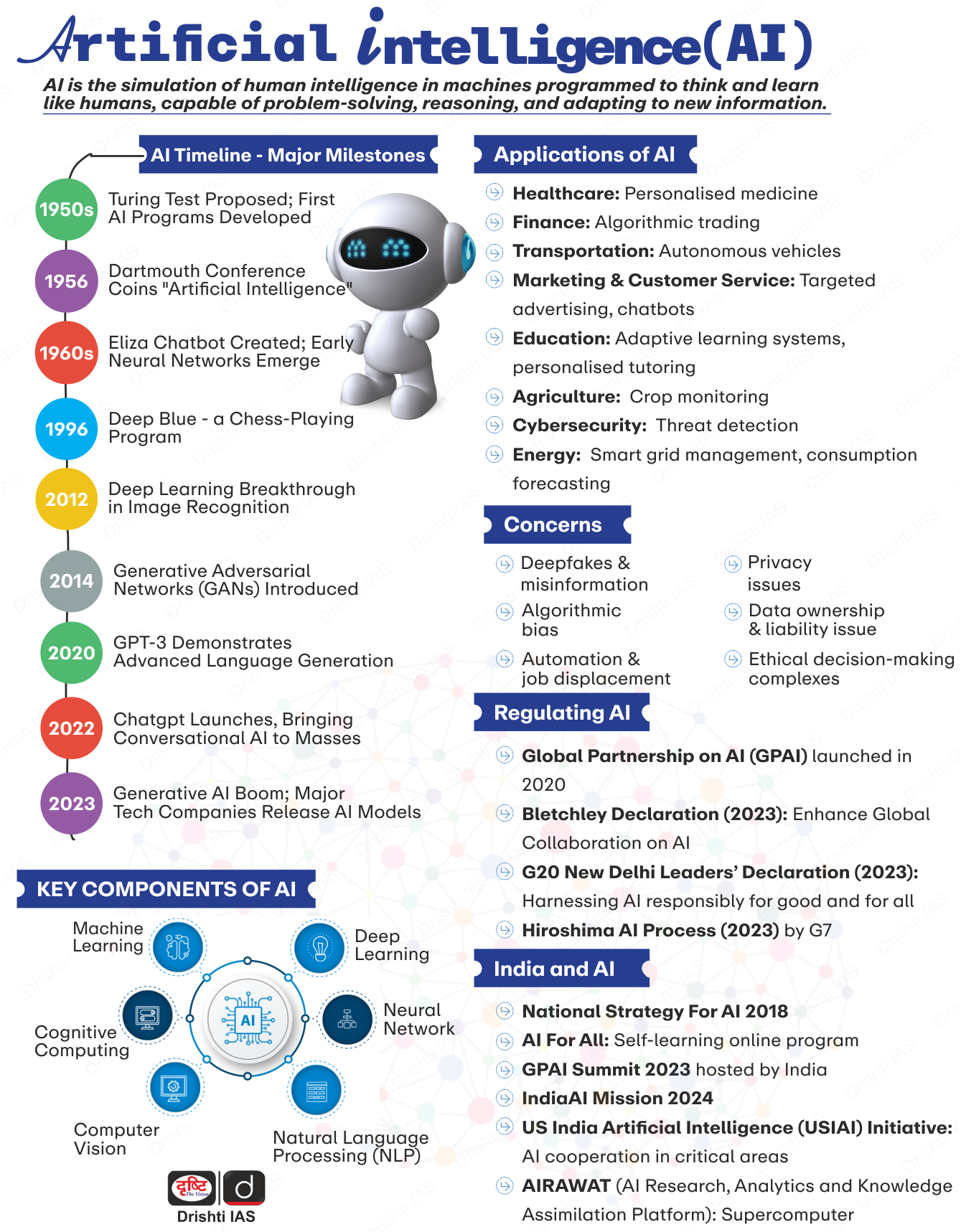
Conclusion
Sovereign AI is not just a tech upgrade but a strategic necessity for India to move from being a data supplier to a creator of indigenous intelligence. By embedding AI within Digital Public Infrastructure and frugal innovation, India can ensure true Atmanirbharta by owning its algorithms and data in the 21st century.
|
Drishti Mains Question: "Sovereign AI is the digital equivalent of national defense in the 21st century." Discuss this statement in light of recent developments in indigenous AI models |
Frequently Asked Questions (FAQs)
1. What is Sovereign AI?
Sovereign AI refers to a nation’s ability to develop, deploy, and regulate AI using domestic infrastructure, data, talent, and legal frameworks to ensure strategic autonomy.
2. What is the IndiaAI Mission?
The ₹10,300-crore IndiaAI Mission aims to build indigenous AI capabilities, including foundational Large Language Models, AI compute infrastructure, and innovation ecosystems.
3. Why is Sarvam Vision significant?
Sarvam Vision is a 3B-parameter vision-language model trained on 22 Indian languages, excelling in document intelligence and outperforming global models on India-specific OCR benchmarks.
4. How does the DPDP Act, 2023 support Sovereign AI?
The Digital Personal Data Protection Act, 2023 strengthens data residency and local processing requirements, encouraging domestic AI infrastructure development.
5. What are the key challenges in building India’s Sovereign AI ecosystem?
Challenges include linguistic data gaps, algorithmic bias, limited patient capital for deep tech, data silos, and dependence on foreign AI hardware and foundational models.
UPSC Civil Services Examination Previous Year Question (PYQ)
Prelims
Q. With the present state of development, Artificial Intelligence can effectively do which of the following?(2020)
- Bring down electricity consumption in industrial units
- Create meaningful short stories and songs
- Disease diagnosis
- Text-to-Speech Conversion
- Wireless transmission of electrical energy
Select the correct answer using the code given below:
(a) 1, 2, 3 and 5 only
(b) 1, 3 and 4 only
(c) 2, 4 and 5 only
(d) 1, 2, 3, 4 and 5
Ans: (b)
Mains:
Q. Introduce the concept of Artificial Intelligence (AI). How does AI help clinical diagnosis? Do you perceive any threat to privacy of the individual in the use of AI in healthcare? (2023)