
Restoring Soil Organic Carbon for Sustainable Agriculture | 11 Nov 2025
For Prelims: Indian Council of Agricultural Research (ICAR), Soil Organic Carbon (SOC), Micronutrient, Carbon Credit, National Mission for Sustainable Agriculture (NMSA), Soil Health Card Scheme, Natural Farming, No-till Farming, Organic Manuring, PM-KISAN, Paramparagat Krishi Vikas Yojana (PKVY).
For Mains: Status of soil organic carbon in India, implications of depleting organic carbon and measures needed for sustainable soil management.
Why in News?
A study by the Indian Council of Agricultural Research (ICAR) reveals that unscientific fertilizer use and climate change are depleting organic carbon in India’s arable lands, based on 254,236 soil samples from 620 districts across 29 States.
- Soil Organic Carbon (SOC) is the carbon in soil organic matter, including decomposed residues and microbes, and indicates soil health, fertility, water retention, and climate impact.
What are the Key Findings of the ICAR Study on Soil Organic Carbon in India?
- Impact of Fertilisers and Climate Change: Unscientific fertiliser use and rising temperatures reduce soil organic carbon. States like Haryana, Punjab, and parts of Western Uttar Pradesh overuse urea and phosphorus, harming soil health, while Bihar, with balanced fertiliser use, fares better.
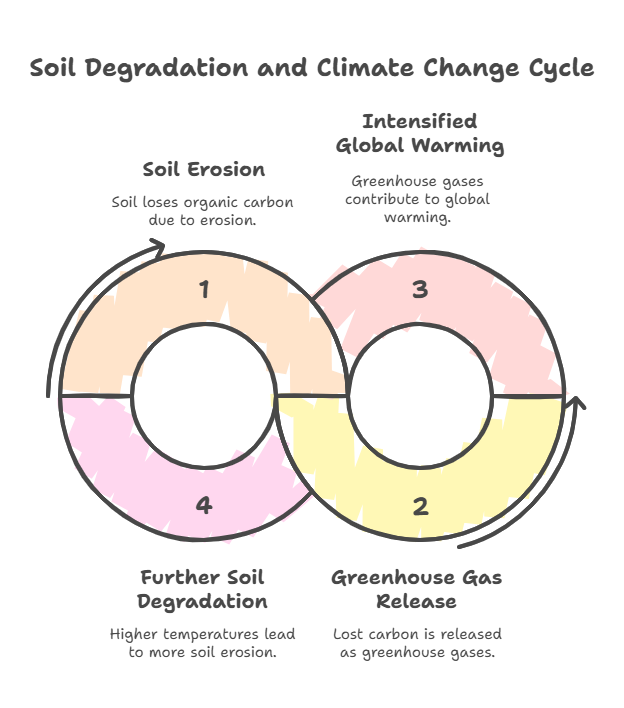
- Influence of Environmental Factors: Organic carbon is higher at higher elevations and lower in lowlands, and decreases with higher temperatures, as seen in Rajasthan and Telangana. Rainfall has a smaller effect compared to temperature and elevation.
- Impact of Cropping Systems: Rice-based and pulse-based systems help retain higher organic carbon due to microbial activity and irrigation. Wheat and coarse-grain systems have lower organic carbon content.
- Correlation with Micronutrients: Low organic carbon results in higher micronutrient deficiency, while high organic carbon improves soil fertility.
Soil Profile
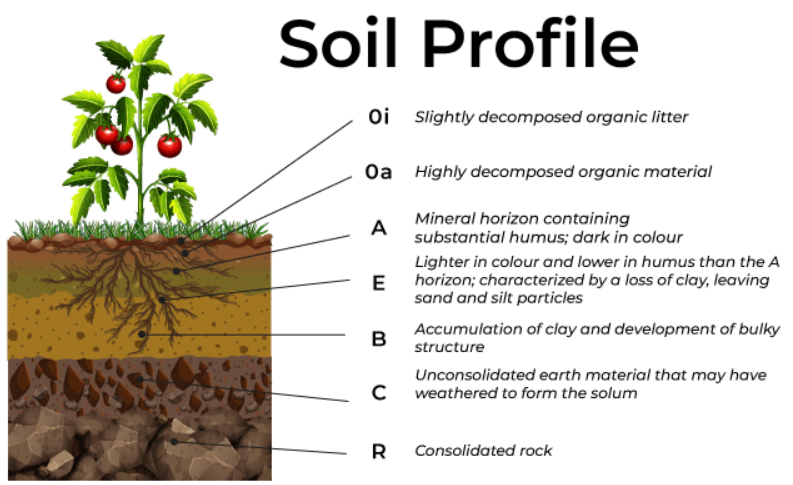
- About: A soil profile is a vertical slice of the ground revealing distinct layers (horizons), each differing in texture, colour, and chemical composition. These soil horizons, shaped by climate, organisms, and the land surface, can be organic (O) or mineral (A, E, B, C).
- Layers of Soil:
- O Horizon (Organic Layer): Contains undecomposed organic matter like leaves, twigs, and moss.
- A Horizon (Topsoil): Rich in organic matter and minerals, supports plant growth, soft and porous.
- E Horizon (Eluviated Layer): A lighter, nutrient-depleted layer due to leaching (removal of minerals by water).
- B Horizon (Subsoil): Accumulates leached minerals from upper layers; contains iron, clay, and organic compounds.
- C Horizon (Parent Rock): Made up of broken bedrock or saprolite, with little organic matter.
- R Horizon (Bedrock): Unweathered bedrock at the base of the soil profile.
What are the Key Implications of Depleting Organic Carbon?
- Reduced Soil Fertility & Productivity: Organic carbon is vital for soil health, and its depletion causes poor soil structure, reduced water retention, and micronutrient deficiencies, affecting crop quality and yield.
- This leads to stagnating or declining crop yields, posing a long-term threat to India’s food security.
- Climate Change Feedback Loop: Depleted soils create a two-way problem: they release stored carbon as CO₂, and their lighter, poorly structured surfaces reflect more heat, contributing to localized warming and altered microclimates.
- Increased Cost of Cultivation: Declining soil fertility increases fertilizer use, costs, and farming risks, while depleted soils miss carbon credit opportunities, reducing profit incentives for sustainable practices.
- Threat to Agricultural Sustainability: The current input-driven agriculture model is unsustainable, degrading soil and undermining initiatives like the National Mission for Sustainable Agriculture (NMSA), Soil Health Card Scheme, and targets for natural farming and carbon credits.
- Loss of Biodiversity: Soil organic carbon is the primary energy source for a vast ecosystem of microorganisms, earthworms, and other biota essential for nutrient cycling. Its depletion decimates this underground biodiversity.
What Steps are Needed for Sustainable Soil Management in India?
- Sustainable Crop Management: Zero tillage, cover cropping, and residue retention can preserve Soil Organic Carbon (SOC) by improving soil health and carbon sequestration, with no-till systems and diverse crops building carbon over time.
- Balanced Fertiliser Use: Strengthen the Soil Health Card Scheme by creating a digital soil database to provide farmers with site-specific nutrient management plans specifying N, P, K, and micronutrient dosages.
- Promote organic and alternative fertilisers and reform the subsidy policy to support balanced, soil-test-based fertilisation.
- Carbon-Sequestering Cropping Systems: Promote cropping diversification and agroforestry to build biomass and enhance soil organic matter. Encourage carbon-rich practices like conservation agriculture, System of Rice Intensification (SRI), and cover cropping to improve soil health and retain organic carbon.
- Carbon Credit Framework for Agriculture: Develop a National Carbon Credit Framework for agriculture using ICAR’s soil map to measure soil carbon stocks.
- Provide direct incentives for farmers to adopt carbon-sequestering practices like no-till farming and organic manuring, creating a new revenue stream and promoting sustainable farming.
- Leveraging Technology: Develop digital platforms integrating Soil Health Card data, satellite imagery, and weather data for real-time irrigation and nutrient advisories. Promote drip irrigation and sprinklers under the "Per Drop, More Crop" initiative to ensure efficient water use and protect soil health.
- Policy Integration: Incorporate soil health management into key schemes like PM-KISAN, NMSA, and Paramparagat Krishi Vikas Yojana (PKVY), focusing on areas with very low soil organic carbon (<0.25%).
- Provide farmer training through Krishi Vigyan Kendras (KVKs) on the relationship between soil organic carbon, fertiliser efficiency, and long-term profitability.
Conclusion
The ICAR study highlights that unscientific fertilizer use and climate change are depleting soil organic carbon, threatening soil fertility, biodiversity, and agricultural sustainability. Adoption of balanced fertilisation, carbon-sequestering cropping systems, digital monitoring, and carbon credit frameworks is critical to restore soil health, improve crop productivity, and achieve long-term sustainable agriculture in India.
|
Drishti Mains Question: Examine the impact of declining soil organic carbon on India’s agricultural sustainability and food security. |
Frequently Asked Questions (FAQs)
1. What is Soil Organic Carbon (SOC)?
Soil Organic Carbon (SOC) is the carbon stored in soil organic matter, which includes decomposed plant and animal residues, microbes, and humus.
2. How does declining soil organic carbon affect agricultural productivity?
It reduces soil fertility, microbial activity, water retention, and nutrient availability, leading to lower crop yields and threatening food security.
3. What is the significance of creating a Carbon Credit Framework for Indian agriculture?
It would create a financial incentive for farmers to adopt carbon-sequestering practices like zero-till farming, providing a new revenue stream while simultaneously addressing soil degradation and climate change.
UPSC Civil Services Examination Previous Year Question (PYQ)
Prelims
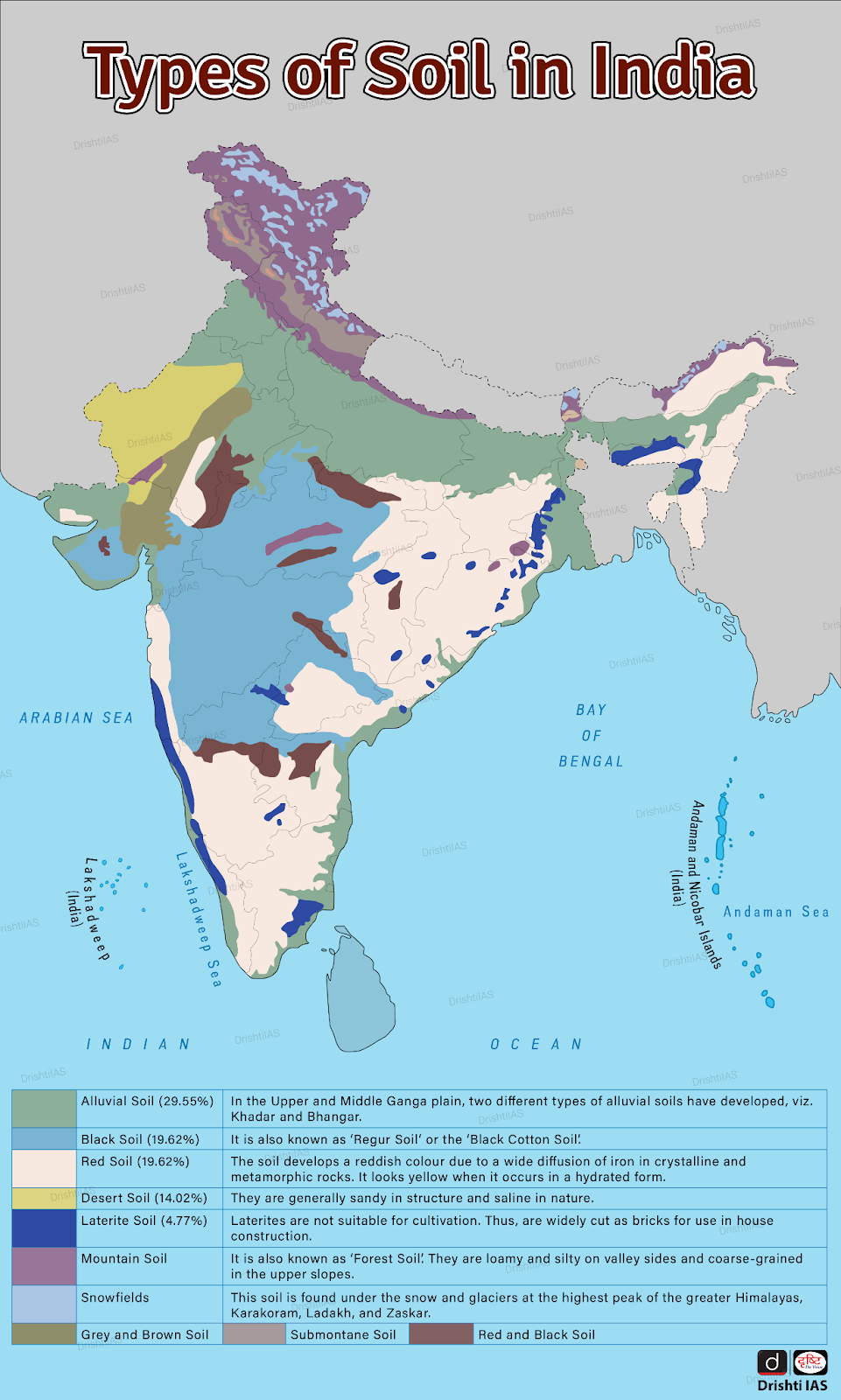
Q. The black cotton soil of India has been formed due to the weathering of (2021)
(a) brown forest soil
(b) fissure volcanic rock
(c) granite and schist
(d) shale and limestone
Ans: (b)
Q. Consider the following statements: (2017)
- The nation-wide ‘Soil Health Card Scheme’ aims at
- expanding the cultivable area under irrigation.
- enabling the banks to assess the quantum of loans to be granted to farmers on the basis of soil quality.
- checking the overuse of fertilisers in farmlands.
Which of the above statements is/are correct?
(a) 1 and 2 only
(b) 3 only
(c) 2 and 3 only
(d) 1, 2 and 3
Ans: (b)
Mains
Q. How far is the Integrated Farming System (IFS) helpful in sustaining agricultural production? (2019)