
Reforming the Governor’s Office in India | 02 Dec 2025
For Prelims: Governor, Chief Minister, Speaker, Hung Assembly, Prime Minister, President, Sarkaria Commission (1988), Punchhi Commission (2010).
For Mains: Various Areas of Tension Between the State Government and the Governor, Committees Recommendations and Judicial Verdicts to Resolve them and Further Measures Needed for a Healthy Relationship between Governor and State Government.
Why in News?
The Supreme Court (SC) criticised the Kerala Governor for ignoring court-appointed committee recommendations on vice-chancellors (VCs) appointments, highlighting state-Governor tensions.
- In August 2025, SC formed a Justice Dhulia-led committee to shortlist candidates, underscoring friction in the Governor’s Chancellor role.
What are the Key Controversies Associated with the Role of Governors in India?
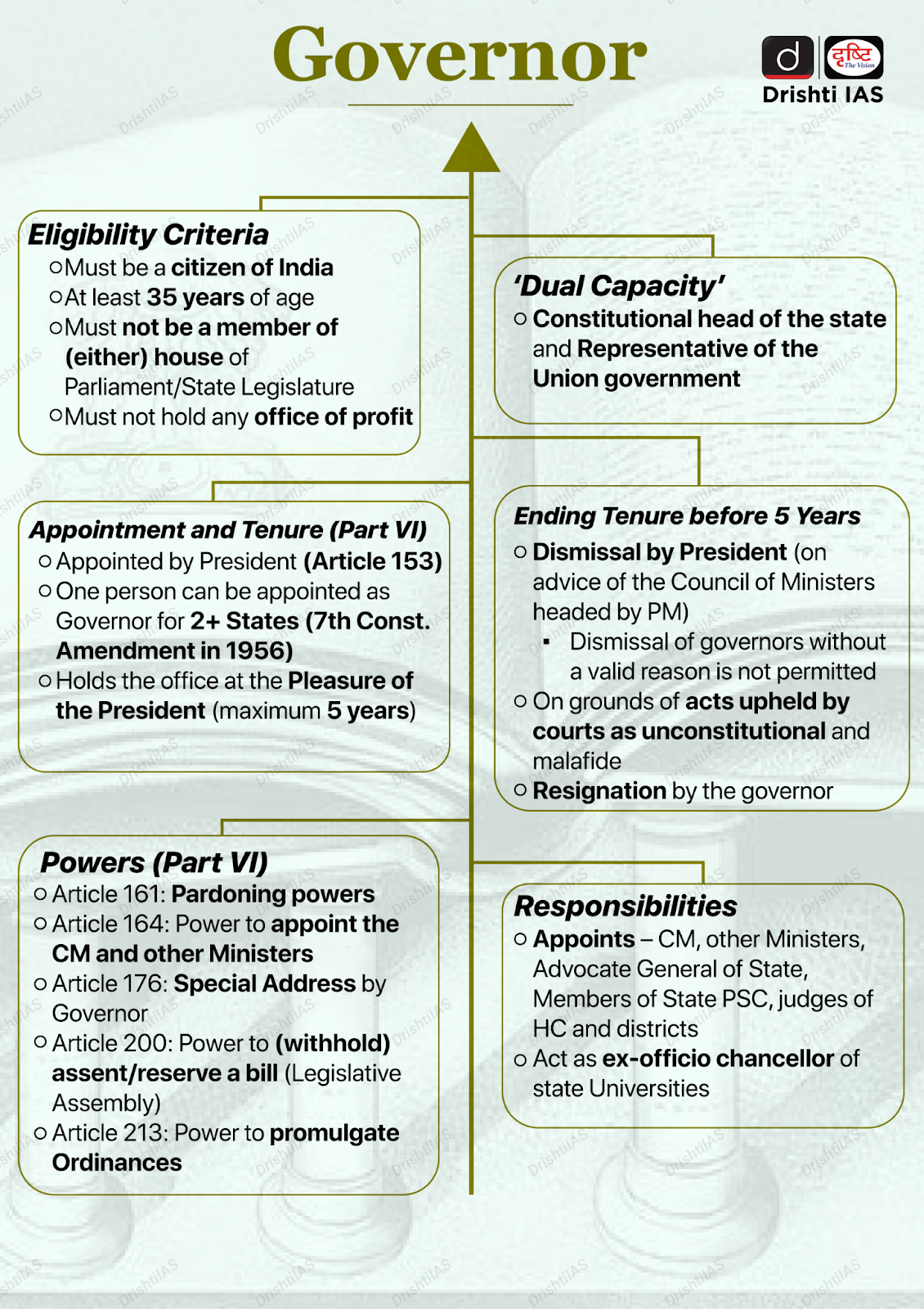
- Role as Chancellor of State Universities: In most cases, the Governor serves as the ex-officio Chancellor of state universities. Tensions arise when the Governor acts contrary to the state government’s advice, especially in Vice-Chancellor appointments or university administration.
- This results in conflicts over institutional autonomy, the limits of the Governor’s discretionary power, and the broader tussle between the central government (which appoints the Governor) and state governments for control.
- Withholding Assent to Bills: The main flashpoint involves 3 Governor powers, i.e., withholding assent to stall state laws, reserving bills for the President, and prolonged inaction, where bills are left pending for long periods.
- Appointment and Tenure of the Governor: Governors are often seen as political appointees, usually retired politicians or bureaucrats close to the central ruling party, which creates a perception of bias when another party governs the state.
- Their tenure depends on the “pleasure of the President,” allowing the Centre to remove them anytime, especially after a change in government, weakening the independence and dignity of the office.
- Governor’s Legislative Interference: Tensions rise when Governors delay summoning the Assembly or, during a majority crisis, ignore the Chief Minister’s advice to dissolve the house and instead invite a rival to form the government.
- Governors sometimes bypass the Speaker by ordering floor test based on opposition claims and sometimes set procedures (e.g., voice vote vs. physical division) that disadvantage the ruling party.
- Appointment of the Chief Minister: In a Post-Hung Assembly, the Governor's discretion creates tension when they are perceived to bypass the single largest party or invite a coalition whose majority is not demonstrably clear.
- Furthermore, following a CM's Death or Resignation, the Governor's choice of a successor can be highly controversial if the ruling party is internally divided, leading to accusations of partisan interference.
What are the Various Committees/Commissions Related to Reforming the Office and Conduct of the Office of Governor?
|
Committee |
Recommendation |
|
Sarkaria Commission (1988) |
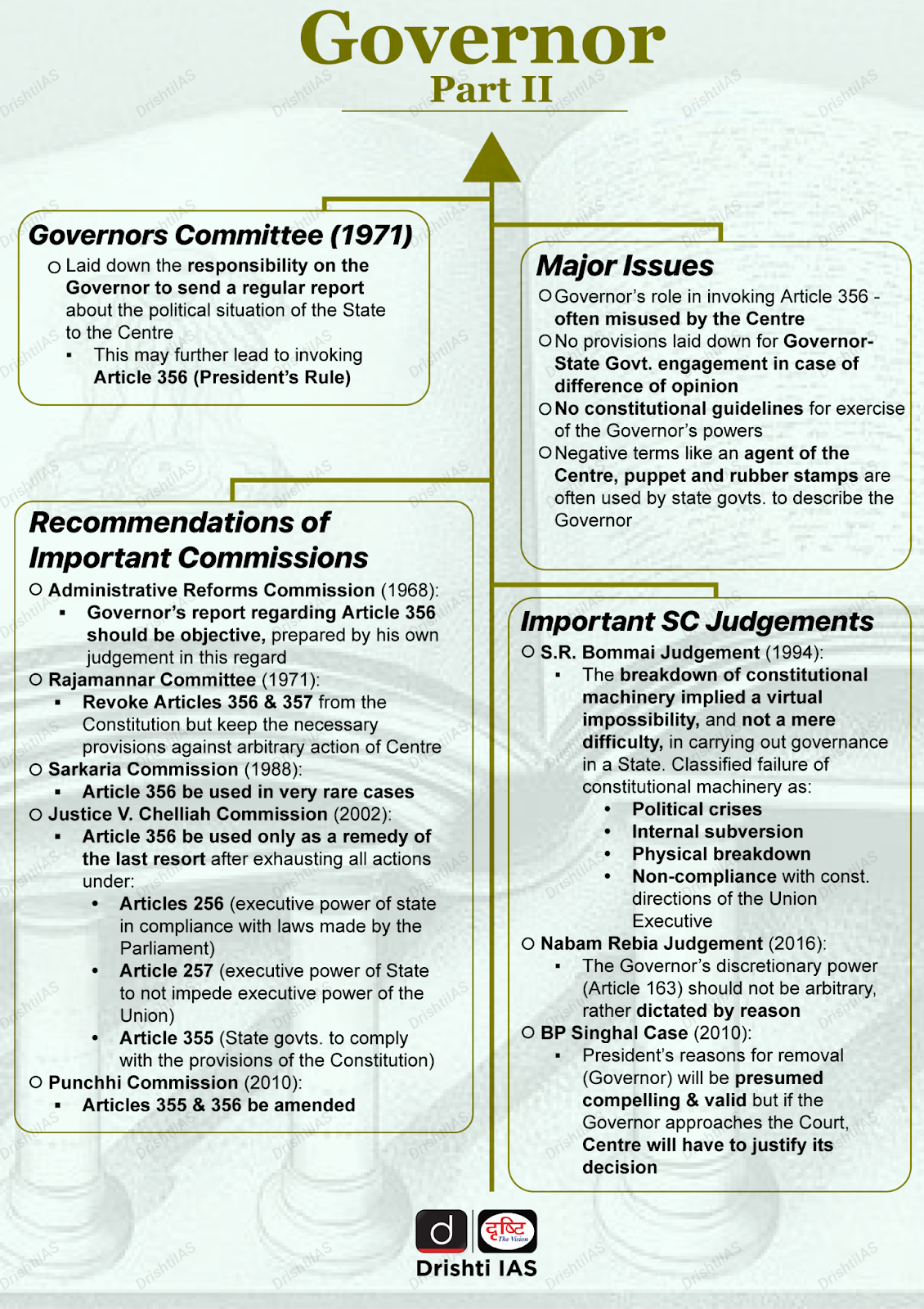
An intergovernmental council should resolve center-state issues, with Article 356 used sparingly and the state assembly dissolved only with Parliament’s approval. |
|
Venkatachaliah Commission (2002) |
Governors complete their five-year term, with early removal requiring consultation with the Chief Minister. |
|
Punchhi Commission (2010) |
The Governor’s Chancellor role should be limited to constitutional duties, Bills must be decided within fixed timelines (six months for reserved Bills), and stronger safeguards are needed to prevent Article 356 misuse. |
What are the Key Judicial Pronouncements on Resolving Tensions between the State & the Governor?
- Nabam Rebia Case 2016: The SC clarified that the Governor’s power to summon or prorogue the Assembly is not discretionary and must be exercised only on the aid and advice of the Council of Ministers.
- Shivraj Singh Chouhan Case, 2020: The SC ruled that both the Speaker and the Governor can order a floor test-the Speaker, if the government is likely to have lost its majority, and the Governor, if credible information suggests that the majority is in doubt.
- State of Tamil Nadu v The Governor of Tamil Nadu Case, 2023: The Court ruled Governors must grant assent to re-passed bills unless materially different, setting strict deadlines i.e., one month to withhold assent, three months for actions against Cabinet advice, and one month for reconsidered bills.
- 2025 Presidential Reference on Governor’s Powers (under Article 143): SC held that courts cannot impose rigid timelines on the Governor (or President) for acting on Bills under Articles 200 or 201. It overruled the idea of “deemed assent.” But the Court reiterated that prolonged, unexplained delays may attract limited judicial review.
What Measures can Resolve the Recurring Tensions between State Governments and Governors?
- Codify the Governor's 'Discretion': The SC and Union government should clearly define and exhaustively list the specific circumstances under which the Governor can act in their own discretion, moving beyond the vague provision in Article 163. This would minimize arbitrary interpretations.
- Procedural Reforms: The "floor test" should be the only legally acceptable mechanism to prove a majority. The Governor should only administer the oath to the claimant with the most support, who must prove majority on the House floor within 48 hours.
- Institutionalize the Appointment Process: Establish an independent collegium or committee (e.g., comprising the Prime Minister, Chief Justice of India, Lok Sabha Speaker, and the concerned Chief Minister) to select Governors. This would depoliticize appointments and ensure impartiality.
- Adhere to Established Conventions: Governors should act on the aid and advice of the Council of Ministers, and maintain transparent, regular communication with the Chief Minister to ensure cooperation rather than confrontation.
- Implementing Commission Recommendations: Key reforms proposed by the Sarkaria Commission (1988) and Punchhi Commission (2010)—including consulting the Chief Minister before appointing a Governor and selecting eminent persons from outside the state—should be seriously implemented.
Conclusion
The recurring tensions between State Governments and Governors stem from ambiguous discretionary powers and political appointments. A lasting resolution requires implementing key committee reforms, codifying the Governor's discretion, and fostering strict adherence to the constitutional spirit of acting on the elected government's aid and advice.
|
Drishti Mains Question: Q. The office of the Governor has often been described as a 'linchpin' in Centre-State relations, yet it frequently becomes a 'flashpoint'. Analyze the reasons for this paradox and suggest remedial measures. |
Frequently Asked Questions (FAQs)
Q. What constitutional provision governs the Governor’s discretionary powers?
Article 163 allows discretionary powers, but the Governor must generally act on the aid and advice of the Council of Ministers.
Q. What are the key recommendations of the Sarkaria Commission regarding Governors?
Limit unrelated statutory powers, respect five-year tenure, and ensure consultation before removal or appointment.
Q. What was the Supreme Court's stance in the 2025 Presidential Reference under Article 143?
While the Court declined to impose rigid timelines for assent to bills, it affirmed that prolonged and unexplained delays by the Governor are subject to judicial review.
UPSC Civil Services Examination Previous Year Questions (PYQs)
Prelims
Q. Consider the following statements: (2018)
- No criminal proceedings shall be instituted against the Governor of a State in any court during his term of office.
- The emoluments and allowances of the Governor of a State shall not be diminished during his term of office.
Which of the statements given above is/are correct?
(a) 1 only
(b) 2 only
(c) Both 1 and 2
(d) Neither 1 nor 2
Ans: (c)
Q. Which of the following are the discretionary powers given to the Governor of a State? (2014)
- Sending a report to the President of India for imposing the President’s rule
- Appointing the Ministers
- Reserving certain bills passed by the State Legislature for consideration of the President of India
- Making the rules to conduct the business of the State Government
Select the correct answer using the code given below:
(a) 1 and 2 only
(b) 1 and 3 only
(c) 2, 3 and 4 only
(d) 1, 2, 3 and 4
Ans: (b)
Q. Which one of the following statements is correct? (2013)
(a) In India, the same person cannot be appointed as Governor for two or more States at the same time
(b) The Judges of the High Court of the States in India are appointed by the Governor of the State just as the Judges of the Supreme Court are appointed by the President
(c) No procedure has been laid down in the Constitution of India for the removal of a Governor from his/her post
(d) In the case of a Union Territory having a legislative setup, the Chief Minister is appointed by the Lt. Governor on the basis of majority support
Ans: (c)
Mains
Q. Discuss the essential conditions for exercise of the legislative powers by the Governor. Discuss the legality of re-promulgation of ordinances by the Governor without placing them before the Legislature. (2022)
Q. Though the federal principle is dominant in our constitution and that principle is one of its basic features, but it is equally true that federalism under the Indian Constitution leans in favour of a strong Center, a feature that militates against the concept of strong federalism. Discuss. (2014)