
PSLV Failures and Implications | 21 Jan 2026
For Prelims: Indian Space Research Organisation, PSLV, Low Earth Orbit (LEO) , EOS-09
For Mains: Role of PSLV in India’s space programme and national security, Causes and implications of repeated launch vehicle failures, Commercialisation of India’s space sector and challenges therein
Why in News?
Indian Space Research Organisation (ISRO) is facing scrutiny after two consecutive PSLV mission failures (PSLV-C61 (May 2025) and PSLV-C62 (January 2026)) both linked to third-stage anomalies.
- The near-identical issues raise concerns about quality control in the PSLV, ISRO’s most reliable workhorse, while ISRO’s overall launch record remains strong, these setbacks could affect strategic surveillance missions and weaken commercial launch credibility.
Summary
- Two consecutive PSLV failures (C61 and C62) linked to third-stage anomalies have raised concerns over ISRO’s quality control, strategic surveillance capability, and declining commercial credibility in the global launch market.
- Restoring confidence requires reliability-first engineering, transparent failure analysis, diversified launch infrastructure, accelerated indigenisation, and stronger military–space integration.
What is the Polar Satellite Launch Vehicle (PSLV)?
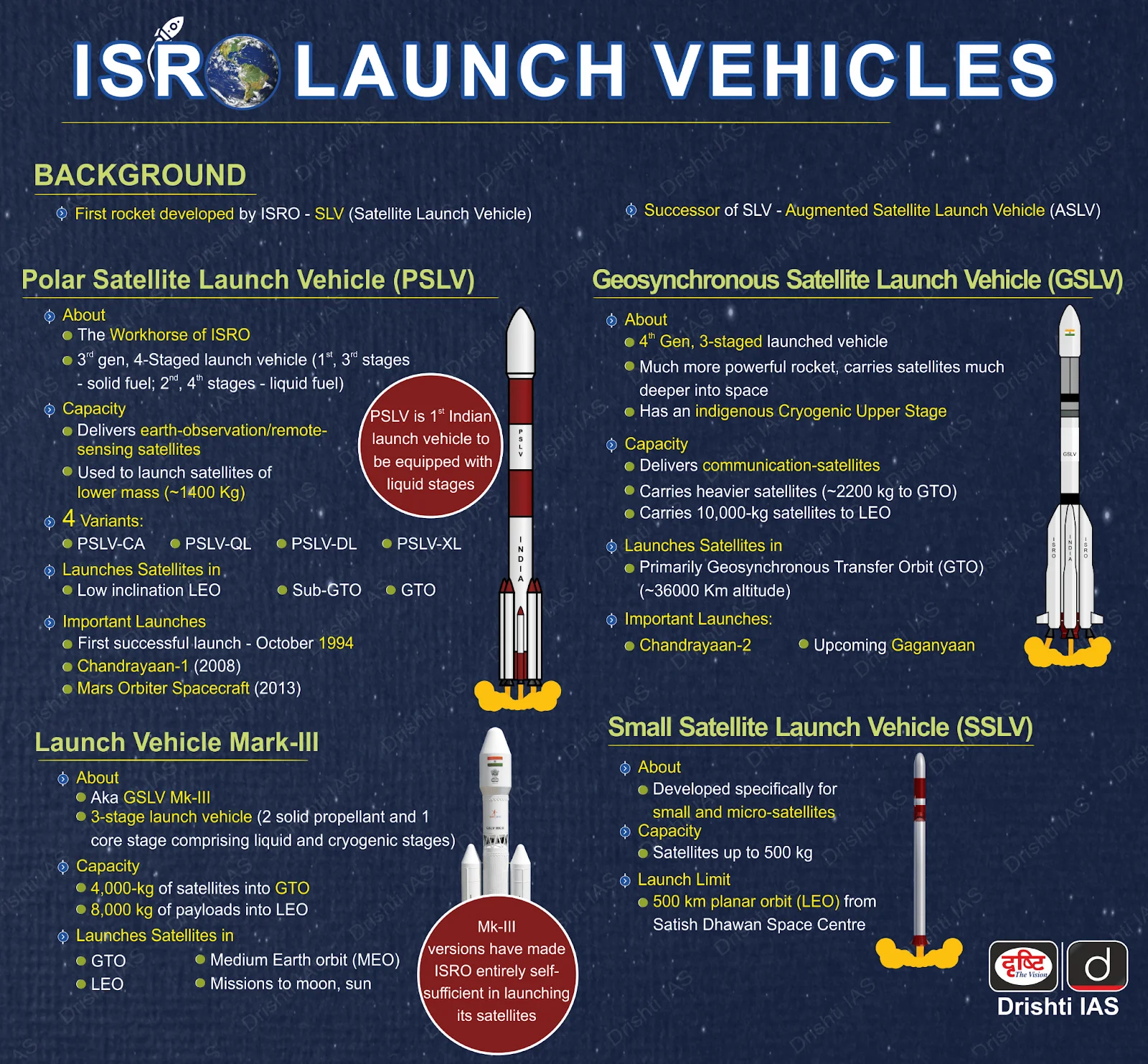
- About: The PSLV is India’s third-generation launch vehicle developed by the ISRO. Since its first successful launch in October 1994, PSLV has become the backbone of India’s space launch programme.
- PSLV was the first Indian rocket to use liquid propulsion stages, marking a major technological leap in India’s space programme.
- PSLV is known as ISRO’s “workhorse” because of its long record of consistent, precise, and cost-effective launches, especially into Low Earth Orbit (LEO) and Sun-Synchronous Polar Orbit (SSPO).
- PSLV Structure: Technically, PSLV is a four-stage rocket using an optimal mix of solid and liquid propulsion:
- PS1 (First Stage): It has a solid rocket motor that uses HTPB (hydroxyl-terminated polybutadiene) as propellant and generates high lift-off thrust, providing the initial lift-off force.
- In the PSLV-XL configuration, this stage is augmented by six solid strap-on boosters, significantly increasing thrust at launch and enabling the vehicle to carry heavier payloads.
- PS2 (Second Stage): It is powered by the Vikas liquid engine, which ensures a controlled and stable ascent after lift-off.
- It uses UDMH (unsymmetrical dimethylhydrazine) as fuel and N₂O₄ (nitrogen tetroxide) as oxidiser, producing thrust, allowing precise velocity and trajectory control.
- PS3 (Third Stage): It is a solid rocket motor that again uses HTPB propellant.
- It operates during the near-vacuum phase of flight and provides high thrust to accelerate the vehicle to the required orbital velocity, making it a critical stage for mission success.
- PS4 (Fourth Stage): It is a liquid propulsion stage with two engines, using MMH (monomethylhydrazine) and MON (mixed oxides of nitrogen).
- This stage enables highly precise orbital insertion, allowing PSLV to deploy satellites accurately, including in multi-orbit and multi-satellite missions.
- PS1 (First Stage): It has a solid rocket motor that uses HTPB (hydroxyl-terminated polybutadiene) as propellant and generates high lift-off thrust, providing the initial lift-off force.
- PSLV’s Payload Capacity: It can place up to 1,750 kg into a 600 km Sun-Synchronous Polar Orbit (SSPO), and around 1,425 kg into Sub-Geostationary Transfer Orbit (GTO), demonstrating high mission flexibility.
- Achievements: Its credibility was cemented by landmark interplanetary missions such as Chandrayaan‑1 and the Mars Orbiter Mission, which successfully travelled to the Moon and Mars respectively.
- PSLV has also launched a large number of foreign commercial satellites, reinforcing India’s position in the global launch market.
What are the Causes for PSLV-C61 and PSLV-C62 Failures?
- PSLV-C61:
- Mission objective: Deploy EOS-09, a high-resolution Earth observation satellite.
- Anomaly: Sudden drop in combustion chamber pressure in the third stage (PS3) after normal performance of the first two stages.
- Outcome: Vehicle failed to achieve required velocity, resulting in mission failure and loss of the satellite.
- PSLV-C62:
- Mission objective: Launch EOS-N1 (Anvesha) for the Defence Research and Development Organisation along with 15 commercial co-passenger satellites.
- Anomaly: Roll-rate disturbance and loss of control during the PS3 burn.
- A roll-rate disturbance is an unintended spin of the rocket around its long axis. It is dangerous because excessive roll can disorient navigation sensors and guidance systems, making control impossible.
- Outcome: Rocket deviated from trajectory, leading to the loss of all 16 satellites, including strategic and commercial payloads.
- Technical Issue: The PS3 stage is a solid rocket motor, which means it cannot be throttled or shut down once ignition occurs and is therefore extremely sensitive to manufacturing and material defects.
- Even minor defects in the PS3 solid motor can cause uneven burning, leading to pressure loss or side-venting of exhaust gases.
- In the case of PSLV-C62, such side-venting likely produced asymmetric thrust, generating excess torque that overwhelmed the vehicle’s attitude-control system.
- The result was uncontrolled spinning (roll anomaly), deviation from the planned trajectory, and eventual mission failure.
- Both failures point to PS3-specific issues, indicating a common failure mode.
What are the Concerns Regarding Repeated PSLV Failures?
- Strategic Implications:
- Surveillance Gaps: The primary payloads lost in these missions were Earth Observation Satellites (EOS-09 and EOS-N1/Anvesha).
- These assets are critical for border surveillance, monitoring military movements, and disaster management. A delay in deploying replacements creates a "blind spot" in India's space-based intelligence capabilities.
- Defence Reliance: With the military increasingly relying on dedicated space assets, launcher reliability is a matter of national security.
- Surveillance Gaps: The primary payloads lost in these missions were Earth Observation Satellites (EOS-09 and EOS-N1/Anvesha).
- Commercial Credibility Loss:
- Threat to Global Market Share: Through NewSpace India Limited (NSIL), India has been aggressively marketing the PSLV as a cost-effective and reliable launcher for international small satellites.
- Private players like SpaceX (Falcon 9 Rideshare) and emerging small-satellite launchers (e.g., Rocket Lab) are already fierce competitors.
- India’s global small-satellite launch share collapsed from about 35% in 2017 to nearly zero by 2024.
- Repeated mission failures can amplify this decline, giving competitors a clear advantage as global customers increasingly prioritise mission assurance and reliability over lower launch costs.
- Private players like SpaceX (Falcon 9 Rideshare) and emerging small-satellite launchers (e.g., Rocket Lab) are already fierce competitors.
- Rising Insurance Costs: In the space insurance market, premiums are determined by vehicle reliability.
- Two consecutive failures will likely cause insurance premiums for future PSLV launches to spike, potentially eroding the cost-competitiveness that makes ISRO attractive to foreign clients.
- Threat to Global Market Share: Through NewSpace India Limited (NSIL), India has been aggressively marketing the PSLV as a cost-effective and reliable launcher for international small satellites.
- Quality Control and Supply Chain Vulnerabilities:
- Systemic Manufacturing Defects: The fact that both failures were linked to the third stage (solid motor) suggests a systemic issue rather than a random error.
- Issues like propellant cracks, bonding defects, or nozzle material failure often stem from the manufacturing or storage phase.
- Component Dependency: Despite Atmanirbhar Bharat, India still depends on imports for space-grade electronics, carbon fibre, and semiconductors.
- India’s space-technology import costs are about 12 times higher than its export earnings (2021–22).
- This creates vulnerability to export controls and Taiwan-centric chip supply disruptions.
- Privatisation Challenges: As ISRO transfers 50% of PSLV development to an industry consortium (HAL-L&T), these failures raise concerns about technology transfer absorption and whether the stringent Quality Assurance (QA) standards are being maintained across the tiered supply chain.
- Systemic Manufacturing Defects: The fact that both failures were linked to the third stage (solid motor) suggests a systemic issue rather than a random error.
What Steps Should ISRO Adopt to Restore Technical Reliability and Commercial Credibility?
- Restore Launch Reliability: India must move from mission-centric testing to fleet-level reliability engineering, using block upgrades, rapid feedback loops, and incremental validation.
- ISRO should openly commit to a “reliability-first phase”, prioritising fewer launches with higher scrutiny and full disclosure. Short-term commercial losses are manageable to long-term reputational damage.
- Institutionalise Transparency After Failures: Failure Analysis Committee (FAC) findings should be mandated to be released in a time-bound manner, with sensitive details redacted if needed.
- Transparency reassures insurers, commercial clients, and strategic partners far more than silence or vague statements.
- Diversify Launch Infrastructure: India’s near-total dependence on Sriharikota should be reduced by accelerating a second orbital launch site and fully operationalising alternative pads.
- India must create a fully empowered Space Command with operational authority and dedicated funding, shift to constellation-based ISR (Intelligence, Surveillance, and Reconnaissance), and SSA (Space Situational Awareness), and ensure real-time fusion of space data into a joint military operating picture.
- This improves redundancy, weather resilience, and crisis-response capability.
- Accelerate indigenisation of critical components: Mission-linked indigenisation is needed for space-grade electronics, TWTs, composites, and semiconductors.
- Assured government demand should be used to de-risk private manufacturing and reduce exposure to export controls and supply shocks.
Conclusion
India’s space challenge is no longer about capability, but about credibility, resilience, and execution. Restoring confidence requires moving from isolated fixes to a whole-of-system transformation, where technical reliability, strategic autonomy, and commercial growth reinforce each other. In space, trust is built slowly—but lost instantly; India’s response must therefore be decisive, transparent, and forward-looking.
|
Drishti Mains Question: The Polar Satellite Launch Vehicle (PSLV) has long been regarded as the workhorse of India’s space programme. In the context of recent PSLV failures, examine the challenges and their implications for India’s global launch credibility. |
Frequently Asked Questions (FAQs)
1. What caused the failure of PSLV-C61 and PSLV-C62 missions?
Both missions failed due to anomalies in the third stage (PS3), a solid rocket motor, involving chamber pressure loss (C61) and roll-rate disturbance (C62).
2. Why is a third-stage failure particularly critical in PSLV?
PS3 operates in near-vacuum and provides final acceleration; solid motors cannot be throttled or shut down, making them highly sensitive to manufacturing defects.
3. How do repeated PSLV failures affect India’s strategic interests?
They delay deployment of Earth Observation and surveillance satellites, creating intelligence gaps and affecting border security, disaster management, and defence preparedness.
4. What key reforms are needed to restore confidence in ISRO?
Critical steps include fleet-level reliability engineering, transparent FAC reporting, diversified launch infrastructure, accelerated indigenisation, and creation of a fully empowered Space Command.
UPSC Civil Services Examination, Previous Year Question (PYQ)
Prelims
Q. With reference to India’s satellite launch vehicles, consider the following statements: (2018)
- PSLVs launch the satellites useful for Earth resources monitoring whereas GSLVs are designed mainly to launch communication satellites.
- Satellites launched by PSLV appear to remain permanently fixed in the same position in the sky, as viewed from a particular location on Earth.
- GSLV Mk III is a four-staged launch vehicle with the first and third stages using solid rocket motors, and the second and fourth stages using liquid rocket engines.
Which of the statements given above is/are correct?
(a) 1 only
(b) 2 and 3
(c) 1 and 2
(d) 3 only
Ans: (a)
Mains
Q. What is the main task of India’s third mood mission which could not be achieved in its earlier mission? List the countries that have achieved this task. Introduce the subsystems in the spacecraft launched and explain the role of the ‘Virtual Launch Control Centre’ at the Vikram Sarabhai Space Centre which contributed to the successful launch from Sriharikota.(2023)
Q. What is India’s plan to have its own space station and how will it benefit our space programme? (2019)
Q. Discuss India’s achievements in the field of Space Science and Technology. How the application of this technology helped India in its socio-economic development? (2016)