
Political Funding Reforms | 04 Apr 2026
For Prelims: Election Commission of India (ECI), Electoral Trusts, Representation of the People Act (RPA), 1951, Foreign Exchange Management Act, 1999 (FEMA), FDI Policy, FCRA, 2010, Supreme Court, Indrajit Gupta Committee (1998), Comptroller and Auditor General (CAG), Shell Companies.
For Mains: Key highlights of the ADR report on political funding, Statutory provisions regarding political donations in India, Need of financial transparency in elections for democratic accountability, Reforms needed for ensuring transparent political funding in India.
Why in News?
A report by the Association for Democratic Reforms (ADR) focuses on donations of Rs 20,000 or more declared to the Election Commission of India (ECI) by national political parties for FY 2024-25, highlighting efforts toward democratic accountability.
- It revealed that the Bharatiya Janata Party (BJP) received Rs 6,074 crore in donations during FY 2024-25, marking a 171% increase from the previous year.
Summary
- The 2024-25 ADR report highlights a 161% surge in national party donations, with corporate contributions accounting for over 92% of the total.
- The report emphasizes the dominance of Electoral Trusts and the BJP’s 91% share of aggregate funding.
- This data underscores the urgent need for transparency reforms and stricter ECI oversight to ensure democratic accountability.
What are the Key Highlights of the ADR Report on Political Funding?
- Massive Funding Surge: Total donations (above Rs 20,000) to National parties rose by 161% to Rs 6,648 crore, with the BJP accounting for over 91% of the total aggregate.
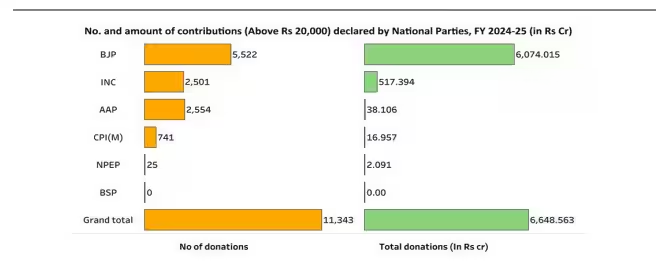
- Dominance of Corporate Funding: Business sectors contributed 92.18% of total donations, while individual contributors accounted for only 7.61%.
- Role of Electoral Trusts: The Prudent Electoral Trust remains the largest donor, contributing Rs 2,413 crore collectively to the BJP, Indian National Congress (INC), and Aam Aadmi Party (AAP), with a major share directed toward the BJP.
- Geographic Concentration: The highest volume of donations originated from Delhi, followed by Maharashtra and Gujarat.
- Zero-Declaration Trend: The Bahujan Samaj Party (BSP) maintained its 19-year streak of declaring nil donations above the Rs 20,000 threshold.
Political Funding
- About: Political funding refers to the methods and sources through which political parties and candidates raise financial resources to cover their operational costs, election campaigns, and party activities.
- Primary Sources: Political parties in India generally receive funds through the following channels:
- Individual Donations: Voluntary contributions from citizens; donations above Rs 2,000 must be made through non-cash modes (cheque/digital).
- Corporate Funding: Companies can donate to parties, provided they disclose the total amount in their Profit and Loss account (Section 182 of the Companies Act, 2013).
- Electoral Trusts: Electoral Trusts collect corporate and individual donations for political parties (cash transactions prohibited). They must distribute 95% of annual funds to registered parties, retaining only 5% for administrative costs.
- Public/State Funding: In some countries (though not fully in India), the government provides funds to parties based on their performance in previous elections. Currently, India has "indirect" state funding, such as free airtime on public broadcasters and subsidized land for party offices.
- Transparency Requirements: Under Section 29C of the Representation of the People Act (RPA), 1951, parties must submit a "Contribution Report" to the ECI for all donations exceeding Rs 20,000 to claim tax exemptions.
- Statutory Provisions:
- Representation of the People Act (RPA), 1951: Section 29A mandates that every political party must be registered with the ECI to be eligible for donations and tax exemptions.
- Section 29B allows political parties to accept voluntary contributions from any person or company (except government companies and foreign sources).
- Income Tax Act, 1961: Section 13A grants 100% tax exemption to registered political parties on income from voluntary contributions, house property, and capital gains.
- Section 80GGC/80GGB allows 100% deduction from the gross total income for individuals (80GGC) and companies (80GGB) for contributions made to a registered political party or an electoral trust, provided the payment is not in cash.
- Companies Act, 2013: Under Section 182, only companies in existence for more than 3 years can make political contributions. Government companies are strictly prohibited. Previously, there was a cap of 7.5% of average net profits, but the Finance Act 2017 removed this cap.
- Companies must disclose the total amount contributed and the name of the recipient political party in their Profit and Loss Account.
- Foreign Contribution (Regulation) Act (FCRA), 2010: Section 3 explicitly prohibits candidates for election, members of legislatures, and political parties from accepting any "foreign contribution."
- However, under the Finance Act, 2016 and Finance Act, 2018 retrospective amendments, an Indian company is not considered a "foreign source" even if more than 50% of its share capital is held by a foreign entity, provided it complies with the sectoral caps and other limits prescribed under Foreign Exchange Management Act, 1999 (FEMA) (and the FDI Policy notified thereunder).
- Representation of the People Act (RPA), 1951: Section 29A mandates that every political party must be registered with the ECI to be eligible for donations and tax exemptions.
How has the Political Funding Landscape Evolved in India?
- Pre-2017 Era: Before 2017, the system was largely informal. Most donations were made in cash, with a reporting threshold of Rs 20,000. Parties often broke down large donations into smaller "anonymous" chunks to avoid disclosure.
- Companies were restricted from donating more than 7.5% of their average net profit from the previous three years.
- Electoral Bond Era (2018–2024): It prioritized donor privacy over public transparency. While it successfully moved funds into the banking system (reducing "black money"), it created an information asymmetry where the public did not know who was funding whom.
- The 7.5% corporate profit cap was removed, and the requirement for companies to disclose which party they funded in their profit-and-loss accounts was eliminated.
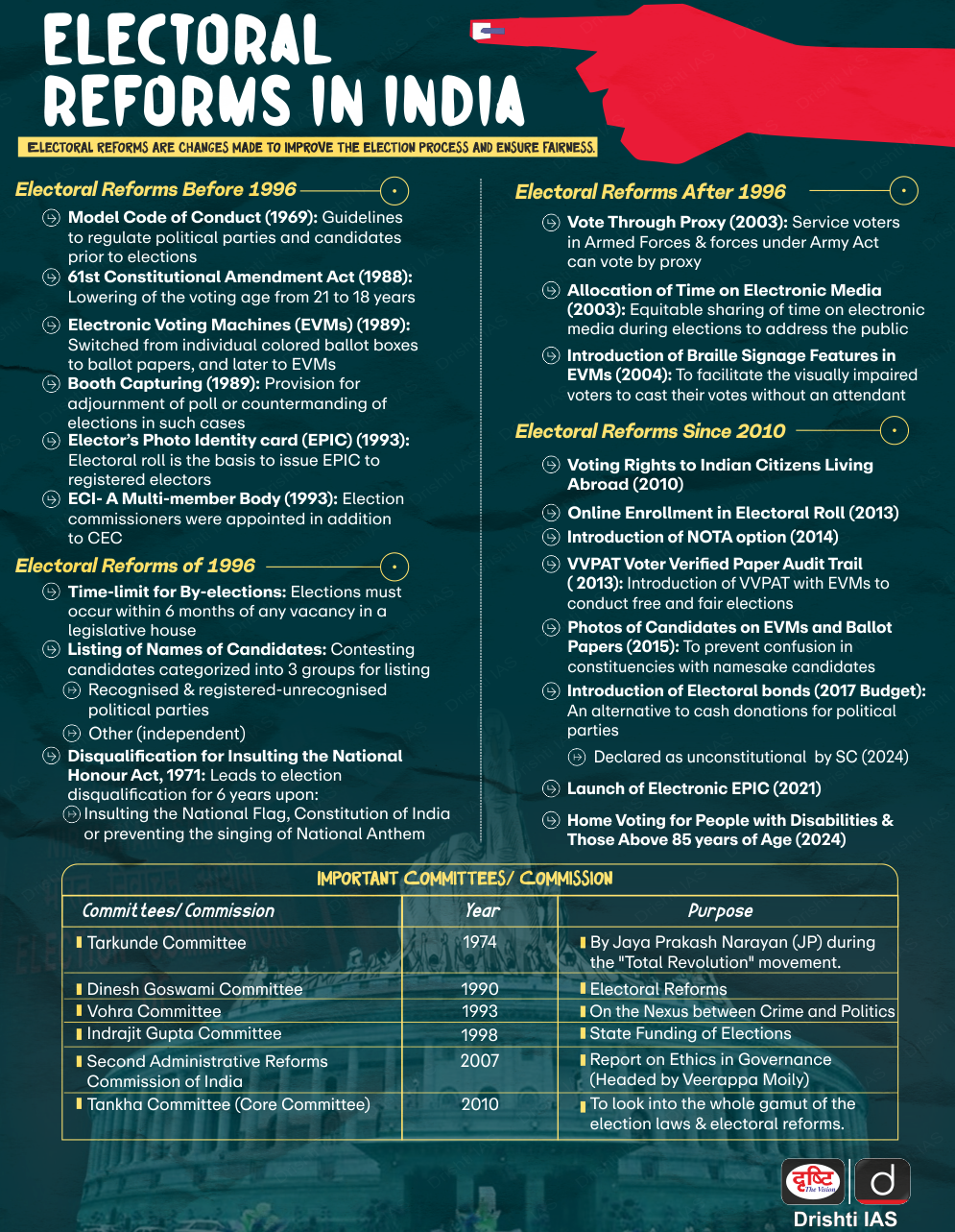
- Supreme Court Electoral Bond Ruling 2024: In Association for Democratic Reforms & Anr. v. Union of India & Ors Case 2024, the Supreme Court struck down the Electoral Bond Scheme as unconstitutional. The Court ruled that anonymous funding violates the voters' right to information under Article 19(1)(a).
- The Court highlighted that unlimited corporate funding could lead to "institutionalized corruption" where policies are influenced by large donors.
- Current Landscape (2025–2026): Since the ban on bonds, political funding has reverted to three primary pillars:
- Electoral Trusts: These act as intermediaries. Companies donate to the Trust (e.g., Prudent Electoral Trust), which then distributes funds to parties.
- Direct Corporate/Individual Donations: Parties are back to receiving direct cheques and digital transfers.
- Digital Reporting (IEMS): The Election Commission of India (ECI) now requires the online filing of contribution reports through the Integrated Election Management System (IEMS) to speed up the auditing process.
How does Financial Transparency in Elections Ensure Democratic Accountability?
- Prevent "Quid Pro Quo" Arrangements: Without transparency, large corporate donors can provide massive funds to political parties in exchange for favorable policies, licenses, or contracts once that party is in power. Transparency acts as a deterrent against the "politico-corporate nexus" by making these transactions visible to the public eye.
- Ensure a Level Playing Field: Elections should be a competition of ideas, not a competition of wallets. By knowing the source of funds, ECI can better enforce spending limits, preventing a "financial arms race" that marginalizes the common citizen.
- Protect National Sovereignty: Foreign entities may attempt to influence a country’s domestic policies by funding specific candidates or parties. Strict enforcement of the FCRA, 2010 and mandatory disclosure ensure that political parties are not beholden to foreign interests.
- Empower the "Informed Voter": A voter has the right to know who is "powering" a candidate. If a candidate is funded by an industry that the voter opposes (e.g., a specific tobacco or mining conglomerate), that information is vital for the voter to make a rational decision.
- When funding is transparent, the mandate given by the people is based on a clear understanding of the candidate's allegiances.
- Constitutional Perspective: The Supreme Court struck down the Electoral Bonds Scheme specifically because it compromised transparency in political funding. The Court ruled that while curbing black money is a legitimate goal, it cannot be used as a "blanket excuse" to keep the entire funding process anonymous.
Key Committees/Commissions on Political Funding
|
Committee/Commission |
Core Focus & Recommendations |
|
Tarkunde Committee (1974-75) |
Recommended that political parties must submit audited accounts and that the Election Commission should be a multi-member body. |
|
Dinesh Goswami Committee (1990) |
Proposed partial state funding in kind (e.g., fuel, stationery) and suggested a ban on company donations to reduce the "nexus." |
|
Indrajit Gupta Committee (1998) |
Specifically explored State Funding of Elections. It endorsed state support to ensure a level playing field, but only for "recognized" parties and only "in-kind" (not cash). |
|
Law Commission (170th Report) (1999) |
Argued that state funding is "desirable" but only if parties are strictly prohibited from taking funds from other sources and have internal democracy. |
Which Reforms are Essential for Ensuring Transparent Political Funding in India?
- Mandatory & Real-Time Disclosure: Currently, parties only report individual donations above Rs 20,000 annually. The disclosure threshold should be lowered (e.g., to Rs 2,000) to prevent "splitting" large donations into many small, anonymous ones.
- State Funding of Elections (In-Kind): Indrajit Gupta Committee (1998) proposed "partial state funding" in kind—providing facilities like free airtime on media, fuel for vehicles, paper for posters, and rent-free office space—rather than giving cash.
- Some experts suggest a central fund like Electoral Trust where corporates can donate blindly; the ECI then distributes these funds to parties based on their previous vote share.
- Ceiling on Party Expenditure: While there is a legal limit on how much an individual candidate can spend, there is currently no limit on what a political party can spend on an election. Introduce a formal cap on the total expenditure a political party can incur during an election cycle to ensure a level playing field for smaller parties.
- The Law Commission of India (255th Report, 2015) has supported the introduction of expenditure ceilings for political parties to complement candidates’ expenditure limits.
- Independent Auditing: Currently, political parties choose their own auditors. Mandate that political party accounts be audited by a panel of auditors approved by the Comptroller and Auditor General (CAG) or the ECI. This would ensure that the audits are impartial and rigorous.
- Decoupling Corporate Influence: Restore the cap on corporate donations (previously 7.5% of net profit) to prevent loss-making "shell companies" from being used as conduits for money laundering.
- Require companies to get explicit approval from shareholders during Annual General Meetings (AGMs) before making political donations.
- Empowering ECI: The ECI currently has limited power to punish parties for financial non-compliance. Grant the ECI the statutory power to de-register a political party if it fails to submit audited accounts or violates funding norms.
Conclusion
The surge in political donations, dominated by corporate interests and specific parties, highlights a critical intersection of finance and governance. Addressing these disparities through capping party expenditure, reintroducing corporate donation limits, and granting the ECI de-registration powers is essential to safeguard democratic integrity and ensure a level playing field.
|
Drishti Mains Question: Discuss the feasibility of State Funding of Elections in India as a measure to reduce the influence of black money in politics. |
Frequently Asked Questions (FAQs)
1. What is the significance of Section 29C of the Representation of the People Act, 1951?
It mandates political parties to report donations exceeding ₹20,000 to the ECI annually; failure to do so disqualifies the party from Income Tax exemptions under Section 13A.
2. How did the Finance Act 2017 alter corporate political funding?
It removed the previous cap of 7.5% of average net profits for donations, allowing companies (including loss-making ones) to contribute unlimited amounts to political parties.
3. Are foreign contributions allowed for Indian political parties?
No, the FCRA 2010 prohibits it; however, recent amendments allow donations from Indian companies with over 50% foreign shareholding if they follow FEMA guidelines.
UPSC Civil Services Examination Previous Year Questions (PYQ)
Prelims
Q. Consider the following statements: (2017)
- The Election Commission of India is a five-member body.
- Union Ministry of Home Affairs decides the election schedule for the conduct of both general elections and bye-elections.
- Election Commission resolves the disputes relating to splits/mergers of recognised political parties.
Which of the statements given above is/are correct?
(a) 1 and 2 only
(b) 2 only
(c) 2 and 3 only
(d) 3 only
Ans: (d)
Mains
Q. In the light of recent controversy regarding the use of Electronic Voting Machines (EVM), what are the challenges before the Election Commission of India to ensure the trustworthiness of elections in India? (2018)
Q. To enhance the quality of democracy in India the Election Commission of India has proposed electoral reforms in 2016. What are the suggested reforms and how far are they significant to make democracy successful? (2017)