
PC&PNDT Act in the Digital Age | 17 Dec 2025
For Prelims: Pre-Conception and Pre-Natal Diagnostic Techniques (Prohibition of Sex Selection) Act, 1994, Sex Ratio, 2011 Census, Sample Registration System (SRS) 2023, National Family Health Survey (NFHS-5, 2019-2021), UN Population Fund,
For Mains: Key facts regarding the Pre-Conception and Pre-Natal Diagnostic Techniques (Prohibition of Sex Selection) Act, 1994 (PC&PNDT Act), Son meta preference and its reasons, Reasons for lax implementation of the PC&PNDT Act, 1994 and ways to strengthen strenthen the act for an equitable sex ratio.
Why in News?
The fight against sex-selective abortion in India has moved online, where influencers and self-styled doctors circumvent the Pre-Conception and Pre-Natal Diagnostic Techniques (Prohibition of Sex Selection) Act, 1994 (PC&PNDT Act) by promoting unscientific gender-prediction myths to vast audiences.
- The internalised bias for sons has renewed focus on gender bias, digital regulation, and reproductive rights.
Summary
- India’s skewed sex ratio stems from deep-rooted son preference, reinforced by cultural and economic norms despite legal prohibition.
- Enforcement of the PC&PNDT Act, 1994 is weakened by institutional gaps, low convictions, and the shift of illegal promotion to digital platforms.
- Effective change requires a holistic strategy i.e., tech-enabled monitoring, swift justice, online regulation, and societal campaigns to value the girl child.
What is Pre-Conception and Pre-Natal Diagnostic Techniques (Prohibition of Sex Selection) Act, 1994 (PC&PNDT Act)?
- About: It was enacted in 1994 to address the issue of female foeticide and the declining child sex ratio resulting from the misuse of diagnostic technologies for sex selection. (India’s sex ratio as per 1991 Population Census - 929 females per 1,000 males).
- The Act was significantly amended in 2003 to strengthen its provisions, explicitly include pre-conception techniques, and prohibit sex selection more comprehensively.
- Key Provisions:
- Prohibition of Sex Selection: Bans any procedure, technique, or test like ultrasound aimed at determining or selecting the sex of a foetus (Section 3A).
- Permitted Uses:
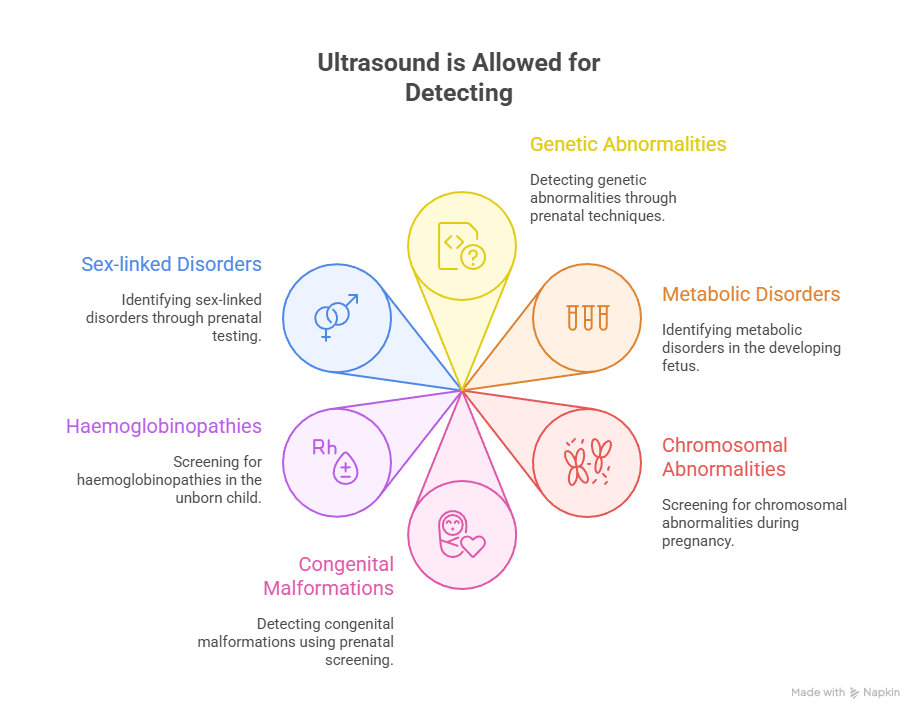
- Regulation of Facilities: Genetic counselling centres, laboratories, and clinics must register under the Act. Unregistered facilities are prohibited from conducting such procedures (Section 18).
- Advertisement Ban: Prohibits advertisements related to pre-conception or pre-natal sex determination (Section 22).
- Supervisory Bodies: Establishes the Central Supervisory Board, State Supervisory Boards, and Appropriate Authorities for implementation and monitoring.
- 2003 Amendment: Extended coverage to pre-conception sex selection techniques.
- Explicitly included ultrasound and imaging technologies within the regulatory ambit.
- Empowered supervisory boards and authorities with greater enforcement powers, including search and seizure.
- Offences and Penalties: Every offence under this Act shall be cognizable, non-bailable, and non-compoundable.
- Penalties include up to 3–5 years imprisonment and fines ranging from Rs 10,000 to Rs 100,000 or more, depending on the offence and whether it is a repeat violation.
Son Meta Preference and Skewed Sex Ratios
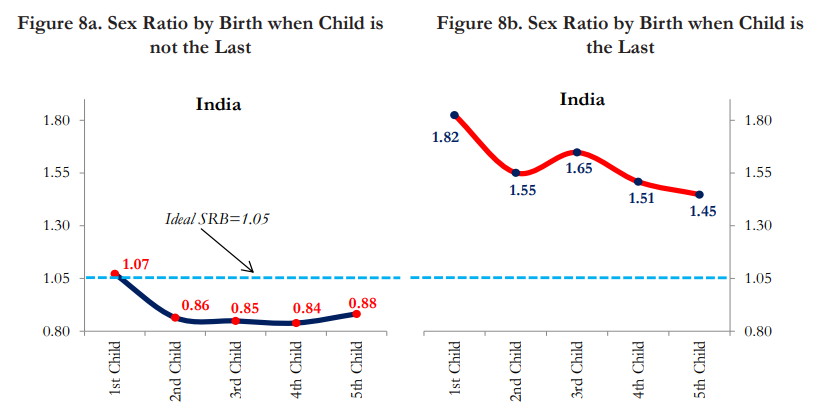
- Son Meta Preference: It refers to a subtle manifestation of son preference in which parents continue having children until they achieve their desired number of sons (typically at least one).
- This behaviour follows fertility-stopping rules, where families are more likely to cease childbearing once a son is born, resulting in a skewed sex ratio of the last child (higher proportion of males as the final birth).
- It led to 21 million "unwanted" girls who may face resource neglect.
- The Scale of Missing Women: Using Amartya Sen's methodology, the estimated stock of missing women in India reached nearly 63 million by 2014, with over 2 million women going missing annually due to sex-selective abortion, disease, and neglect.
- Missing females refers to the shortfall of women and girls in a population due to sex-selective practices, female foeticide, infanticide, or neglect, resulting in fewer females than expected. The term was popularized by economist Amartya Sen in 1990.
- Skewed Sex Ratios Defying Development: India's Sex Ratio at Birth (SRB) worsened from 1,060 to 1,108 males per 1,000 females between 1970 and 2014, moving opposite to global trends where higher income typically improves the ratio, indicating strong human intervention through sex-selective abortion.
Primary Reasons for Son Preference
- Economic Factors: Sons are seen as financial providers and caregivers in old age, especially where social security is weak.
- In patrilineal systems, they inherit property and increase household wealth, while daughters are often viewed as an economic burden due to dowry practices, despite being legally prohibited.
- Cultural and Social Factors: Patrilocality (daughters marrying into the husband’s family) fosters the view that “raising a daughter is like watering a neighbour's garden”, as they leave the natal home.
- Sons are expected to continue the family lineage, name, and social status.
- Religious Factors: In certain traditions, especially among Hindus, sons perform essential rituals like funeral rites and ancestor worship, believed to ensure spiritual merit and parental salvation
India’s Sex Ratio
- As per India's 2011 Census, the overall sex ratio was 943 females per 1,000 males, up from 933 in 2001.
- According to government Sample Registration System (SRS) 2023 data, India’s sex ratio at birth (females per 1,000 males) improved from 904 in 2019 to 917 in 2023.
- According to the National Family Health Survey (NFHS-5, 2019-2021), India has 1,020 women per 1,000 men.
- In 2020, the UN Population Fund reported that India accounted for 45.8 million of the world’s 142.6 million “missing females”.
What are the Reasons for Lax implementation of the PC&PNDT Act, 1994?
- Collusion and No-complainant Dynamics: Sex selection continues due to shared incentives—families demand it, and providers supply it—making reporting rare and enforcement difficult without proactive intelligence and strong enforcement systems.
- Inadequate Infrastructure: District/State Appropriate Authorities face staff shortages, limited budgets, and inadequate training, reducing inspections, follow-up, and case-building.
- Low Conviction Rates: Conviction rates remain abysmally low (e.g., only 617 convictions in 25 years, as per a Parliamentary Committee report), with many states registering few or no cases.
- Digital and Online Challenges: Conceived long ago, the Act is ill-equipped to tackle modern challenges, especially the indirect promotion of son preference via social media, where influencers, self-styled experts, and religious figures spread unscientific claims, rituals, and narratives to large online audiences.
- Deep-Rooted Societal Demand: Persistent son preference, driven by patriarchal norms, cultural expectations, and economic factors, sustains demand for sex selection and encourages illegal circumvention of the law.
- Professional Misconduct: Sex determination remains a highly lucrative illegal business, with practitioners using coded language, odd-hour scans, and portable machines to evade detection.
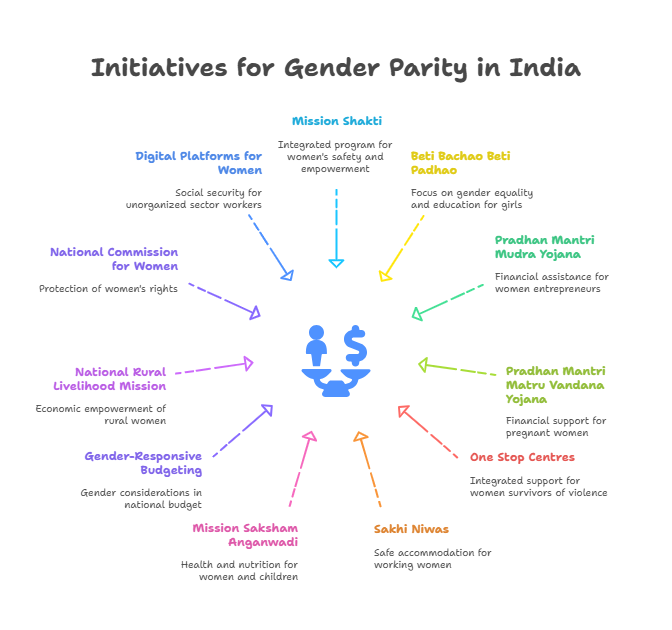
How can Implementation of the PC&PNDT Act, 1994 be Strengthened?
- Strengthen Institutional Framework: Appoint dedicated Appropriate Authorities (e.g., Civil Surgeons, Medical Superintendents) and Appellate Authorities at state and district levels, with clear roles to ensure timely registrations, inspections, and appeals.
- Leverage Technology: Mandate online submission of Form F (pre-test declarations) for real-time tracking and provide anonymous grievance redressal via helplines and dedicated websites to report illegal practices.
- Addressing the Online Ecosystem: Legally require technology platforms (Google, Meta, Amazon, etc.) to proactively remove sex-selection content, while supporting credible health influencers to counter myths and promote the value of girls online.
- Legal and Procedural Reforms: Establish fast-track courts for PC&PNDT cases to ensure swift convictions and deterrence, and expand the Act’s definition of advertisement to cover all indirect promotions and online sex-prediction services.
- Awareness and Behavioral Change: Official reviews note that enforcement alone cannot stop sex selection without addressing deep-rooted son preference.
- They emphasize the need for sustained awareness, community engagement, and regulation of indirect promotion, especially via advertisements and digital/social media, where enforcement strategies need urgent updating.
Conclusion
The PC&PNDT Act’s main challenge is deep-rooted son preference, now amplified by digital platforms. Effective implementation requires modernizing the law for the online era, ensuring swift legal deterrence, and fostering societal change to value the girl child, shifting from clinic-based policing to an ecosystem approach.
|
Drishti Mains Question Discuss the socio-economic and cultural factors that sustain the demand for sex-selective technologies in India. How can a multi-pronged strategy address these determinants effectively? |
Frequently Asked Questions (FAQs)
Q. What is the PC&PNDT Act, 1994?
It is a law enacted to prohibit sex selection and regulate pre-conception and pre-natal diagnostic techniques to prevent female foeticide in India.
Q. What does the term "missing females" refer to in demographic studies?
It refers to the significant shortfall in the number of women and girls in a population, primarily due to gender-biased practices like sex-selective abortion and postnatal discrimination, as highlighted by Amartya Sen.
Q. What are the key trends in India's sex ratio according to recent data?
As per the Sample Registration System (SRS) 2023, India's sex ratio at birth improved to 917 (from 904 in 2019). However, the National Family Health Survey-5 (2019-21) reports a healthier overall sex ratio of 1,020 women per 1,000 men.
UPSC Civil Services Examination, Previous Year Questions (PYQs)
Prelims
Q. To obtain full benefits of demographic dividend, what should India do? (2013)
(a) Promoting skill development
(b) Introducing more social security schemes
(c) Reducing infant mortality rate
(d) Privatization of higher education
Ans: (a)
Mains
Q. How do you explain the statistics that show that the sex ratio in Tribesin India is more favourable to women than the sex ratio among Scheduled Castes? (2015)