
Padma Awards 2026 | 27 Jan 2026
Why in News?
On the eve of the 77th Republic Day 2026, the President approved the 2026 Padma awards list of 131 recipients, comprising 5 Padma Vibhushan, 13 Padma Bhushan, and 113 Padma Shri awards.
- The major awardees include actor Dharmendra Singh Deol and former Kerala Chief Minister VS Achuthanandan, who have been honoured with the Padma Vibhushan posthumously.
What are Padma Awards?
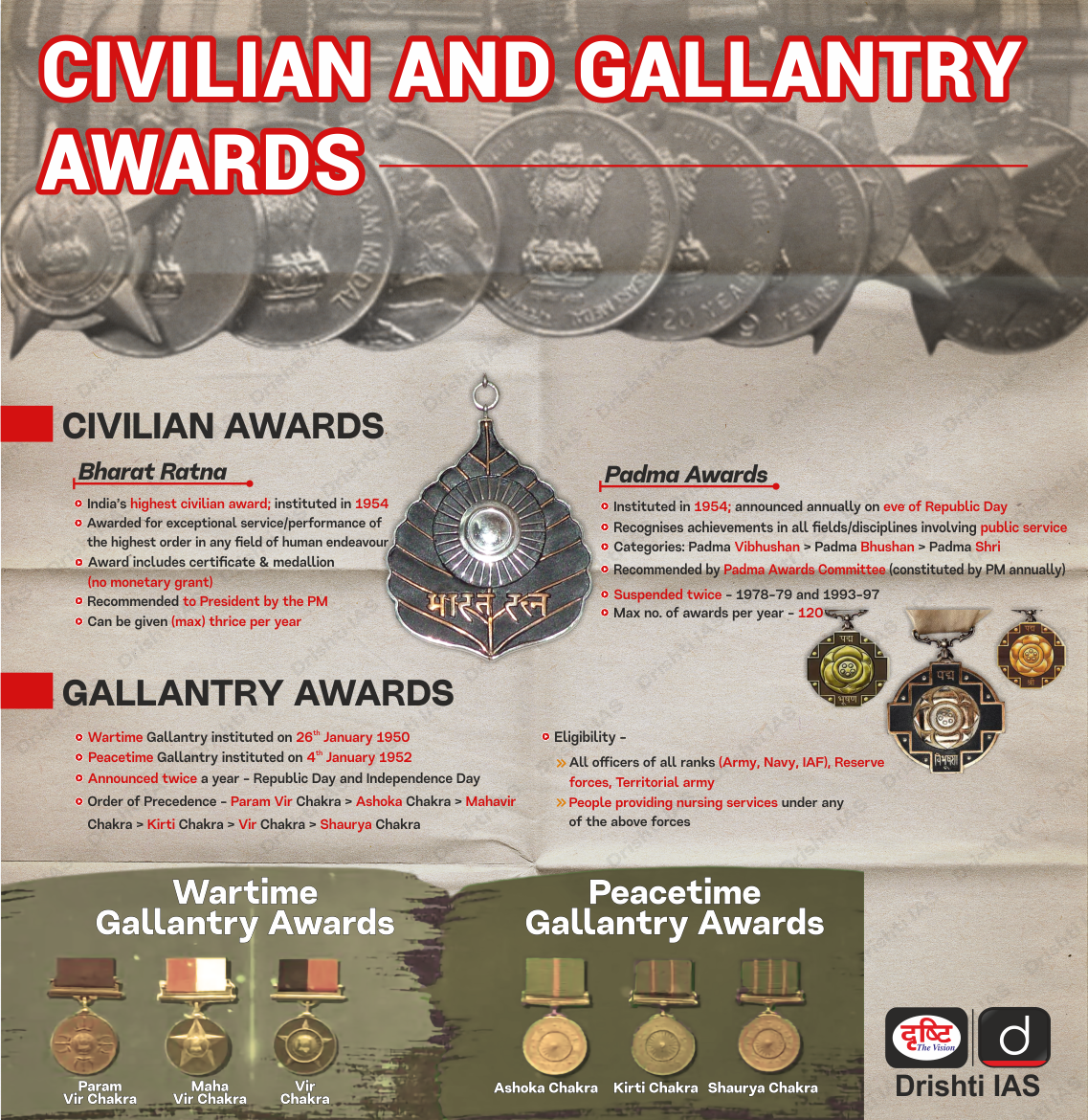
- About: The Padma Awards, alongside the Bharat Ratna, are the nation's premier awards for recognizing distinguished contributions across all fields of public service and human endeavour.
- Historical Evolution: The Padma Awards were instituted in 1954. Initially, two civilian awards were created, i.e., Bharat Ratna (the highest) and Padma Vibhushan (with three classes). In 1955, Padma Vibhushan classes were restructured into the three distinct awards in descending order of prestige:
- Padma Vibhushan: For "exceptional and distinguished service"; the 2nd-highest civilian award after the Bharat Ratna.
- Padma Bhushan: For "distinguished service of high order".
- Padma Shri: For "distinguished service in any field.
- Constitutional Provisions: Article 18(1) of the Indian Constitution abolishes all titles (e.g., Rai Bahadur, Nawab) and prohibits the State from conferring titles on any person, citizen or non-citizen. However, the prohibition has two explicit exceptions, i.e., military and academic distinctions.
- Judicial Stand: In the Balaji Raghavan v. Union of India, 1996, the Supreme Court (SC) held that National awards like Bharat Ratna, and Padma awards are state recognitions of exceptional work and merit, not hereditary or personal distinctions and hence can be conferred to meritorious individuals.
- Similarly, in Indira Jaising v. Supreme Court of India, 2017, the SC ruled that the designation ‘senior advocate’ is a professional demarcation of experience and proficiency, not a title, and thus does not violate Article 18.
- Broad Scope: Awards are given across diverse disciplines, including Art, Social Work, Public Affairs, Science & Engineering, Civil Service, and more.
- Eligibility: All individuals, irrespective of race, occupation, rank, or gender—including Indian citizens, foreigners, NRIs, PIOs, and OCIs—are eligible for these awards.
- Since 2014, the government has been recognizing "unsung heroes" with the Padma Awards, transforming them into the "People's Padma".
- Selection Process: It is governed by the Padma Awards Committee, which is appointed annually by the Prime Minister. The committee is chaired by the Cabinet Secretary and includes the Home Secretary, Secretary to the President, and 4–6 eminent persons. Its recommendations are submitted to the Prime Minister and the President of India for final approval.
- Based on the committee recommendations, it is announced annually on the eve of Republic Day and formally conferred by the President of India in March/April, with recipients receiving a Sanad (certificate), medallion, and replica.
- Key Regulations: Generally not conferred posthumously (with rare, highly deserving exceptions).
- A higher category Padma award is only granted after at least five years since the previous Padma award.
- The award is not a title and cannot be used as a prefix or suffix.
- Capped at a maximum of 120 awards per year (excluding posthumous, NRI, foreigner, and OCI recipients).
- Suspension of the Awards: The annual awards have been suspended on two occasions:
- 1978–79: By the Morarji Desai-led Janata Party government, which deemed them "worthless and politicized."
- 1993–97: Due to protracted litigation (the Balaji Raghavan case, 1996), challenging their constitutional validity in the courts.
Frequently Asked Questions (FAQs)
1. What are Padma Awards?
Padma Awards are India’s premier civilian honours, instituted in 1954 to recognise distinguished and exceptional service in diverse fields of public service and human endeavour.
2. Why are Padma Awards not considered “titles” under Article 18?
The Supreme Court held that Padma Awards are non-hereditary recognitions of merit, not prefixes or suffixes, and hence do not violate Article 18(1).
3. Who oversees the selection of Padma Award recipients?
The Padma Awards Committee, chaired by the Cabinet Secretary and appointed by the Prime Minister, scrutinises nominations and submits recommendations.
UPSC Civil Services Examination, Previous Year Questions (PYQs)
Q. Consider the following statements in respect of Bharat Ratna and Padma Awards: (2021)
- Bharat Ratna and Padma Awards are titles under the Article 18(1) of the Constitution of India.
- Padma Awards, which were instituted in the year 1954, were suspended only once.
- The number of Bharat Ratna Awards is restricted to a maximum of five in a particular year.
Which of the above statements are not correct?
(a) 1 and 2 only
(b) 2 and 3 only
(c) 1 and 3 only
(d) 1, 2 and 3
Ans: (d)