
One Health Approach | 08 Apr 2026
For Prelims: One Health approach, World Health Organization, Nipah, Avian Influenza (H5N1), Rabies, Indian Council of Medical Research
For Mains: One Health Approach: Concept, significance, and applicability, Integrated disease surveillance systems, Environmental degradation and health linkages
Why in News?
On World Health Day 2026, experts stressed the need for a One Health approach to strengthen pandemic preparedness and ensure equitable healthcare access.
Summary
- On World Health Day 2026, the need for a One Health approach was highlighted to tackle zoonotic diseases, climate-linked risks, and strengthen pandemic preparedness in India.
- Through initiatives like the National One Health Mission, India is moving towards a coordinated, preventive, and sustainable public health system.
World Health Day
- World Health Day is celebrated annually on 7th April to mark the anniversary of the founding of the World Health Organization (WHO) in 1948. It aims to draw global attention to a specific health topic of concern to people all over the world, mobilizing efforts to address critical health challenges.
- World Health Day 2026 is themed “Together for health. Stand with science”, highlighting the role of scientific collaboration and the One Health approach in protecting global health.
- Global Campaigns:
- International One Health Summit: Hosted by France (under the French G7 Presidency), prioritizing multilateral cooperation across human, animal, and environmental sectors.
- Global Forum of WHO Collaborating Centres: A massive gathering of 800 scientific institutions from 80+ countries.
- These events create the largest scientific network in UN history, emphasizing science-driven partnerships as the primary tool for global health security.
What is One Health Approach?
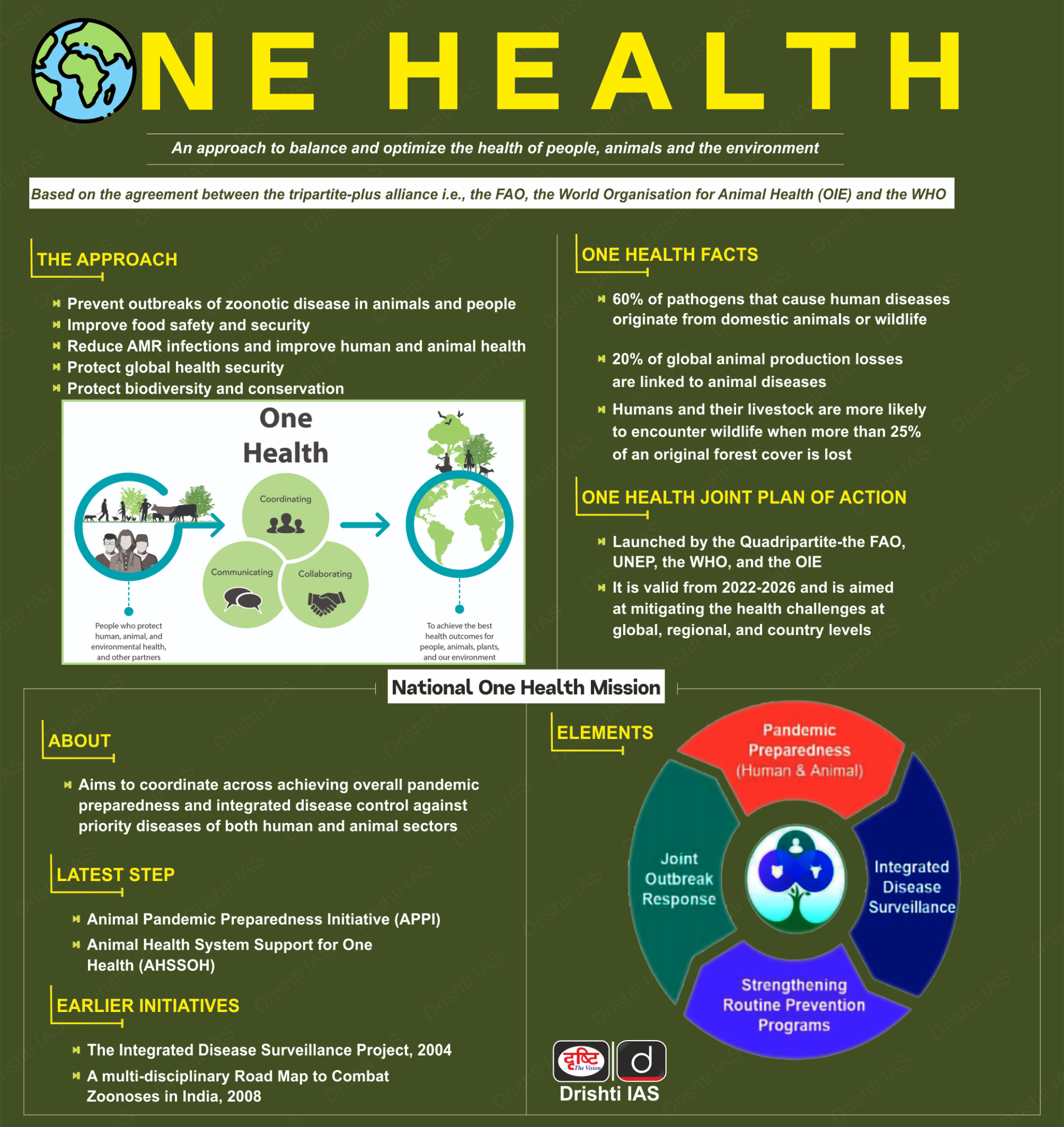
- One Health: It is an integrated, unifying approach that aims to sustainably balance and optimize the health of people, animals, and ecosystems.
- It recognizes that the health of humans, domestic and wild animals, plants, and the wider environment are closely linked and interdependent.
- One Health enables comprehensive disease control and strengthens global health security.
- It is applied at community, subnational, national, regional, and global levels, and relies on coordination, collaboration, and shared governance for holistic and equitable solutions.
- Need of One Health Approach for India:
- High Biodiversity & Interaction: With 2.4% of the world's land but 8% of its species, India has high human-wildlife contact, increasing the risk of zoonotic diseases (diseases that spread from animals to humans).
- Outbreaks of Nipah, Avian Influenza (H5N1), and Rabies show that over 60–70% of emerging infectious diseases in India are animal-borne.
- Massive Livestock Population: India has one of the world's largest livestock populations, which are often the bridge between wildlife and human infections.
- Antimicrobial Resistance (AMR): The overuse of antibiotics in both humans and livestock leads to "superbugs" that travel through the environment and food, making common infections untreatable.
- Climate Change & Vector-Borne Diseases: Deforestation, changing land use, and global warming are altering vector habitats (such as mosquitoes and ticks), leading to the spread of diseases like Dengue and Malaria to new areas, while also bringing forest diseases like Kyasanur Forest Disease (KFD) into human settlements.
- High Biodiversity & Interaction: With 2.4% of the world's land but 8% of its species, India has high human-wildlife contact, increasing the risk of zoonotic diseases (diseases that spread from animals to humans).
- National One Health Mission (NOHM): The National One Health Mission (NOHM), a cross-ministerial initiative approved by the 21st PM-STIAC (Prime Minister’s Science, Technology, and Innovation Advisory Council), represents India’s shift toward an integrated bio-security architecture.
- As of 2026, the mission is anchored by the National Institute for One Health in Nagpur and implemented by the Indian Council of Medical Research (ICMR), utilizing a two-tiered governance structure comprising an Executive Committee (policy-focused) and a Scientific Steering Committee (technical-focused).
- By integrating over 13 government departments, the NOHM aims to address India's high zoonotic burden.
- Its operational focus spans the "full spectrum" of disease control: leveraging AI-enabled tools for early pathogen detection, streamlining R&D for vaccines and diagnostics, and establishing a National Wildlife Health Policy to monitor spillover risks.
- Ultimately, the mission moves beyond reactive healthcare to a proactive, holistic model that secures the health of humans, the world's largest livestock population, and the environment simultaneously.
What are the Challenges in Implementing the One Health Approach in India and the Measures to Strengthen?
|
Challenges |
Measures to Strengthen |
|
Siloed Governance: Human, animal, and environmental sectors work independently with weak coordination and limited data sharing |
Institutionalising Coordination: Establish a statutory body with representation from key ministries to ensure integrated policy-making |
|
Resource Constraints: Veterinary and wildlife health systems suffer from inadequate funding, infrastructure, and skilled manpower |
Integrated Surveillance: Develop a unified, real-time system to monitor diseases across humans, livestock, and wildlife |
|
Low Public Health Spending: Health expenditure (~2.1% of GDP) remains below the National Health Policy target of 2.5%, limiting capacity |
Strengthening Primary Care: Enhance Ayushman Arogya Mandirs to improve early detection, prevention, and grassroots healthcare delivery |
|
Ecological Degradation: Deforestation and urbanisation increase human-wildlife interaction, raising zoonotic disease risks |
Regulating Antibiotic Use: Implement strict controls on antibiotic use in livestock and poultry to tackle antimicrobial resistance (AMR) |
Conclusion
For India, the One Health approach is the best defense against the "Triple Threat" of pandemics, climate change, and drug resistance. By treating the health of the farmer, the cow, and the forest as one single system, India can move from "crisis management" to "prevention."
|
Drishti Mains Question: “One Health approach is critical for addressing emerging public health threats in India.” Discuss. |
Frequently Asked Questions (FAQs)
1. What is the One Health approach?
An integrated framework linking human, animal, and environmental health to improve disease control and global health security.
2. What is the National One Health Mission (NOHM)?
A cross-ministerial initiative integrating 13 departments to strengthen zoonotic disease control, surveillance, and pandemic preparedness.
3. Why is One Health Important for India?
Due to high biodiversity, large livestock population, and rising zoonotic diseases, increasing health risks at the human-animal interface.
4. What is Antimicrobial Resistance (AMR)?
Resistance developed by microbes due to overuse of antibiotics, making infections harder to treat and increasing mortality risks.
5. What are key challenges in implementing One Health?
Siloed governance, low funding, weak veterinary infrastructure, and ecological degradation leading to increased zoonotic spillovers.
UPSC Civil Services Examination, Previous Year Questions (PYQs)
Mains
Q. “Besides being a moral imperative of a Welfare State, primary health structure is a necessary precondition for sustainable development.” Analyse. (2021)