
National Voters’ Day (NVD) 2026 | 28 Jan 2026
Why in News?
The President of India presided over the National Voters’ Day (NVD) celebrations, observed on 25th January, to celebrate democracy and encourage citizen participation in the electoral process.
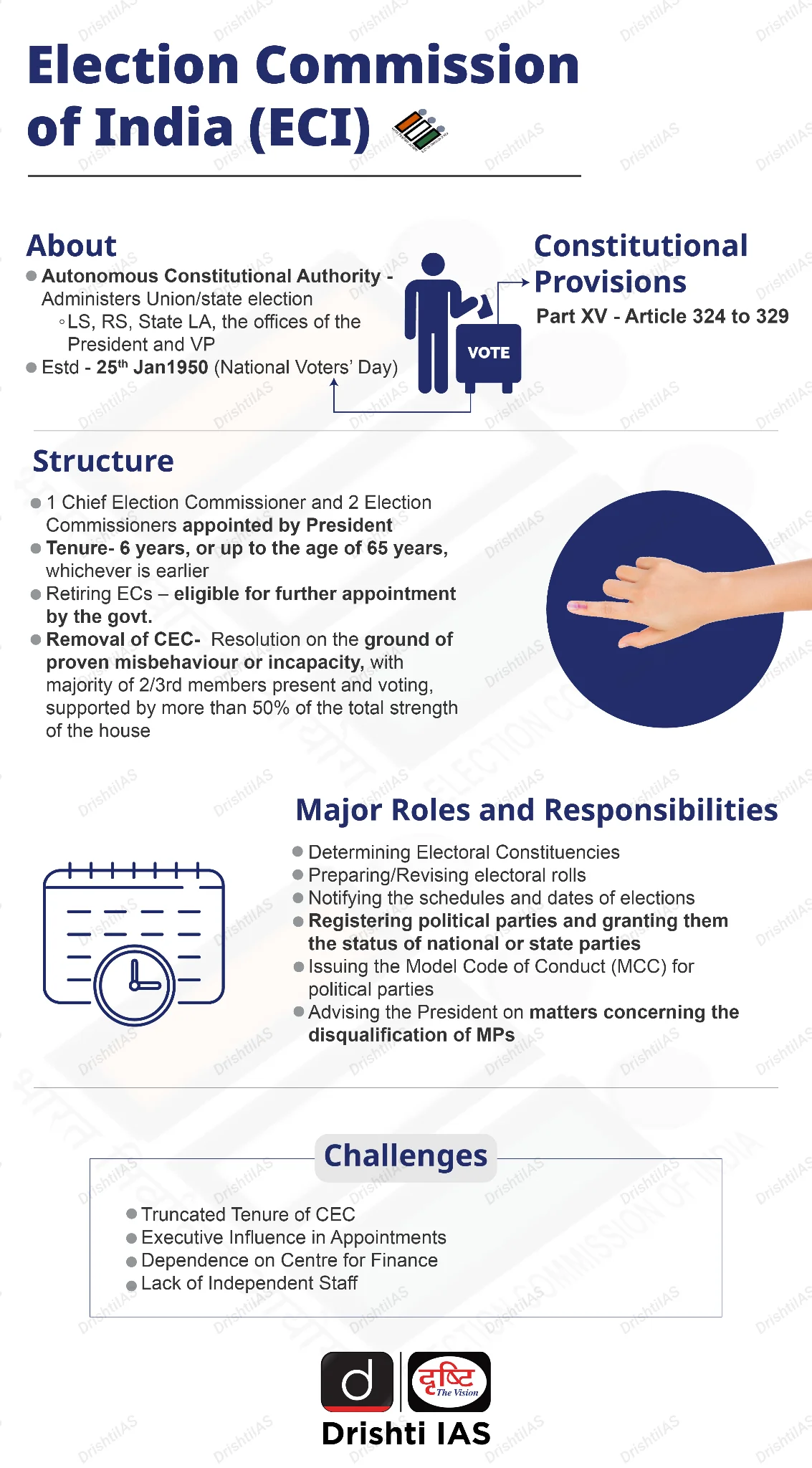
- NVD marks the foundation of the Election Commission of India (ECI), which was established on 25th January 1950 under Article 324 of the Indian Constitution.
What are the Key Highlights of National Voters’ Day (NVD) 2026?
- Theme: The theme for NVD 2026 is "My India, My Vote" with the tagline "Citizen at the Heart of Indian Democracy".
- This symbolizes the ECI's efforts to design citizen-centric electoral processes where the convenience of the voter is paramount.
- Significance: It underscores the importance of voter participation in a democracy. It promotes voter enrolment and awareness, with special focus on new and young voters, through nationwide celebrations and outreach activities led by the ECI.
- Initiatives Launched:
- Best Election District Awards in 2026: The President presented the Best Electoral Practices Awards, recognising states like Bihar, Kerala, Tamil Nadu, Odisha, Gujarat, Meghalaya, Mizoram, UP, Jharkhand, and Delhi for excellence in technology use, election management, voter awareness, Model Code of Conduct enforcement, and training.
- Publications: On NVD 2026, the publications “2025: A Year of Initiatives and Innovations” and “Chunav Ka Parv, Bihar Ka Garv” were released, showcasing the ECI’s leadership in electoral management.
What are the Major Electoral Reforms Introduced by the ECI?
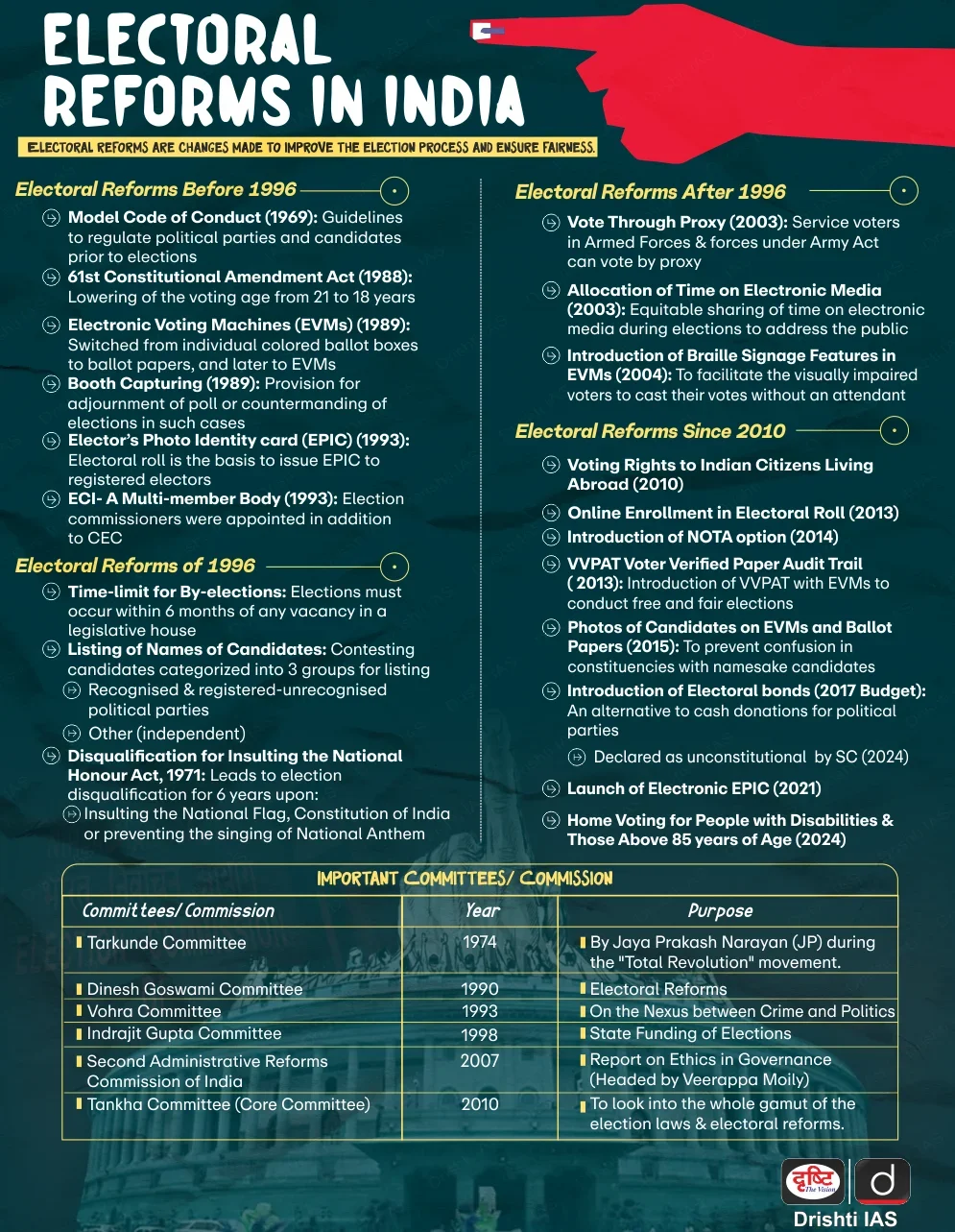
- Photo Identity Cards for Voters (1993): The ECI introduced the Electors Photo Identity Card (EPIC) scheme to prevent impersonation and fraudulent voting. While initially a physical card, the initiative evolved to include Photo Electoral Rolls (PERs) in 2004.
- In 2021, the e-EPIC was launched, allowing voters to download a secure, non-editable digital version of their ID, making it easier to carry and access on mobile devices.
- Electronic Voting Machines (EVMs) (1998): First used experimentally in 1982 (Kerala), EVMs were formally introduced on a larger scale in 1998 for State Assembly elections in Madhya Pradesh, Rajasthan, and Delhi.
- They eliminated "invalid votes" (a common issue with paper ballots), reduced the time required for counting from days to hours, and are eco-friendly by saving paper.
- Systematic Voters' Education and Electoral Participation (SVEEP) (2009): This is the ECI’s flagship program for voter education. It aims to bridge the "participation gap" by addressing urban apathy and youth disengagement.
- The program uses targeted interventions (like street plays, social media, and campus ambassadors) to ensure "No Voter to be Left Behind".
- Voter Verifiable Paper Audit Trail (VVPAT) (2013): Following a Supreme Court directive in 2013 (Subramanian Swamy vs. ECI), the VVPAT was introduced to add a layer of verification to EVMs.
- VVPATs allow voters to verify their vote through a printed slip visible through a glass window for seven seconds.
- National Electoral Roll Purification and Authentication Programme (NERPAP) (2015): This programme allowed electoral officers to conduct door-to-door verification drives.
- It focused on linking EPIC data with Aadhaar to identify and remove duplicate or multiple entries across different constituencies to create an error-free and authenticated electoral roll.
- ERO-NET (2018): A digital form-processing system for election officials available in 14 languages and 11 scripts. It helps voters track the status of their applications and allows for real-time processing of forms to prevent dual registration.
- Accessible Elections for Persons with Disabilities (2018): The ECI declared 2018 as the "Year of Accessible Elections".
- ECI provided Braille-enabled EPICs for visually impaired voters, establishing auxiliary polling stations to reduce travel distance, and offering free transport to polling stations for Persons with Disabilities (PwDs).
- cVIGIL App (2018): This mobile app empowers citizens to act as "election observers".
- Citizens can take a photo or video of Model Code of Conduct (MCC) violations (like hate speech or bribe distribution). The app uses geo-tagging to pinpoint the location.
- The ECI mandates that authorities must investigate and respond to cVIGIL complaints within 100 minutes.
- Special Intensive Revision (SIR) (2025): A comprehensive electoral roll revision ordered by the ECI to ensure no eligible citizen is excluded and no ineligible person is included.
- SIR covered over 51 crore electors across 12 States/UTs, targeting the removal of deceased voters and duplicate entries.
- ECINET (2026): A user-friendly digital interface launched by the ECI for electors, election officials, political parties, and civil society. More than 40 existing mobile and web applications of the ECI will be integrated by this platform into a single "one-stop" interface.
- International Cooperation: India strengthened international electoral cooperation through bilateral engagements and by hosting the India International Conference on Democracy and Election Management (IICDEM) 2026 in New Delhi, which led to the adoption of the Delhi Declaration 2026.
- The Declaration outlines five pillars - clean electoral rolls, free and fair elections, research and publications, use of technology (including sharing India’s ECINET platform), and training and capacity building through IIIDEM - to advance global electoral integrity and democratic innovation.
Frequently Asked Questions (FAQs)
1. What is National Voters’ Day and why is it observed?
National Voters’ Day is observed on 25thJanuary to mark the foundation of the Election Commission of India and to promote voter awareness, enrolment, and participation in elections.
2. What was the theme of National Voters’ Day 2026?
The theme was“My India, My Vote” with the tagline “Citizen at the Heart of Indian Democracy”, highlighting voter-centric electoral reforms.
3. What is ECINET and why is it important?
ECINET is a unified digital platform integrating over 40 ECI applications into a single interface, improving accessibility, transparency, and efficiency for all electoral stakeholders.
4. How does cVIGIL strengthen electoral integrity?
The cVIGIL app enables citizens to report Model Code of Conduct violations in real time, with a mandatory response time of 100 minutes, enhancing enforcement and accountability.
5. What is the significance of the Delhi Declaration 2026?
Adopted at IICDEM 2026, the Declaration outlines five pillars—clean electoral rolls, free and fair elections, research, technology use, and capacity building—to strengthen global democratic processes.
UPSC Civil Services Examination Previous Year Questions (PYQ)
Prelims:
Q.1 Consider the following statements: (2017)
- The Election Commission of India is a five-member body.
- The Union Ministry of Home Affairs decides the election schedule for the conduct of both general elections and bye-elections.
- Election Commission resolves the disputes relating to splits/mergers of recognised political parties.
Which of the statements given above is/are correct?
(a) 1 and 2 only
(b) 2 only
(c) 2 and 3 only
(d) 3 only
Ans: (d)
Mains:
Q.1 To enhance the quality of democracy in India the Election Commission of India has proposed electoral reforms in 2016. What are the suggested reforms and how far are they significant to make democracy successful? (2017)