
National Counter-Terrorism Policy and Strategy: PRAHAAR | 25 Feb 2026
For Prelims: Multi Agency Centre, Intelligence Bureau, Central Armed Police Forces, National Investigation Agency, Universal Declaration of Human Rights, Mutual Legal Assistance Treaties
For Mains: India’s counter-terrorism architecture and the role of PRAHAAR, Intelligence-led policing and inter-agency coordination in internal security, Balancing national security with human rights and civil liberties.
Why in News?
The Ministry of Home Affairs (MHA) unveiled India’s first-ever comprehensive National Counter-Terrorism Policy and Strategy, titled 'PRAHAAR'. This marks a paradigm shift from a reactive security stance to a proactive, intelligence-driven doctrine.
Summary
- India’s first-ever comprehensive National Counter-Terrorism Policy and Strategy, titled 'PRAHAAR' shifts to a proactive, intelligence-led, whole-of-government and whole-of-society approach, combining prevention, swift response, de-radicalisation, legal frameworks, and international cooperation to address evolving terror threats.
- Its effectiveness will depend on overcoming federal coordination challenges, capacity gaps, and civil liberties concerns while strengthening technology use, inter-agency coordination, and global partnerships to ensure security with adherence to the rule of law.
What is PRAHAAR?
- PRAHAAR: The strategy is an acronym representing the core pillars of India's proactive defense mechanism:
- Prevention of terror attacks to protect Indian citizens and interests;
- Responses, which are swift and proportionate to the threat posed;
- Aggregating internal capacities for achieving synergy in a whole-of-government approach;
- Human rights and ‘Rule of Law’ based processes for mitigation of threats;
- Attenuating the conditions enabling terrorism, including radicalization;
- Aligning and shaping the international efforts to counter terrorism;
- Recovery and resilience through a whole-of-society approach.
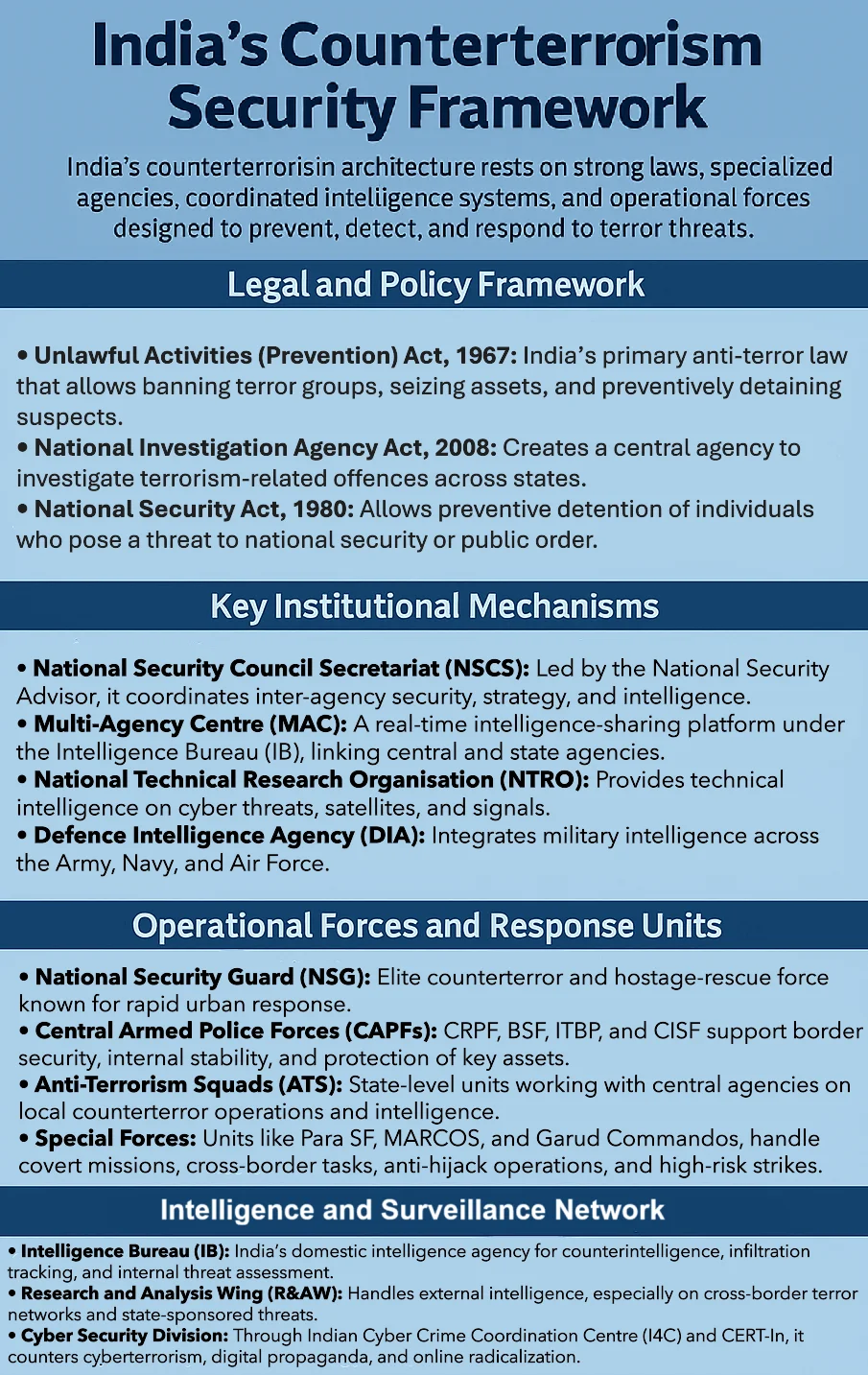
- Prevention of Terror Attacks: India follows a proactive, intelligence-led counter-terrorism approach anchored by the Multi Agency Centre (MAC) and Joint Task Force on Intelligence (JTFI) under the Intelligence Bureau for real-time intelligence sharing among central and state agencies.
- Law enforcement actively counters terrorist misuse of the internet for recruitment, propaganda, and communication, while dismantling over-ground worker (OGW) support networks.
- Coordinated operations target the emerging nexus between illegal arms syndicates and terrorist groups and disrupt terror funding through legal frameworks.
- Border guarding forces and immigration authorities deploy advanced technologies to address threats across land, air, and maritime domains, alongside strengthened protection of critical infrastructure such as power, railways, aviation, ports, defence, space, and atomic energy sectors.
- Response: The local police serve as the primary first responders, bolstered by specialized State Counter-Terror (CT) Forces and Central Armed Police Forces (CAPFs).
- The National Security Guard (NSG) acts as the nodal national agency under the MHA, providing elite intervention for major attacks and leading capacity-building initiatives for state units.
- Coordination is streamlined through an MHA-issued Standard Operating Procedure (SOP) and the Multi-Agency Centre (MAC), which facilitates real-time intelligence dissemination and analysis.
- Post-incident, the National Investigation Agency (NIA) works alongside State Police to ensure high prosecution rates, aiming to establish a robust legal deterrent against future terror threats.
- Aggregating Capacities: Focuses on standardization and modernization across India's security landscape.
- It mandates the continuous acquisition of advanced weaponry and technology while upgrading training faculties to incorporate global best practices.
- Key agencies like the Bureau of Police Research & Development (BPR&D) and CAPFs lead large-scale training, while the NSG provides specialized urban combat expertise to state units.
- By identifying resource gaps and advocating for a uniform anti-terrorism structure across all States, the policy ensures that multi-agency responses are synergistic and interoperable.
- Human Rights and Rule of Law Based Processes: Underscores India’s commitment to a justice-based counter-terrorism framework.
- It balances national security with fundamental rights by adhering to the Rule of Law, the Protection of Human Rights Act (1993), and international treaties like the Universal Declaration of Human Rights (1948) and the International Covenant on Civil and Political Rights.
- The legal backbone consists of the Unlawful Activities (Prevention) Act (UAPA), 1967, supported by the new criminal codes (Bharatiya Nyaya Sanhita, 2023, Bharatiya Nagarik Suraksha Sanhita, 2023, Bharatiya Sakshya Adhiniyam, 2023) alongside specialized laws like the PMLA (2002) and the Arms Act (1959).
- To prevent misuse, the policy highlights a robust multi-level judicial redressal system from District Courts to the Supreme Court ensuring due process, affordable legal representation, and ample opportunities for appeal.
- Attenuating Conducive Conditions: It focuses on a "Soft-Power" approach to supplement hard security.
- It addresses the root causes of radicalization through a multi-stakeholder de-radicalization framework involving community leaders, religious heads, and NGOs to counter extremist narratives.
- The policy adopts a graded response to radicalised youth, prioritising rehabilitation for minor cases and legal action against hardcore elements.
- It also focuses on socio-economic empowerment to prevent recruitment and includes measures to curb prison radicalisation by separating ideologues from vulnerable inmates.
- Aligning and Shaping the International Efforts: Targets the trans-national nature of terror through a multi-layered diplomatic and legal strategy.
- It focuses on denying safe havens by utilizing Mutual Legal Assistance Treaties (MLATs), Extradition Treaties, and Joint Working Groups (JWGs) to facilitate evidence sharing and the deportation of fugitives.
- Beyond agency-to-agency intelligence exchange, India leverages international forums to share global best practices and collaborates with partners to designate terrorists at the United Nations, ensuring a holistic and globally-aligned national response.
- Recovery and Resilience: Advocates for a "Whole-of-Society" approach to minimize the impact of terror attacks.
- Central to this is a strong public-private partnership that facilitates rapid restoration and long-term community strength.
- By combining state-led restoration with reinforced police security measures, the policy aims to restore normalcy swiftly and build long-term psychological and physical resilience against terror-induced disruption.
Cross-Border and Emerging Terror Threats
- State-Sponsored Terrorism: Persistent cross-border support to jihadi outfits and affiliated groups planning and executing attacks in India.
- Global Terror Linkages: Groups such as Al-Qaeda and ISIS attempt to incite violence through sleeper cells and online radicalisation.
- Use of Advanced Technologies: Drones and modern tools are used by handlers abroad to facilitate attacks, especially in Punjab and Jammu & Kashmir.
- Criminal-Terror Nexus: Terror groups increasingly collaborate with organised crime networks for logistics, recruitment, and funding.
- Digital Ecosystem Misuse: Social media, encrypted messaging apps, dark web, and cryptocurrencies enable propaganda, coordination, and anonymous financing.
- CBRNED Threats: Risks of terrorists accessing Chemical, Biological, Radiological, Nuclear, Explosive, and Digital (CBRNED) materials remain a major concern.
- Drone and Robotics Risks: Potential misuse by state and non-state actors for surveillance and lethal operations.
- Cyber Threats: Criminal hackers and hostile nation-states continue to target India through cyber-attacks on critical systems.
What are the Implementation Challenges of PRAHAAR Strategy?
- Federal Friction in Execution: "Public Order" and "Police" are subjects under the State List of the Indian Constitution.
- Centralizing the anti-terror structure can lead to jurisdictional overlaps and center-state operational delays.
- Technological and Capacity Asymmetries: Local police (the first responders) often lack the funding, cyber-training, and advanced infrastructure needed to tackle modern threats like drones and the dark web.
- Upgrading these state units requires massive financial outlays that many states cannot independently afford.
- Subjectivity in De-radicalization: The policy proposes a "graded police response" based on the level of an individual's radicalization.
- Because measuring radicalization is inherently psychological and subjective, lacking clear legal benchmarks could lead to inconsistent application, arbitrary profiling, or localized grievances.
- Concerns Regarding Stringent Security Laws: Heavy reliance on stringent security laws often brings up concerns regarding low conviction rates and prolonged pre-trial detentions.
- Inter-Departmental Silos: Despite advocating for a "Whole-of-Government" approach, the Indian security apparatus has historically struggled with institutional turf wars.
- Ensuring seamless, real-time intelligence sharing and operational synergy among local police, central armed police forces, and national intelligence networks without bureaucratic delays remains a practical hurdle.
What Measures can Strengthen the PRAHAAR Strategy?
- Inter-Agency Coordination: Strengthen intelligence-sharing mechanisms and regularly update counter-terror laws to address emerging threats.
- Capacity Building: Enhance State and UT Counter-Terrorism Units and Anti-Terrorism Squads (ATS) with uniform structures, modern resources, advanced training, and standardised investigation methods.
- Embed legal experts throughout terror investigations to improve prosecution quality and conviction rates.
- Global Cooperation: Expand national, regional, and international collaboration to combat transnational terrorism and advance a comprehensive global framework aligned with PRAHAAR.
- Technological Countermeasures: Invest in technology and partner with the private sector to counter terrorist misuse of Information and Communication Technology (ICT) and address evolving digital threats.
- Amend IT Rules to hold social media platforms accountable for promoting extremist content and mandate independent radicalisation audits.
- Integrate Crypto-Based Financing tracking tools into the Central Bank Digital Currency framework and enforce strict KYC norms on decentralized finance platforms to curb terror funding.
- Use big data fusion and machine learning to detect suspicious financial and behavioural patterns before attacks materialise.
- Specialised Terror Prosecution: Create a dedicated cadre of federal prosecutors trained in cyber forensics and anti-terror laws to improve conviction rates.
- Digital Evidence Sharing: Establish fast-track international agreements for real-time access to encrypted data during critical investigations.
Conclusion
PRAHAAR reflects a zero-tolerance, proactive whole-of-society approach that combines technological disruption, legal action, and community-based de-radicalisation to strengthen national security. Its success will depend on balancing firm enforcement with the protection of fundamental rights.
|
Drishti Mains Question Q. Evaluate the significance of the 'PRAHAAR' policy in the context of India’s evolving internal security challenges. |
Frequently Asked Questions (FAQs)
1. What is PRAHAAR?
PRAHAAR is India’s first comprehensive National Counter-Terrorism Policy launched by the Ministry of Home Affairs to adopt a proactive, intelligence-led, zero-tolerance approach to terrorism.
2. What are the key pillars of PRAHAAR?
Its pillars include prevention, response, capacity aggregation, human rights compliance, de-radicalisation, international cooperation, and recovery through a whole-of-society approach.
3. Which legal frameworks support PRAHAAR?
Key laws include the Unlawful Activities (Prevention) Act (1967), Prevention of Money Laundering Act (2002), Arms Act (1959), and the new criminal codes of 2023.
4. What are the major challenges in implementing PRAHAAR?
Challenges include federal coordination issues, capacity gaps in state police, subjectivity in de-radicalisation, civil liberties concerns, and inter-agency coordination hurdles.
5. How does PRAHAAR address modern terror threats?
It targets cyber radicalisation, crypto-based financing, drone threats, CBRN risks, and cross-border terror networks through technology, intelligence sharing, and international cooperation.
UPSC Civil Services Examination, Previous Year Questions (PYQs)
Mains
Q. What are India’s internal security challenges? Give out the role of Central Intelligence and Investigative Agencies tasked to counter such threats. (2023)
Q. Analyse the multidimensional challenges posed by external state and non-state actors, to the internal security of India. Also discuss measures required to be taken to combat the threats. (2021)
Q. The banning of ‘Jamaat-e – islaami’ in Jammu and Kashmir brought into focus the role of over-ground workers (OGWs) in assisting terrorist organizations. Examine the role played by OGWs in assisting terrorist organizations in insurgency affected areas. Discuss measures to neutralize the influence of OGWs. (2019)