
National Consumer Day and Consumer Commissions in India | 24 Dec 2025
For Prelims: Consumer commissions, E-Daakhil portal, Quasi-judicial bodies, Central Consumer Protection Authority
For Mains: Effectiveness of quasi-judicial bodies in India, Consumer Protection Act, 2019, Consumer rights as part of inclusive governance
Why in News?
National Consumer Day, observed on 24th December, highlights the importance of consumer rights and protection in India. It also draws attention to growing delays in consumer commissions, where rising case backlogs and structural gaps are undermining timely justice.
Summary
- Despite strong legal backing under the Consumer Protection Act, 2019, consumer commissions face severe delays due to rising case backlogs, manpower shortages, frequent adjournments, and weak infrastructure, undermining the goal of speedy consumer justice highlighted on National Consumer Day.
- Strengthening commissions requires fast-track appointments, strict case-flow management, full digital integration through e-Jagriti, mandatory mediation, and performance-based monitoring to ensure efficient, technology-driven, and timely consumer grievance redressal.
Note: National Consumer Day marks the President’s assent to the Consumer Protection Act, 1986, which laid down key consumer rights such as the right to be informed, protected, heard, and seek redressal.
- The day aims to promote consumer awareness and responsible practices.
- The 2025 theme, “Efficient and Speedy Disposal through Digital Justice,” highlights the push for technology-driven and timely consumer grievance redressal.
What are Consumer Commissions?
- About: Consumer Commissions are quasi-judicial bodies established under the Consumer Protection Act of 1986 (now Consumer Protection Act (CPA), 2019) to resolve disputes between consumers and sellers or service providers.
- They aim to provide speedy, affordable, and effective justice and protect consumers from unfair trade practices, defective goods, and deficient services.
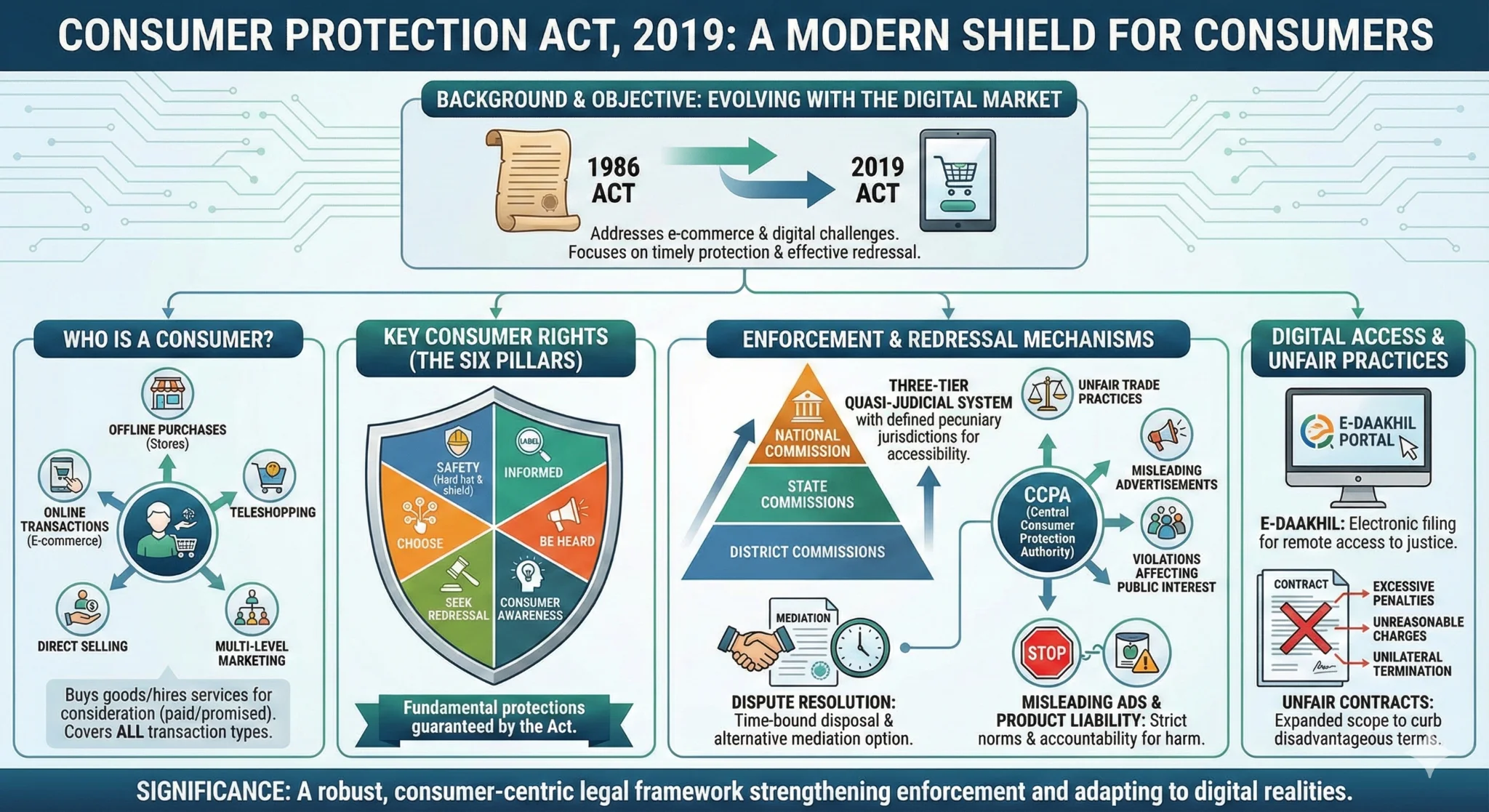
- Types of Consumer Commissions in India: The CPA, 2019 promulgates a three-tier quasi-judicial mechanism for redressal of consumer disputes namely district commissions, state commissions and national commission, each with defined pecuniary jurisdiction.
- The District and State Consumer Commissions are set up by State Governments with Central approval, while the National Commission is established by the Central Government.
- These bodies offer an alternative dispute-resolution mechanism and do not replace civil courts.
|
Consumer Commission |
Pecuniary Jurisdiction |
Composition |
Appellate Authority |
|
District Consumer Disputes Redressal Commission |
Up to Rs 50 lakh. |
President (District Judge or equivalent) and Members. |
Appeals lie to the State Commission. |
|
State Consumer Disputes Redressal Commission |
Above Rs 50 lakh and up to Rs 2 crore. |
President (Either a sitting Judge or a retired Judge of a High Court) and Members. |
Appeals lie to the National Commission. |
|
National Consumer Disputes Redressal Commission (NCDRC) |
Above Rs 2 crore. |
President (sitting or a retired Judge of the Supreme Court or a sitting or a retired Chief Justice of a High Court) and Members. |
Appeals lie to the Supreme Court. |
- Judicial Pronouncements:
- Indian Medical Association vs. V.P. Shantha (1995): The Supreme Court held that the services that are being provided by medical practitioners will fall within the ambit of the Consumer Protection Act, 1986.
- Ambrish Kumar Shukla vs. Ferrous Infrastructure (2016): Clarified pecuniary jurisdiction, considering the total claim value (product cost and compensation) for determining the court level.
- Ganeshkumar Rajeshwarrao Selukar & Others vs. Mahendra Bhaskar Limaye & Others: The Supreme Court (SC) of India urged the Centre to set up permanent adjudicatory bodies for consumer disputes, emphasizing that consumer rights are constitutionally protected and need a stable framework due to gaps in implementing the CPA, 1986.
Consumer Protection Act, 2019
- The CPA, 2019, enacted in 2020, replaced the Consumer Protection Act, 1986 to strengthen consumer rights and grievance redressal in a modern marketplace.
- It promotes fair trade practices, informed consumer choice, and speedy dispute resolution.
- The law guarantees several key rights, including the right to be informed about the quality, quantity, potency, purity, and standards of goods or services, thereby safeguarding consumers against unfair trade practices.
- Central Consumer Protection Authority (CCPA) established in 2020 under the CPA, 2019, protects consumer interests at a collective level.
- CCPA enforces consumer rights, prevents unfair trade practices, regulates misleading advertisements, and takes action against manufacturers, endorsers, and publishers.
What are the Causes of Delay in Consumer Commissions in India?
- Rising Case Backlog: As of January 2024, 5.43 lakh cases were pending across district, State, and national consumer commissions.
- In 2024, 1.73 lakh new cases were filed, while only 1.58 lakh were disposed of, adding nearly 14,900 cases to the backlog.
- Severe Manpower Shortages: A large number of posts of Presidents and Members remain vacant in State and district consumer commissions, significantly reducing functional bench strength and slowing case disposal.
- Frequent Adjournments: The Consumer Protection Act (CPA), 2019 mandates disposal of cases within 3–5 months and discourages adjournments unless sufficient cause is shown and reasons are recorded in writing.
- However, cases are frequently adjourned due to time constraints, non-appearance of parties, and incomplete records, leading to routine delays despite clear legal provisions.
- Weak Enforcement of Orders: Poor enforcement of final orders often forces consumers into execution proceedings, while non-compliance by companies leads to re-litigation, increasing case pendency.
- CAG and Department of Consumer Affairs reports have flagged low recovery rates of compensation awards as a key concern.
- Inadequate Infrastructure and Logistics: Limited courtrooms, insufficient support staff, and weak digital case management through E-Daakhil portal slow hearings and case tracking.
- Lack of Specialised Expertise: Cases involving insurance claims, medical negligence, or financial products require expert opinions and technical reports, extending timelines.
- Members often lack subject-specific training, leading to repeated clarifications and dependence on external experts.
- Strategic Delays by Opposite Parties: Well-resourced companies sometimes seek repeated adjournments to exhaust individual consumers financially and mentally.
India’s Consumer Protection Initiatives
- Consumer Welfare Fund: Supports consumer protection and awareness initiatives by providing financial assistance to States and UTs to create a Consumer Welfare Corpus Fund, funded in a 75:25 ratio (90:10 for Special Category States/UTs).
- Programme activities are financed through interest from the corpus, and Rs 38.68 crore was released in 2024–25.
- e-Jagriti: Launched in 2025, is a unified digital platform for consumer grievance redressal that integrates e-Daakhil, NCDRC CMS, and CONFONET into a single system.
- It enables online complaint filing, fee payment, virtual hearings, and case tracking.
- With multilingual support, chatbots, voice-to-text features, and secure payment gateways like Bharat Kosh and PayGov, the platform ensures accessibility, inclusivity, faster case disposal, and safe transactions, including for NRIs, senior citizens, and persons with disabilities.
- National Consumer Helpline 2.0: It is an AI-enabled, multilingual grievance redressal platform that allows consumers to register complaints, seek pre-litigation remedies, and access consumer rights information,
- NCH now resolves over 12 lakh complaints annually, many within 21 days, reflecting growing consumer trust and faster digital redressal.
- Consumer Awareness: The Department of Consumer Affairs has deployed AI-based digital tools on the Airawat Supercomputer to detect deceptive online practices such as dark patterns.
- The Jago Grahak Jago App alerts users to unsafe e-commerce platforms, while the Jagriti App and Dashboard enable real-time reporting and monitoring of suspicious websites by the CCPA.
- To counter manipulation, the CCPA has issued guidelines against dark patterns like drip pricing, disguised ads, and false urgency, strengthening transparency and consumer protection in digital markets.
- Bureau of Indian Standards (BIS): India’s national standards body under the BIS Act, 2016, formulates standards, certifies products, and ensures quality and safety in the market.
- With over 22,300 Indian Standards in force, 94% aligned with ISO and IEC norms.
- BIS Quality Control Orders, support consumer safety, export competitiveness, and import substitution.
- The BIS Care App enables consumers to verify jewellery hallmarking, and lodge complaints, promoting transparency and fair trade.
- National Test House (NTH): Established in 1912 under the Department of Consumer Affairs, provides testing, calibration, and quality certification for engineering materials and products.
- In 2024–25, sample testing rose by over 60%, highlighting its growing role in quality assurance.
- Legal Metrology (Packaged Commodities) Amendment Rules, 2025: These rules along with the Legal Metrology (Government Approved Test Centre) Amendment Rules, 2025 simplified labelling rules, expanded approved test centres, and strengthened disclosure norms such as country-of-origin filters for imported e-commerce goods.
- Overall, they improve pricing transparency, regulatory clarity, and consumer protection while reducing compliance burdens on businesses.
What Measures can Strengthen the Effective Functioning of Consumer Commissions in India?
- Fast-track Appointments: Fill vacancies through time-bound selection processes and consider creating a dedicated consumer judiciary cadre to ensure continuity and expertise.
- Mandatory Case-flow Management: Introduce case-age benchmarks (6 months, 1 year, 2 years) with compulsory priority listing of long-pending matters, similar to High Court case-flow rules.
- Full integration Digital Adjudication: Expand e-Jagriti beyond filing to include automated listing, document scrutiny, and compliance tracking, reducing registry-level delays and repeated adjournments.
- Mandatory Referral to Mediation: Operationalise consumer mediation cells at district level and mandate referral at the admission stage for low-value and service-related disputes to reduce caseload.
- Outcome-based Performance Monitoring: Publish quarterly disposal and pendency reports for each commission to introduce transparency and administrative accountability.
Conclusion
Consumer Commissions play a crucial role in protecting consumer interests and ensuring accountability in the marketplace. However, delays, manpower shortages, and enforcement challenges must be addressed to restore their promise of speedy and effective justice.
|
Drishti Mains Question: Consumer commissions were envisaged as instruments of social justice. Critically assess whether they are fulfilling this mandate today. |
Frequently Asked Questions (FAQs)
1. Why is National Consumer Day observed in India?
It marks the enactment of the Consumer Protection Act, 1986, and aims to promote consumer rights, awareness, and fair market practices.
2. What is the purpose of Consumer Commissions in India?
Consumer Commissions provide speedy, affordable redressal against unfair trade practices, defective goods, and deficient services under the Consumer Protection Act, 2019.
3. What is the current structure of Consumer Commissions?
India follows a three-tier system comprising District, State, and National Consumer Disputes Redressal Commissions based on pecuniary jurisdiction.
4. Why are Consumer Commissions facing delays despite statutory timelines?
Rising case pendency, vacancies in commissions, frequent adjournments, and procedural inefficiencies undermine the 3–5 month disposal mandate.
5. What is the role of the E-Daakhil portal?
E-Daakhil enables online filing, e-notices, document access, and virtual hearings, reducing physical travel and procedural delays.
UPSC Civil Services Examination Previous Year Question
Prelims
Q.1 With reference to ‘consumers’ rights/privileges under the provisions of law in India, which of the following statements is/are correct ? (2012)
- Consumers are empowered to take samples for food testing.
- When a consumer files a complaint in any consumer forum, no fee is required to be paid.
- In case of death of consumer, his/her legal heir can file a complaint in the consumer forum on his/ her behalf.
Select the correct answer using the codes given below:
(a) 1 only
(b) 2 and 3 only
(c) 1 and 3 only
(d) 1, 2 and 3
Ans: c
Mains
Q. What is quasi judicial body? Explain with the help of concrete examples. (2016)
Q. How far do you agree with the view that tribunals curtail the jurisdiction of ordinary courts? In view of the above, discuss the constitutional validity and competency of the tribunals in India.(2018)