
Nanorobots in Healthcare | 12 Jan 2026
For Prelims: Nanorobots, Nanotechnology, Semiconductors, Quantum Dots, Solar Cells, Polymers, Stem Cells, mRNA Vaccines, T-cells, Bioaccumulation, Food Chain, Genetically Modified Organisms (GMOs), Environmental Impact Assessment.
For Mains: Key facts regarding magnetic nanorobots, applications of nanotechnology in healthcare, associated concerns and way forward.
Why in News?
A researcher from IISc Bangalore has received the prestigious New York Academy of Sciences 2025 and Tata Sons’ Transformation Prize for developing magnetic nanorobots, paving the way for precise, minimally invasive, and more effective therapies.
- His work aims to overcome a key limitation in current cancer treatment by enabling drugs to be delivered deep inside tumors without harming healthy tissue, thereby opening new avenues for the use of nanotechnology in healthcare.
Summary
- Magnetic nanorobots enable precise, minimally invasive drug delivery, hyperthermia, and potential imaging-guided therapy.
- Nanotechnology applications span diagnostics, regenerative medicine, antimicrobial therapies, and vaccines.
- Challenges include nanotoxicity, regulatory gaps, ethical concerns, and high costs, requiring clinical trials and policy support for mainstream adoption.
What are Magnetic Nanorobots?
- About: Magnetic nanorobots are microscopic, externally powered machines made from or coated with magnetic materials like iron oxide. Guided by magnetic fields from outside the body, they can be precisely steered to navigate blood vessels or tissues without an onboard power source.
- Functioning: They mimic the corkscrew motion of bacteria, using a tiny, helix-shaped tail that functions like a propeller.
- A magnet attached to this helix allows it to be controlled and propelled by external magnetic fields, enabling a drilling motion to navigate through complex biological environments.
- Their structure is biocompatible, made of silica and iron, and can be coated with cancer drugs, effectively turning them into targeted delivery trucks.
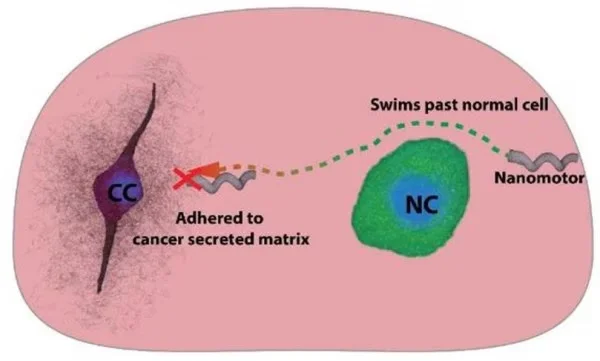
- Primary Applications: They hold significant promise for minimally invasive procedures, including:
- Maximizing Treatment Impact: Guiding therapeutic payloads directly to disease sites, such as tumors, to enhance efficacy and reduce systemic side effects.
- Diagnostic Tools: Biosensing, imaging enhancement, or biofilm removal.
- Medical Dentistry: They offer a promising, pain-free alternative for root canal treatments, effectively targeting antibiotic-resistant bacteria (E. faecalis) without damaging surrounding tissue.
Nanotechnology
- About: Nanotechnology involves designing and engineering structures at the nanoscale—where dimensions are 100 nanometres or smaller—by manipulating individual atoms and molecules.
- Molecular simulation is essential for this field, as it allows scientists to model the behavior of atoms, molecules, and nanostructures under different conditions using computer models.
- Properties:
- Mechanical Attributes: The small grain size of nanomaterials gives them high mechanical strength, making them ideal for strong, lightweight applications in the aerospace and automotive industries.
- Quantum Size Effect: As grain size decreases, quantum mechanical effects become dominant, a property vital for semiconductors, optoelectronics, and nonlinear optics. For example, quantum dots can be tuned to emit or absorb specific light wavelengths by adjusting their size, making them crucial for display technologies and solar cells.
- Catalytic Potential: Nanomaterials have enhanced catalytic properties due to their increased surface area, making them ideal for chemical reactions and environmental remediation.
- Magnetic Features: Nanoparticles often form a single magnetic domain, resulting in superparamagnetism, a property useful in magnetic recording and information storage.
- Applications:
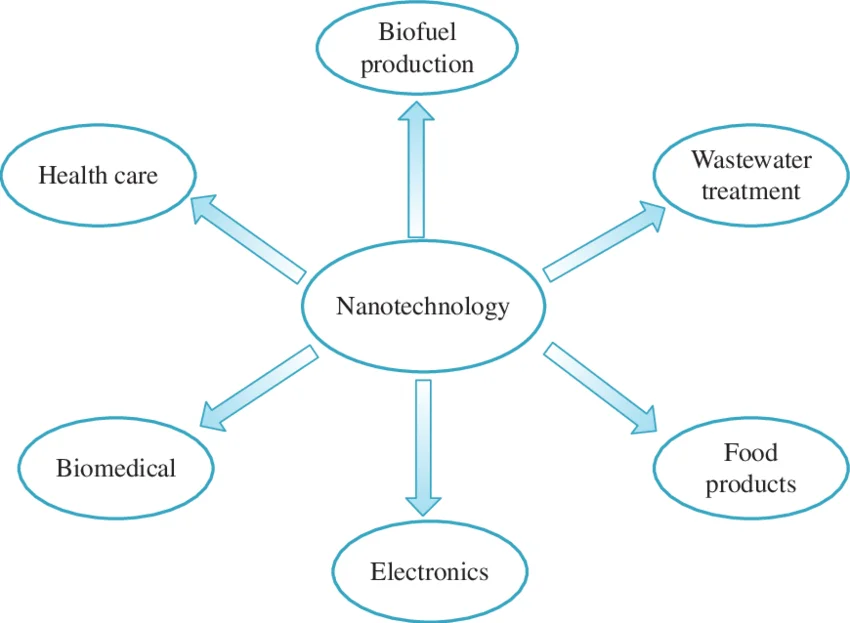
What are the Applications of Nanotechnology in Healthcare?
- Targeted Drug Delivery & Therapeutics: Nanoparticles, such as liposomes, polymers, and dendrimers, serve as targeted carriers or magic bullets to deliver drugs, genes, or diagnostics specifically to diseased cells like tumors, reducing systemic side effects and improving treatment efficacy.
- This targeted approach also enables drug delivery across difficult barriers, such as the Blood-Brain Barrier, for treating neurological disorders like Alzheimer's.
- Advanced Diagnostics & Imaging: Nanotechnology enables rapid, sensitive, and portable detection of pathogens, biomarkers, and glucose levels, which is crucial for early disease diagnosis and epidemic management. Furthermore, gold nanoparticles and quantum dots enhance the resolution and specificity of MRI, CT scan, and fluorescence imaging, allowing for more accurate disease detection.
- Regenerative Medicine & Tissue Engineering: Nanotechnology can provide the structural and biochemical cues needed to guide cell growth and tissue regeneration, aiding in the repair of bones, cartilage, nerves, and cardiac tissue. Additionally, nanoparticles can track, differentiate, and deliver therapeutic genes to stem cells, which enhances treatments for spinal cord injuries and degenerative diseases.
- Antimicrobial Applications: Coatings of silver, copper, or zinc oxide nanoparticles on medical devices (catheters, implants, surgical tools) and hospital surfaces prevent Healthcare-Associated Infections (HAIs).
- Vaccine Development & Immunotherapy: Nanoparticle-based vaccine platforms, such as those in mRNA vaccines, improve antigen stability, enable controlled release, and enhance the immune response. Additionally, nanoparticles can deliver immunomodulators to precisely activate T-cells against cancer cells, representing a key advancement in oncology.
What are the Main Obstacles for Adoption of Nanotechnology in Healthcare?
- Nanotoxicity: A major challenge is the unknown long-term effects due to insufficient data on nanoparticle bioaccumulation, biodegradability, and chronic toxicity in humans and ecosystems. Their environmental persistence risks creating lasting nanopollution in soil, water, and food chains.
- Regulatory and Standardization Challenges: Current regulations, such as those from the CDSCO, are ill-suited for the novel properties of nanomaterials, creating a regulatory gap. Additionally, the lack of universal standards for nomenclature, characterization, and safety testing results in inconsistency and hampers quality control.
- Ethical, Legal, and Social Implications (ELSI): Implantable nanosensors raise serious concerns about data privacy, security, and bodily autonomy, while also risking a nano-divide where advanced therapies are accessible only to the wealthy, worsening global health inequities.
- Furthermore, public trust is challenged by lack of awareness and fears, such as grey goo scenarios (uncontrolled self-replication), which can trigger resistance similar to that seen with Genetically Modified Organisms (GMOs).
- High Costs and Economic Viability: Nanotechnology research requires expensive, sophisticated instrumentation like electron microscopes, making fundamental work and prototyping costly. Scaling up nanomaterial production from the lab to industry while maintaining quality and cost is a major challenge, creating a persistent lab-to-market gap.
What Steps are Necessary to Ensure Sustainable and Safe Adoption of Nanotechnology in Healthcare?
- Research & Development: Establish mandatory, well-funded studies on nanomaterial bioaccumulation, degradation pathways, and chronic effects. Develop Green Nanotechnology for biodegradable, non-toxic nanomaterials using lipids and natural polymers with a safety by design principle.
- Ethical, Social & Economic Governance: Fund proactive ELSA research parallel to technical R&D to address privacy, autonomy, equity, and data ownership. Ensure equitable access via public-private partnerships to prevent a nano-divide and launch transparent public engagement to build trust.
- Clinical Translation & Commercialization: Bridge the Valley of Death with funding for translational research and develop scalable manufacturing for cost-effective, large-scale production. Foster interdisciplinary collaboration among material scientists, clinicians, and engineers to ensure clinically relevant and practical solutions.
- Environmental Stewardship: Mandate Environmental Impact Assessments for nanomaterial production and disposal, and develop specific safe disposal and recycling protocols. Establish environmental monitoring programs to track engineered nanoparticles in water, soil, and air.
Conclusion
Magnetic nanorobots mark a major advance in nanomedicine by enabling precise, minimally invasive therapies. However, clinical adoption depends on addressing nanotoxicity, regulatory, and ethical challenges through sustained R&D, ethical governance, equitable access, effective clinical translation, and strong environmental safeguards to ensure safe, affordable, and responsible healthcare deployment.
|
Drishti Mains Question: Nanotechnology holds immense promise for revolutionizing healthcare. Discuss its key applications and the major ethical and regulatory challenges hindering its widespread adoption in India. |
Frequently Asked Questions (FAQs)
Q. What are magnetic nanorobots?
Magnetic nanorobots are microscopic helix-shaped devices powered by external magnetic fields to deliver drugs precisely to target tissues like tumors.
Q. How do magnetic nanorobots navigate inside the human body?
They are propelled and steered by external magnetic fields, using a corkscrew-like helical structure that mimics bacterial motion to drill through tissues and fluids.
Q. What is meant by the 'nano-divide' in the context of healthcare?
It refers to the risk of inequitable access where advanced, expensive nanomedicine therapies are available only to wealthy individuals or nations, exacerbating global health disparities.
UPSC Civil Services Examination, Previous Year Question (PYQ)
Prelims
Q: Consider the following statements: (2022)
- Other than those made by humans, nanoparticles do not exist in nature.
- Nanoparticles of some metallic oxides are used in the manufacture of some cosmetics.
- Nanoparticles of some commercial products which enter the environment are unsafe for humans.
Which of the statements given above is/are correct?
(a) 1 only
(b) 3 only
(c) 1 and 2 only
(d) 2 and 3 only
Answer: (d)
Q: There is some concern regarding the nanoparticles of some chemical elements that are used by the industry in the manufacture of various products. Why? (2014)
- They can accumulate in the environment, and contaminate water and soil.
- They can enter the food chains.
- They can trigger the production of free radicals.
Select the correct answer using the code given below.
(a) 1 and 2 only
(b) 3 only
(c) 1 and 3 only
(d) 1, 2 and 3
Ans: (d)
Mains
Q. What do you understand by nanotechnology and how is it helping in the health sector? (2020)
Q. Why is nanotechnology one of the key technologies of the 21st century? Describe the salient features of Indian Government’s Mission on Nanoscience and Technology and the scope of its application in the development process of the country. (2016)