
Mission for Aatmanirbharta in Pulses | 09 Feb 2026
Why in the News?
The roadmap for the Self-Reliance (Aatmanirbharta) in Pulses Mission was finalised at the Food Legumes Research Centre (FLRP), Amlaha, Sehore district, Madhya Pradesh.
What is the Mission for Aatmanirbharta in Pulses?
- Mission for Aatmanirbharta in Pulses: Announced in the Union Budget 2025–26, the Mission for Aatmanirbharta in Pulses was launched in October 2025. It is a centrally sponsored scheme with an outlay of Rs 11,440 crore, aimed at achieving self-sufficiency in pulses over 2025–26 to 2030–31.
- Focus Crops: The mission places specific emphasis on Tur (Arhar), Urad, and Masoor, which are critical for daily consumption but currently face production gaps.
- Need:
- Nutritional Security: Pulses are a "nutritional powerhouse," contributing 20-25% of the total protein intake in Indian diets.
- However, per capita consumption falls short of the recommended 85 grams per day, exacerbating protein-energy malnutrition.
- Import Dependence: While domestic production rose by 31% (from 192.6 lakh tonnes in 2013-14 to 252.38 lakh tonnes in 2024-25), India still imported 47.38 lakh tonnes in 2023-24 to meet demand.
- Reducing imports is vital to conserve foreign exchange and protect farmers from international price volatility.
- Nutritional Security: Pulses are a "nutritional powerhouse," contributing 20-25% of the total protein intake in Indian diets.
- Key Objectives and Targets: The Mission aims to expand pulses cultivation by additional 35 lakh hectares, raising total area to 310 lakh hectares, and boosting production to 350 lakh tonnes by 2030–31.
- It focuses on reducing imports, improving yields, promoting climate-resilient practices, enhancing farmers’ incomes, and ensuring long-term nutritional security.
- Operational Strategy:
- SATHI Portal (Seed Authentication, Traceability & Holistic Inventory): A centralized portal developed by the Ministry of Agriculture and NIC to automate the entire seed life cycle.
- SATHI Portal ensures traceability from seed production to certification, licensing, and sale, guaranteeing farmers access to quality seeds.
- Assured Procurement: 100% procurement of Tur, Urad, and Masoor will be ensured in participating states for the next four years.
- Agencies like National Agricultural Cooperative Marketing Federation of India (NAFED) and the National Cooperative Consumers’ Federation (NCCF) will lead this under the Pradhan Mantri Annadata Aay Sanrakshan Abhiyan (PM-AASHA) (PM-AASHA) to guarantee fair prices and reduce market uncertainty.
- Cluster-Based Approach: Interventions will follow a cluster model to promote geographic diversification and efficient resource use.
- SATHI Portal (Seed Authentication, Traceability & Holistic Inventory): A centralized portal developed by the Ministry of Agriculture and NIC to automate the entire seed life cycle.
Key Highlights of the Roadmap for Mission for Aatmanirbharta in Pulses
- It aims to establish 1,000 pulse mills across the country (including 55 in MP) under a cluster model, with a government subsidy of Rs 25 lakh per unit to promote local value addition.
- Under the “seed to market” approach, seeds will no longer be released from Delhi but distributed directly in states.
- Farmers joining clusters will receive seed kits and Rs 10,000 assistance per hectare for model farming.
NITI Aayog Recommendations for Aatmanirbharta in Pulses
- One Block–One Seed Village: Recommended strengthening pulses seed systems through cluster-based seed hubs and Farmer-Producer Organizations (FPOs).
- Rice Fallows: Recommended utilizing fallow lands after rice harvest for pulses cultivation.
- Dietary Integration: Integrating pulses into welfare programs like PDS and Mid-Day Meals to boost demand and address malnutrition.
- Technology: Recommended promoting climate-resilient, short-duration varieties and using the SATHI Portal for data-driven monitoring.
What are the Key Facts About the Pulses?
- About: Pulses are edible seeds of leguminous plants, harvested solely for their dry grains, and belong to the Leguminosae (Fabaceae) family.
- Pulses are high in protein, fiber, and nutrients, low in fat, act as nitrogen-fixing crops that improve soil fertility, and have a long shelf life when dried.
- Climatic Conditions: Pulses require 20–27°C temperature, 25–60 cm rainfall, and sandy-loamy soil, and are cultivated year-round.
- Kharif : Arhar (Tur), Urd (Blackgram), Moong (Greengram), Lobia (Cowpea), Kulthi (Horsegram) and Moth.
- Rabi : Gram, Lentil, Pea, Lathyrus and Rajmash.
- Summer: Greengram, Blackgram and Cowpea.
- Global and National Position: India is the largest producer and consumer of pulses globally, contributing about 25% of world production.
- However, the share of pulses in India’s total food grain output has declined from 16% in 1950 to around 8% in 2022–23, reflecting a long-term cereal-centric policy bias.
- The major regions of Pulse cultivation are Madhya Pradesh, Maharashtra, Rajasthan, Uttar Pradesh, Gujarat, Karnataka, Jharkhand, Andhra Pradesh, Chhattisgarh, West Bengal.
- Studies project India's pulse demand at about 39 million tonnes by 2050, requiring an annual production growth of around 2.2% to bridge the gap.
- Agronomic and Environmental Benefits: Pulses improve soil fertility through nitrogen fixation, enhance soil biodiversity, and support intercropping systems, making them environmentally sustainable.
- They are considered a low-carbon crop, aligning with climate-resilient agriculture and the growing shift toward vegetarian and plant-based diets.
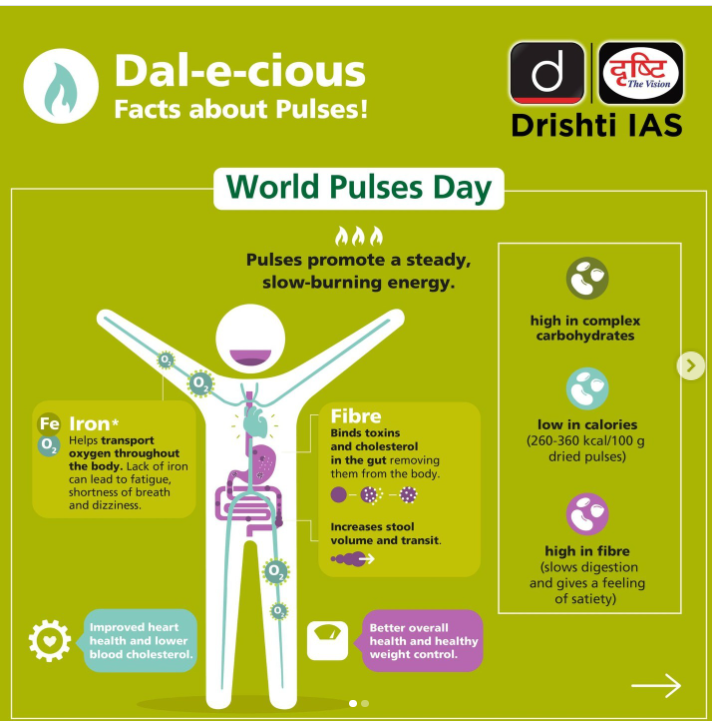
India’s Initiatives to Boost Pulses Production
Frequently Asked Questions (FAQs)
1. What is the Mission for Aatmanirbharta in Pulses?
It is a centrally sponsored scheme launched in October 2025 with an outlay of ₹11,440 crore to achieve self-sufficiency in pulses during 2025–26 to 2030–31.
2. Which pulses are prioritised under the mission?
Tur (Arhar), Urad, and Masoor are the focus crops due to persistent production gaps and high consumption demand.
3. What are the production targets under the mission?
Expansion of pulses area to 310 lakh hectares and production to 350 lakh tonnes by 2030–31.
4. What is the role of assured procurement in the mission?
100% procurement of Tur, Urad, and Masoor will be undertaken by NAFED and NCCF under PM-AASHA to ensure price stability.
UPSC Civil Services Examination, Previous Year Question (PYQ)
Prelims
Q. With reference to pulse production in India, consider the following statements: (2020)
- Black gram can be cultivated as both kharif and rabi crop.
- Green gram alone accounts for nearly half of pulse production.
- In the last three decades, while the production of kharif pulses has increased, the production of rabi pulses has decreased.
Which of the statements given above is/are correct?
(a) 1 only
(b) 2 and 3 only
(c) 2 only
(d) 1, 2 and 3
Ans: (a)