
Minimum Import Price on Penicillin G | 03 Feb 2026
Recently, the Union government has imposed a minimum import price (MIP) on key pharmaceutical inputs, Penicillin G and its salts, 6-APA, and amoxicillin to regulate imports.
- The move aims to curb low-cost imports, especially from China, which threaten the sustainability of domestic Active Pharmaceutical Ingredients (APIs) producers.
- China currently supplies around 70% of raw materials used by India’s pharmaceutical industry, valued at $10–12 billion, highlighting India’s import dependence.
- The MIP will remain in force for one year, but exemptions apply to 100% export-oriented units (EOUs), Special Economic Zone units, and imports under advance authorisation, provided inputs are not sold in the domestic tariff area.
- MIP is a government-mandated temporary floor price below which specific goods cannot be imported, aimed at protecting domestic industries from cheap, predatory or dumped imports.
- The measure builds on earlier steps such as the Production Linked Incentive (PLI) scheme and the November MIP on sulphadiazine, balancing domestic manufacturing support with affordability by restricting only imports for local consumption without affecting exports.
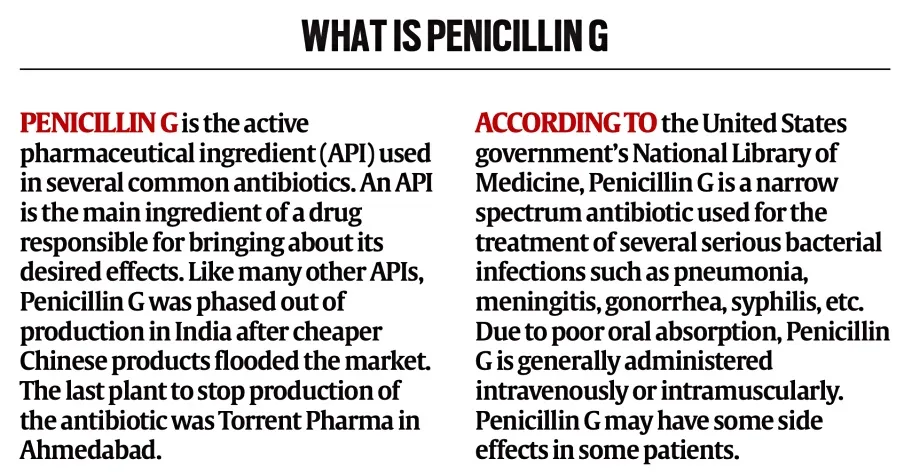
Penicillin G
- Benzylpenicillin (Penicillin G) is a narrow-spectrum antibiotic used to treat infections caused by sensitive bacteria.
- Due to poor oral absorption, it is given intravenously or intramuscularly, and in some cases is also used for preventive (prophylactic) treatment against susceptible organisms.
| Read more: Penicillin G and PLI Scheme |