
Maternal Healthcare in India | 14 Apr 2026
For Prelims: World Health Organization, Maternal Mortality Ratio, SDG Target 3.1, Health and Wellness Centers , Anemia
For Mains: Maternal Mortality and SDG 3.1 targets, Public health infrastructure and governance challenges, Role of social determinants in health outcomes
Why in News?
A study in The Lancet Obstetrics, Gynaecology & Women’s Health highlights that although India has reduced maternal mortality significantly since 1990, the progress has slowed after 2015, raising concerns over gaps in maternal healthcare and the need for a more comprehensive approach beyond mere access.
Summary
- Despite a significant decline in maternal mortality (MMR) in India, progress has slowed after 2015, with regional disparities and preventable causes still posing major challenges.
- Strengthening healthcare quality, infrastructure, midwifery, and addressing social determinants like anemia and early marriage is essential to achieve SDG target 3.1.
What are the Key Highlights of the Study on Maternal Healthcare?
- Pace of Progress and Persistent Burden: Despite maternal mortality dropping to a fifth of its 1990 levels, progress has worryingly slowed since 2015.
- India still accounts for one in 10 global maternal deaths, with preventable causes like haemorrhages, infections, and blood pressure-related disorders remaining the primary culprits.
- SDG Challenge and Regional Disparities: Meeting the Sustainable Development Goal (SDG) target 3.1 of reducing maternal mortality to 70 deaths per 1,00,000 live births by 2030 is hindered by severe regional imbalances.
- While states like Kerala, Maharashtra, and Tamil Nadu have achieved an MMR below 70, others, such as Assam (195), Madhya Pradesh (173), Uttar Pradesh (167), and Bihar (118), lag behind the national average, reflecting regional disparities in maternal healthcare.
- The Pandemic's Impact: Covid-19 exposed the system's fragility, diverting frontline workers and delaying essential antenatal visits and institutional deliveries.
- Strengthening Healthcare Infrastructure: The study emphasises the need for a decisive shift towards strengthening primary and secondary healthcare systems.
- It also highlights that expanding medical infrastructure alone will be insufficient unless the social determinants of health are adequately addressed.
Maternal Mortality
- Maternal Mortality: It is defined as the death of a woman while pregnant or within 42 days of termination of pregnancy, from any cause related to or aggravated by pregnancy or its management, excluding accidental or incidental causes. It is a key health indicator measuring risks associated with childbirth.
- Globally, in 2023, approximately 260,000 women died during or following pregnancy, equating to over 700 preventable maternal deaths every day (one death every two minutes).
- Maternal Mortality Ratio (MMR): It is the number of maternal deaths per 100,000 live births in a given time period.
- It is a key indicator used to assess the quality of maternal healthcare and access to medical services during pregnancy and childbirth.
- India’s MMR: India has made progress, with the MMR falling from 384 in 2000 to 103 in 2020, and further down to 80 in 2023, an 86% drop since 1990, surpassing the global average decline of 48%.
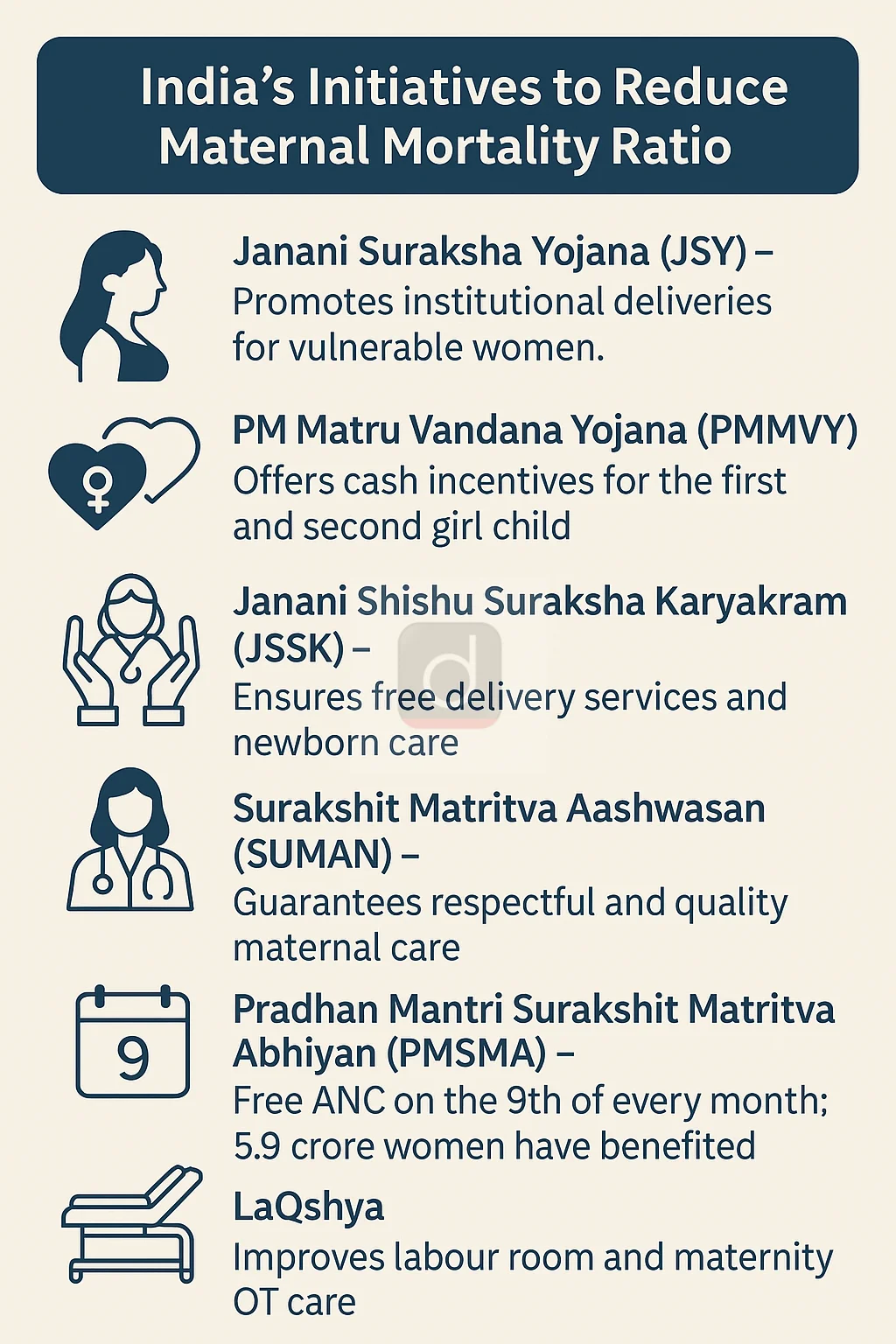
What are the Challenges Hindering Quality Maternal Healthcare in India?
- Human Resource Crisis in Rural India: According to the Rural Health Statistics (RHS) 2021-22, there is an alarming nearly 80% shortfall of specialized doctors (Surgeons, Obstetricians & Gynaecologists, Physicians, and Paediatricians) at Community Health Centres (CHCs).
- Underutilized Midwifery Cadre: Unlike Scandinavian countries or the UK, where midwives lead low-risk deliveries, India’s healthcare system remains highly doctor-centric.
- The Nurse Practitioner in Midwifery (NPM) initiative is still in its nascent stages, leaving existing nurses severely overburdened.
- Infrastructure and Supply Chain Deficits: Many designated First Referral Units (FRUs) lack 24x7 operational readiness for Emergency Obstetric Care (EmOC).
-
Postpartum Haemorrhage (severe bleeding) is the leading cause of maternal death in India. Yet, secondary care centers frequently lack functional, fully stocked blood
-
banks or even basic blood storage units, leading to fatal delays as patients are shuttled to tertiary urban hospitals.
-
Intermittent shortages of life-saving, low-cost drugs such as Magnesium Sulfate (for eclampsia/seizures) and Oxytocin (for bleeding) cripple frontline workers' ability to stabilize mothers.
-
-
Quality vs. Commercialization Divide: Quality care means appropriate care. According to the National Family Health Survey (NFHS-5), the rate of Caesarean sections in private health facilities in India stands at an alarming 47.4%, far exceeding the WHO’s recommended ideal rate of 10-15%.
-
This over-medicalization exposes women to unnecessary surgical risks, longer recovery times, and higher out-of-pocket expenditures.
-
-
Ignoring the Social Determinants of Health: Clinical quality cannot completely offset the deep socio-economic inequalities that women face before they even become pregnant.
-
According to NFHS-5, a staggering 57% of women (aged 15-49) in India are anemic. Driven by patriarchal household dynamics where women often "eat last and least," chronic malnourishment means minor obstetric bleeding can easily turn fatal.
-
Despite legal frameworks, 23.3% of women aged 20-24 years were married before the age of 18 (NFHS-5). Teenage bodies are biologically less prepared for childbirth, leading to a higher incidence of cephalopelvic disproportion and prolonged labor.
-
What Measures can Strengthen Maternal Healthcare?
- Adopting Respectful Maternity Care (RMC): Moving beyond clinical outcomes to prioritize the dignity of the mother. This includes training healthcare staff in "soft skills" to eliminate obstetric violence, ensuring privacy during labor, and allowing a "birth companion" of the woman's choice, which is proven to reduce stress and complications.
- Midwifery-Led Care Units (MLCUs): Establishing a dedicated cadre of Nurse Practitioners in Midwifery (NPM). Midwives can handle low-risk natural births, which decongests tertiary hospitals and reduces the "epidemic" of unnecessary C-sections.
- Blood Storage and Transport: Expanding the "Hub and Spoke" model for blood banks.
- Every high-delivery-load facility must have a functional blood storage unit to treat Postpartum Hemorrhage (PPH) within the "golden hour."
- Digital Tracking: Leveraging the Pradhan Mantri Surakshit Matritva Abhiyan portals to identify "High-Risk Pregnancies" (e.g., severe anemia or hypertension) early and ensuring they are referred to specialists long before labor begins.
- Combatting Maternal Anemia: Strengthening the Anemia Mukt Bharat strategy through mandatory iron-folic acid (IFA) supplementation and, more importantly, community-level nutritional counseling to change the "women eat last" household dynamic.
- Empowering ASHA and Anganwadi Workers: Providing these frontline workers with better diagnostic tools (like digital hemoglobinometers) and higher incentives for tracking postpartum care, not just the delivery itself.
- Conclusion
- India has made strong progress in maternal healthcare, but the final stretch remains challenging. Achieving SDG 3.1 will require shifting focus from infrastructure to quality, equitable care, along with improving women’s social and nutritional status.
|
Drishti Mains Question: Q. “India has improved maternal health outcomes, yet structural and social challenges persist.” Critically examine |
Frequently Asked Questions (FAQs)
1. What is Maternal Mortality?
Death of a woman during pregnancy or within 42 days of termination due to pregnancy-related causes; a key public health indicator.
2. What is Maternal Mortality Ratio (MMR)?
Maternal Mortality Ratio (MMR) is the number of maternal deaths per 100,000 live births; it reflects the quality of maternal healthcare.
3. What is the SDG target for maternal health?
Sustainable Development Goal (SDG) 3.1 aims to reduce global MMR to below 70 per 100,000 live births by 2030.
4. What are the major causes of maternal deaths in India?
Haemorrhage, infections, and hypertensive disorders are the leading preventable causes.
5. What is Respectful Maternity Care (RMC)?
Respectful Maternity Care (RMC) ensures dignity, privacy, informed consent, and emotional support for women during childbirth.
UPSC Civil Services Examination, Previous Year Question (PYQ)
Mains
Q. In order to enhance the prospects of social development, sound and adequate health care policies are needed particularly in the fields of geriatric and maternal health care. Discuss. (2020)