
Loggerhead Turtle | 19 Feb 2026
A study has revealed that climate change is undermining the reproductive capacity and physical structure of loggerhead sea turtles threatening their long-term survival.
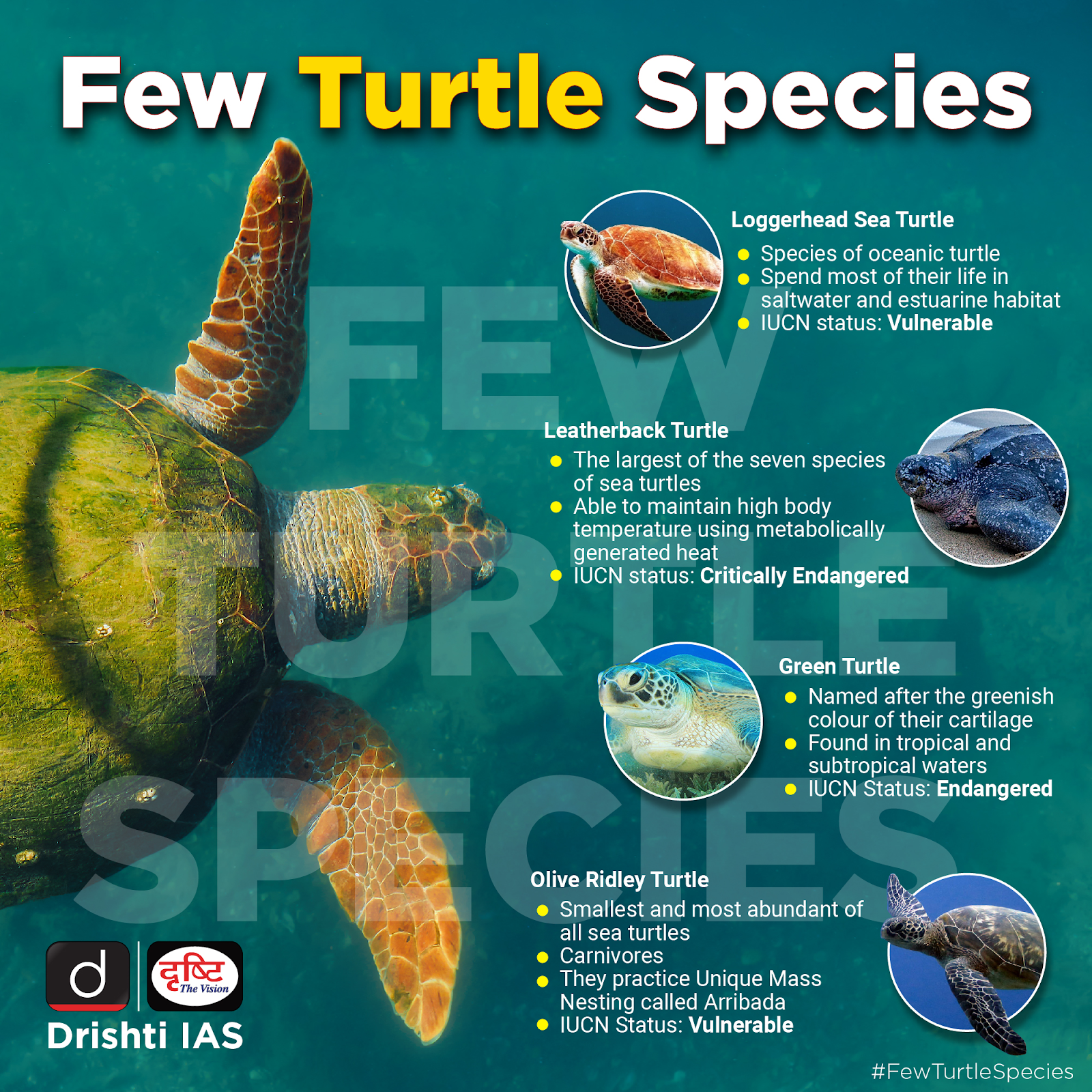
- About: The Loggerhead sea turtle (Caretta caretta) is a large omnivorous marine reptile recognized as one of the seven extant species of sea turtles.
- It is named for its distinctive large, block-like head, which supports powerful jaw muscles capable of crushing hard-shelled prey.
- Global Distribution: The loggerhead turtle is found across the Atlantic Ocean, Pacific Ocean, and Indian Ocean, as well as the Mediterranean Sea, with ten recognized subpopulations.
- Threats: Due to warming oceans and dwindling marine food supplies, female loggerheads are now breeding less frequently—shifting from every two years to a four-year gap—and producing fewer eggs per nest.
- As "capital breeders," these turtles rely on stored energy from foraging over several years to reproduce. Both males and females undertake breeding migrations spanning hundreds to thousands of kilometres between feeding grounds and nesting beaches. Satellite data shows a decline in ocean chlorophyll, indicating a reduction in food supply that is eroding their energy reserves.
- Conservation Status: The species is assessed as 'Vulnerable' by the IUCN. It was included in Appendix II of the Convention on the Conservation of Migratory Species of Wild Animals (CMS) in 1979 and upgraded to Appendix I in 1985. In India, it is protected under Schedule I of the Wildlife Protection Act, 1972.
- International Cooperation Mechanisms: The loggerhead is covered by multiple CMS instruments, including Memorandums of Understanding (MOUs) for the Atlantic Coast of Africa and the Indian Ocean-SouthEast Asia regions, and a Single Species Action Plan for the South Pacific Ocean.
| Read More: World Turtle Day 2025 |