
Left Wing Extremism-Free India | 03 Apr 2026
For Prelims: Left Wing Extremism (LWE), National Investigation Agency, Dharti Aaba Janjatiya Gram Utkarsh Abhiyan
For Mains: Left Wing Extremism (LWE) in India: causes, spread, and decline, Role of security vs development approach in internal security, SAMADHAN doctrine and counter-insurgency strategies
Why in News?
The Union Home Minister stated that Maoists have been “more or less wiped out” from the Bastar region of Chhattisgarh, historically the strongest bastion of Left Wing Extremism (LWE) in India.
- Declaring that the country has become “Naxal-free”, he highlighted that this progress aligns with the Government of India’s target to completely eliminate LWE by March 2026.
Summary
- India has become “Naxal-free” through a combination of security operations, development initiatives, and strategic policies like the SAMADHAN doctrine.
- However, ensuring lasting peace requires addressing root causes such as tribal rights, governance gaps, and economic inclusion to prevent resurgence.
What is India’s Strategy to Eliminate Left Wing Extremism?
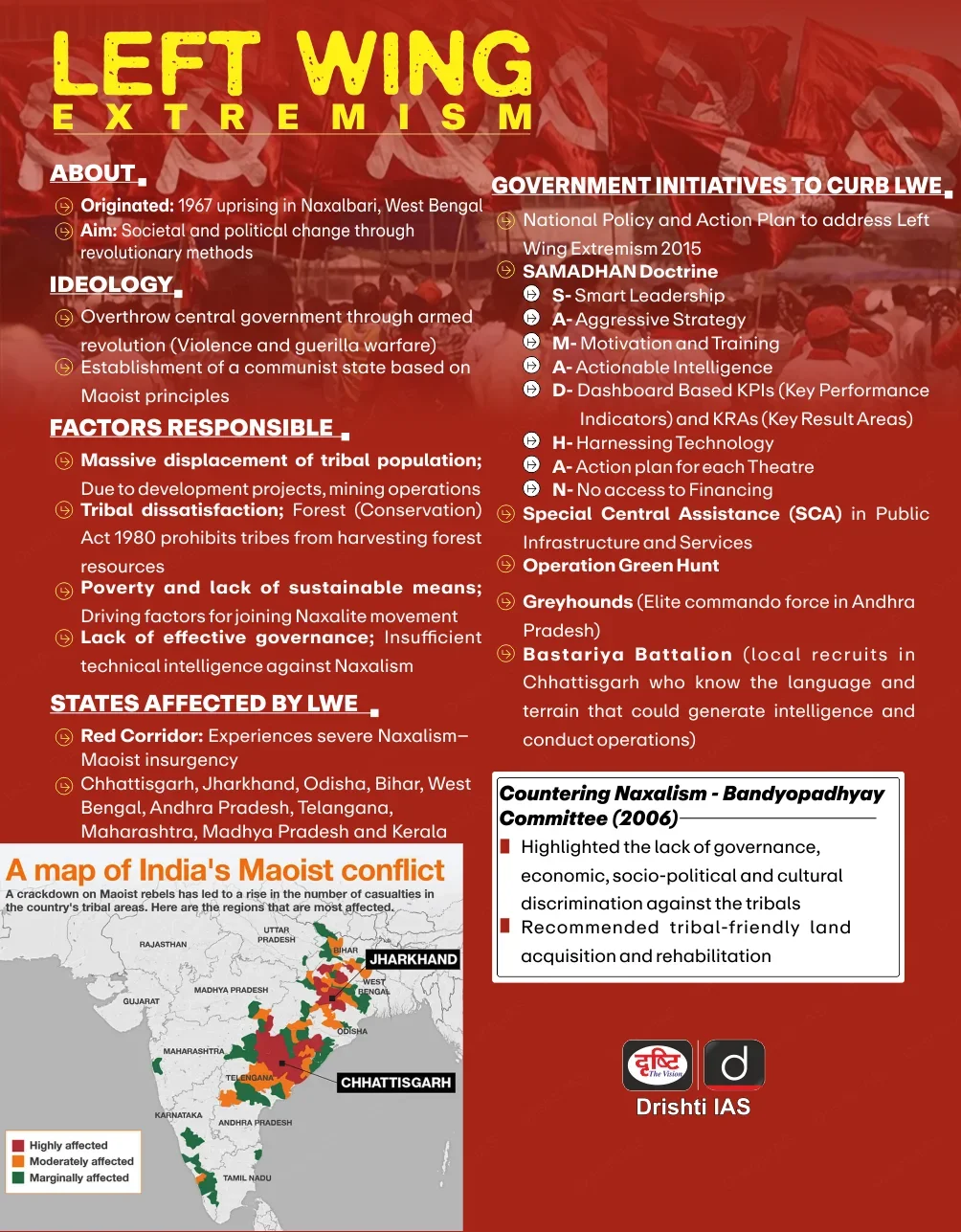
- Policy Framework: Recognizing that insurgency cannot be defeated by military force alone, India transitioned to a holistic, multi-pronged approach codified in the National Policy and Action Plan (2015).
- The overarching goal of this strategy is to achieve a Naxal-free Bharat and transform erstwhile "Red Zones" into "Growth Corridors" by March 2026.
- To achieve this, the government employs a synchronized, three-pillar strategy based on the globally recognized "Clear, Hold, and Build” counter-insurgency doctrine.
- Security Measures: The foremost priority is to re-establish the state's territorial supremacy by neutralizing armed insurgents and destroying their safe havens.
- SAMADHAN Doctrine: Launched in 2017, this is the operational blueprint for security forces.
- SAMADHAN stands for Smart leadership, Aggressive strategy, Motivation and training, Actionable intelligence, Dashboard-based KPIs, Harnessing technology, Action plan for each theater, and No access to financing.
- Intelligence-Led Offensives: Executing massive, targeted kinetic operations using specialized jungle warfare units like CoBRA (CRPF), Greyhounds (Andhra/Telangana), and the District Reserve Guard (DRG).
- Security forces have achieved significant success in countering Left-Wing Extremism through major operations such as Operation Octopus, Operation Double Bull, and Operation Chakrabandha in 2022. Most recently, Operation Kagar (2025) in Chhattisgarh has further strengthened efforts to curb the insurgency.
- Forward Operating Bases (FOBs): Shifting from defensive containment to an offensive posture by establishing heavily fortified police camps deep inside unmapped Maoist strongholds (e.g., Abujhmad).
- This permanently chokes insurgent supply lines and prevents them from regrouping.
- Choking Terror Finance: Utilizing the National Investigation Agency (NIA) and the Enforcement Directorate (ED) to track, freeze, and dismantle the complex extortion (levy) networks that fund the Maoist ecosystem.
- SAMADHAN Doctrine: Launched in 2017, this is the operational blueprint for security forces.
- Accelerated Development (Build): Extremism breeds in geographical isolation and extreme poverty. The state counters this by executing a massive infrastructure push to break the isolation and fill the governance vacuum.
- Physical Connectivity: Implementation of the Road Connectivity Project for LWE Affected Areas (RCPLWEA) to build all-weather roads through dense forests, enabling both rapid troop movement and local economic access to mainland markets.
- Digital Connectivity: Rapid installation of thousands of mobile towers to ensure 100% 4G saturation in LWE districts, breaking the communication blackout and integrating locals into the digital economy.
- Human Capital & Financial Inclusion: Establishing Eklavya Model Residential Schools (EMRS) and ITIs to provide quality education and vocational training, shielding tribal youth from radicalization.
- Concurrently, expanding bank branches and post offices helps bypass the cash-based extortion economy.
- Targeted Village Welfare: Executing saturation campaigns like the Dharti Aaba Janjatiya Gram Utkarsh Abhiyan to ensure basic personal amenities reach the most remote tribal villages.
Maoism
- Maoism is a revolutionary form of communism developed by Mao Tse Tung that advocates for the capture of state power through a "Protracted People’s War."
- This ideology prioritizes a "military line," utilizing armed insurgency, mass mobilization, and strategic alliances to overthrow established institutions.
- In India, this manifested as Naxalism (or Left-Wing Extremism), originating from the 1967 Naxalbari uprising in West Bengal.
- The largest and the most violent Maoist formation in India is the Communist Party of India (Maoist) formed in 2004, which along with its various front organizations is banned under the Unlawful Activities (Prevention) Act (UAPA), 1967.
- These groups often use propaganda and misinformation to erode the credibility of state institutions while operating through off-shoots to evade legal liability for their violent insurrection.
What are the Challenges that Remain after the Elimination of Left Wing Extremism in India?
- Security Vacuum & "Vacuum Effect": As Central Armed Police Forces (CAPFs) begin their phased withdrawal, a localized power vacuum is created.
- If state police forces are not sufficiently "augmented" in terms of numbers and training, splinter groups or criminal syndicates often fill this void.
- Transformation into Organized Crime: The Maoists have historically controlled a multi-crore extortion economy involving mining, tendu leaf trade, and infrastructure projects.
- Deprived of ideological leadership, surviving lower-level cadres may transition into armed "mafia" groups to maintain control over these illicit revenue streams.
- "Absentee Administration" Syndrome: The state has built the "hardware" (schools, hospitals, administrative blocks), but the "software" (service delivery) remains weak.
- Ensuring that doctors, teachers, and bureaucrats are physically present and motivated to work in these remote, erstwhile "Red Zones" remains a massive logistical and motivational hurdle.
- Tackling 'Urban Naxalism' and Frontal Organizations: While the "Jungle Squads" (Dalam) may be neutralized, the intellectual and financial "overground" networks in urban centers continue to exploit localized grievances (labor strikes, land acquisition) to keep the Maoist ideology alive.
- Neutralizing this network without infringing on civil liberties is a delicate legal and intelligence challenge.
- Threat of Tactical Counter Offensive Campaigns (TCOC): Historically, desperate and cornered Maoist cadres launch TCOCs during the summer months to inflict heavy casualties on security forces. Tactical alertness remains paramount.
What Measures can Ensure Sustainable Peace and Development in Erstwhile LWE Zones?
- Strengthening State Police (The Hub-and-Spoke Model): The reliance on CAPFs must be replaced by a robust State Police presence.
- This includes the "Police-Station-as-a-Growth-Center" model, where the local police station acts as a facilitator for grievance redressal and welfare delivery, not just an enforcement unit.
- Civic Action Programmes (CAP) should be institutionalized into permanent community-police partnerships to maintain the "Hearts and Minds" (WHAM) advantage.
- Strict Enforcement of PESA and FRA: To prevent the resurgence of grievances, the state must ensure the Forest Rights Act (FRA, 2006) and the PESA Act (1996) are implemented in letter and spirit.
- Empowering the Gram Sabha over "Jal, Jangal, Zameen" is the most potent antidote to Maoist ideology.
- Tribal-Sensitive Development: As mining and industrial projects surge in these mineral-rich areas, the state must adopt a "Tribal-First" development model.
- Ensuring that the District Mineral Foundation (DMF) funds are spent transparently on the direct welfare of the affected tribal families is non-negotiable.
Conclusion
India appears closer than ever to eliminating Naxalism through a mix of security operations and development initiatives, lasting peace will depend on addressing the root socio-economic causes. The transition from a security-driven approach to trust-based governance will be crucial to ensure that Left Wing Extremism does not re-emerge in the future.
|
Drishti Mains Question: Discuss the relevance of the “Clear, Hold, Build” doctrine in India’s counter-insurgency strategy. |
Frequently Asked Questions (FAQs)
1. What is Left Wing Extremism (LWE) in India?
It is a Maoist insurgency aimed at overthrowing the state through armed struggle, rooted in issues like tribal marginalisation and underdevelopment.
2. What is the SAMADHAN doctrine?
It is a counter-insurgency strategy focusing on intelligence-led operations, technology use, and financial disruption of Maoist networks.
3. Which law bans Maoist organisations in India?
The Unlawful Activities (Prevention) Act (UAPA), 1967 bans CPI (Maoist) and its affiliated organisations.
4. What are the key challenges after eliminating LWE?
Challenges include security vacuum, rise of organized crime, weak governance, and urban Maoist networks.
5. How can sustainable peace be ensured in LWE areas?
Through strong state policing, effective implementation of PESA & FRA, and tribal-centric inclusive development.
UPSC Civil Services Examination, Previous Year Question (PYQ)
Mains
Q. What are the determinants of left-wing extremism in the Eastern part of India? What Strategy should the Government of India, civil administration and security forces adopt to counter the threat in the affected areas? (2020)
Q. The persisting drives of the government for development of large industries in backward areas have resulted in isolating the tribal population and the farmers who face multiple displacements. With Malkangiri and Naxalbari foci, discuss the corrective strategies needed to win the Left Wing Extremism (LWE) doctrine that affected citizens back into the mainstream of social and economic growth. (2015)