
International Criminal Court | 21 Feb 2026
Former Philippine President Rodrigo Duterte will face a pre-trial hearing at the International Criminal Court over alleged crimes against humanity related to his anti-drug campaign, in which the number of killings is believed to run into the thousands.
International Criminal Court
- About: ICC is the world's first permanent international tribunal, established to prosecute individuals for the most serious crimes of international concern, operating on the principle of complementarity to national judicial systems.
- The Principle of Complementarity establishes ICC as a court of last resort, which can only step in when national authorities are genuinely unwilling or unable to carry out proceedings.
- It does not serve as an appellate body to review or overturn decisions made by domestic courts.
- Legal Basis & Establishment: Established by the Rome Statute, adopted on 17th July 1998 and entered into force on 1st July 2002. Headquartered in The Hague, Netherlands.
- Jurisdiction & Core Crimes: Prosecutes individuals, not states, for four core crimes i.e., Genocide, Crimes against Humanity, War Crimes, and the Crime of Aggression (jurisdiction for aggression activated in 2018). It has jurisdiction over crimes committed after 1st July 2002 (Rome Statute entered into force).
- Triggering Jurisdiction: Territory or national of a State Party.
- UN Security Council (UNSC) referral, even for non-member states.
- Proprio motu (on its own) investigation by the Prosecutor, authorized by the Pre-Trial Chamber.
- Membership and India's Stand: 125 countries (as of February 2026) are States Parties to the Rome Statute of the ICC. India, USA, China, and Israel are non-parties.
- India has objected due to concerns over national sovereignty and the UNSC's referral powers, which it views as politically motivated.
- Structure: Four main organs are the Presidency, Judicial Divisions, Office of the Prosecutor, and Registry.
- The Assembly of States Parties (ASP) provides legislative and management oversight.
- Enforcement: Lacks its own police force; relies on voluntary cooperation of member states for arrest, surrender of suspects, and enforcing sentences.
- Distinction from ICJ: The ICC prosecutes individuals for criminal acts, whereas the International Court of Justice (ICJ) resolves disputes between states.
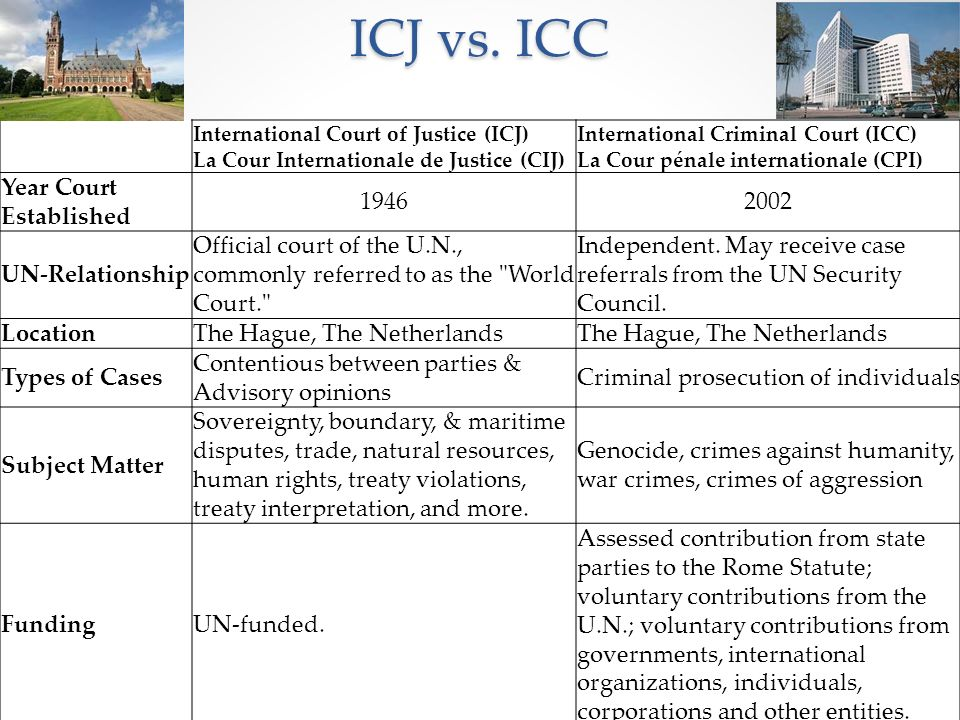
| Read More: USA Sanctions Against the International Criminal Court |