
India’s Fisheries Sector | 10 Apr 2026
Why in News?
India has emerged as the world’s 2nd-largest fish-producing nation (after China), accounting for approximately 8% of global output and establishing the fisheries sector as the fastest-growing segment within agriculture and allied activities.
What are the Key Facts Regarding India's Fisheries Sector?
- Economic Contribution: Fisheries account for 7.43% of Agricultural Gross Value Added (GVA), with total production doubling to 197.75 lakh tonnes in FY 2024–25.
- Export Performance: Seafood exports reached Rs 62,408 crore in FY 2024–25, dominated by frozen shrimp, with the US and China as primary markets.
- Budgetary Support: The Union Budget 2026–27 allocated a record Rs 2,761 crore to the sector, with Rs 2,500 crore specifically earmarked for the Pradhan Mantri Matsya Sampada Yojana (PMMSY).
- Infrastructure & Credit: The Fisheries and Aquaculture Infrastructure Development Fund (FIDF) and the extension of Kisan Credit Cards (KCC)—with limits raised to Rs 5 lakh—have institutionalized credit and boosted processing capabilities.
- Technological Shift: Rapid adoption of high-efficiency models like Recirculatory Aquaculture Systems (RAS) and Bio-floc technology is driving sustainable, high-density farming.
- RAS is a high-density fish farming technology that uses a closed-loop filtration system to treat and continuously reuse water, minimizing environmental impact and land requirements.
- Bio-floc Technology is a sustainable aquaculture method where a carbon source is added to the water to grow beneficial microbial protein (floc), which simultaneously treats waste and serves as a direct food source for the fish.
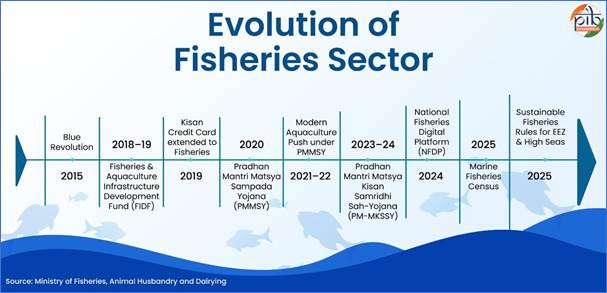
- Digital Governance: The National Fisheries Digital Platform (NFDP), launched in 2024, provides digital identities to over 30 lakh stakeholders, streamlining access to insurance and subsidies.
- Formalization: The Pradhan Mantri Matsya Kisan Samridhi Sah-Yojana (PM-MKSSY), with an outlay of Rs 6,000 crore, focuses on formalizing the unorganized fisheries value chain and enhancing traceability.
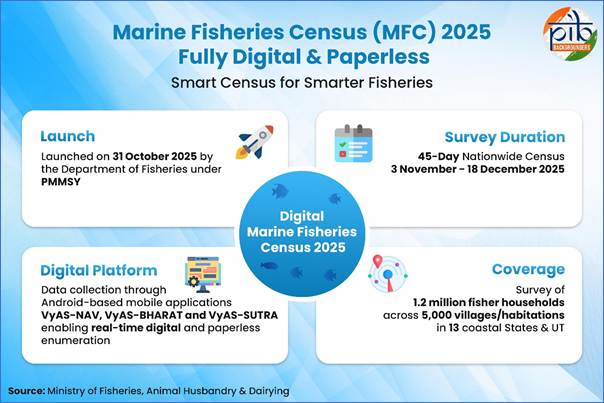
- Resource Management: The Marine Fisheries Census 2025 and new rules for the Exclusive Economic Zone (EEZ) ensure data-driven governance and alignment with Sustainable Development Goal 14 (Life Below Water).
- Inland Potential: Integration of 500 reservoirs and 1,222 Amrit Sarovars into the fisheries value chain is targeting rural livelihood diversification.
- Fisheries-related schemes since 2014–15 have generated an estimated 74.66 lakh direct and indirect employment opportunities.
- Regulatory Framework: The 2025 Rules for Sustainable Harnessing of Fisheries in the EEZ and High Seas ensure international compliance and long-term resource security for India's 24 lakh sq. km EEZ.
What is Pradhan Mantri Matsya Sampada Yojana?
- About: PMMSY is a flagship scheme launched in September 2020 to bring about a "Blue Revolution" through the sustainable and responsible development of the fisheries sector in India.
- It is implemented by the Department of Fisheries (Ministry of Fisheries, Animal Husbandry, and Dairying) and was originally designed for a five-year period (FY 2020-21 to FY 2024-25). It is extended up to 2025-26.
- The government has further introduced the Pradhan Mantri Matsya Kisan Samridhi Sah-Yojana (PMMKSSY). This is a sub-scheme of PMMSY focused specifically on formalizing the unorganized fisheries sector and supporting micro-enterprises with an additional investment of over Rs. 6,000 crore.
- It is being implemented for 4 years from FY 2023-24 to FY 2026-27 across all the States and UTs.
- Financial Allocation: PMMSY has a total estimated investment of Rs 20,050 crore. It operates as an umbrella scheme with two main components:
- Central Sector Scheme (CS): Fully funded by the Central Government.
- Centrally Sponsored Scheme (CSS): Jointly funded by the Centre and States/UTs, further divided into beneficiary-oriented and non-beneficiary-oriented activities.
- General Category: 40% subsidy for individuals/groups.
- SC/ST/Women Category: 60% subsidy to encourage inclusive growth.
- Core Components: The PMMSY focuses on several "activity clusters" to modernize the sector:
- Inland & Marine Fisheries: Promoting cage culture, seaweed farming, and ornamental fisheries.
- Technology Infusion: Support for modern systems like RAS and Bio-floc technology.
- Infrastructure: Building "Fishing Harbours," "Landing Centers," and "Cold Chain" facilities to improve market links.
- Fisher Welfare: Providing insurance coverage for fishing vessels and fishers, as well as support during "lean periods" (fishing bans).
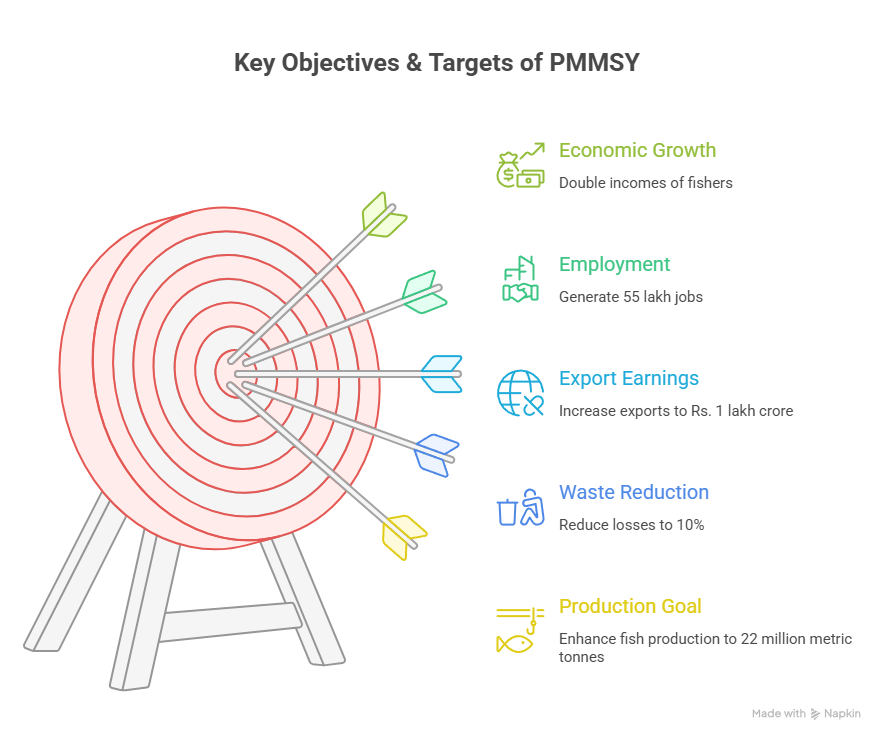
- Key Objectives & Targets:
Frequently Asked Questions (FAQs)
1. What is the significance of the fisheries sector to India's Agricultural GVA?
Fisheries contribute 7.43% to the Agricultural GVA, making it the fastest-growing allied sector and a critical pillar for rural employment and nutritional security.
2. How do RAS and Bio-floc technologies support sustainable aquaculture?
RAS conserves water through closed-loop filtration, while Bio-floc converts organic waste into nutrient-rich feed; both enable high-density farming with minimal environmental footprints.
3. What is the primary focus of the PM-MKSSY sub-scheme?
It is a Central Sector sub-scheme aimed at formalizing the unorganized fisheries sector, enhancing traceability, and supporting micro-enterprises through a ₹6,000 crore outlay.
UPSC Civil Services Examination Previous Year Question (PYQ)
Q. Under the Kisan Credit Card scheme, short-term credit support is given to farmers for which of the following purposes? (2020)
- Working capital for maintenance of farm assets
- Purchase of combine harvesters, tractors and mini trucks
- Consumption requirements of farm households
- Post-harvest expenses
- Construction of family house and setting up of village cold storage facility
Select the correct answer using the code given below:
(a) 1, 2 and 5 only
(b) 1, 3 and 4 only
(c) 2, 3, 4 and 5 only
(d) 1, 2, 3, 4 and 5
Ans: (b)