
India’s 1,000-km Quantum Communication Breakthrough | 13 Apr 2026
Why in News?
India, under the National Quantum Mission, has developed a 1,000 km quantum communication network within less than two years of its launch, ahead of its target of 2,000 km in eight years. The network was developed using indigenous technology by QNu Labs, with support from the Department of Science and Technology.
What is the Significance of the 1,000-km Quantum Communication Network?
- Enhanced Security: Built using Quantum Key Distribution (QKD), the network represents one of the longest QKD deployments globally since the mission’s inception.
- The development is poised to strengthen secure communication capabilities across highly sensitive sectors, including defence, financial systems, and critical national infrastructure.
- Terrain Versatility: The deployed technology is designed to operate seamlessly across challenging terrains, making it viable for complex underwater and underground networks.
- Strategic Expansion: It actively advances India’s broader push toward a highly secure digital ecosystem with expansive civilian and strategic applications.
Quantum Key Distribution (QKD) Network
- QKD is a highly secure way to share secret encryption keys between two users using quantum particles (photons). It ensures that communication remains safe from hacking.
- If anyone tries to intercept the key, the quantum particles get disturbed (due to the observer effect and no-cloning rule), which immediately alerts the users about the intrusion.
What is the National Quantum Mission (NQM)?
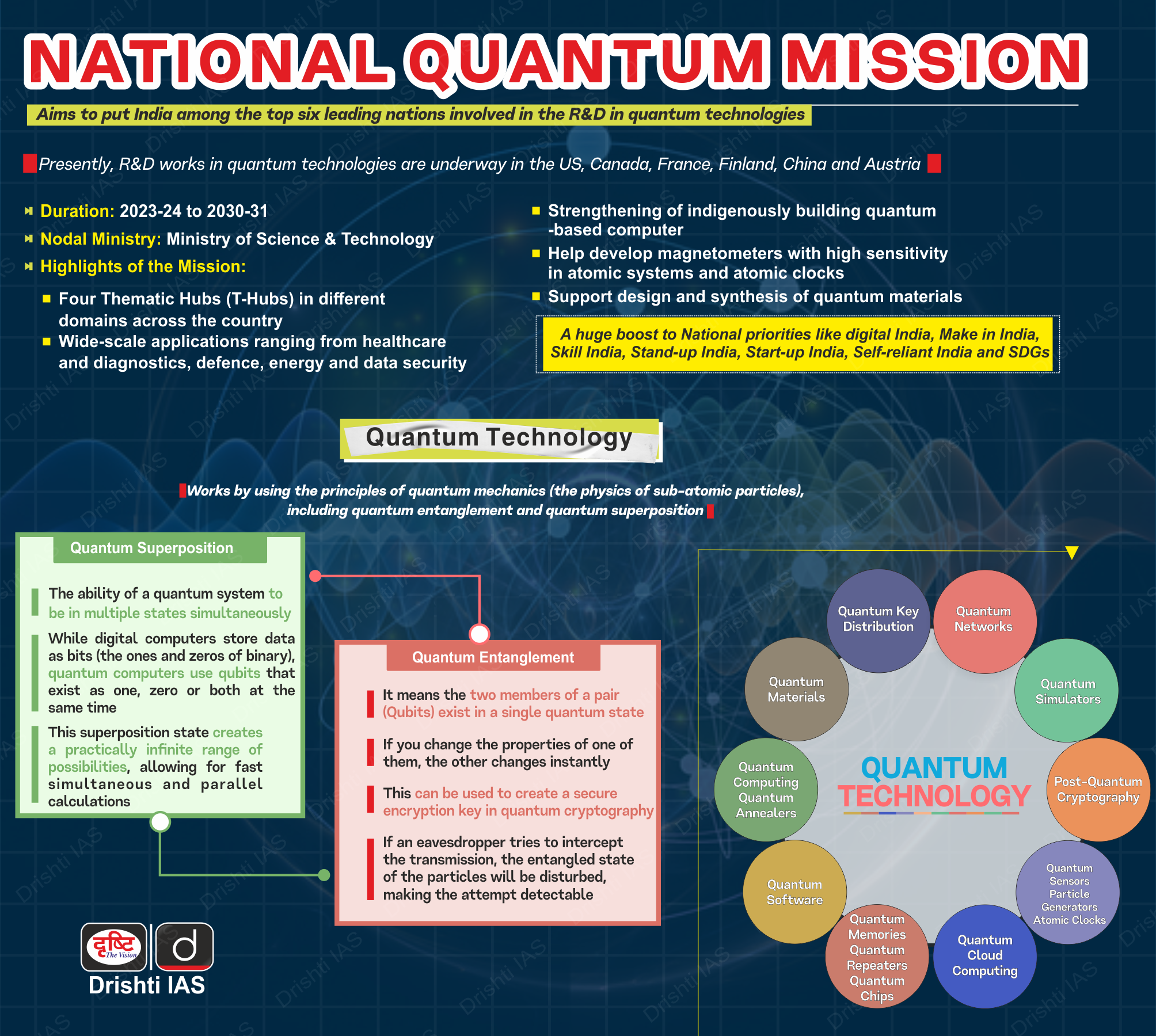
- About: The National Quantum Mission (NQM) was approved by the Union Cabinet in April 2023 and launched in October 2024 to position India as a global leader in quantum science and technology. The mission aims to seed, nurture, and scale up scientific and industrial R&D in quantum technologies.
- Implemented by the Department of Science and Technology (DST), the mission has a total budget outlay of Rs 6,003 crore for a period of eight years (2023-24 to 2030-31).
- Key Objectives and Targets
- Quantum Computing: Developing intermediate-scale quantum computers with 50 to 1,000 physical qubits using various platforms like superconducting and photonic technology.
- Quantum Communication: Establishing satellite-based secure quantum communications between ground stations over a range of 2,000 kilometres within India, as well as with other countries.
- Developing inter-city Quantum Key Distribution (QKD) networks over 2,000 km using existing optical fibres.
- Quantum Sensing and Metrology: Developing highly sensitive magnetometers and atomic clocks for precision timing, communication, and navigation (crucial for GPS, defence, and aviation).
- Quantum Materials and Devices: Supporting the design and synthesis of advanced quantum materials, such as superconductors, novel semiconductors, and topological materials, for the fabrication of quantum devices.
- Institutional Framework: To build research infrastructure and execute these goals, the mission has established four dedicated Thematic Hubs (T-Hubs) in top academic institutions:
- Support for Startups and Deep-Tech: The NQM actively funds and incubates deep-tech startups working on quantum-safe cybersecurity, biosensors, photon sensing, and atomic memory.
- Currently, the mission supports 17 deep-tech ventures (including companies like QNu Labs, which helped achieve the 1,000-km communication milestone).
- The government is utilizing new financial instruments like Optionally Convertible Debt (OCD). This supports startups with capital without forcing immediate equity dilution, helping attract private investment alongside public funds.
- Strategic Significance of Quantum Technology:
- Global Standing: Currently, only a handful of nations (like the US, China, Canada, Austria, Finland, and France) are aggressively developing quantum tech.
- The NQM aims to give India a "quantum jump" to catch up and compete with these countries.
- National Security: Quantum tech, especially Quantum Key Distribution (QKD), provides virtually unhackable communication, which is vital for defence, financial systems, and critical national infrastructure.
- Economic Growth: It supports the "Aatmanirbhar Bharat" (Self-Reliant India) initiative by reducing reliance on imported technologies and patents, fostering home-grown innovation in critical future technologies.
- Global Standing: Currently, only a handful of nations (like the US, China, Canada, Austria, Finland, and France) are aggressively developing quantum tech.
Frequently Asked Questions (FAQs)
1. What is the National Quantum Mission (NQM)?
It is a government initiative (2023) to develop quantum technologies with a budget of ₹6,003 crore over 8 years.
2. What is Quantum Key Distribution (QKD)?
It is a secure communication method using quantum mechanics, enabling virtually unhackable data transmission.
3. What is the significance of the 1,000-km quantum network?
It enhances secure communication in defence, finance, and critical infrastructure while showcasing indigenous capability.
4. What are the key objectives of NQM?
Developing quantum computers, secure communication networks, quantum sensors, and advanced quantum materials.
5. How does NQM support startups?
It funds deep-tech ventures and uses instruments like Optionally Convertible Debt to promote innovation and investment.
UPSC Civil Services Examination Previous Year Question (PYQ)
Prelims
Q. Which one of the following is the context in which the term "qubit" is mentioned?
(a) Cloud Services
(b) Quantum Computing
(c) Visible Light Communication Technologies
(d) Wireless Communication Technologies
Ans: (b)
Mains
Q. “The emergence of the Fourth Industrial Revolution (Digital Revolution) has initiated e-Governance as an integral part of government”. Discuss. (2020)