
India Submits 7th National Report to the CBD | 07 Mar 2026
Why in News?
India has submitted its 7th National Report to the Convention on Biological Diversity (CBD), providing a comprehensive assessment of the country's progress toward the 23 national biodiversity targets (NBT) and 142 indicators aligned with the Kunming-Montreal Global Biodiversity Framework (KMGBF).
- Of the 23 national biodiversity targets, only two are on track. The report outlines policies for the rest, but lacks quantitative evidence or clear projections for 2030.
What are the Key Facts Regarding the 7th National Report to the Convention on Biological Diversity?
- About: This is India's first full progress assessment since the adoption of the KMGBF in 2022, serving as a crucial "reality check" on the nation's commitment to halting biodiversity loss by 2030.
- Preparation and Scope: Prepared by the Union Ministry of Environment, Forest and Climate Change (MoEFCC) with inputs from 33 central ministries, Wildlife Institute of India, the National Biodiversity Authority, and technical support from the United Nations Development Programme (UNDP).
- Report Significance: As one of the world's megadiverse countries, India's performance is critical to global biodiversity outcomes. The report's data will feed into international assessments tracking progress toward the KMGBF's 23 global targets, which include the "30x30" goal (conserving 30% of land and sea by 2030).
- Targets On Track: Progress is tracked using 142 national indicators compiled through a digital NR7 data portal.
- NBT1 (Biodiversity-inclusive planning): Steady progress with forest and tree cover now at 25.17% (827,357 sq km), an increase of 1,445.81 sq km between 2021 and 2023. Wetland inventories completed, PARIVESH 2.0 portal streamlined environmental approvals, and eco-sensitive zones notified.
- NBT2 (Ecosystem Restoration): India has restored/placed under restoration 24.1 million hectares against its Bonn Challenge pledge of 26 million hectares.
- India’s forest carbon stock rose by about 81.5 million tonnes to 7,285.5 million tonnes, while mangrove cover increased modestly and bamboo area expanded by 1,540 sq km.
- Marine protected areas have expanded, and the government is now identifying Other Effective Area-Based Conservation Measures (OECMs) beyond the formal protected area network.
- Critical Challenges and Concerns:
- Land Degradation: Despite restoration efforts, 29.77% (97 million hectares) of India's geographical area is undergoing degradation, suggesting new degradation may be outpacing restoration.
- Conservation Coverage (30x30 Goal): Only a little over 5% of India's geographical area is designated as formal protected areas. The report does not clarify if India will reach the global 30% conservation target by 2030.
- Species Recovery Bias: Success is highlighted for flagship species (tigers at 3,167, Asiatic lions, rhinos, and the first national snow leopard assessment). However, data on lesser-known species is limited.
- Data Gaps and Monitoring: Biodiversity data is scattered across departments with no uniform methods for new indicators. Different collection intervals and rapid technological changes make long-term trend comparisons difficult.
- Financial and Technical Capacity: The report points to limited financial resources and technical capacity as structural hurdles, along with the growing impact of climate change (floods, droughts, forest fires) on ecosystems.
- Agriculture and Invasive Species: While agroforestry covers 8.65% of the country, the report lacks quantitative analysis on critical issues like pesticide reduction, nutrient runoff, and control of invasive species, which are major drivers of biodiversity loss.
Kunming-Montreal Global Biodiversity Framework
- About: KMGBF is a landmark international agreement adopted at Conference of the Parties (COP15) to the UN Convention on Biological Diversity (CBD) in December 2022.
- Its goal is to halt and reverse biodiversity loss by 2030 and achieve living in harmony with nature by 2050. It replaces the earlier Aichi Biodiversity Targets (2011-2020).
- Structure of the Framework: It is built around four long-term goals for 2050 (vision for living in harmony with nature) and 23 action-oriented targets for 2030 (the "global milestones"), covering critical areas like ecosystem conservation, sustainable use, and benefit-sharing.
- The "30x30" Target (Target 3): It aims to ensure that at least 30% of the world's terrestrial, inland water, and coastal and marine areas are effectively conserved and managed through protected areas and Other Effective Area-based Conservation Measures (OECMs) by 2030. This is a significant increase from the current global coverage of around 16%.
- Implementation Mechanism: All parties to the CBD, including India, are required to set and implement national targets aligned with the GBF, update their National Biodiversity Strategies and Action Plans (NBSAPs), and establish robust monitoring systems to track progress.
Convention on Biological Diversity
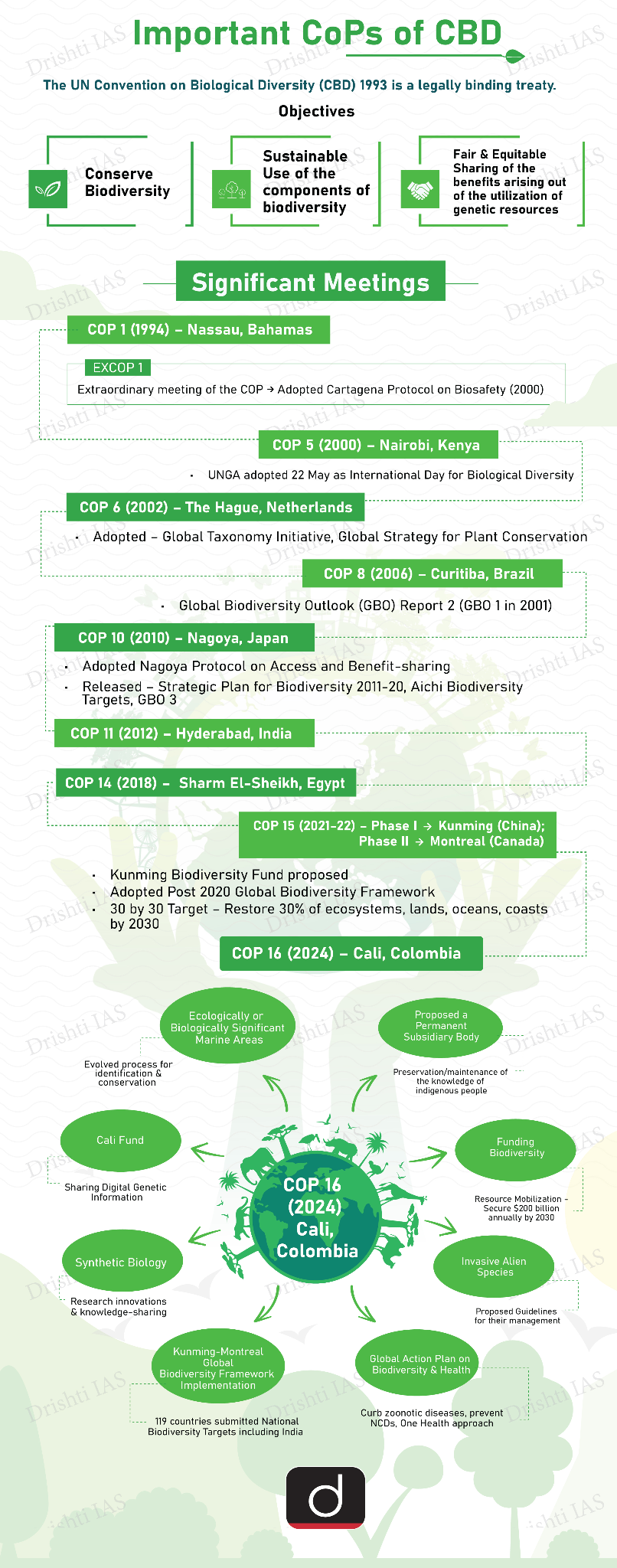
- About: The Convention on Biological Diversity (CBD) is a landmark international treaty originating from the 1992 Rio Earth Summit that provides the primary global framework for conserving and sustainably using biological resources.
- Three Core Objectives: The CBD is founded on three interconnected goals:
- Conservation of biological diversity,
- Sustainable use of its components, and
- Fair and equitable sharing of benefits arising from genetic resources.
- Comprehensive Scope: The Convention covers biodiversity at all levels i.e., diversity within species (genetic), between species, and of ecosystems. It applies to terrestrial, marine, and other aquatic ecosystems.
- Key Supplementary Protocols:
- Cartagena Protocol on Biosafety (2000): Focuses on the safe handling, transport, and use of Living Modified Organisms (LMOs) resulting from modern biotechnology.
- Nagoya Protocol on Access and Benefit-Sharing (2010): Provides a legal framework for the fair and equitable sharing of benefits arising from the utilization of genetic resources, thereby operationalizing the third objective of the CBD.
Frequently Asked Questions (FAQs)
1. What is the Kunming–Montreal Global Biodiversity Framework (KMGBF)?
It is a global agreement adopted at CBD COP15 (2022) to halt and reverse biodiversity loss by 2030, built around 23 targets for 2030 and four long-term goals for 2050.
2. What is the “30x30 Target” under the KMGBF?
It aims to conserve at least 30% of the world’s land, inland waters, and marine areas by 2030 through protected areas and Other Effective Area-based Conservation Measures (OECMs).
3. Which biodiversity targets are currently on track in India according to the 7th National Report?
NBT1 (Biodiversity-inclusive land and sea-use planning) and NBT2 (Ecosystem restoration) are identified as being on track among the 23 national biodiversity targets.
UPSC Civil Services Examination Previous Year Question (PYQ)
Q. With reference to ‘Global Environment Facility’, which of the following statements is/are correct? (2014)
(a) It serves as financial mechanism for ‘Convention on Biological Diversity’ and ‘United Nations Framework Convention on Climate Change’
(b) It undertakes scientific research on environmental issues at global level
(c) It is an agency under OECD to facilitate the transfer of technology and funds to underdeveloped countries with specific aim to protect their environment
(d) Both (a) and (b)
Ans: (a)
Q.“Momentum for Change: Climate Neutral Now” is an initiative launched by (2018)
(a) The Intergovernmental Panel on Climate Change
(b) The UNEP Secretariat
(c) The UNFCCC Secretariat
(d) The World Meteorological Organisation
Ans: (c)