
India-Canada Relations | 02 Feb 2026
For Prelims: Canada, Carbon capture, Muriate of Potash , ANTRIX , Advanced Chemistry Cell
For Mains: India–Canada relations: opportunities and constraints, Energy diplomacy and critical minerals in India’s foreign policy, Diaspora politics and its impact on bilateral relations
Why in News?
India and Canada have reset and revitalised their bilateral relations through high-level engagements in January 2026, marking a renewed phase of cooperation.
- The partnership now rests on four strategic pillars including nuclear energy, critical minerals, clean energy, and allied sectors aimed at aligning Canada’s resource strengths with India’s large industrial and agricultural scale.
What are the Key Highlights of India and Canada High-level Engagements?
- Energy: On the sidelines of India Energy Week (IEW) 2026, both nations re-launched the Canada–India Ministerial Energy Dialogue (CIMED), focusing on diversified energy supplies including LNG, LPG, and crude oil.
- Both nations agreed to collaborate on hydrogen production, carbon capture, and sustainable aviation fuels.
- Food Security: Canada, which already provides 25% of India’s Muriate of Potash (MOP), reaffirmed its commitment as a reliable supplier.
- In a significant policy move, Canada pledged to match any investment made by Indian partners in its natural resources sector.
- Critical Minerals & Clean Mobility: Both sides agreed to build coordination frameworks for Advanced Chemistry Cell (ACC) manufacturing and next-generation battery R&D.
- Canada reiterated its readiness to support India’s needs for Lithium, Cobalt, Graphite, and Rare Earth Elements (REEs), essential for India's EV missions (PM E-DRIVE).
- The first Canada–India Critical Minerals Annual Dialogue was announced for March 2026 in Toronto to secure transparent and resilient supply chains.
- Trade: Both nations agreed to accelerate negotiations for the Comprehensive Economic Partnership Agreement (CEPA), aiming to double trade to USD 50 billion by 2030.
- Canadian Prime Minister proposed India visit in March, 2026 is expected to finalise a 10-year uranium supply agreement worth 2.8 billion Canadian dollars.
What are the Key Highlights of India-Canada Bilateral Relations?
- Background: India and Canada share a long-standing relationship rooted in shared democratic values and multicultural societies, with Indian migration to Canada beginning during the freedom struggle, when institutions such as the Swadesh Sevak Home in Vancouver mobilised support against British rule.
- Diplomatic relations were established in 1947, and India’s Constitution drew inspiration from the Canadian federal model, including a strong Centre and residuary powers vested in the Centre.
- Ties expanded again in the post-1990s period with India’s economic liberalisation, culminating in the elevation of bilateral relations to a Strategic Partnership in 2015.
- Strategic Importance: India is a key partner under Canada’s Indo-Pacific Strategy, reflecting growing economic and geopolitical convergence.
- Trade: In 2024, India was Canada’s 7th largest trading partner, with two-way trade worth USD 30.9 billion, and India maintaining a trade surplus in goods.
- Top Canadian exports to India: Vegetables, mineral fuels and oils, wood pulp, fertilisers, paper and paperboard
- Top Indian exports to Canada: Pharmaceuticals, machinery, electronics, precious stones and metals, iron and steel products.
- Diaspora: Canada is home to one of the largest Indian diasporas in the world, with over 1.8 million individuals of Indian origin.
- Technology and Innovation Cooperation anchored in the Canada–India Science and Technology Cooperation Agreement (2005). Supported by the Joint Science and Technology Coordination Committee (JSTCC).
- ISRO and the Canadian Space Agency (CSA) have MoUs, and ISRO’s commercial arm, ANTRIX, has launched several Canadian nanosatellites.
- Security Cooperation: It is anchored in the Joint Working Group on Counter Terrorism (1997) and the Framework for Cooperation on Countering Terrorism (2018), while legal collaboration is strengthened through the Extradition Treaty (1987) and the Mutual Legal Assistance Treaty (1994).
What are the Major Challenges in India-Canada Relations?
- The Khalistan Issue: The gangster–terrorist nexus operating from Canadian soil, where Khalistani separatists are alleged to collaborate with organised crime syndicates to carry out extortion, intimidation, and targeted killings in India.
- New Delhi views Canada’s approach as “permissive vote-bank politics”, alleging that it provides a safe haven to extremists who exploit asylum loopholes, thereby posing a direct threat to India’s internal security, particularly in Punjab.
- Both nations struggle to align on the distinction between legitimate political activism and violent extremism, especially concerning gangs that operate across borders.
- Trade & Economic Obstacles: Progress towards a CEPA remains constrained by high tariffs on Canadian agricultural exports and Indian textiles and pharmaceuticals, as well as non-tariff barriers, including India’s complex sanitary and phytosanitary (SPS) norms and Canada’s stringent regulatory standards for Indian electronics and chemicals.
- Digital Trade & Privacy: Divergent models of data governance and data localization laws in India present challenges for Canadian tech and AI firms looking to integrate with the Indian market.
- Geopolitical Divergence: Though both nations are part of the "Indo-Pacific" vision, their strategic priorities often differ.
- Canada’s Indo-Pacific strategy is heavily focused on de-risking and human rights, whereas India's focus is more on maritime security and counter-balancing Chinese influence in the neighborhood.
- Both nations are currently pivoting toward each other partly to hedge against US trade volatility.
What Measures can Strengthen India-Canada Relations?
- Diplomatic Recalibration: Establish a Bilateral Security and Sovereignty Dialogue at the National Security Advisor level to address Khalistani extremism with protocols for intelligence sharing, and legal cooperation.
- Institute a 2+2 Dialogue Mechanism to bridge strategic misalignment on Indo-Pacific security, counter-terrorism, and maritime cooperation.
- Strengthening Human Capital: Both countries should actively engage the diaspora and strengthen Track-II diplomacy to deepen people-to-people ties, promote cultural exchanges, and support dialogue and conflict-resolution efforts.
- Expanding bilateral co-production in films and arts to celebrate the "Living Bridge" (diaspora) and counter negative political narratives.
- Intelligence Coordination: Revitalizing the Joint Working Group on Counter-Terrorism to create a shared database on organized crime and extremist funding.
- Enhancing the use of the existing Extradition Treaty (1987) and Mutual Legal Assistance Treaty (1994) to ensure that criminal elements cannot use either country as a "safe haven."
- Digital Public Infrastructure (DPI) Export: Canada can serve as a testing ground for India's DPI in a G7 economy, facilitating seamless cross-border payments.
- Professional Accreditation: Mutual recognition of professional qualifications (doctors, engineers, and nurses). This would turn the "student migration" issue into a "skilled talent partnership," reducing friction over visa caps.
- GIFT City Ecosystem: Encouraging Canadian "Research Clusters" to set up in India, focusing on cold-chain technology and sustainable mining, which are critical to India’s Viksit Bharat@2047 goals.
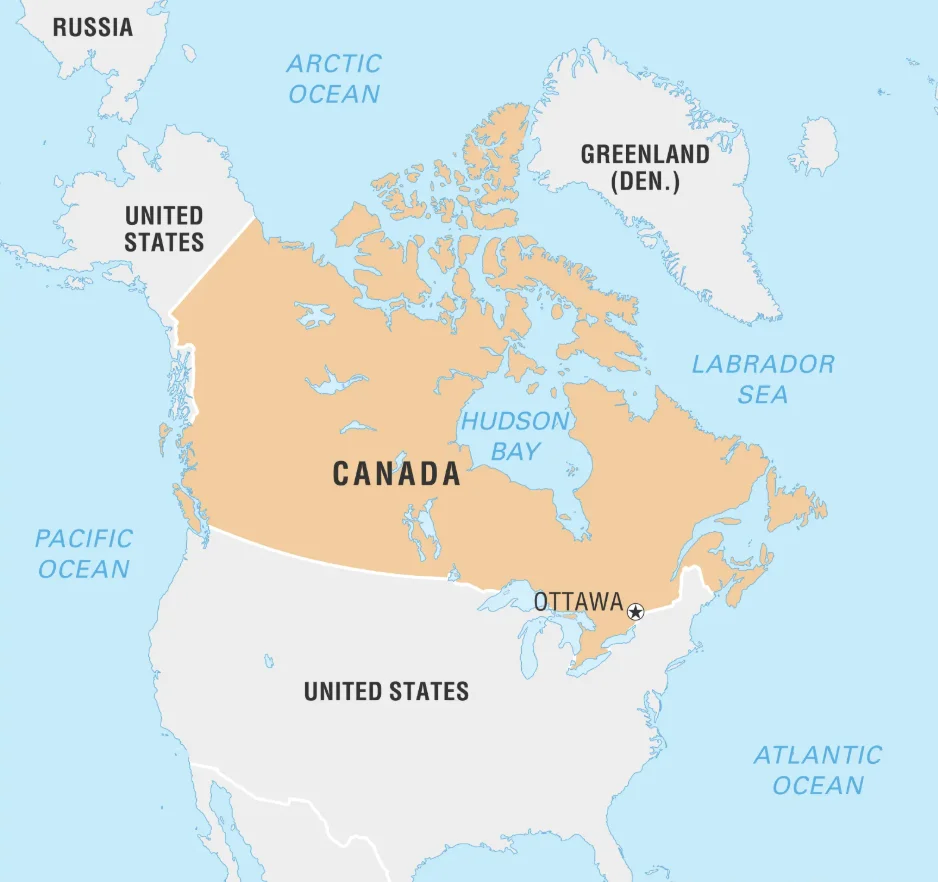
Canada
- It is located in the northern part of North America and is the second-largest country in the world by area, after Russia.
- It shares borders with Alaska to the northwest and US states to the south, with the Canada–US border being the longest bi-national land border globally. Canada is bounded by the Arctic Ocean to the north, the Atlantic Ocean to the east, and the Pacific Ocean to the west, and also shares maritime boundaries with Greenland and the French islands of Saint Pierre and Miquelon.
- Its capital is Ottawa, and the country spans seven climatic zones, including Arctic, Subarctic, Prairie, Great Lakes, Cordilleran, and the East and West Coasts.
- Major physical features include the Rocky, St. Elias, and Laurentian mountain ranges, rivers such as the Mackenzie, Yukon, and Saint Lawrence, and the Great Lakes, which form a natural boundary with the US.
- Canada is richly endowed with natural resources, including iron ore, nickel, copper, gold, uranium, rare earth elements, potash, and diamonds.
|
Drishti Mains Question: Discuss the prospects and challenges of concluding a Comprehensive Economic Partnership Agreement (CEPA) between India and Canada. |
Frequently Asked Questions (FAQs)
1. What security frameworks govern India–Canada cooperation?
Security cooperation is based on the Joint Working Group on Counter Terrorism (1997) and the Framework for Cooperation on Countering Terrorism (2018), supported by the Extradition Treaty (1987) and Mutual Legal Assistance Treaty (1994).
2. Why is the Khalistan issue significant in bilateral relations?
India views Canada’s handling of pro-Khalistan elements as a national security concern, which led to a major trust breakdown.
3. How important is trade between India and Canada?
In 2024, India was Canada’s 7th largest trading partner, with two-way trade of USD 30.9 billion, and India maintaining a trade surplus in goods.
4. Why is Canada strategically important for India?
Canada’s vast energy resources, critical minerals, advanced technology base, and position in the Indo-Pacific strategy make it a key long-term partner for India’s growth and energy security.
UPSC Civil Services Examination, Previous Year Question (PYQ)
Prelims
Q. In which one of the following groups are all the four countries members of G20? (2020)
(a) Argentina, Mexico, South Africa and Turkey
(b) Australia, Canada, Malaysia and New Zealand
(c) Brazil, Iran, Saudi Arabia and Vietnam
(d) Indonesia, Japan, Singapore and South Korea
Ans: (a)