
India-Austria Relations | 17 Apr 2026
Why in News?
The Federal Chancellor of the Republic of Austria undertook a four-day official visit to India. This diplomatic engagement marks a historic milestone as it is the first visit to India by an Austrian Chancellor in over four decades (the last being in 1984).
What are the Key Outcomes of the Austrian Chancellor’s 2026 Visit to India?
- Defence and Security Integration: Signed a Letter of Intent (LoI) on military matters to boost defence industrial and technology partnerships, building upon the momentum of the India-EU Defence and Security Partnership of January 2026.
- Both Nations agreed to establish a Joint Working Group on Counter-Terrorism to deepen strategic cooperation and coordinate efforts in the global fight against terror.
- Economic and Trade Facilitation: Instituted a Fast-Track Mechanism to resolve operational bottlenecks for investors, significantly enhancing the 'Ease of Doing Business' between the two nations.
- High-Technology and R&D: Cemented tech cooperation as a central pillar of the partnership, focusing on joint research and development in critical areas like quantum technology, machine learning, lasers, and material science.
- Space Sector Collaboration: Announced a joint bilateral space industry seminar to be held in Vienna in Autumn 2026 to integrate their respective space innovation ecosystems.
- Global Peacekeeping: Forged a strategic partnership between India’s Centre for UN Peacekeeping and the Austrian Armed Forces International Centre (AUTINT).
- Food Security and Agricultural Trade: Signed an MoU between FSSAI (India) and AGES (Austria) to harmonize risk assessment, share best practices, and promote the trade of safe agricultural products.
- Cybersecurity and Infrastructure: Launched a dedicated Institutional Cybersecurity Dialogue and renewed technical cooperation in advanced road infrastructure, specifically Intelligent Transport Systems (ITS).
- Skill Development and Youth Mobility: Operationalized the Working Holiday Programme, alongside an LoI to promote dual vocational training and the mutual recognition of educational and vocational qualifications.
- Startup and Academic Exchange: Enhanced the India-Austria Startup Bridge( 2024) and launched the "Focus India" initiative by top Austrian technical universities to facilitate admissions for Indian engineering students.
- An MoU signed between IIT Delhi and Montanuniversität Leoben was highlighted as a “shining example of growing knowledge exchange and academic cooperation” between India and Austria.
How are the India-Austria Bilateral Relations?
- Remarkable Trade Growth: Bilateral trade has seen a significant upward trajectory, doubling from USD 1.08 billion in 2019-20 to USD 2.06 billion in 2023-24, showcasing a Compound Annual Growth Rate (CAGR) of 17.36%.
- India successfully reversed its trade deficit to record a trade surplus of US$ 214 million with Austria in 2023-24.
- Key Traded Commodities: India primarily exports electronic goods, textiles, and machinery, while its imports from Austria are dominated by heavy machinery and steel.
- Foreign Direct Investment (FDI) Trends: Cumulative Austrian FDI in India reached USD 663 million (between April 2000 and March 2024.
- Foundational Economic Treaties: The economic partnership is underpinned by vital agreements, most notably the Double Taxation Avoidance Agreement (1999, amended in 2017) and the Bilateral Agreement on Promotion and Protection of Investments (1999).
- Migration and Mobility Pact: A landmark achievement is the Comprehensive Partnership for Migration and Mobility (2023), designed to facilitate the legal, seamless movement of Indian skilled workers, students, and researchers while actively combating illegal migration.
- Space: Austria's first two satellites, TUGSAT-1/BRITE and UniBRITE, were launched from India's Satish Dhawan Space Centre, Sriharikota, in 2013.
Geographical and Strategic Profiling of Austria
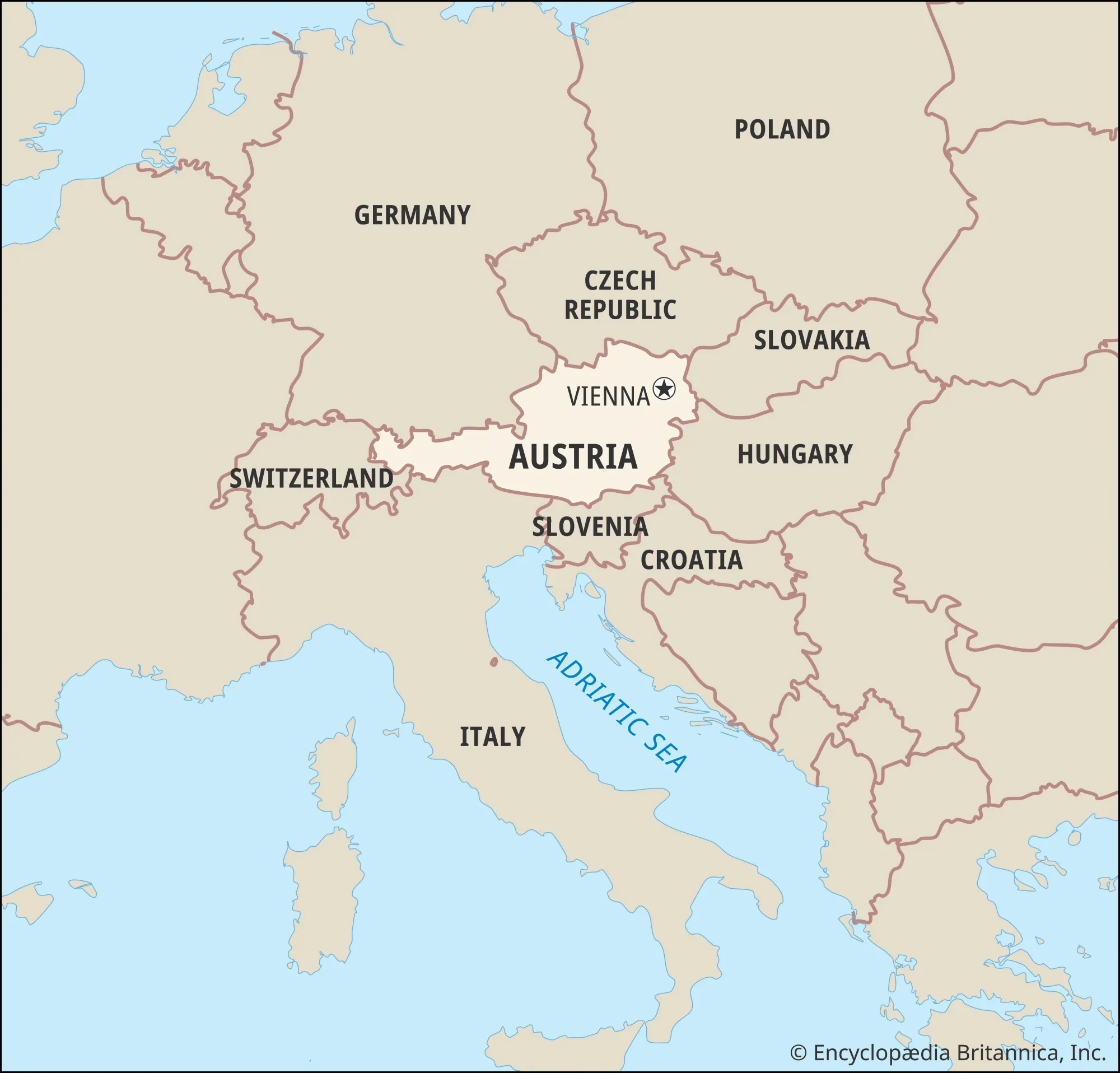
- Location and Borders: Austria is a mountainous, landlocked country in south-central Europe.
- It is bordered by Germany (north-west), Czech Republic (north), Slovakia (north-east), Hungary (east), Slovenia (south), Italy (south-west), and Switzerland & Liechtenstein (west).
- Geopolitical Stance: Alongside Switzerland, Austria forms the "neutral core of Europe."
- It established permanent neutrality in 1955 (following post-WWII Allied occupation), yet it has been a full member of the European Union (EU) since 1995.
- Jawaharlal Nehru played a crucial role in facilitating the emergence of a neutral Austria by acting as a diplomatic mediator during the Cold War, supporting Austria’s case at the United Nations and engaging with the Soviet Union to break negotiation deadlocks regarding the Austrian State Treaty, which was concluded in 1955.
- Following the treaty, Nehru was the first foreign leader to visit newly independent Austria in June 1955.
- Strategic Transit Hub: Its prominent geographic position embeds it centrally in European trade, bridging the East and West via the Danubian trade route and the North and South via the crucial Alpine passes.
- Topography and Relief: The physical backbone of the country is formed by the Austrian Alps (divided into northern/southern limestone ranges and a central crystalline range).
- The highest peak is the Grossglockner and the northern region includes a portion of the Bohemian Massif.
- Drainage System: Nearly all of Austria's territory drains into the Danube River system, which ultimately flows eastward into the Black Sea.
Frequently Asked Questions (FAQs)
1. Why is the 2026 Austrian Chancellor’s visit significant?
It is the first visit in over 40 years, marking a major boost to India–Austria strategic relations.
2. Where is Austria located geographically?
Austria is a landlocked country in south-central Europe, situated at the crossroads of major European routes.
3. Which countries border Austria?
It borders Germany (NW), Czech Republic (N), Slovakia (NE), Hungary (E), Slovenia (S), Italy (SW), and Switzerland & Liechtenstein (W).
4. What is meant by Austria being part of Europe’s “neutral core”?
Austria follows permanent neutrality (since 1955), similar to Switzerland, while remaining outside military alliances.
5. Which river system drains most of Austria?
The Danube River system, which flows eastward into the Black Sea.
UPSC Civil Services Examination, Previous Year Questions (PYQs)
Prelims
Q. Consider the following statements: (2023)
- The ‘Stability and Growth Pact’ of the European Union is a treaty that
- limits the levels of the budgetary deficit of the countries of the European Union
- makes the countries of the European Union to share their infrastructure facilities
- enables the countries of the European Union to share their technologies
How many of the above statements are correct
(a) Only one
(b) Only two
(c) All three
(d) None
Ans: (a)