
Impact of Global Warming on Sea Breezes | 21 Apr 2026
Recently, a study reported that global warming is weakening sea-land breeze systems in coastal cities, reducing their cooling effect.
- Global warming refers to the long-term increase in Earth's average surface temperature due to human activities, primarily the emission of greenhouse gases (GHG) like carbon dioxide (CO2) and methane (CH4).
Sea Breeze
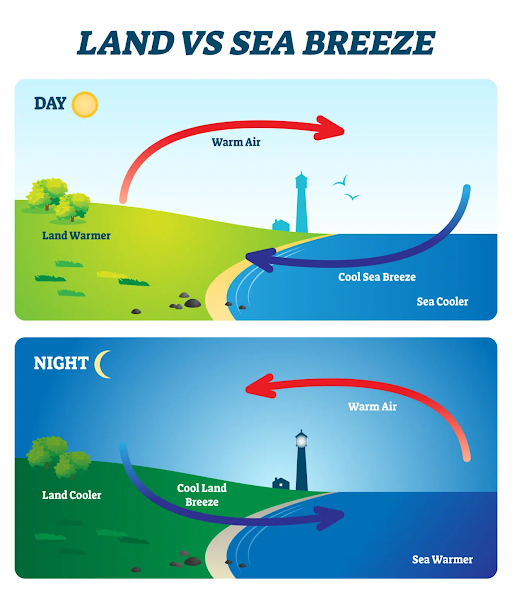
- About: A sea breeze is a local wind system caused by differential heating between land and sea, where the thermal contrast drives cool air from the sea to the land during the day and reverses at night.
- In contrast, land breeze is an offshore wind that occurs mainly at night or in cooler conditions, when land cools faster than the sea, creating higher pressure over land and causing winds to blow from land to sea.
- Key Finding: Rising ocean temperatures are reducing this land–sea thermal contrast, weakening the breeze mechanism and reducing both its frequency and intensity, with the number of sea-breeze days already declining by ~3% across 18 major coastal megacities, including Mumbai and Miami.
- Mid-latitude cities such as London, New York, Shanghai and Buenos Aires have seen sharper declines.
- Impacts: Weakening breezes can lead to increased urban heat, reduced natural cooling, and worsening air pollution, affecting health and habitability.
- By 2050, sea breezes may weaken up to 4.5 times faster if emissions remain high.
| Read more: Record Global Warming and its Effect on India |