
Hybrid Model Framework for Generative AI | 16 Dec 2025
For Prelims: Copyright Act, 1957, Artificial Intelligence (AI), MSMEs, Generative AI, Machine Learning, High Court.
For Mains: Key provisions of the Copyright Act, 1957 and gaps in the Copyright Act, 1957 in addressing AI-related copyright issues. Proposed changes in the Copyright Act, 1957 to address AI-related copyright issues.
Why in News?
The Indian government is initiating a major overhaul of the Copyright Act, 1957 under the hybrid model to address the challenges posed by artificial intelligence (AI) to copyrighted works.
- The hybrid model involves a mandatory blanket license allowing AI firms to use copyrighted works for training, coupled with a statutory right to remuneration for creators.
Summary
- India proposes amendments to the Copyright Act, 1957, introducing a blanket license for AI training and creator remuneration.
- The reforms aim to balance innovation and creator rights, positioning India differently from the EU (transparency focus) and UK (computer-generated work clause).
What are the Proposed Changes to the Copyright Act, 1957 to Address AI-related Copyright Issues?
- Blanket License for AI Developers: Introduction of a statutory provision granting AI developers mandatory blanket license to use all lawfully accessed copyright-protected works for training AI systems.
- Rights holders will lose the right to withhold their works from being used in AI training.
- The license would be non-negotiable and universal, eliminating the need for individual permissions currently required under Section 14 (copyright as the exclusive right of the owner) of the Act.
- Statutory Remuneration Rights: Creation of a new statutory remuneration right for copyright holders as compensation for use of their works in AI training.
- Copyright holders entitled to royalties even without their explicit consent. Royalty to be calculated as a fixed percentage of revenue generated from AI systems trained on copyrighted content.
- AI firms will pay royalties only after commercialising their models, not while collecting or training data from the internet.
- Collection and Distribution Mechanism: Amendment to establish a centralized non-profit entity designated by the Central Government for collecting payments from AI developers.
Why is There a Need to Amend the Copyright Act, 1957 to Address AI-Related Copyright Issues?
- Absence of AI-Specific Definitions: The Copyright Act, 1957 lacks definitions for key terms like Artificial Intelligence, Generative AI, machine learning, and training data, making it outdated for modern technologies.
- It creates legal uncertainty regarding the applicability of existing provisions to AI systems and text and data mining (TDM).
- Ambiguity on AI Training as Copyright Use: No specific provisions exist addressing whether AI training constitutes reproduction, adaptation, or infringement under Section 14 (exclusive rights).
- Current law is ambiguous on whether AI training falls under fair dealing exceptions under Section 52 (certain acts not to be infringement of copyright).
- Unauthorized Use of Copyrighted Materials: Current practice of AI training bypasses the permission-based framework that forms the foundation of the Copyright Act, 1957.
- Mass-scale scraping and use of copyrighted content for AI training occurs without compensation to creators.
- Copyrightability of AI-Generated Outputs: Section 2(d)(vi) of the 1957 Act defines an author only in human terms, leaving no clarity on authorship of AI-generated content or its copyrightability.
- Although Section 2 (ffc) mentions computer-generated works, it treats the computer as a tool, creating uncertainty over ownership of AI-created works.
- Cross-Border and Jurisdictional Issues: Section 40 of the 1957 Act protects foreign works based on traditional territorial copyright but does not address AI systems trained abroad with Indian works, cloud-based AI training, or cross-border data flows.
- This creates enforcement challenges for AI developers outside India and highlights a gap in international coordination for AI copyright issues.
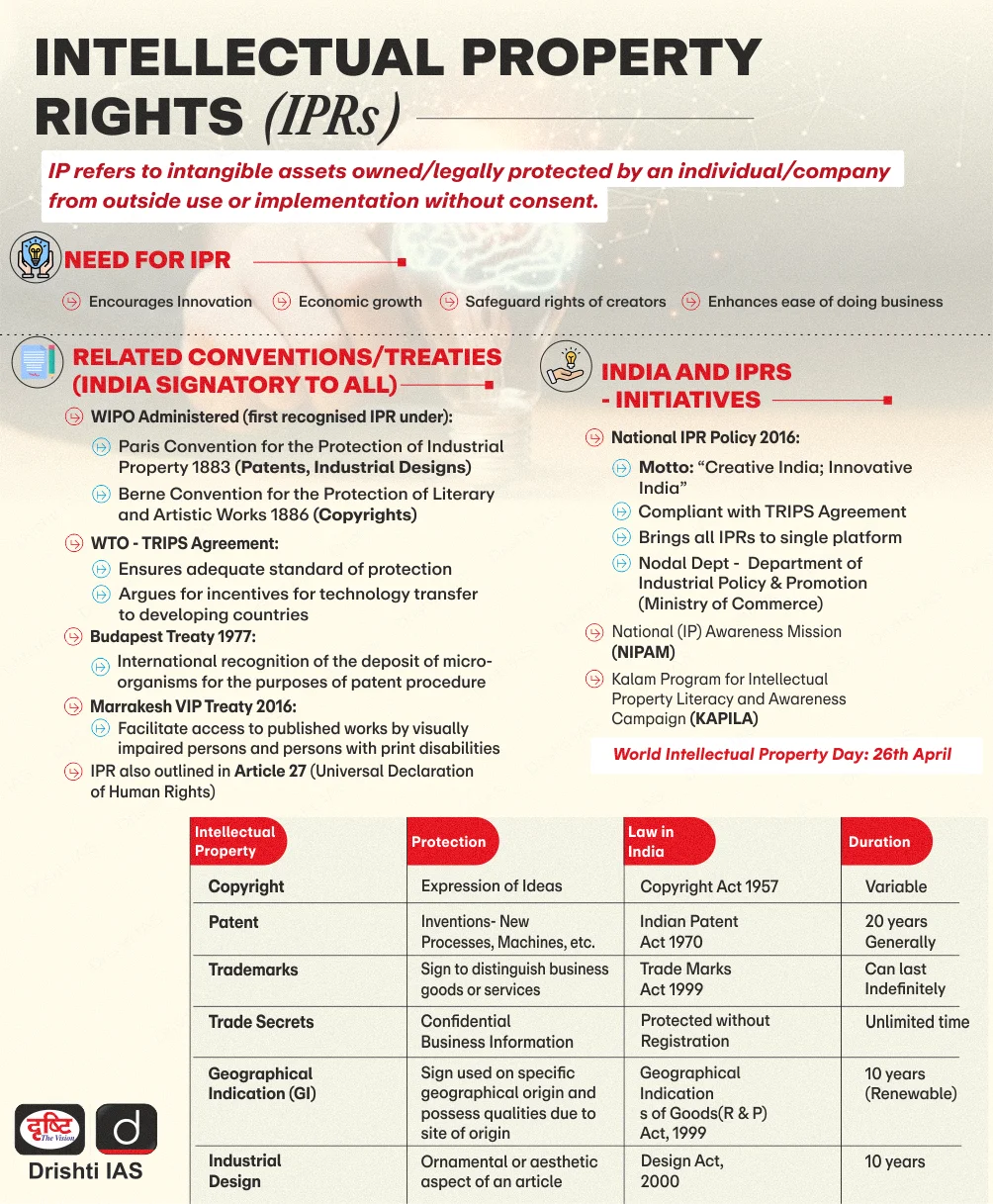
Copyright Act, 1957
- About: Copyright is a legal right in India that protects original works like literature, art, music, films, and computer programs.
- It safeguards the expression of ideas, granting the owner exclusive rights to adapt, reproduce, publish, translate, and communicate the work to the public.
- Key Sections: Section 2 defines the types of works covered under copyright e.g., literary works (2(o)) and dramatic works (2(h)).
- Section 13 extends copyright protection to literary, musical, dramatic works, cinematographic films, and sound recordings.
- Section 14 grants the owner exclusive rights to adapt, reproduce, publish, translate, and communicate the work, which cannot be exercised without the owner’s permission.
- Judicial Interpretation on Copyrighted Material:
- Mr. Dattatray Bapu Dighe v. The State of Maharashtra (2024): The Bombay High Court ruled copyright registration is not mandatory for initiating infringement action; the copyright exists automatically upon creation of the content.
- Star India Pvt. Ltd v. Magicwin.Games (2024): The Delhi High Court emphasized proactive legal action to counter the "hydra-headed" issue of digital piracy, where blocked sites resurface. It permanently barred such rogue websites and entities from unauthorized hosting or streaming of content with exclusive rights.
- India TV v. Yashraj Films (2012): The Delhi HC held that small amounts of usage of songs does not amount to copyright infringement.
- Oxford v. Rameshwari Photocopy Services (2016): The Delhi HC ruled that photocopying book excerpts for educational use was fair dealing (does not amount to infringement), affirming access to knowledge and public interest as guiding principles.
Global Views on AI-Generated Content
- United States: Copyright requires substantial human creativity (Thaler v. Perlmutter, 2023). Purely AI-generated works are not protected.
- European Union: The AI Act (2024) mandates training data transparency. A new sui generis right for AI outputs is under debate, as the current 2019 Copyright Directive lacks specific rules.
- China: The Beijing Internet Court has recognized AI-generated images as protected art, emphasizing the "originality" and intellectual contribution of the human creator.
- United Kingdom: Section 9(3) of the Copyright, Designs and Patents Act, 1988 grants copyright for computer-generated works without a human author, assigning it to the person making the "necessary arrangements." Such works lack moral rights, and the provision is rarely applied due to legal ambiguities.
Conclusion
The proposed amendments to the Copyright Act, 1957 aim to balance AI innovation with protection of creators’ rights through a mandatory blanket license and statutory royalties. The reforms address gaps in definitions, AI training, and authorship while providing a centralized mechanism for royalty collection, fostering fair compensation and legal clarity.
|
Drishti Mains Question: Critically analyze the gaps in the Copyright Act, 1957 concerning AI-generated content and cross-border enforcement. |
Frequently Asked Questions (FAQs)
Q. What is the core objective of the proposed amendments to India's Copyright Act regarding AI?
To establish a mandatory blanket licensing and statutory royalty framework that balances AI innovation with fair compensation for creators whose works are used for training AI models.
Q. Do copyright holders have the right to withhold works from AI training?
No, under the mandatory blanket license, copyright holders cannot withhold lawfully accessed works; they receive statutory remuneration instead.
Q. Why is Section 40 of the Copyright Act, 1957 inadequate in the context of AI?
Section 40 protects foreign works only through traditional territorial copyright reciprocity, but it does not cover AI systems trained abroad using Indian works, cloud-based AI training, or cross-border data flows, creating regulatory gaps in the AI-driven digital economy.
UPSC Civil Services Examination, Previous Year Question (PYQ)
Prelims
Q1.With reference to the ‘National Intellectual Property Rights Policy’, consider the following statements: (2017)
- It reiterates India’s commitment to the Doha Development Agenda and the TRIPS Agreement.
- Department of Industrial Policy and Promotion is the nodal agency for regulating intellectual property rights in India.
Which of the above statements is/are correct?
(a) 1 only
(b) 2 only
(c) Both 1 and 2
(d) Neither 1 nor 2
Ans: (c)
Q2. Consider the following statements: (2019)
- According to the Indian Patents Act, a biological process to create a seed can be patented in India.
- In India, there is no Intellectual Property Appellate Board.
- Plant varieties are not eligible to be patented in India.
Which of te statements given above is/are correct?
(a) 1 and 3 only
(b) 2 and 3 only
(c) 3 only
(d) 1, 2 and 3
Ans: (c)
Mains
Q. In a globalized world, Intellectual Property Rights assume significance and are a source of litigation. Broadly distinguish between the terms—Copyrights, Patents and Trade Secrets. (2014)