
Himalayan Griffon Vultures Death | 09 Apr 2026
25 Himalayan Griffon vultures died in the Dudhwa Tiger Reserve due to suspected secondary poisoning after scavenging on stray dog carcasses that had consumed pesticide-laced rice.
- Dudhwa Tiger Reserve in Uttar Pradesh’s Lakhimpur Kheri and Bahraich districts lies in the Terai belt along the Indo-Nepal border. It comprises Dudhwa National Park, Kishanpur Wildlife Sanctuary, and Katarniaghat Wildlife Sanctuary, and is drained by the Mohana and Suheli rivers.
Himalayan Griffon Vulture
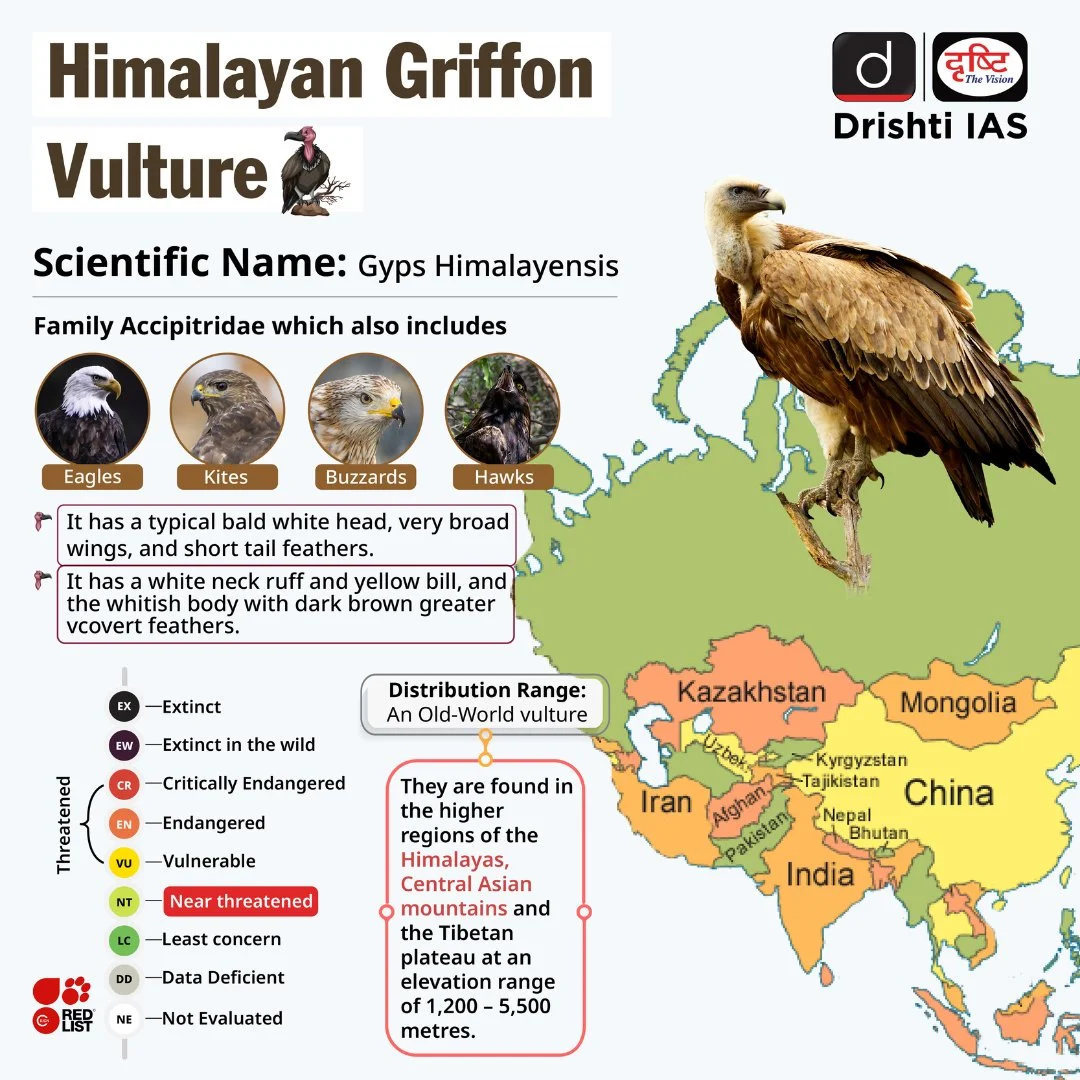
- About: The Himalayan Griffon vulture (Gyps himalayensis) is an Old World vulture and ranks 2nd only to the cinereous vulture in size among Old World vultures.
- Old World vultures are a group of scavenging birds found in Europe, Asia, and Africa. While they share many physical similarities with New World vultures (found in the Americas), they are biologically distinct and belong to the family Accipitridae—the same family that includes eagles, hawks, and harriers.
- Key Physical Characteristics: They have a pale, khakhi-colored body with dark flight feathers. Their heads are covered in white down, and they sport a distinct "ruff" of long, pale brown feathers around the neck.
- They have an impressive wingspan, typically ranging from 2.5 to 3 meters (8 to 10 feet). An adult can weigh between 8 and 12 kg.
- Habitat and Range: They are usually found at altitudes between 1,200 and 5,500 meters. Their range extends across India, Nepal, Bhutan, China (Tibetan Plateau), and parts of Central Asia (e.g., Kazakhstan and Uzbekistan).
- They are colonial nesters, typically building their nests on inaccessible, steep rock cliffs.
- Diet and Behaviour: Like all vultures, the Himalayan Griffon is a carrion eater. They feed almost exclusively on the carcasses of dead animals.
- They are social birds, often seen in large groups gathering around a single carcass.
- Threats: Primary threats include poisoning from diclofenac and other veterinary drugs used in livestock, which remain in carcasses and prove fatal to vultures. Additional pressures involve habitat disturbance and changes in food availability
- Conservation Status: The Himalayan Griffon is listed as Near Threatened by the IUCN.
- It is listed under Schedule I of the Wildlife Protection Act, 1972, providing it the highest level of legal protection in the country.
- It is listed under Appendix II of CITES, which regulates international trade of the species.
| Read More: Vultures at Risk in Protected Areas |