
Gross Domestic Product and Net Domestic Product | 08 Jan 2026
For Prelims: Gross Domestic Product, GDP deflator, GDP per capita, Gross Fixed Capital Formation , Net Domestic Product (NDP)
For Mains: GDP vs NDP: Conceptual differences and policy implications, Limitations of GDP as a welfare and sustainability indicator
Why in News?
The Ministry of Statistics and Programme Implementation (MoSPI), through the National Statistics Office, has released the First Advance Estimates of Gross Domestic Product (GDP) for Financial Year (FY) 2025–26, projecting a robust 7.4% growth in real GDP.
- Alongside, India is planning to shift from GDP to Net Domestic Product (NDP) as the primary measure of economic activity, in line with the United Nations’ System of National Accounts (SNA) 2025, with implementation expected from 2029–30, to better reflect the real cost of production.
Summary
- The First Advance Estimates for FY 2025–26 project a robust 7.4% real GDP growth, driven mainly by the services sector, with healthy private consumption and investment momentum.
- India plans to transition from GDP to Net Domestic Product (NDP) in line with SNA 2025 to better capture net, sustainability-adjusted economic growth, addressing limitations of GDP such as depreciation, environmental costs, and inequality.
What is Gross Domestic Product (GDP)?
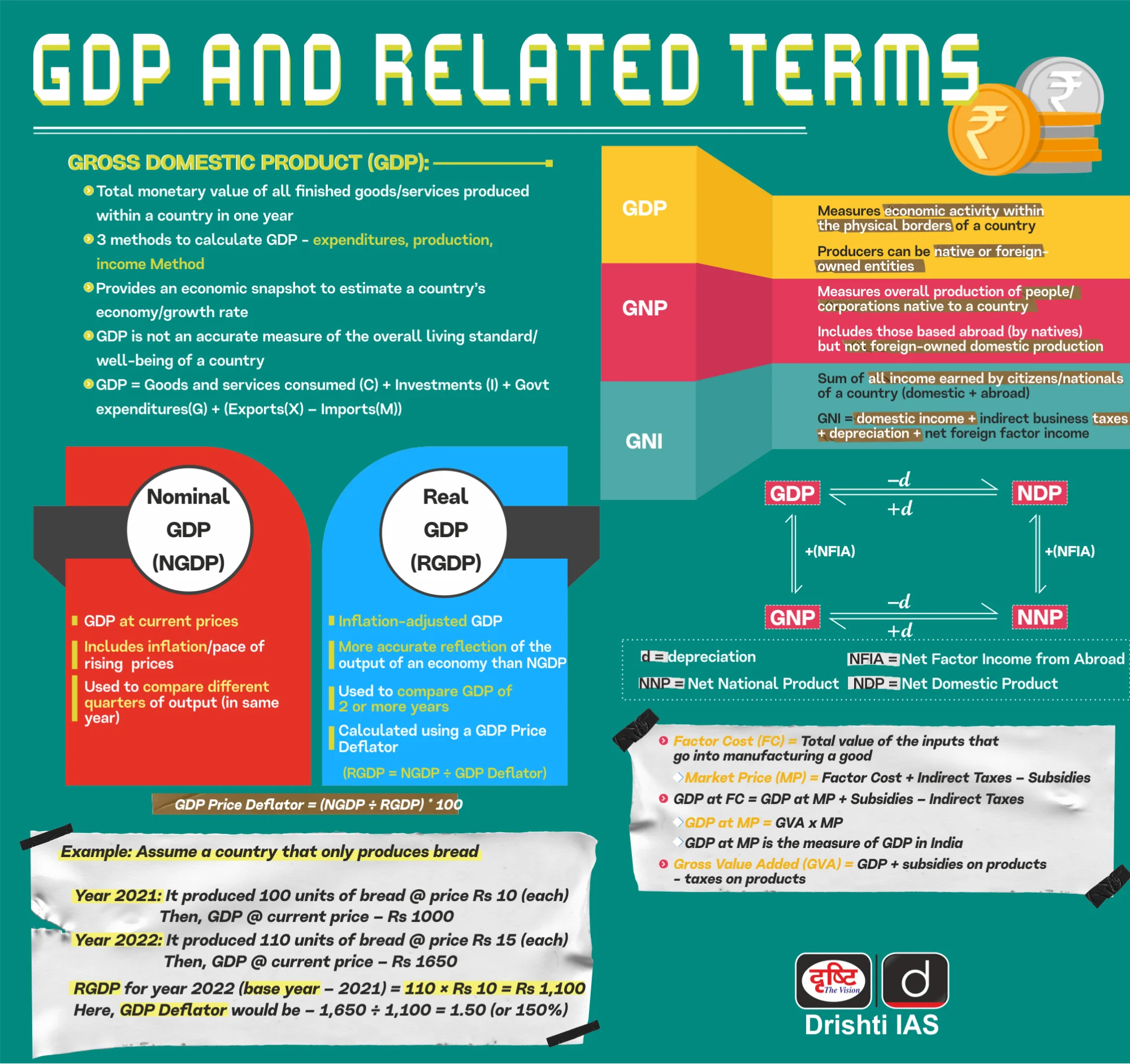
- About: GDP is the total monetary value of all final goods and services produced within a country’s borders during a specific period (usually a year or a quarter).
- Types of GDP:
- Nominal GDP: Measured at current market prices, without adjusting for inflation. Useful for same-year comparisons but not reliable across years.
- Real GDP: Adjusted for inflation using the GDP deflator. Reflects the actual quantity of goods and services produced. It enables comparison of economic growth over time.
- GDP Computation Methodology in India:
- Before 2015: India computed GDP with 2004–05 as the base year, and measured GDP at factor cost, excluding indirect taxes and subsidies.
- Sectoral coverage was narrower, and labour income was estimated uniformly without distinguishing worker types.
- After 2015: GDP computation shifted to a 2011–12 base year, and adopted GDP at market prices, including taxes and subsidies. Labour income estimation improved through effective labour input, and coverage expanded in agriculture and financial services.
- Before 2015: India computed GDP with 2004–05 as the base year, and measured GDP at factor cost, excluding indirect taxes and subsidies.
- Potential GDP: It is the maximum sustainable output an economy can produce using all its resources (labor, capital, technology) efficiently, without causing accelerating inflation.
- Significance: It is a key indicator of economic size, productivity, growth, and macroeconomic performance. GDP growth rate reflects the pace of economic expansion or contraction.
- Base year Revision: India is revising its GDP base year from 2011–12 to 2022–23 to better reflect current economic realities, with the revised GDP series scheduled for release in February 2027.
- The revised GDP series will continue to follow SNA 2008, while the NDP shift aligns with SNA 2025.
Limitations of GDP
- Non-adjustment for Capital Depreciation: GDP measures gross output and does not deduct depreciation of physical capital such as machinery, infrastructure, and buildings, thereby overstating the net income generated by the economy.
- Exclusion of Environmental Costs: GDP treats resource extraction and pollution-intensive activities as value addition, without accounting for depletion of natural capital or environmental degradation, despite their adverse implications for long-term economic welfare.
- GDP focuses on short-term economic output and neglects intergenerational costs, making it an inadequate measure for assessing sustainable and inclusive long-term development.
- Underrepresentation of Unpaid Work: Non-market activities such as household labour, care work, and large segments of the informal economy are either undervalued or excluded, leading to an incomplete estimation of total economic activity.
- Insensitivity to Income Distribution: GDP aggregates output without reflecting how income is distributed across different sections of society, allowing economic growth to coexist with widening income and wealth inequalities.
- Emphasis on Output Quantity over Growth Quality: GDP captures the volume of production but fails to measure qualitative dimensions of development such as health outcomes, educational attainment, social well-being, and environmental sustainability.
- In 2025, India has become the world’s fourth-largest economy by nominal GDP (USD 4.18 trillion), surpassing Japan. However, Japan remains far ahead in per-capita terms, with India’s GDP per capita at USD 2,694 in 2024 compared to Japan’s USD 32,487, highlighting a sharp gap in average income levels.
- Inclusion of Defensive and Remedial Expenditures: Expenditures on disaster recovery, pollution control, healthcare due to accidents, or crime prevention raise GDP figures, even though they represent costs incurred to mitigate social or environmental damage rather than genuine welfare gains.
Key Highlights of the First Advance Estimates of GDP for the FY 2025-26
- Real GDP Growth: Estimated at 7.4% in FY 2025–26, compared to 6.5% in FY 2024–25.
- Nominal GDP Growth: Estimated at 8.0% in FY 2025–26.
- Real GVA Growth: Estimated at 7.3%, driven mainly by buoyant growth in the services sector.
- High-Growth Tertiary Segments:
- Financial, Real Estate & Professional Services and Public Administration, Defence & Other Services: Estimated growth of 9.9% at constant prices.
- Trade, Hotels, Transport, Communication & Broadcasting: Estimated growth of 7.5% at constant prices.
- Secondary Sector Performance:
- Manufacturing and Construction: Estimated to grow by 7.0% at constant prices.
- Primary and Utilities Sector:
- Agriculture & Allied Activities: Estimated growth of 3.1%.
- Electricity, Gas, Water Supply & Other Utility Services: Estimated growth of 2.1%, indicating moderate expansion.
- Private Consumption: Private Final Consumption Expenditure (PFCE) estimated to grow by 7.0%, reflecting sustained household demand.
- Investment: Gross Fixed Capital Formation (GFCF) has been estimated to have 7.8% growth rate at Constant Prices during FY 2025-26, compared to 7.1% growth rate in previous FY.
What is Net Domestic Product (NDP)?
- About: Net Domestic Product (NDP) is a measure of a country's economic output, representing the value of all final goods and services produced within its borders in a given period, minus the value of depreciation of capital assets.
- Under SNA 2025, NDP = GDP – (depreciation of fixed capital + depletion of natural resources), making it a more sustainability-aware indicator.
- Significance: Shows the actual net income generated by the economy rather than gross output.
- Accounts for wear and tear of physical capital and exhaustion of natural resources.
- Helps assess whether economic growth is genuine or achieved by running down assets.
- Supports long-term planning, fiscal sustainability, and intergenerational equity.
- NDP’s Superiority Over GDP: Adjusts for depreciation, while GDP ignores capital consumption.
- Internalises environmental costs by deducting natural resource depletion under SNA 2025.
- Provides a more realistic measure of economic welfare and productive capacity.
- Prevents overestimation of growth by focusing on net value addition, not mere expansion of output.
United Nations’ System of National Accounts (SNA) 2025
- The SNA 2025 is a comprehensive international framework for compiling national accounts that replaces SNA 2008 and moves beyond GDP to better capture sustainability, distribution, and non-market activities.
- Under the SNA 2025, the Reserve Bank of India’s output will be classified as non-market activity, and regulatory payments by banks will be treated as transfers, not service fees.
- It introduces natural capital accounting, treating depletion of minerals, coal, oil, and gas as production costs while recognising renewables as assets, and adds distributional accounts showing income, wealth, consumption, and savings across household groups.
- By incorporating unpaid household and care work in extended accounts, SNA 2025 enhances policy relevance by linking economic growth with equity, ecological balance, and inclusiveness.
|
Drishti Mains Question: Q. Critically examine the limitations of GDP as a measure of economic welfare in the Indian context. |
Frequently Asked Questions (FAQs)
1. What is Net Domestic Product (NDP)?
NDP measures net output by deducting capital depreciation and natural resource depletion from GDP, reflecting true income generation.
2. How did India’s economy perform in FY 2025–26 as per Advance Estimates?
Real GDP grew 7.4%, led by services; Real GVA grew 7.3%, with strong private consumption and investment.
3. What are the key limitations of GDP?
GDP ignores depreciation, environmental costs, unpaid work, income distribution, and counts remedial spending as growth.
UPSC Civil Services Examination, Previous Year Questions (PYQs)
Prelims
Q1. With reference to Indian economy, consider the following statements: (2015)
- The rate of growth of Real Gross Domestic Product has steadily increased in the last decade.
- The Gross Domestic Product at market prices (in rupees) has steadily increased in the last decade.
Which of the statements given above is/are correct?
(a) 1 only
(b) 2 only
(c) Both 1 and 2
(d) Neither 1 nor 2
Ans: (b)
Q2. A decrease in tax to GDP ratio of a country indicates which of the following? (2015)
- Slowing economic growth rate
- Less equitable distribution of national income
Select the correct answer using the code given below:
(a) 1 only
(b) 2 only
(c) Both 1 and 2
(d) Neither 1 nor 2
Ans: (a)
Mains
Q1. Define potential GDP and explain its determinants. What are the factors that have been inhibiting India from realizing its potential GDP? (2020)
Q2. Explain the difference between computing methodology of India’s Gross Domestic Product (GDP) before the year 2015 and after the year 2015. (2021)